

US manufacturing hits 4-year high as exports rebound in July


US factory indicators strengthened in July, with demand, production and hiring improving in signals relevant to manufacturers, importers, exporters and sourcing teams tracking US industrial capacity.

For textile and apparel supply-chain participants, the key signals include the return of export-order growth, rising factory payrolls and increased capital-goods imports linked to retooling and expansion of factory capacity.

US manufacturing activity surged in July at the strongest rate in more than four years, with the ISM PMI expanding for a seventh straight month.
New export orders returned to expansion, while production, payrolls and wages rose, signalling stronger demand for US-made goods.
Capital goods imports exceeded 40 per cent of US goods imports as factories retooled and expanded.

US manufacturing activity surged in July at the strongest rate in more than four years, driven by strong demand, record production and new hiring, the White House said in press release.

The White House noted that the Institute for Supply Management (ISM) Manufacturing PMI showed the sector expanding for the seventh consecutive month. It described this as a reversal after contraction in every month of the previous Administration, outside a temporary post-pandemic bounce. New export orders also moved back into expansion.
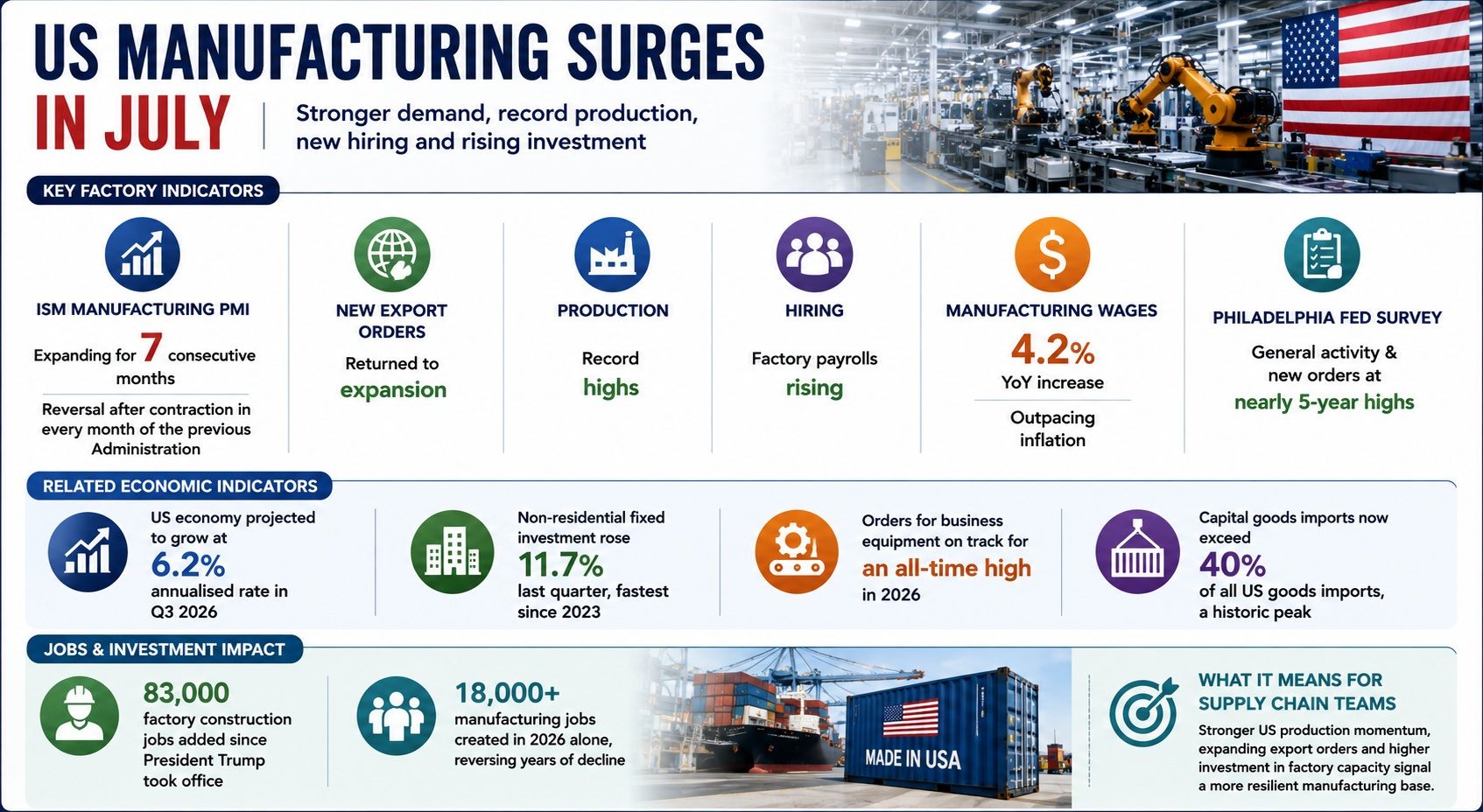
Citing Federal Reserve indicators, the White House said manufacturing activity, payrolls and wages were rising nationwide. Manufacturing wages climbed 4.2 per cent year-on-year (YoY), outpacing inflation. Philadelphia Fed survey showed general activity and new orders at nearly five-year highs, added the release.

It mentioned President Trump’s Working Families Tax Cuts had supported six million American jobs, protected $540 billion in worker wages and preserved $1.1 trillion in US economic activity.

The White House also listed several related indicators: the US economy is projected to grow at a 6.2 per cent annualised rate in the third quarter of 2026; non-residential fixed investment rose 11.7 per cent last quarter, the fastest since 2023; orders for business equipment are on track for an all-time high in 2026; and capital goods imports now exceed 40 per cent of all US goods imports, which it called a historic peak as factories retool and expand.

The release further added that 83,000 factory construction jobs had been added since President Trump took office, and more than 18,000 manufacturing jobs had been created in 2026 alone, reversing years of decline. For sourcing and manufacturing teams, the published indicators frame July as a month of stronger US production momentum, expanding export orders and higher investment in factory capacity.

Fibre2Fashion News Desk

Free Training

Source link

US manufacturing hits 4-year high, with AI buildout a major driver of growth, though price volatility looms: survey


Manufacturing activity in July hit a four-year high, with massive AI infrastructure investment a major driver of growth — even as industry leaders sounded the alarm over price volatility, according to a survey released Monday.

The Institute for Supply Management’s July manufacturing gauge jumped to 55.6 – expanding at its fastest pace since May 2022 and marking its seventh consecutive month of growth, the survey said.

President Trump has called for a return to US manufacturing. REUTERS

Any reading above 50 in the ISM’s monthly survey indicates growth while any measure below 50 signals contraction.

Susan Spence, chair of the ISM Manufacturing Business Survey Committee, said increased certainty around President Trump’s tariff policy and hopes for a more permanent deal to end the war in Iran helped encourage the boost in manufacturing.

“My gut is, it’s not just a one- or two-month trend,” Spence told reporters. “Companies are seeing six or more months of these solid demand factors going in the right direction.”

The survey’s gauge for production jumped to 58.5, its highest level since the end of 2021; the employment measure hit 52.8, rising for the first time in nearly three years; and new orders growth, which signals demand, also increased.

Massive business investments in AI infrastructure helped drive the expansion, along with political pressure to ramp up US manufacturing, according to experts.

Despite the growth in manufacturing, individuals’ responses to the ISM survey were overwhelmingly negative, with many industry leaders calling out price shocks from the Iran war and the chances that the Fed could raise interest rates next month to counter inflation fears.

“Pricing volatility was mentioned in 57% of negative comments, the Iran war 43%, increasing lead times 22% and tariffs 18%,” Spence said.

Among the survey responses, one metals producer remarked that “it makes me yearn for the coronavirus pandemic chaos, which was more manageable than whatever this is that we are in.”

The Institute for Supply Management’s July manufacturing gauge jumped to 55.6. AFP via Getty Images

Some transportation equipment manufacturers lamented increased costs and transit time “for rerouted shipments due to conflicts in the Red Sea, Strait of Hormuz and Suez Canal.”

Others noted that a spike in demand for certain electronics supplies due to the AI race was “challenging on-time fulfillment for our supply chains.”

Jackson Barnes, CEO of Novo, a financial platform for small businesses, said the build-out of massive AI data centers is largely driving manufacturing investments – but that has a lopsided impact on the industry. 

“Look at where the demand is coming from. It’s coming from semiconductors, AI infrastructure and defense. Those are capital-intensive supply chains dominated by large manufacturers,” Barnes told The Post.

Massive business investments in AI infrastructure helped drive the expansion, according to experts. Getty Images

“That gap shows up clearly in what we see. Across the small manufacturers we work with, the median firm’s quarterly revenue is down roughly 12% from two years ago, even though total volume across that same group is up about 14%.”

Tech giants like Meta and Microsoft have announced planned capital expenditures this year of as much as $145 billion and $190 billion, respectively, as they ramp up their AI efforts.

Rising oil prices amid the Iran war have multiplied costs for nearly every manufacturer – and the concern for many in the industry is that the Federal Reserve could soon raise interest rates as a result, which could hit their growth streak.

Overall, it was a strong report, according to experts, as all but one manufacturing industry reported growth in July — including electrical equipment, appliances and components and computer and electronic products. Chemical products marked the only sector that contracted over the month.

“I would say that a lot of the tech investment right now has a lag,” said Amrita Bhasin, co-founder and CEO of Sotira and a manufacturing expert. “There is a lot of money being poured into AI infrastructure and that infrastructure is very resource-intensive.”

“I am optimistic just because we’ve got a lot of factors that are all coinciding at the right time,” Bhasin told The Post.

Free Training

Source link

US manufacturing activity hits 4-year high: White House


US manufacturing is witnessing a surge across the country as the sector is growing for the third consecutive month, with key indicators showing broad strength, the White House recently said.

The Institute for Supply Management’s (ISM) key manufacturing index—which tracks factory activity across the country—registered the sector’s third straight month of expansion for its highest reading since 2022.

US manufacturing is seeing a surge as the sector is growing for the third month in a row, with key indicators showing broad strength, the White House said.
The ISM manufacturing index saw the third straight month of expansion for its highest reading since 2022.
The Federal Reserve Bank of Philadelphia’s April manufacturing index rose.
Orders for capital goods exceeded $4 billion in each month of Q4 2025.

The ISM new orders index expanded for the third consecutive month as both domestic and global buyers turn to US-made goods. The production index expanded for the fifth consecutive month and is accelerating as factories run at a pace not seen since before the Joe Biden-era slowdown, a White House release said.

The Federal Reserve Bank of Philadelphia’s manufacturing index surged in April, smashing expectations.

The manufacturing sector capped off the first quarter of 2026 with the first positive manufacturing job growth in three years. In a year, real manufacturing worker pay increased by $2,400 under President Trump after falling by $830 during President Biden’s four years in office.

The broader US economy has now expanded for 17 consecutive months, a streak of sustained growth the Biden Administration was never able to deliver.

Meanwhile, US Trade Representative Jamieson Greer testified this week before the House of Representatives Ways and Means Committee to lay out how Trump’s trade policy is delivering tangible results for American workers and their families, eliminating long-standing trade barriers abroad while reshoring jobs and production back home.

He highlighted the surge in orders for capital goods used for production, exceeding $4 billion each month of the fourth quarter of 2025.

Fibre2Fashion News Desk (DS)

Free Training

Source link