
The Semiconductor and Data Center Boom Does Not Make a Manufacturing Rebound


I normally pontificate on things I think about in In the Arena. But for this one, I want to comment on a great new report that analysts at the investment bank Jefferies sent me. The report, The Buildout: What’s Actually Happening With U.S. Reindustrialization?, offers an important look at what is happening with U.S. manufacturing.

To be clear, my comments are not about whether Trump or Biden policies toward manufacturing are good or bad, working or failing. They are about presenting an accurate picture of what’s actually going on.

Jefferies points to a massive increase in capital expenditures. To be sure, some of this activity is technically in the manufacturing sector, so when analysts say that “manufacturing momentum accelerates” or that “current data suggest that US manufacturing is in its strongest position in years,” they are pointing to real investment. But they are telling a misleading story.

It’s like the 2000s, when pundits touted manufacturing growth, even though BEA data showed that much of the measured growth was in one sector—computers and electronics—reflecting quality adjustments for Moore’s Law improvements.

One talking point of the cheerleaders is the rise in nonresidential fixed investment, which reached 14.5 percent of GDP in the second quarter of 2026, a multidecade high.

So what’s wrong? Jefferies rightly concludes that the current cycle looks less like a manufacturing renaissance and more like a buildout of computing, digital infrastructure, and power systems.

The analysts report that AI-related investment is tracking toward $600 billion this year, about 2 percent of GDP. They estimate that in 2025, it added more than 0.7 percentage points to GDP growth, roughly a third of the total. Business fixed investment grew at an 11 percent annualized rate in the first quarter of 2026, driven largely by AI spending. Data center construction hit an annual pace above $75 billion in July.

In addition, the annual pace of manufacturing construction spending rose from about $75 billion in 2020 to $244 billion in 2024, with much of the increase following passage of the CHIPS Act. Semiconductor fabs accounted for much of the boom. Spending has since reversed. Year-over-year growth peaked near 80 percent in early 2023 and has fallen to around −20 percent in 2026. Jefferies puts the decline in spending over the past two years at about 30 percent.

Enjoying this piece? Please share it!

Share

The investment announcements are also quite narrow, concentrated in just a few industries. Semiconductors and advanced technology account for about 70 percent of tracked, announced manufacturing investment since 2025, biopharma about 18 percent, and all other industries just 12 percent.

The output numbers confirm it. Jefferies finds that manufacturing industrial production is largely flat. Capacity utilization is 75.7 percent, 3.3 percent below its long-term average. Manufacturing employment has also fallen over the past two years. However, falling employment alone does not establish industrial weakness; the problem is stagnant output.
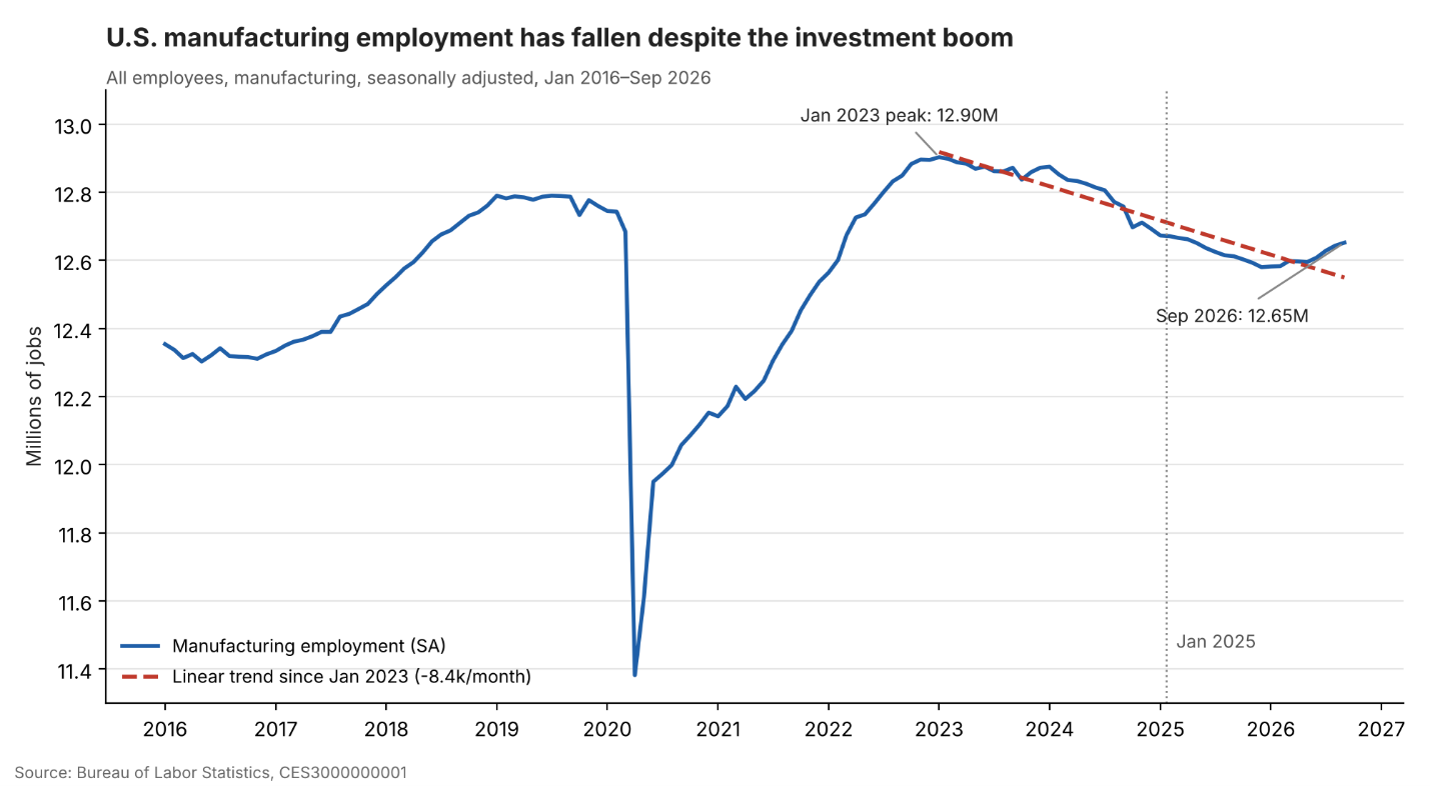
Source: U.S. Bureau of Labor Statistics, manufacturing employment, seasonally adjusted, January 2016–September 2026.

The trade data tell a similar story. Capital goods imports hit a record $140.3 billion in July, with computers and semiconductors leading, which is the AI buildout showing up as imports. Moreover, Jefferies notes that the United States is now 100 percent import-reliant for 16 of the 90 nonfuel commodities the U.S. Geological Survey (USGS) tracks. For critical minerals specifically, the report identifies 11 with complete import dependence.

The bulls have one counterpoint. The Institute for Supply Management’s (ISM) Manufacturing Index has reached its highest readings since 2022. But Jefferies attributes part of that to businesses front-loading orders ahead of Iran-related supply disruptions, with AI spending offsetting tariffs. That is not proof of broad-based industrial strength.

Besides, the ISM Index measures changes reported by surveyed, surviving firms, not total manufacturing output. Dead men tell no tales. We need output data that capture the whole sector: That means accounting for firms that have gone out of business and whose purchases have fallen to zero.

What is perhaps most bizarre is that the growing backlash against data centers would have us shut down even this positive development, leading to further declines in manufacturing capital expenditures. The opponents’ so-called “pause” is Latin for “ban.”

So, the data and analysis Jefferies provides should tell us three things.

  1. We need to stop putting barriers in the way of the AI, semiconductor, and data center transformation.

  2. We need a national industrial policy to restore the rest of U.S. manufacturing. Related to that, let’s stop using manufacturing jobs as evidence of the health of U.S. manufacturing. What we want to see is broad-based growth in inflation-adjusted value added across most major manufacturing subsectors at the three-digit NAICS level. That growth should outpace real GDP growth and be accompanied by a decline in the goods trade deficit. Ideally, automation will allow manufacturers to produce more with fewer workers.

  3. We need an across-the-board decline in dependence on China for key inputs. USGS identifies China as a major source of 14 of the 33 critical minerals for which the United States is most dependent on imports. Chinese firms also supply significant portions of key equipment used in the U.S. AI production economy, including transformers, batteries, switchgear, and optical transceivers.

The policies needed to fix all this will not be fully forthcoming until two things happen. First, the elite policy class and elected officials will need to realize the United States is in a techno-economic war with China—and that China is winning. Second, they will need to recognize that the only solution is an advanced manufacturing industrial policy.

Only time will tell if that happens. In the meantime, at least we have growth in AI, semiconductors, and data centers. Well, that is, until the anti-growth, anti-tech crowd shuts that down too.


Free Training

Source link

Silent Boom: Business, Manufacturing Surge Despite Inflation | News Radio 1200 WOAI


While public perception of the economy continues to wallow in negativity focused mostly on gas prices and stubborn inflation, there is a quiet boom underway that is not getting as much attention. New federal data reveal that U.S. manufacturing activity is surging, with factory output rising last month at the highest level in more than four years, while business service activity rose to its highest mark in nearly five years. At the same time, employmant in manufacturing and business services increased at a four-year high. “What we’re seeing is actually a business boom in the United States,” says John Carney, economics and finance editor of Breitbart. “The economy appears to be growing as fast as five percent annualized in September, and probably for the third quarter we’re going to get a (GDP) number as high as four percent…so this is a rapidly growing economy.”

These positive numbers come on the heels of recent news that the U.S. poverty rate hit a record low last year, while household wages reached a record high. Still, much of the media coverage and public opinion remain negative on the economy, primarily due to inflation and gas prices. And time is rapidly running out for President Trump and Republicans to turn that narrative around. “In my experience, people’s impressions about how the country and the economy are doing really get settled between Memorial Day and July 4th,” says Carney. “After that, it becomes very hard to change people’s minds about what is happening on the ground…so most people’s views on the economy are probably going to be unchanged between now and Election Day.”

Ironically, all of the positive factors in the economy helped convince the Fed to raise its benchmark interest rate this month, which can raise the cost of large purchases like homes and cars and further dampen public perception of the economy. “The problem is that inflation ran so hot under Biden that we’re still struggling with prices that seem too high,” says Carney. “One of the things inflation does is it poisons people’s minds against the economy for years to come, and we’re still dealing with that.”

“But objectively, this is one of the best economies we have seen in a generation.”

Free Training

Source link

2 ETFs Play the Reshoring Boom


Traditionally speaking, when new threats of tariffs hit the headlines, it tends to be a bad thing for many investment approaches.

  • While escalating tariffs could be a concern for the markets, a couple of different sectors may be more insulated than others.
  • This includes sectors engaged in reshoring: the process in which a company moves its production or manufacturing back to its original country.
  • Both the iShares U.S. Manufacturing ETF (MADE B) and the Amplify Lithium & Battery Technology ETF (BATT ) could offer compelling routes to take advantage of momentum in the reshoring space.

Granted, there are plenty of fair reasons why tariffs become a problem for the market. Not only do tariffs tend to ratchet up geopolitical tensions, but they can also cause the price of certain imported goods and raw materials to increase.

However, there are some sectors of the market that tend to be less exposed to the dangers of tariffs. This includes companies that benefit from reshoring—the act of moving a company’s manufacturing or production operations back to its original country.

Companies currently thoroughly engaged in the reshoring process could be at a distinct advantage as tariffs continue to escalate. After all, businesses with stronger domestic supply chains may require less international shipping, and thus can avoid some of these rising costs.

Notably, the United States has a number of reshoring incentives that benefit different sectors of the market. This includes the Chips & Science Act for semiconductors, and Inflation Reduction Act for clean energy. Additionally, the industrials sector is benefitting from different manufacturing companies engaging in reshoring.

See More: Take-Two Latest Earnings: Try These 2 ETFs Ahead of GTA 6

Since reshoring can benefit a few different sectors, advisors and investors have some different options for how they wish to capitalize on the trend. For instance, the iShares U.S. Manufacturing ETF (MADE B) could be a straightforward option.

MADE invests in companies based in the United States that are heavily engaged in the manufacturing industry. This approach can help investors capitalize on reshoring, while attaining targeted domestic manufacturing exposure. As of July 31, 2026, the fund is offering a year-to-date total return of 17.88%.

See More: Balance China’s Shifting Lithium Market With the BATT ETF

Another option is to take a look at the Amplify Lithium & Battery Technology ETF (BATT ). BATT invests in companies that derive significant revenue from the lithium battery industry, which is a natural beneficiary of clean energy.

Leaning into a fund like BATT can help investors and advisors capitalize on clean energy reshoring, while tapping into the broad need for battery storage and lithium batteries as a whole. The fund’s NAV is up 16.45% year-to-date, as of August 26, 2026.

BATT and MADE showcase how there are plenty of different approaches that can work for tackling the reshoring opportunity set. Whether one wants to lean into clean energy, manufacturing, or a different sector entirely, the flexibility of the ETF wrapper allows folks to ensure there are plenty of options at their disposal.

For more news, information, and analysis, visit the Thematic Investing Content Hub.

VettaFi LLC (“VettaFi”) is the index provider for BATT, for which it receives an index licensing fee. However, BATT is not issued, sponsored, endorsed, or sold by VettaFi, and VettaFi has no obligation or liability in connection with the issuance, administration, marketing, or trading of BATT.

Free Training

Source link

US Manufacturing Boom Favors 167 High-Conviction Hubs


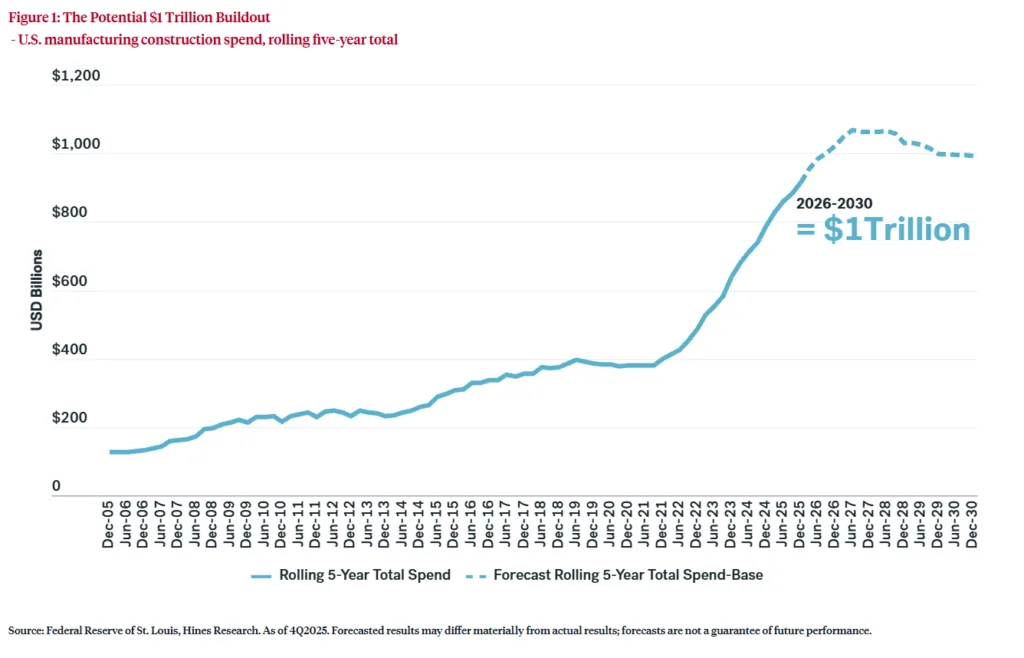
  • US manufacturing construction spending may reach $1 trillion from 2026–2030, with growth concentrated in select industrial submarkets.
  • Advanced manufacturing and ‘New Companies Doing New Things’ are driving leasing demand in regional hubs such as Dallas–Fort Worth, Houston, Phoenix, Atlanta, Chicago, and San Jose.
  • A Hines study identified just 167 ‘high-conviction’ submarkets out of 1,500 nationwide as best positioned to convert manufacturing investment into sustained rent and demand growth.

Key Takeaways

Rise of the Advanced Manufacturing Ecosystem

The US manufacturing surge is sharpening investor focus on a small group of emerging and established industrial hubs. According to Hines Research, manufacturing construction spending could reach roughly $1 trillion between 2026 and 2030. Cyclical rebounds will contribute, alongside a structural shift toward advanced manufacturing.

Hines analyzed about 1,500 submarkets and found that outperformance remains highly concentrated. Winning markets have deep industrial ecosystems or supply constraints that strengthen tenant demand and rent growth. Wholesale reshoring remains limited, but federal incentives and supply chain resilience continue driving capital into US manufacturing. These forces reinforce regional clusters and attract industrial occupiers seeking capacity for next-generation production.

US manufacturing construction spending is projected to reach a rolling five-year total of roughly $1 trillion from 2026 through 2030.

The Details

Hines Research applied its proprietary Manufacturing Market Growth Score (MMGS) across submarkets in 75 US metros. The score weighs manufacturing stock at 48% and five-year manufacturing employment growth at 47%. Current manufacturing workforce size accounts for the remaining 5%. Only 167 submarkets, or roughly 12%, scored above 70, highlighting concentrated investment opportunities.

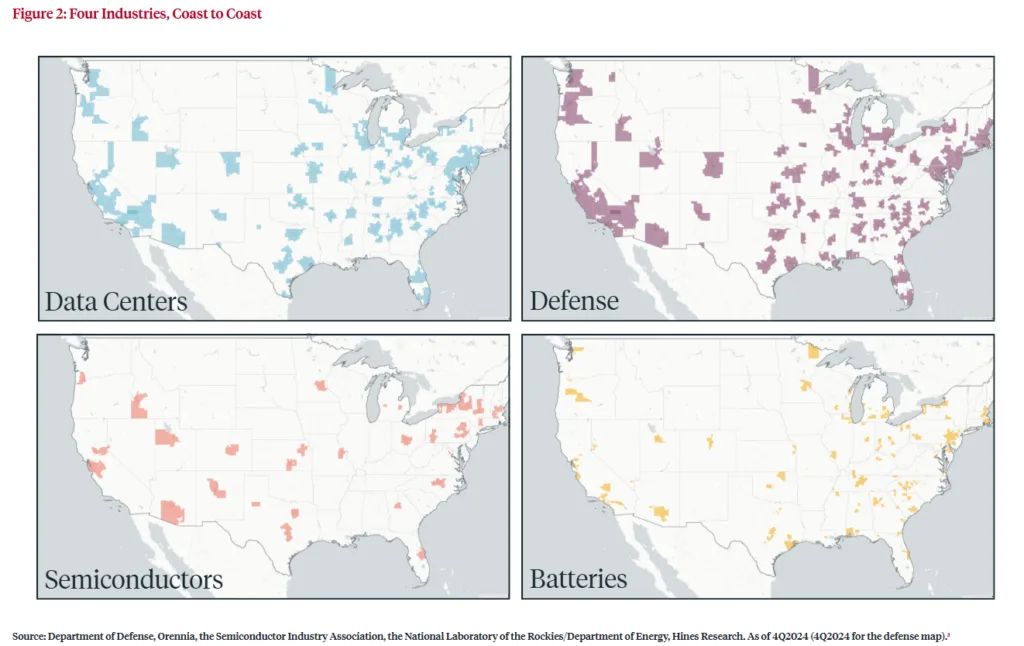
Dallas–Fort Worth leads as a logistics and defense hub, while Houston stands out in energy and petrochemicals. Phoenix and San Jose excel in semiconductors. Data centers also attract logistics companies and advanced component providers, despite falling outside traditional manufacturing. Meanwhile, battery hubs stretch from the Great Lakes through Tennessee and the Southeast. Many overlap with Opportunity Zones, adding another consideration for tax-sensitive capital.

US map showing geographic clusters for data centers, defense, semiconductor, and battery industries across major manufacturing markets.

Concentration, Not Uniformity, Defines Growth

Despite the $1 trillion forecast, Hines found that capital and tenant demand remain tightly clustered. Of 167 high-conviction submarkets, 162 have significant defense and data center footprints. Those sectors now function as industrial table stakes rather than meaningful differentiators. Semiconductor and battery clusters remain more selective. Battery activity concentrates across 54 submarkets that also qualify as Opportunity Zones.

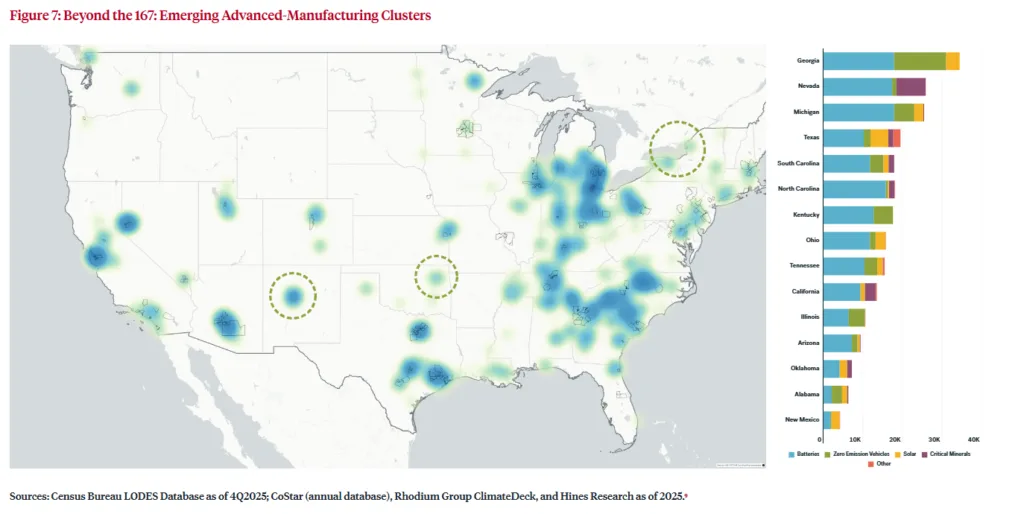
Spillover activity is emerging along the Great Lakes-Tennessee corridor and in upstate New York, Tulsa, and New Mexico. These markets offer lower-cost alternatives for manufacturers seeking available land and power outside highly competitive metros. Recent shifts in Austin battery facility plans also show how quickly manufacturers can adjust investment and production strategies. Data centers follow different site-selection patterns, favoring power-rich markets like West Texas and Iowa. That trend creates parallel industrial demand across regions with limited historical manufacturing density.

US map showing emerging advanced manufacturing clusters, with battery-related employment concentrated across the Southeast, Midwest, and selected Western markets.

Why It Matters

Investors must determine which markets can translate manufacturing investment into durable rent and demand growth. Hines analyzed Census Bureau and CoStar data through 2025 to measure historical performance. Top-scoring submarkets recorded stronger five-year rent growth and occupied SF gains than lower-scoring peers. The demand gap proved especially significant. Highest-scoring markets gained occupied space, while the bottom quartile recorded net declines.

Institutional capital can gain more by targeting established ecosystems than broadly chasing the manufacturing boom. Scale, infrastructure, and supply chain depth create a virtuous cycle that supports additional investment. Supply constraints can amplify rent growth in tight clusters. New industrial nodes offer potential upside but carry greater oversupply risk. Opportunity Zones can further improve risk-adjusted returns for tax-sensitive investors near battery and semiconductor clusters.

The advanced manufacturing buildout also changes CRE demand fundamentals. Companies and government entities increasingly prioritize supply chain resilience alongside operating efficiency. Large projects can create self-reinforcing hubs of investment, skilled labor, and supplier networks. This agglomeration effect expands demand beyond manufacturers to logistics, infrastructure, and component businesses. In turn, those supporting industries strengthen the competitive advantages of leading submarkets.

What’s Next

Federal policy and private capital could sustain the manufacturing expansion and intensify investor focus on Hines’ 167 high-conviction submarkets. Developers will likely pursue emerging corridors with affordable land and sufficient grid capacity. Areas near new data centers and battery plants could attract particularly strong interest.

However, investors must carefully manage exposure in tertiary markets. Rapid construction could outpace tenant absorption and weaken rent growth. The strongest markets will combine supply constraints, established industrial ecosystems, and infrastructure capable of supporting additional investment. Those fundamentals offer the clearest path for converting the $1 trillion manufacturing boom into durable CRE returns.

Free Training

Source link

AI boom lifts Mexico tech exports, complicating Trump trade goals


WASHINGTON – The United States’ frenzied rush to build out AI infrastructure has boosted exports of Mexican technology, complicating President Donald Trump’s hand heading into trade negotiations.

Trump, who campaigned on boosting US manufacturing, hopes to narrow the trade deficit with Mexico during talks to update the USMCA free trade agreement, which kick off Tuesday in Mexico City.

But the dizzying rise in computer equipment exports from Mexico — the largest US trading partner — is doing the opposite.

Between January and April, Mexico tripled its sales of computer equipment to the United States compared to the same period last year, with exports topping $50 billion versus just $2.2 billion in imports, according to AFP calculations.

The sector now makes up 30 percent of all Mexican products shipped to the United States, overtaking the automotive industry as the largest component of exports.

“It’s a milestone largely driven by demand for advanced AI electronics,” Diego Flores, head of electronic and digital industries at Mexico’s Economy Ministry, told AFP.

The sector, which includes processing units and data centre hardware, is not officially on the agenda for this round of negotiations.

– Explosive demand –

The most in-demand products are server racks that house AI processing cards — a key component for the data centres multiplying across the United States.

The main export hub is the Pacific state of Jalisco, dubbed the “Mexican Silicon Valley,” where an ecosystem of global industry giants and tech startups have set up shop, Flores said.

Taiwanese giant Foxconn assembles server racks in Jalisco, and serves as a strategic partner to US chip designer Nvidia.

In March, Foxconn announced $137 million in investments across two Mexican subsidiaries after estimating its production could double this year.

“The United States and Mexico will remain our primary production hubs,” Chief Executive Michael Chiang said, announcing the company would invest 30 percent more than in 2025 to expand its AI-related capacity.

Faced with booming demand, Flextronics, another tech manufacturer in Jalisco, even had to repurpose its parking lots to expand manufacturing capacity, Flores said. 

Yet the boom comes amid a volatile political climate.

The Trump administration rejected a 16-year extension of the USMCA, opting instead for annual reviews with Mexico and Canada.

Washington is also continuing to push for more goods to be manufactured domestically, even as US reliance on imports from Mexico, Taiwan, and China to fuel its AI boom grows.

– ‘In the line of fire’ –

Could the thriving sector become Trump’s next tariff target?

“Nobody can say for sure,” Flores admitted. However, he expressed confidence that the sector might escape protectionist policies due to its immense strategic value to the United States.

Washington is also seeking to limit the use of Asian technology within North America, according to William Jackson, a chief emerging markets economist at Capital Economics.

“The Trump administration has to weigh the demand for these technologies and the need to stay at the forefront of AI development,” he told AFP, noting that “tariffs could prove counterproductive to that goal.”

But balancing the preservation of a booming industry with protectionist rhetoric puts the sector “very easily in the line of fire,” he warned.

That risk is heightened by the fact that Mexican manufacturers use components sourced from China and Taiwan, which Trump could view as a “backdoor” or Trojan horse for Asian technology entering the United States.

Free Training

Source link

235 new clean energy factories opened in 5 years as a US manufacturing boom powers through policy headwinds


235 new clean energy factories opened in 5 years as a US manufacturing boom powers through policy headwinds Photo Credit: iStock

America’s clean energy manufacturing boom is still gaining speed — even as tariffs and broader policy uncertainty hang over the sector.

According to SolarQuarter, a new industry report said the United States added more than 235 clean energy factories in just five years, with domestic production emerging as a major force in both the economy and the energy transition.

What’s happening?

The American Clean Power Association’s second annual State of Clean Energy Manufacturing said the sector has grown rapidly.

In addition to the new clean energy manufacturing facilities, the report found that U.S. production capacity is sufficient to meet domestic demand for solar modules, battery modules, wind towers, and wind nacelles. That marks a major shift for an industry that has long depended on overseas supply chains.

Jason Grumet, CEO of the American Clean Power Association, said the surge is especially important amid rising energy demand, per SolarQuarter. But he also cautioned that sustaining the momentum will require clear, targeted, and consistent trade policy, along with realistic timelines for tariff compliance and greater regulatory certainty.

Why does it matter?

More domestic clean energy manufacturing can help make the electrical grid more reliable, reduce dependence on foreign supply chains, and support the faster deployment of renewable power sources (such as wind and solar) that can lower energy costs over time.

The report also found that each clean energy manufacturing job supports four additional jobs across the broader economy — one linked to suppliers and three tied to household spending.

As U.S. manufacturing expands, technologies like solar panels and batteries may become more accessible.

What are people saying?

Grumet said that as energy demand rises, the U.S. needs more clean power systems built at home.

The ACPA report points to factory growth, domestic manufacturing strength, and the sector’s ripple effects on jobs and local economies.

Even with policy headwinds, clean energy manufacturing can become a cornerstone of American industry.

Get TCD’s free newsletters for easy tips, smart advice, and a chance to earn $5,000 toward home upgrades. To see more stories like this one, change your Google preferences here.

Free Training

Source link

Trump’s crackdown on China-linked solar firms stalls U.S. factory boom


Top solar companies, banks and insurers have stopped doing business with at least a half dozen recently built U.S. panel factories because of ⁠uncertainty over whether their ties to China could disqualify them from clean-energy subsidies, according to industry executives and documents.

The shift, driven by new policies of U.S. President Donald Trump’s administration, jeopardizes more than a third of U.S. solar capacity in factories initially built by Chinese firms. Details of how the policy uncertainty is driving installers and insurers away from U.S. solar factories with China ties have not been previously reported.

The emerging effects dovetail with Trump’s broader efforts to block Chinese companies from the U.S. market and to slash government support for green energy. However, the policy could backfire by imperiling growth in U.S. manufacturing jobs and power generation at a time of rising utility bills and soaring electricity demand from data centers serving the artificial intelligence industry, industry experts say.

Free Training

Source link

Trump’s promised ‘manufacturing boom’ couldn’t save these Whirlpool jobs


New York
 — 

The US has lost thousands of manufacturing jobs over the last year. Beverly Dawson’s family was among them.

Dawson was laid off this month at Whirlpool’s refrigerator factory in Amana, a small town in eastern Iowa. Her son’s offer to work full-time at the plant when he graduates from college in a few semesters was also pulled. Her husband was the only one to survive the latest round of layoffs.

At the Amana plant, the hope of a stable future building appliances in the town that introduced America’s first side-by-side refrigerator is dimming. The factory’s workforce has been cut by more than half over the last few years as Whirlpool expands production in Mexico.

“You have generations working at the Amana plant. People’s parents and grandparents,” Dawson, 48, said. “It’s a central part of the community and was a good, solid place to work.”

Dawson is one of more than 100,000 American manufacturing workers who have lost their jobs since President Donald Trump entered office last year. Trump as a candidate promised a “manufacturing boom” and once in office launched broad global tariffs as the way to revitalize factory production in the United States.

Exterior of the Whirlpool Amana factory. More than 100,000 American manufacturing workers have lost their jobs since President Donald Trump entered office last year.

A 'Save Our Jobs at Whirlpool' rally, on March 6 in Amana. IAM Union said Whirlpool has shifted production to Mexico in recent years.

The Whirlpool factory in Amana. Whirlpool has said Trump's trade policies level the playing field for Whirlpool and other US manufacturers.

Despite the administration’s push, the decades-long decline in manufacturing has marched on. The US economy has shed more than 7.5 million manufacturing jobs since a peak in 1979, driven by global competition, automation and exchange rates.

Whirlpool has invested hundreds of millions of dollars in Mexico to manufacture refrigerators at two factories in recent years, said the International Association of Machinists and Aerospace (IAM), which represents workers at the Amana plant.

IAM opposes Trump’s broad tariffs, fearing they would disrupt US production and cause layoffs.

“Whirlpool advertised quite often that they’re the only American manufacturer of refrigerators and tariffs will only be beneficial,” Dawson said. “I don’t understand how that reconciles with opening up more in Mexico.”

Whirlpool, which also owns the KitchenAid, Maytag and Amana brands, supports Trump’s tariffs.

The Michigan-based company has said the import taxes give it an advantage. That’s because most of the appliances it sells in the United States are produced domestically at 10 US plants, in contrast to its rivals in Asia like LG and Samsung.

The administration’s “trade policies are critical to closing trade loopholes and leveling the playing field for Whirlpool and other US manufacturers,” Whirlpool spokesperson Chad Parks said in a statement to CNN.

Whirlpool said it’s making “difficult but necessary changes” to the plant in Amana “all with the goal of keeping Amana competitive and a viable manufacturing presence in the community for the long term.”

Whirlpool said it’s committed to American manufacturing, pointing to a recent $300 million investment in Ohio to build washing machines.

But the pull to produce in lower-cost countries like China and Mexico remains strong for all US manufacturers. The power of tariffs has not been enough to make US manufacturing competitive with these countries. Trump’s snap decisions on tariff rates have also chilled companies’ long-term investment and hiring plans. (The White House did not respond to CNN’s request for comment.)

A Whirlpool refrigerator on display at Lowe's.

Meanwhile, tariffs have hiked costs. For example, Trump’s 50% tariffs on imported steel and aluminum increased Whirlpool’s costs by $300 million last year. The company also paid more for appliance components that are only made overseas.

“Supply chains are integrated across countries. They can’t be changed overnight,” said Susan Houseman, an economist at the Upjohn Institute for Employment Research. “To think companies can turn on a dime and rearrange supply chains or make massive investments in this country is unrealistic.”

Big-ticket refrigerators and dishwashers are also going untouched at stores as fewer people move or buy new homes. Whirlpool’s sales dropped 6.5% last year and its stock declined around 35%.

Tariffs have “done little to benefit” the home appliance sector, said Jason Miller, a professor of supply chain management at Michigan State University.

Since Trump took office last year, the tariff rate on major home appliances has increased from 5% to 16.4% in December. That rate isn’t high enough for domestic manufactures to benefit, especially when steel and aluminum prices have spiked, Miller said.

“Production didn’t increase in 2025 and payrolls fell,” he said.

But Whirlpool’s pledge to keep jobs in Amana rings hollow to laid off workers like Dawson. When she goes into a nearby Lowe’s, she’s frustrated to see Whirlpool refrigerators made in Mexico and China.

There is a long history of building home appliances in Amana, one of seven villages outside Cedar Rapids that were German communal societies until the Great Depression.

A general store in Amana, Iowa, selling bakery goods and Hotpoint appliances in 1961.

In 1934, Amana entrepreneur George Foerstner began making beer coolers. The business grew into the Amana household appliances’ brand — the first side-by-side fridge in the United States was introduced there in 1949 and the first bottom-freezer fridge came in 1957. Hollywood stars like Gary Cooper and Groucho Marx advertised Amana’s appliances in magazines and on the radio.

Raytheon, the inventor of the microwave oven, bought Amana a decade later as it pushed to bring microwaves to households around the country.

Whirlpool eventually acquired the plant in 2006, which is still an economic engine for the area and processes wastewater for the local community. Roughly 950 people work there.

The factory has had a “wide-reaching benefit for people around Amana,” said Sandy Freytag, who has worked there for more than 30 years. She worries that the layoffs will have a spillover effect on local businesses and the economy.

An Amana chrome Radarange microwave oven sits on a kitchen countertop in the 1970s.

“People don’t trust that the factory will stay open,” she said. “I hope I am very wrong.”

Dawson had hoped to work there for the rest of her career, but the 48-year-old mother of four is now sending out job applications to dozens of employers.

She’s currently competing in a tough labor market with a weaker safety net. Iowa in 2022 cut its unemployment insurance from 26 weeks to 16, and a federal program for workers who lost their jobs due to foreign trade has expired.

Her husband has taken on a second job and is now working seven days a week to help the family make ends meet. If she can’t find a new job soon, she plans to tap into her retirement savings.

“I’ve worked hard. I’ve been loyal. I’ve made things better, and that still isn’t enough for me to be successful,” she said.

Correction: A previous version of this article incorrectly stated the number of factories Whirlpool has in Mexico. Whirlpool has two refrigerator plants in Mexico and recently expanded its investments at them.

Free Training

Source link

Trump promised a manufacturing boom, but factory jobs continue to decline


William Brangham:

The U.S. job market has been cooling recently, and government data shows it’s only getting harder for Americans to find a job.

One sector that has proved tougher than most is manufacturing. President Trump has promised a manufacturing boom in both his terms, but while he’s been able to get pledges for more factory investment, the actual jobs inside those factories tell a different story thus far.

Economics correspondent Paul Solman has this report.

Paul Solman:

The Ohio State marching band and its featured instrument, the brassy sousaphone, emblem of school spirit and state pride, made just outside Cleveland.

Rob Hines, Sousaphone Buffer, Conn Selmer:

We handcraft everything. We have perfected the process for it and it’s been working for 58 years in our facility. And that’s what I think you get when you get that American craftsmanship.

Paul Solman:

Rob Hines, an American craftsman, sousaphone buffer at the Conn Selmer plant, where he’s worked for nine years.

Rob Hines:

It’s not an easy job. It’s a grueling job. But we do it because we love what we do.

Paul Solman:

And what they lovingly produce, which is why he and co-workers were stunned when the company suddenly said it will shutter the factory in June and relocate to China, shunting 150 people to the street.

Rob Hines:

It’s a lot of fear right now. A lot of people are afraid.

Wyatt Georskey, Sousaphone Buffer, Conn Selmer:

We’re talking about some of the best brass instrument craftsmen in the world going into job interviews and being told, well, that’s good and all, but you don’t actually have any skills.

Paul Solman:

Wyatt Georskey, another buffer. His future?

Wyatt Georskey:

I don’t know what I’m going to do. We’re all left in a limbo right now.

Paul Solman:

Of course, some of you have seen it as long as I have, manufacturing jobs on the wane ever since 1979.

President Donald Trump:

Jobs and factories will come roaring back into our country, and you see happening already.

Paul Solman:

It’s a trend President Trump has famously vowed to reverse with tariffs and domestic investment. Foreign leaders and business executives have frequently visited the White House grounds pledging to spend in the U.S. of A.

DONALD TRUMP:

In 12 months, I secured commitments for more than $18 trillion pouring in from all over the globe.

Paul Solman:

This number is widely thought to be implausible and almost assuredly includes commitments that were made before Trump’s second term. But there’s no contesting the fact that, since President Trump took office, the U.S. has lost nearly 100,000 manufacturing jobs.

The administration and its allies, however, tout their dedication to a turnaround.

John Paulson, Founder, Paulson & Co.: We need to protect American jobs and protect American manufacturing. We can’t have Americans, American producers closing American factories and offshoring.

Paul Solman:

And yet it’s this same famed investor, John Paulson, who owns the brass instrument factory. Paulson hosted a $50 million fund-raiser for President Trump during the 2024 campaign.

Rob Hines:

A lot of our members support Trump and believed in the administration.

Paul Solman:

Or did, claims Conn Selmer union Rob Hines.

And how are people feeling about it now?

Rob Hines:

Some people feel slighted. Some people are even questioning if Trump actually knows about the moves his allies are making in the dark. Some people still believe in administration. Some people feel let down.

Paul Solman:

In recent years, the company had already been moving parts to China, cheaper production, to buff the bottom line, but at a hidden cost, says Hines.

Rob Hines:

We have seen over the last year the quality deteriorate just from trying to integrate those foreign parts.

Paul Solman:

Wait, the myopic maximizing of shareholder value we have heard so much about? Or do the workers here just see what they want to see?

Rob Hines:

I don’t think it would be just because it’s in our interest. As somebody who works with these parts day in and day out, six days a week, we see the quality, and the employees have complained about the quality. And it’s fallen on deaf ears.

Paul Solman:

Meanwhile, the job attrition in Wyatt Georskey’s part of the plant.

Wyatt Georskey:

At times, it’s been over 100, and now we’re down to this group of 16 of us who are sending out the last American-made French horns and sousaphones and tubas.

Paul Solman:

Plus, there’s another cost often ignored when a plant goes under, the loss of internal community.

Rob Hines:

That’s just as big a weight as losing your job financially. I mean, it might sound kind of bizarre to say, but a lot of people are devastated, because we have people 40, 50 years have been working together.

Wyatt Georskey:

It’s been a tragedy, right, not only for community, but for bar buddies and friends everywhere.

Paul Solman:

But that too has been happening for eons. In fact, the destruction of all those jobs down on the farm is what helped create the manufacturing boom of the last century. But is there no way to protect American jobs from foreign competition?

The push now is, let’s get manufacturers from here and especially abroad to bring their manufacturing to the United States, which is then supposedly going to create more jobs than at least are here now.

Robert Lawrence, Harvard University:

The question is, how significant would those jobs be relative to the whole economy?

Paul Solman:

Trade economist Robert Lawrence.

Robert Lawrence:

We had a $1.2 trillion trade deficit in manufacturing last year. Suppose all the money that is going abroad would be used to buy American goods.

Paul Solman:

Even under such a fantasy, how much would actual factory floor jobs increase? Professor Lawrence estimates less than 1 percent. And, of course, American-made products would then cost more. In addition, he says:

Robert Lawrence:

If we were self-sufficient, what would it do to the opportunities for the typical worker in the United States who doesn’t have a college education? Would it create large numbers of employment opportunities? That’s basically what’s been driving our policies. And the answer is very little.

But, in addition, those jobs are increasingly likely to be displaced as a result of increased automation.

Paul Solman:

And perhaps increasingly likely to be overpromised, like two Ohio Intel plants.

Tim Bubb, Licking County, Ohio, Commissioner:

Intel promised 5,000 jobs into construction. We’re seeing less than half that, and 3,000 permanent jobs to man those two plants and manufacture silicon chips. Frankly, I think that’s overpromised and underdelivered, as they say.

Paul Solman:

Licking County Commissioner Tim Bubb, where the Intel project is located.

Is it an unrealistic expectation that we’re going to have lots more manufacturing jobs in this country than we used to?

Tim Bubb:

Well, I’m not going to go as far as unrealistic, but you don’t want to be overly optimistic. We’re still an expensive labor market. We have competitors around the world. It’s a world market now in Asia and other places that have been pretty darn competitive in manufacturing and shipping to this country.

Paul Solman:

More over, ads Bubb:

Tim Bubb:

One of the problems we have in this country is trained work force. You can move manufacturing plants back here, but who’s going to work in them?

Paul Solman:

But at the Alliance for American Manufacturing, the watchword is patience.

Scott Paul, President, Alliance for American Manufacturing: Just as it took a couple of decades for us to deindustrialize, I don’t think that we’re going to see immediate results in manufacturing.

Paul Solman:

Scott Paul runs the Alliance.

Scott Paul:

I’m optimistic that over time, we will see manufacturing job growth come out of both the massive amount of construction that’s going on right now, the trade deficit coming down a little bit, and a reshoring trend that was already under way before Trump became president.

Paul Solman:

So he says manufacturing jobs won’t be stuck forever at today’s lower level, and new corporate investment promised by Trump will be part of the renaissance. The U.S., he says, added a million manufacturing jobs between 2010 and 2019, when many thought that simply wouldn’t happen.

Scott Paul:

It’s not impossible to regrow the sector if we have the right policies. There might be a ceiling on the manufacturing job growth that we can see because of automation and productivity, but that doesn’t mean that we can’t grow the sector again over time.

Paul Solman:

Patience is a luxury for the likes of Wyatt Georskey, though.

Wyatt Georskey:

I’m not even thinking day to day. I’m thinking second to second. All I’m thinking is, can I get enough sousaphones out, can I get enough tubas out that they won’t close this plant at a whim because they see productivity dip?

All I can think about are the people around me and my duty to them and to our legacy to keep the place open just a little longer so we can get a few paychecks.

Paul Solman:

As of last week, the plant was still open, the paychecks still being issued. But the deadline seems to be the end of June.

For the “PBS News Hour,” Paul Solman.

Free Training

Source link

One Big Beautiful Bill Act Drives U.S. Construction Boom and Manufacturing Growth


The One Big Beautiful Bill Act (BBBA) is reshaping the U.S. manufacturing and construction landscape by introducing significant tax incentives tied to capital investment, domestic production and research activity.

Courtesy: Photo by Scott Blake on Unsplash

Signed as part of President Donald Trump’s broader tax and spending agenda, the legislation is designed to stimulate U.S.-based manufacturing capacity and reduce reliance on overseas production.

BBBA Incentives Expected to Accelerate U.S. Factory Construction

One of the most impactful provisions is the Qualified Production Property Deduction. Under this measure, companies that build new manufacturing facilities — or significantly expand existing ones — can deduct 100% of eligible capital expenditures, provided construction begins between January 20, 2025 and December 31, 2028. Projects must be placed into service by January 1, 2031.

This accelerated deduction dramatically improves project economics. Instead of spreading depreciation over decades, companies can deduct the full investment upfront, strengthening short-term cash flow and improving internal rates of return.

For the construction sector, this creates a narrow but powerful investment window. Industry analysts expect a surge in factory groundbreakings over the next three years as companies race to qualify.

For composites manufacturers and suppliers, the ripple effects could be substantial. Increased factory construction means higher demand for advanced building materials such as fiber-reinforced polymer (FRP) rebar, composite panels, corrosion-resistant structures and lightweight structural components.

100% Bonus Depreciation Strengthens Capital Spending and R&D

In addition to the production property deduction, the BBBA reinstates 100% bonus depreciation for qualifying capital expenditures. Traditionally, capital investments are depreciated over multiple years according to IRS schedules. Under the updated framework, companies can deduct the entire cost of machinery, tooling, and production equipment in the year it is placed in service.

This provision improves liquidity and encourages businesses to modernize production lines, automate facilities and invest in advanced manufacturing technologies.

For the composites industry, this could accelerate:

  • Expansion of domestic composite fabrication plants
  • Investment in automated layup and molding systems
  • Increased capacity for thermoplastic and thermoset production
  • Growth in aerospace, automotive and infrastructure supply chains

Beyond construction, R&D-related incentives embedded in the broader tax package are expected to encourage innovation in advanced materials. Composites firms developing lightweight, high-strength and sustainable materials stand to benefit from a more favorable tax treatment of research expenditures.

Strategic Timing for Composites Manufacturers

The timing window built into the legislation is critical. With eligibility tied to construction start dates and service deadlines, companies must act quickly to secure benefits.

Domestic firms considering U.S. expansion now have a tax-advantaged environment to do so. Likewise, international composites manufacturers evaluating North American production footprints may view the current period as an optimal entry point.

The legislation effectively compresses investment decisions into a three- to four-year horizon. That urgency is likely to generate elevated activity across engineering, procurement and construction (EPC) markets.

For suppliers of composite materials used in industrial flooring, bridge decks, wastewater facilities, reinforcement systems and structural retrofits, the anticipated uptick in manufacturing plant construction could translate into steady order growth through the end of the decade.

Broader Economic Implications

Courtesy: Photo by Pixabay on Pexels

The BBBA’s construction and capital expenditure provisions are not isolated measures; they are part of a broader strategy to strengthen domestic industrial capacity.

If widely adopted, the incentives could:

  • Expand U.S. manufacturing output
  • Increase demand for skilled labor in construction and engineering
  • Shorten supply chains for advanced materials
  • Support long-term infrastructure modernization

For the composites industry, the law represents more than a short-term stimulus. It creates structural incentives for reshoring production and investing in advanced materials technologies — positioning the sector to play a central role in the next wave of U.S. industrial growth.

As companies evaluate investment pipelines for 2025–2029, the BBBA’s tax environment may prove decisive in determining where and when new manufacturing capacity is built.

Originally Reported by JEC Composites.

Free Training

Source link