U.S. defense manufacturing capacity expands as The Whiskey Project Group opens North Carolina facility


The Whiskey Project Group (TWPG) has officially opened its advanced watercraft manufacturing facility in Edenton, North Carolina, marking a major milestone in the company’s U.S. expansion and strengthening domestic production and sustainment capacity for American defence, government and commercial customers.

The facility was officially opened at a ceremony attended by North Carolina Governor Josh Stein and Congressman Don Davis, local government representatives, defense and industry leaders, and TWPG employees and partners.

Located on a 50-acre waterfront site, the 60,000 sq ft facility will serve as TWPG’s primary U.S. manufacturing and sustainment hub, supporting advanced aluminum and composite watercraft production engineering, maintenance and technical services.

The facility is expected to support over 200 high-value American jobs as operations grow, with a planned investment of US $10M to establish and develop its US operations.

Founded by former Royal Australian Navy Clearance Divers, TWPG has built its reputation on developing advanced watercraft informed by frontline operational experience. Its U.S. expansion brings this specialist maritime technology and engineering expertise into American manufacturing, drawing on North Carolina’s skilled maritime workforce.

Darren Schuback, Founder and CEO of TWPG, said the opening reflects the company’s long-term commitment to the U.S. defense industrial base.

“The United States is central to our future, and we’re backing that commitment by investing in local manufacturing, skilled jobs and the capability to build and sustain advanced watercraft here in North Carolina. This is about more than opening a factory, it’s about building long-term capability to support U.S. defense, law enforcement and commercialcustomers and strengthen America’s maritime industrial base.

“Australia has developed exceptional maritime technology and engineering expertise. We’re bringing that innovation together with the talent and strength of American manufacturing to build world-class watercraft in the U.S., with American workers, for the operators who depend on them.”

The Edenton facility establishes a key part of TWPG’s dual-hub manufacturing model, connecting its U.S. operations with established design, engineering, manufacturing and sustainment capability in Yamba, Newcastle, Australia and Picton New Zealand.

This integrated model provides additional production capacity and technical expertise across the Pacific, while enabling vessels to be manufactured, maintained, and supported closer to U.S. customers. It also positions TWPG to better support bilateral defense operations and long-term sustainment requirements across both countries.

“North Carolina has the skilled workforce, manufacturing expertise, and maritime heritage that companies like The Whiskey Project Group need to succeed,” said Governor Josh Stein. “This investment will bring good-paying jobs to northeastern North Carolina, strengthen our national security, and create new opportunities for the people of Chowan and neighboring counties.”

The opening comes amid growing momentum for TWPG in the U.S. defense market.

TWPG has secured a US$36 million production contract to deliver tactical watercraft, with deliveries scheduled through September 2029. The next Whiskey vessels will be manufactured in Edenton, NC, supported by engineering, design and program expertise from TWPG Australia and its industry partners.

TWPG was also selected as one of eight manufacturers for the U.S. Navy’s decade-long program covering up to 474 composite rigid-hulled inflatable boats (RHIBs), with a total potential program value of up to US$650 million across all participating manufacturers if all options are exercised.

The Edenton facility will support the manufacture and sustainment of TWPG’s Whiskey, NAiAD and VYCOR watercraft products, with plans to progressively expand production capacity and manufacture larger vessels as U.S. operations grow.

For more information, visit www.thewhiskeyprojectgroup.com

Free Training

Source link

U.S. Army to stress-test defense production and supply chains in ‘Manufacturing Rodeo’


The U.S. Army plans to hold its first Manufacturing Rodeo early next year to find where its production processes and supply chains fail under pressure. Acting Army Secretary Adam Telle announced the competition at the opening ceremony of the AUSA annual meeting.

“The U.S. Army is going to do something we’ve never done before: early next year we will conduct what I’m calling a Manufacturing Rodeo—a race between our industrial base partners that strains our organic industrial base, stresses the supply chain, pressures manufacturing processes, and shows us exactly where it breaks,” Telle said. The exercise will test both the Army’s Organic Industrial Base and the wider U.S. manufacturing network.

Telle said the Army would learn by doing rather than “sitting around postulating at the Pentagon.” It intends to identify weak links, strengthen them and keep testing improvements to make production more resilient and responsive.

The initiative follows the Army’s shift this year from production targets for individual systems toward manufacturing capabilities that can make a wider range of components. The service has established advanced manufacturing hubs at Red River, Anniston and Tobyhanna Army depots and secured public-private partnerships with Hadrian and Siemens.

The Army said those investments have expanded its ability to manufacture subcomponents on demand for existing and future weapon systems. Products include complex electric motors and replacement parts such as tank engine transmission belt housings.

The service is also seeking to reduce bureaucratic barriers to working with U.S. companies and speed up the acquisition of new capabilities. It said integrating autonomous technologies and expanding production would help provide soldiers with equipment when needed and in sufficient quantities.


Free Training

Source link

CesiumAstro Puts Future of U.S. Space and Defense Manufacturing on Display for EXIM Bank Chairman


Jovanovic and Sabripour tour CesiumAstro's future global headquarters and manufacturing complex near Austin, Texas. Jovanovic and Sabripour tour CesiumAstro’s future global headquarters and manufacturing complex near Austin, Texas.

Visit caps $300 million in EXIM financing, the largest loan under the “Make More in America” Initiative

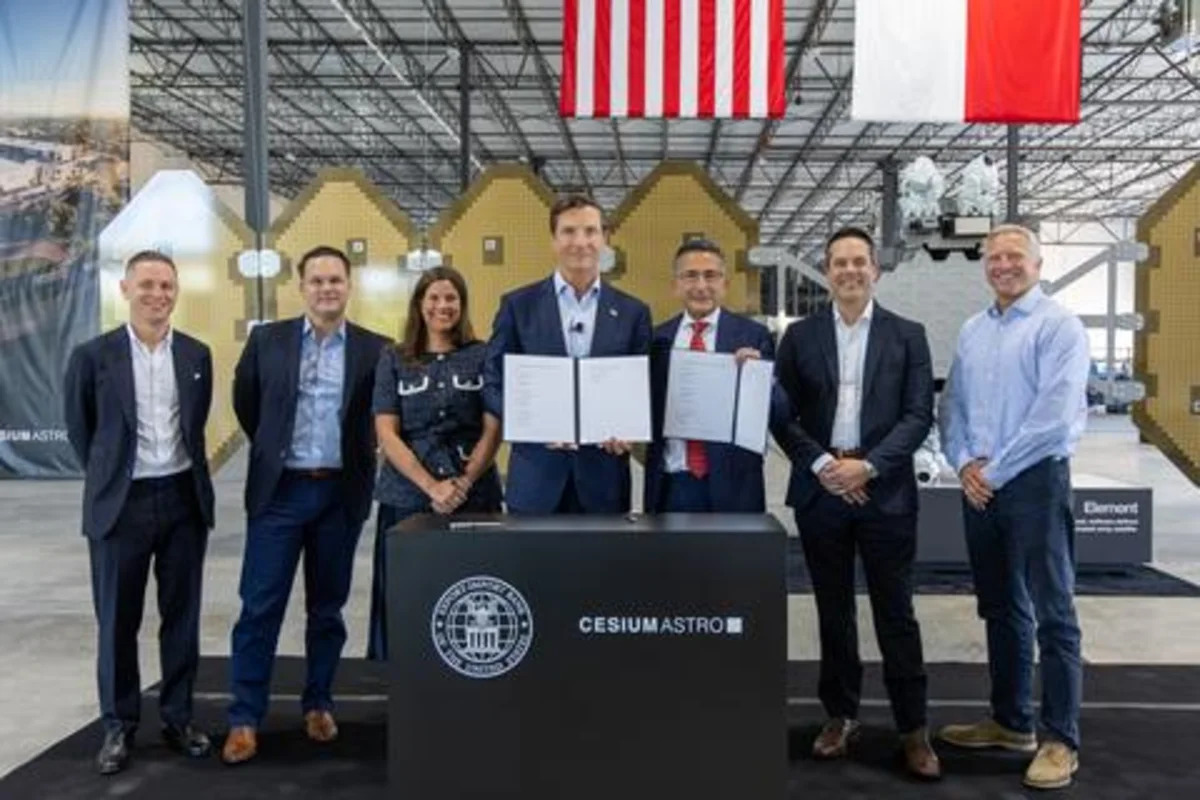
AUSTIN, Texas, September 11, 2026–(BUSINESS WIRE)–This week the Honorable John Jovanovic, the President and Chairman of Export-Import Bank of the United States (EXIM) toured CesiumAstro Inc.‘s future global headquarters and advanced manufacturing complex near Austin. The visit concluded with the signing of a $300 million EXIM credit agreement, including a $20 million revolving credit line from J.P. Morgan. The financing is the largest EXIM has approved under its “Make More in America” Initiative, and makes CesiumAstro the first company to receive a second loan under the program.

“Companies like CesiumAstro prove what it means to make more in America,” said EXIM Chairman John Jovanovic. “With transactions like this one, EXIM is investing in American manufacturing and ensuring that the United States will stay competitive in the industries of the future for generations to come.”

Jovanovic and Sabripour celebrated the milestone with a group of CesiumAstro’s employees, investors, partners, community and education leaders.

“Having Chairman Jovanovic walk our floor today, and see firsthand what our team has built, means as much to us as the financing itself,” said Shey Sabripour, Founder and CEO of CesiumAstro. “It’s a statement that America will continue to invent, manufacture and build the industries that define our future, and that advanced manufacturing, innovation and leadership in space belong in the United States.”

The agreement builds on the company’s $500 million, five-year Texas expansion, expected to create more than 500 jobs and grow the company past 1,000 employees globally. It follows CesiumAstro’s $470 million Series C round and this year’s acquisitions of Vidrovr, Jariet Technologies and 1Aardvark.

About CesiumAstro

A global leader in advanced connectivity solutions for space and defense sectors, CesiumAstro delivers next-generation space systems that connect, detect, and defend across commercial, government, and national security missions. Its full-stack, multi-mission, end-to-end hardware and software solutions encompass satellites, high-performance communications payloads and advanced computing systems. CesiumAstro maintains complete vertical integration with in-house design, manufacturing, and testing capabilities certified to AS9100D/ISO 9001:2015 standards. Headquartered near Austin, Texas, the company operates additional facilities in Colorado, California, the United Kingdom, Germany, and Japan. To learn more, visit CesiumAstro.com.

Free Training

Source link

Forge Nano Breaks Ground on “America’s Battery Gigafactory” to Strengthen U.S. Defense Supply Chains


  • DOE-backed facility will expand to nearly 315,000 square feet, create more than 250 jobs and scale domestic battery manufacturing capacity to up to 3 GWh annually
  • Samsung SDI partnership brings strategic investment, manufacturing expertise and commercial support to Forge Nano’s U.S. battery manufacturing platform
  • Senator Ted Budd, Representative Deborah Ross, Morrisville Mayor TJ Cawley and Assistant Secretary of the Department of Energy Audrey Robertson joined Forge Nano to mark the company’s next phase of U.S. manufacturing growth

DENVER and MORRISVILLE, N.C., Aug. 19, 2026 (GLOBE NEWSWIRE) — Forge Nano, Inc., a leading U.S.-based semiconductor equipment and advanced materials company pioneering Atomic Layer Deposition (“ALD”) technology for artificial intelligence (“AI”)-era chip manufacturing and defense battery applications, which has signed an agreement to merge with Archimedes Tech SPAC Partners II Co. (“Archimedes II”) (NASDAQ: ATII), today celebrated the groundbreaking of a major expansion of its lithium-ion battery manufacturing facility in Morrisville, North Carolina.
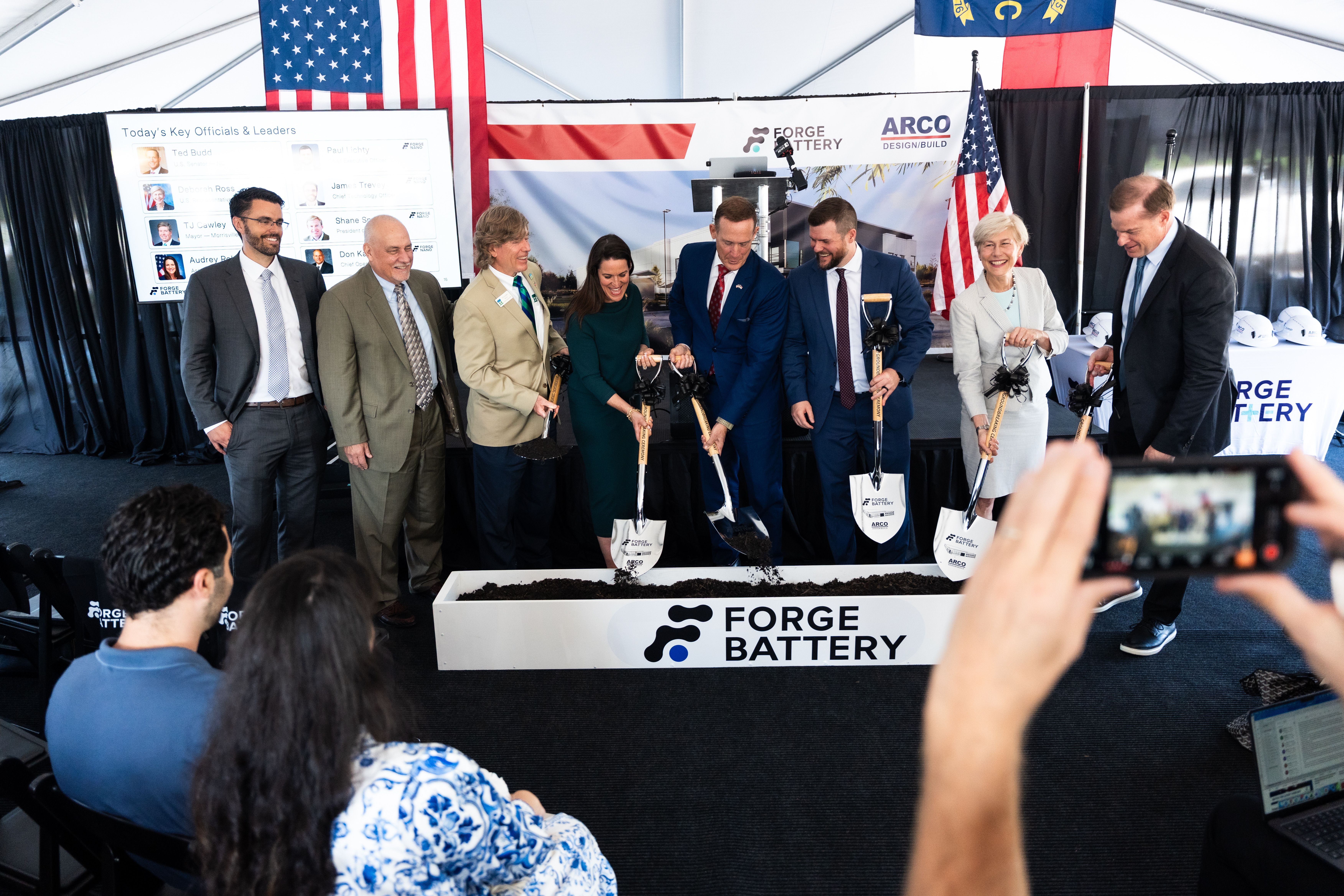
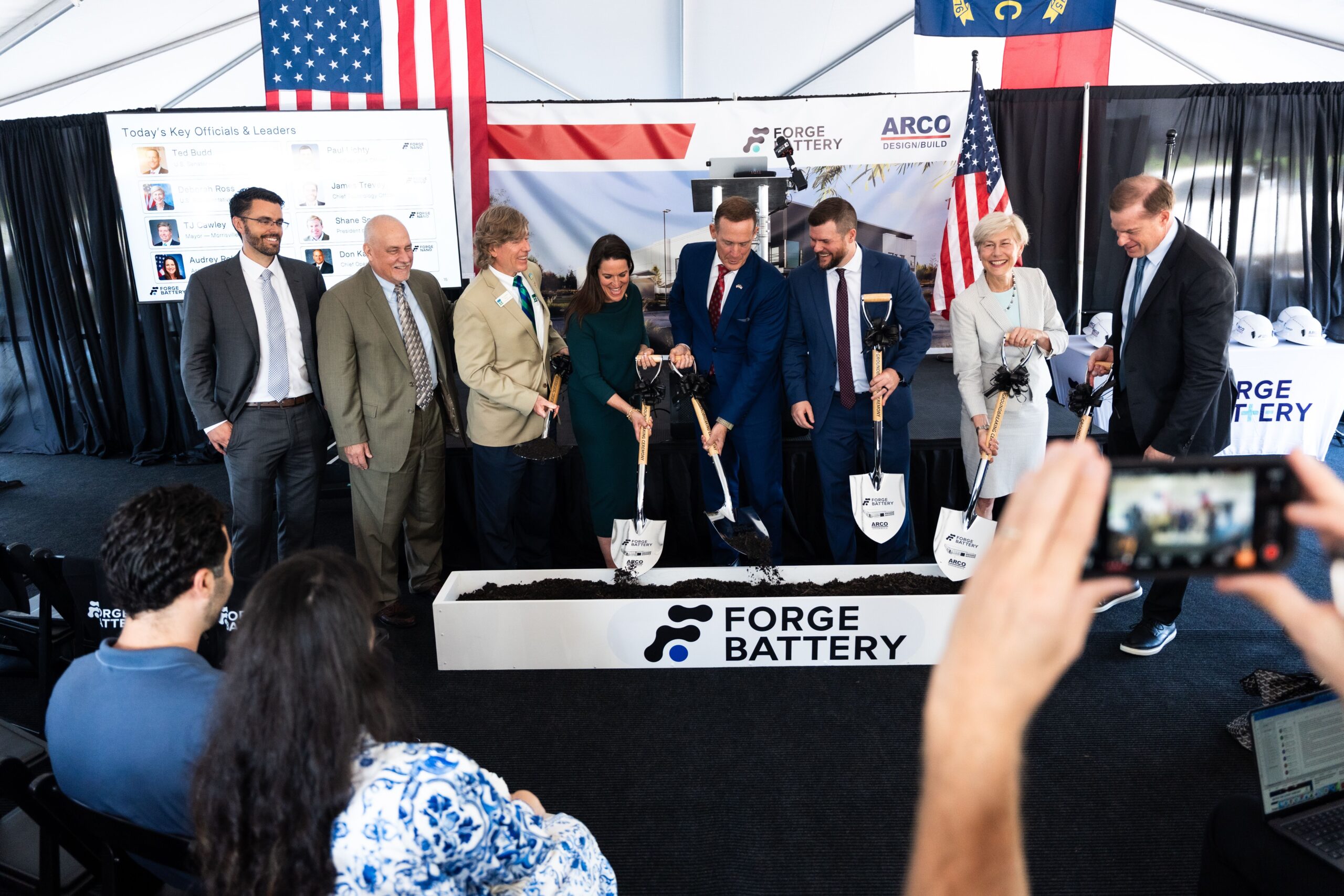
Forge Nano executive leadership team breaks ground on its Morrisville, NC lithium-ion battery manufacturing facility alongside North Carolina Senator Ted Budd, U.S. Representative Deborah Ross, Mayor of Morrisville TJ Cawley and the Assistant Secretary of the Department of Energy Audrey Robertson.

Forge Nano executive leadership team breaks ground on its Morrisville, NC lithium-ion battery manufacturing facility alongside North Carolina Senator Ted Budd, U.S. Representative Deborah Ross, Mayor of Morrisville TJ Cawley and the Assistant Secretary of the Department of Energy Audrey Robertson.

U.S. Senator Ted Budd, U.S. Representative Deborah Ross, Morrisville Mayor TJ Cawley and Assistant Secretary of the Department of Energy Audrey Robertson joined Forge Nano CEO Paul Lichty, employees, strategic partners and community leaders at the facility to mark the milestone and highlight the importance of expanding domestic battery manufacturing capacity for defense, aerospace and other critical U.S. markets.

The expansion will transform Forge Nano’s existing 100,000-square-foot Morrisville operation into a manufacturing campus approaching 315,000 square feet, create more than 250 jobs in North Carolina and establish approximately 3 gigawatt-hours (“GWh”) of annual battery cell manufacturing capacity at full production.

The facility is designed to address one of the most significant vulnerabilities facing the U.S. battery industry: the nation’s dependence on foreign-controlled supply chains for batteries used in applications critical to national security. Forge Nano’s Gigafactory is intended to establish a secure, U.S.-based manufacturing hub capable of supplying advanced lithium-ion batteries at scale.

“Today’s groundbreaking marks an important step toward building a battery supply chain in America,” said Paul Lichty, CEO of Forge Nano. “We’re combining Forge Nano’s technology with world-class manufacturing expertise, federal support and North Carolina’s growing advanced manufacturing ecosystem to bring critical battery production to the United States. America’s Battery Gigafactory will give defense, aerospace and commercial customers access to advanced battery cells manufactured here at home, at the scale needed to compete globally.”

The project is financed by up to $100 million in non-dilutive funding from the U.S. Department of Energy and reflects a collaborative effort among Forge Nano, federal and state partners and strategic industry collaborators to strengthen America’s domestic battery supply chain.

“Maintaining America’s technological edge requires strategic investment in our national security and commercial interests. Forge Nano’s new Morrisville facility will strengthen U.S. battery manufacturing capabilities—advancing American leadership in critical technologies, expanding domestic production, and helping us compete with China. North Carolina’s strong workforce and business climate make it an ideal place to grow this cutting-edge industry. This partnership will strengthen our domestic manufacturing base, create new opportunities for American workers, and keep North Carolina at the forefront of innovation,” said Senator Budd.

“North Carolina’s Research Triangle has long been a center for innovation, and investments like Forge Nano’s are helping translate that progress into advanced manufacturing and good-paying jobs here at home,” said Congresswoman Deborah Ross. “Expanding domestic battery production will drive economic growth, create jobs, support our clean energy transition, and strengthen America’s technology supply chain. I was proud to play a small role in bringing this expansion to life by passing the Bipartisan Infrastructure Law. I look forward to seeing how Morrisville and the Triangle continue leading the next generation of American manufacturing.”

“These batteries will not only serve commercial markets, but also the defense and aerospace applications on which our military depends,” said Assistant Secretary of Energy Audrey Robertson. “That is exactly the kind of manufacturing capacity our country needs. We need to build critical technologies in America. We need to support our armed forces with secure supply chains. And American companies should be able to compete and win in the industries that will define the decades ahead.”

Building Domestic Battery Capacity at Scale

Expansion construction is expected to begin imminently, with manufacturing equipment scheduled to be delivered over the next 2 years. Production at the facility is expected to begin in 2028.

At full production, 3 GWh represents approximately 150 million battery cells per year. Depending on customer demand and product mix, that capacity could support approximately 10–20 million drone batteries, 34,000 electric military vehicles, 6 million BB-2590 radio batteries, 900 6T (Type 2) batteries, or approximately 275 energy storage system containers annually.

The timing of the expansion is expected to align with new National Defense Authorization Act (“NDAA”) battery sourcing requirements taking effect in 2028, further increasing the need for secure domestic sources of advanced battery cells for defense applications.

Samsung SDI Partnership Supports U.S. Reshoring

A central component of Forge Nano’s U.S. battery manufacturing strategy is its strategic partnership with Samsung SDI, one of the world’s leading battery manufacturers.

Samsung SDI is supporting Forge Nano in establishing and beginning operations at the Morrisville facility, providing operational and manufacturing expertise for high-throughput battery production. Once the Gigafactory is operational, Forge Nano expects to manufacture Samsung SDI battery cells alongside Forge Nano’s existing cell products in North Carolina.

Samsung SDI has also entered into a conditional procurement agreement to purchase cells manufactured at the Gigafactory beginning in 2028, while Forge Nano is a contract manufacturer and an authorized distributor of Samsung SDI battery cells in the U.S. market.

The companies are also working to advance the incorporation of Forge Nano’s proprietary Atomic Armor® technology into future Samsung SDI battery products.

Samsung SDI further strengthened the partnership in July through a $20 million strategic investment in Forge Nano, including $10 million in Forge Nano’s Series D financing and $10 million in the company’s PIPE financing associated with its planned public listing.

Investing in North Carolina’s Advanced Manufacturing Workforce

Forge Nano selected North Carolina for the expansion based on the state’s growing advanced manufacturing ecosystem, its pipeline of skilled workers from universities, community colleges and technical programs, competitive state and local incentives and its strong support for companies investing in advanced U.S. manufacturing.

The Morrisville location also positions Forge Nano within the Research Triangle’s deep technical and engineering talent base and provides a strong logistical position for transporting battery cells to defense, aerospace, industrial and other customers.

As the Gigafactory ramps toward full production, Forge Nano expects the facility to create more than 250 jobs across advanced manufacturing, engineering, operations and technical roles.

The project represents a significant investment in both domestic battery manufacturing capacity and the workforce needed to sustain that capacity over the long term.

ABOUT FORGE NANO

Forge Nano is a leading U.S. based semiconductor equipment and advanced materials company pioneering Atomic Layer Deposition (“ALD”) technology for AI-era chip manufacturing and defense battery applications via its platform technology, Atomic Armor. Atomic Armor is a scalable, adaptable nano-scale coating system that strengthens America’s most critical systems – at the atomic level. The superior surface coatings produced by Forge Nano’s Atomic Armor process allow partners to unlock peak performance. Learn more at https://www.forgenano.com.
  
Contacts:

Media Contact
Will McKenna
Brand Communications Director, Forge Nano
wmckenna@forgenano.com

Investor Relations Contact
Bryan Baritot
Alliance Advisors IR
ForgeNanoIR@allianceadvisors.com

A photo accompanying this announcement is available at https://www.globenewswire.com/NewsRoom/AttachmentNg/42a740fd-7057-45f8-a33e-e3320da62ea0

Primary Logo

Free Training

Source link

Trump Pushes U.S. Defense Firms To Expand Arms Manufacturing Capacity


President Donald Trump is expected to call on top defense executives on Wednesday to ramp up weapons production and expand manufacturing capacity as conflicts in Ukraine and the Middle East put pressure on U.S. stockpiles and reveal weaknesses in the industrial base.

Trump will join a roundtable discussion at a two-day Defense and Innovation Summit hosted by Republican Senator Dave McCormick at the U.S. Army War College in Pennsylvania. The gathering brings together military officials, defense contractors, investors and technology leaders to discuss strengthening U.S. manufacturing and accelerating the delivery of advanced weapons systems.

Faster Innovation and Production

Trump’s appearance underscores a broader focus by the administration on defense production as prolonged conflicts have consumed large quantities of missiles, interceptors and other weapons, while highlighting the limits of the U.S. military supply chain and production capacity. Trump is expected to make several Pennsylvania-based defense investment announcements.

Joint Chiefs of Staff Chairman General Dan Caine urged defense companies on Tuesday to accelerate production and innovation, saying the military needs industry partners to help deliver capabilities faster as warfare evolves.

“What I need you to know, and I know this is simple for me to say, but hard to do, is to go faster. Please go faster. Think bolder,” Caine said.

Broader Industrial Strategy

For Trump, expanding defense manufacturing has become part of a wider economic strategy to revive U.S. industrial capacity, with the Pentagon increasingly viewed as a catalyst for factory investment, advanced manufacturing and domestic supply chains.

In late June, Trump met with munitions makers at the White House to urge the industry to move faster.

United States has supplied large quantities of weapons to allies while also using munitions in its own military operations, raising concerns about inventories of key air-defense and precision-guided weapons and increasing pressure on contractors to boost output. Soaring demand for rocket motors used to power missiles and other weapons has spurred new thinking about supply chains.

Seeking big returns, Silicon Valley-style startups are now taking on defense companies that have long dominated the industry, pulled into the competition by a need for production speed, high volume and lower costs. Legacy solid rocket motor makers Northrop Grumman and L3Harris say they have been pushing their own research and development to pull in new technologies like 3D printing and new mixing technologies.

Michael Duffey, who oversees buying for the Pentagon, told the summit audience that the department is using long-term procurement contracts to give defense companies the confidence to invest billions of dollars in expanding factories, citing roughly $20 billion in private investment tied to plans to boost production of Patriot missiles and other high-demand weapons.

“The global environment now demands that we produce at this scale, at this speed, at this volume,” he said.

(With inputs from Reuters)

Free Training

Source link

Lockheed Martin And GM Defense Partner To Strengthen U.S. Manufacturing And Defense Industrial Base


Lockheed Martin and GM Defense announced a new collaboration intended to strengthen America’s manufacturing and defense industrial base.

The collaboration was facilitated by the U.S. Department of War and is structured under a memorandum of understanding. Through the MOU, the companies will explore opportunities to accelerate the delivery of critical defense capabilities and innovation.

The partnership is expected to combine Lockheed Martin’s defense production expertise with General Motors’ advanced industrial capabilities in high-rate commercial manufacturing and engineering.

The collaboration will focus on three areas: strengthening defense supply chains, advancing manufacturing and design capabilities, and evaluating opportunities to expand production capacity through commercial manufacturing expertise and infrastructure.

Initial efforts will include exploring ways to accelerate production readiness and apply proven commercial manufacturing approaches to defense production requirements.

The companies said the collaboration reflects growing demand across the defense sector for greater production capacity, supply chain resilience, and manufacturing agility.

By combining commercial and defense expertise, Lockheed Martin and GM Defense aim to identify opportunities that can accelerate production timelines while maintaining the quality, performance, and reliability standards required for mission-critical systems.

Lockheed Martin is a global defense technology company focused on advancing all-domain mission solutions. GM Defense delivers integrated vehicles, power, autonomy, and connectivity solutions to defense, security, and government markets.

KEY QUOTES:

“America’s security depends not only on developing advanced technologies, but on our ability to produce them quickly, reliably and at scale. This collaboration brings together two leaders in American manufacturing and innovation to explore new ways to strengthen the defense industrial base, expand production capacity and accelerate delivery of critical capabilities for the United States and its allies.”

Frank St. John, Chief Operating Officer of Lockheed Martin

“Working together, GM Defense and Lockheed will further strengthen American manufacturing and national defense by driving greater speed, efficiency, and innovation in the aerospace and defense sectors. Over the coming weeks, we will be working to identify initial projects to pursue together.”

Steve duMont, President of GM Defense


Free Training

Source link

Lockheed Martin and GM Defense to explore manufacturing collaboration aimed at strengthening U.S. defense industrial base


Lockheed Martin and GM Defense have announced a new collaboration to strengthen the U.S. manufacturing and defense industrial base. The effort was facilitated by the U.S. Department of War.

The companies will work under a memorandum of understanding. They will explore opportunities to accelerate the delivery of critical capabilities and innovation.

The collaboration is intended to combine Lockheed Martin’s defense production expertise with General Motors’ industrial capabilities. GM brings experience in high-rate commercial manufacturing and engineering.

The companies said the work will focus on strengthening defense supply chains. It will also cover manufacturing and design capabilities, as well as potential production capacity expansion through commercial manufacturing expertise and infrastructure.

Initial efforts will include exploring ways to accelerate production readiness. The companies will also assess how proven commercial manufacturing approaches could support defense production requirements.

“America’s security depends not only on developing advanced technologies, but on our ability to produce them quickly, reliably and at scale,” said Frank St. John, chief operating officer, Lockheed Martin. “This collaboration brings together two leaders in American manufacturing and innovation to explore new ways to strengthen the defense industrial base, expand production capacity and accelerate delivery of critical capabilities for the United States and its allies.”

“Working together, GM Defense and Lockheed will further strengthen American manufacturing and national defense by driving greater speed, efficiency, and innovation in the aerospace and defense sectors,” said Steve duMont, president of GM Defense. “Over the coming weeks, we will be working to identify initial projects to pursue together.”

The companies said the collaboration reflects growing demand across the defense sector. They identified production capacity, supply chain resilience and manufacturing agility as key areas of need.

By combining commercial and defense expertise, Lockheed Martin and GM Defense aim to identify opportunities to accelerate production timelines. The companies said any such work would need to maintain the quality, performance and reliability standards required for mission-critical systems.

Free Training

Source link

ACMI and NSWC Indian head break ground on $250 million Maryland Energetics Innovation Hub for defense manufacturing


The American Center for Manufacturing & Innovation has broken ground on the Maryland Energetics Innovation Hub near Naval Surface Warfare Center Indian Head Division. The hub is intended to modernize how the United States develops, tests and scales critical technologies and energetics production for the military.

The project is backed by an initial $50 million award from NSWC Indian Head Division. ACMI said the hub is expected to catalyze more than $200 million in additional private investment.

The Maryland Energetics Innovation Hub will include multiple new state-of-the-art buildings outside the gates of NSWC Indian Head Division. The site will host companies and research institutions working on U.S. military priorities.

The hub will focus on eight priority innovation areas. These include energetics for uncrewed systems, next-generation propulsion systems, manufacturing automation and other capabilities needed to strengthen the U.S. munitions industrial base.


“This is a generational investment. ACMI is helping America become faster at moving from ideas to production – faster to innovate, faster to manufacture, and faster to scale the technologies that strengthen our national defense,” said John Burer, Founder and CEO of ACMI.

“MEIH brings together the infrastructure, capital, and private-sector talent needed to rapidly advance new producers and technologies. By leading the effort to recruit and convene top defense technology companies around NSWC Indian Head Division’s priority mission areas, ACMI is creating a new kind of industrial ecosystem designed to accelerate collaboration, compress timelines, and turn breakthrough innovation into operational capability at unprecedented speed,” Burer said.

ACMI also announced that Energetics Technology Center and Applied Research Associates will serve as inaugural tenants and partners. The organization said it is in active talks with several leading defense technology companies about expanding to the hub.

The groundbreaking ceremony brought together military leaders, elected officials, industry executives, academic partners and manufacturing stakeholders. Participants included representatives from the Johns Hopkins Applied Physics Laboratory, National Nuclear Security Administration, National Defense Industrial Association, Parsons, Leidos and Rafael-USA.

“This initiative ensures that NSWC Indian Head Division remains at the forefront of energetics innovation, scale-up, and production,” said Captain Steve Duba, NSWC IHD Commanding Officer.

“By bringing together government and industry partners in a collaborative environment, we can accelerate the development and fielding of critical capabilities that strengthen the Navy’s Arsenal and the larger munitions industrial base,” Duba said.

“Southern Maryland has long been a cornerstone of the nation’s energetics enterprise, and the Maryland Energetics Innovation Hub builds on that strong foundation,” said William Durant, CEO and President of ETC.

“ETC is excited to work alongside ACMI and NSWC Indian Head Division to advance critical technologies and support the next generation of capabilities for the nation’s warfighters,” Durant said.

“Local manufacturing is critical to our economy and our workforce. The new Maryland Energetics Innovation Hub is an important investment in supporting local manufacturing and will further cement our state’s leadership in this critical space,” said U.S. Senator Chris Van Hollen.

“This trailblazing facility will help strengthen our national security, create good-paying jobs, and drive economic growth here in Indian Head,” Van Hollen said.

“Today’s groundbreaking for the Maryland Energetic Innovation Hub marks a crucial and exciting step in supporting Indian Head’s mission, expanding off base partnerships, and improving our nation’s military readiness,” said U.S. Representative Sarah Elfreth.

“The Naval Surface Warfare Center at Indian Head is already at the cutting-edge of energetics research for the Department of Defense. This new partnership will only broaden their horizons and solidify Maryland’s role at the forefront of innovation in this ever-evolving global arena,” Elfreth said.

“I’m grateful to see funding and partnerships like these that not only bolster our national security, but invest in our communities,” Elfreth added.

“The Western Charles County Technology Corridor continues to strengthen its position as a competitive hub for defense, energetics, and advanced technology industries,” said Jim Chandler, Director of the Charles County Economic Development Department.

“We are seeing growth in partnerships, investment, and innovation that are expanding opportunities for both new and existing businesses while reinforcing Charles County’s long-term economic competitiveness. The groundbreaking of the Maryland Energetics Innovation Hub marks an important milestone,” Chandler said.


The Maryland investment builds on ACMI’s regional manufacturing campus model. ACMI said the model is designed to revitalize U.S. manufacturing capacity through shared infrastructure, advanced production ecosystems and public-private partnerships.

Earlier this year, ACMI broke ground on its 1,100-acre National Security Industrial Hub in Indiana. That defense manufacturing campus is backed by an initial $75 million award from the Department of War.

ACMI said the Maryland and Indiana hubs together represent more than $1 billion in investment in the defense industrial base. Initial operations at the Maryland Energetics Innovation Hub are expected to begin in 2027 as phased construction advances.

The hub is expected to create high-quality jobs, attract additional private investment and support the growth of domestic manufacturing capabilities critical to national security. ACMI said it will also help accelerate defense manufacturing modernization and expand domestic energetics capacity.

ACMI is an industrial group focused on revitalizing the U.S. manufacturing base by building infrastructure and supporting manufacturers as they scale. NSWC Indian Head Division is a Naval Sea Systems Command field activity focused on ordnance, energetics and explosive ordnance disposal solutions.

Free Training

Source link

The State of Clean Energy Manufacturing in Q1 2026: Environmental Defense Fund Report | Mitchell, Williams, Selig, Gates & Woodyard, P.L.L.C.


Introduction –

2025 represented a turning point in clean energy manufacturing in the United States. From 2021 to 2024, the country experienced an unprecedented clean energy manufacturing boom supported by federal policies that accelerated private investment. In 2025, growth in clean energy manufacturing largely declined in the wake of the Trump administration’s policies and congressional cuts to clean energy tax credits.

Please see full publication below for more information.

Free Training

Source link

U.S. Department of War promotes defense manufacturing expansion


Key Points

  • United States Secretary of War Pete Hegseth concluded the first phase of the Arsenal of Freedom tour with visits to General Dynamics and L3Harris facilities in Arkansas promoting faster domestic defense production.
  • The Department of War used the nationwide tour to emphasize strengthening the U.S. defense industrial base and expanding workforce support tied to missile and advanced weapons manufacturing.

United States Secretary of War Pete Hegseth concluded the first phase of the Department’s nationwide “Arsenal of Freedom” tour on Feb. 27, 2026, with visits to defense industry facilities operated by General Dynamics and L3Harris in Camden, Arkansas, where he delivered remarks focused on expanding production capacity and accelerating weapons manufacturing.

The tour, organized by the United States Department of War, is intended to demonstrate federal support for the defense industrial base while urging industry and workforce leaders to increase output of military systems and modernize manufacturing practices supporting U.S. warfighters.

Speaking before more than 1,500 employees at the L3Harris facility, Hegseth highlighted the role of defense workers in sustaining military readiness.

– ADVERTISEMENT – CONTINUE READING BELOW –

“Thank you for being the backbone of our department and our great nation [and] for having the backs of our warfighters because what you build right here in Camden is absolutely central to the 21st-century arsenal of freedom,” Hegseth said.

He added that the technologies produced at the site directly support advanced weapons programs.

“The technology that you build for our missiles, interceptors and hypersonic weapons is what allows the War Department to achieve peace through strength, and that mission comes with a nonnegotiable mandate from the War Department [and] straight from the Resolute Desk and President [Donald J.] Trump,” he said.

According to remarks released during the visit, Hegseth emphasized innovation and faster production timelines as core priorities of the tour. He encouraged industry partners to increase manufacturing tempo while maintaining technological advancement across defense programs.

(Photo by Alexander Kubitza)

The secretary also addressed long-standing concerns about inefficiencies within the defense industrial base, arguing that production culture must shift toward faster delivery cycles. Praising L3Harris operations in Camden, he said the company had “set the pace” for industry performance through rapid production practices.

“For far too long, our defense and aerospace industry was a giant swamp, much like Washington. … Those companies moved at a snail’s pace, led by CEOs who cared more about their stock options and golden parachutes than delivering for those on the front lines,” Hegseth said.

He further criticized earlier trends toward outsourcing defense production overseas, stating that domestic manufacturing remains central to national security priorities.

“Well, let them tell that to these great workers and these great patriots at L3,” Hegseth said during the event.

According to the Department of War, the Arkansas stop marked the conclusion of a seven-and-a-half-week first phase of the Arsenal of Freedom tour, which began Jan. 5 with a visit to a shipyard in Newport News, Virginia. The tour included additional stops in Texas, California, Rhode Island, Maine, Missouri, Florida, and Colorado.

As part of each visit, Hegseth has administered enlistment oaths to new service members. During the Arkansas stop, he swore in 40 recruits, bringing the total number of enlistees participating in ceremonies during the tour to more than 260.

(Photo by Alexander Kubitza)

The Department said the enlistment ceremonies are intended to link industrial workforce contributions with military service, underscoring the connection between manufacturing capacity and operational readiness.

In practical military terms, the facilities visited in Camden contribute components and systems supporting missile production, interceptor technologies, and hypersonic weapon development. These systems form part of layered defense architectures designed to counter aerial threats and maintain deterrence capabilities.

The Arsenal of Freedom initiative draws its name from the historical “Arsenal of Democracy,” the large-scale industrial mobilization undertaken by the United States prior to and during World War II, when domestic manufacturing was expanded to supply military equipment to Allied forces.

Free Training

Source link