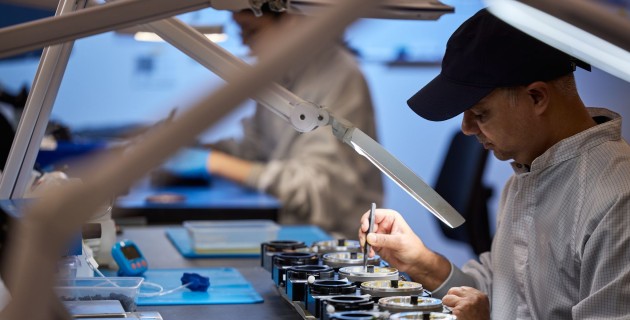

Atlas Copco expands compressor manufacturing in U.S., South Korea


New production facilities increase capacity for centrifugal and oil-free screw compressors serving LNG, hydrocarbon processing, carbon capture and other industrial markets
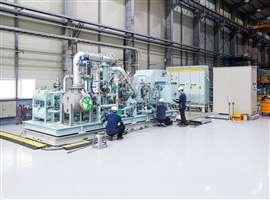
Oil-free gas screw compressors are among the key equipment types manufactured at the Korean factory. (Image: Atlas Copco)

Atlas Copco Gas and Process has expanded its compressor manufacturing operations in the United States and South Korea, adding production capacity to support demand for turbomachinery across the LNG, hydrocarbon processing, carbon capture and industrial gas markets.

The expansions include approximately 63,000 sq. ft. of additional manufacturing space at Atlas Copco Comptec’s facility in Voorheesville, New York, and a new 183,000-sq.-ft. factory in Busan, South Korea. Both facilities were inaugurated in October 2026.

The investments are intended to increase manufacturing capacity, improve production capabilities and support a broader range of compressor applications.

New York expansion targets larger turbomachinery

Atlas Copco Comptec has expanded its manufacturing facility in Voorheesville, where the company has engineered, manufactured and serviced integrally geared centrifugal compressors for 46 years.

The project adds a high-bay manufacturing area designed to accommodate larger integrally geared centrifugal compressors and turboexpanders, expanding the facility’s ability to serve customers in the United States and international markets.

According to Atlas Copco, the additional manufacturing space includes improved testing facilities, multiple cranes and hoists, and expanded logistics and warehousing capabilities.

The investment is intended to support demand from hydrocarbon processing, LNG, carbon capture and industrial gas applications.

Todd Doherty (left, Project Leader High Bay) and Tony Sardella (right, General Manager)

“Our team is excited to embrace the opportunities this expansion creates for our customers,” said Tony Sardella, general manager of Atlas Copco Comptec. “By increasing our manufacturing capacity, we will be better positioned to cater to the market demand across the United States and around the world while continuing to deliver the quality, reliability, and service our customers have come to expect from us.”

The expansion is expected to bring employment at the 45-acre Voorheesville site to approximately 340 people, according to a separate Atlas Copco North America announcement.

South Korean factory expands LNG compressor production

In Busan, Atlas Copco Gas and Process Korea has opened its third manufacturing facility, adding approximately 17,000 square meters (183,000 sq. ft.) of production space at the Eco Delta Industrial Complex in Myeongji-dong.

The company said the new facility more than doubles its operational capabilities and provides additional capacity for compressor technologies.

Atlas Copco established its dedicated Gas and Process operation in Busan in 2021, initially concentrating on the LNG carrier and marine markets.

The Korean operation has manufactured centrifugal and oil-free gas screw compressors for marine LNG applications. The new facility will allow the company to expand into additional market segments and product lines.

“From this new and expanded location, we can work more closely with our customers and connect customer service and product development more effectively,” said SeungHoon Yang, general manager of Atlas Copco Gas and Process Korea.

“As a result, we are now better positioned to respond faster to customer needs and deliver even better solutions.”

The company did not identify the additional compressor product lines planned for the facility or disclose the investment cost.

Expanding global compressor manufacturing capacity

The two projects increase the manufacturing footprint of Atlas Copco’s Gas and Process division, which develops centrifugal compressors, turboexpanders and oil-free gas screw compressors for natural gas, marine, chemical and petrochemical, power generation and industrial applications.

Robert Radimeckzy, president of Atlas Copco Gas and Process, said the expansions are part of the division’s efforts to increase production capabilities and respond to changing market requirements.

“These additions demonstrate the passion we have for quality, customer satisfaction, and future-proof technology,” Radimeckzy said.

Atlas Copco Gas and Process is headquartered in Cologne, Germany, and operates additional production centers in the United States, India, China and South Korea. The division is part of Atlas Copco Group’s Compressor Technique business area.

The company did not disclose the combined investment in the two expansions or provide specific estimates for additional annual compressor production.

Free Training

Source link

Foxconn Targets 50% of Global AI Server Market as It Expands US Manufacturing


Foxconn Targets 50% of Global AI Server Market as It Expands US Manufacturing

Foxconn is targeting a larger share of the global artificial intelligence server market, aiming to increase its position from about 40% currently to as much as 50% within the next few years as technology companies accelerate investment in computing infrastructure.

Chairman Young Liu said the Taiwanese electronics manufacturer could capture approximately 45% of the market next year before reaching the longer-term target. The ambition would strengthen Foxconn’s position in one of the fastest-growing segments of the technology supply chain, where demand for servers, data center equipment and advanced computing systems has expanded alongside the development of generative AI.

“I think we can grow up to 50 percent,” Liu told CNBC’s Christine Tan in an interview, referring to the company’s share of the global AI server market.

Formally known as Hon Hai Precision Industry, Foxconn is best known for assembling Apple’s iPhones. However, the company has increasingly shifted its growth strategy towards AI infrastructure, seeking to capture more value from the hardware and systems required to train and operate increasingly powerful AI models.

Liu expects AI infrastructure to account for 60% to 65% of Foxconn’s revenue within the next three to five years, excluding edge AI devices that run machine-learning applications directly on local hardware.

The revenue forecast signals a significant change in the company’s business mix. Foxconn’s traditional electronics manufacturing operations have made it a major supplier to global consumer technology brands, but the expansion of AI infrastructure offers an opportunity to build a larger presence in higher-value enterprise and data center markets.

Liu said Foxconn’s production capacity was already fully booked for at least the next 18 months, indicating that customers are committing to substantial volumes of AI infrastructure. Demand has so far been driven mainly by AI model developers and cloud service providers, while governments and traditional enterprises have yet to adopt the technology at the same scale.

AI demand remains “quite strong,” he said.

Foxconn is also planning to expand its manufacturing presence in the United States, where technology companies and policymakers are seeking more domestic capacity for critical computing infrastructure.

Liu said the company intends to move further up the supply chain to serve the US market more effectively. Rather than concentrating only on assembling individual components, Foxconn wants to expand its ability to manufacture more complex systems, including AI server racks and data center equipment.

“What we are going to do is we’re going to move up the supply chain,” he said.

The approach would give Foxconn a broader role in the infrastructure supporting AI computing, potentially extending its activities from server manufacturing into integrated data center systems and computing services.

However, manufacturing in the United States carries higher costs than production in some Asian markets. Liu said Foxconn would initially prioritize products with stronger margins, particularly AI server racks and data center equipment, where the value of each manufactured system can justify higher operating expenses.

He also suggested that greater production scale could eventually reduce those costs. Expanding manufacturing capacity and increasing output could improve efficiency, although the extent of any savings will be determined by labor costs, component sourcing, logistics, and the availability of skilled workers.

The US expansion also comes amid efforts by major technology companies to secure reliable supplies of AI infrastructure. Cloud providers and model developers are investing heavily in computing capacity, creating opportunities for manufacturers capable of delivering large volumes of servers and integrated systems.

Foxconn’s existing position in electronics manufacturing gives it an established production base and relationships with major technology customers. Its challenge is to translate those advantages into a stronger position in the more specialized AI infrastructure market, where performance requirements, supply-chain coordination, and delivery schedules are becoming increasingly demanding.

Moving up the supply chain could also improve Foxconn’s exposure to the economics of AI infrastructure. Manufacturing complete server racks and data center equipment may allow the company to capture more revenue per customer than assembling individual components. However, it could also require greater investment and expose the company to more complex operational responsibilities.

Foxconn Warns Against Excessive AI Investment

Despite its ambitious growth targets, Liu warned that the expansion must be managed carefully, particularly as spending across the AI industry reaches unprecedented levels.

“Overinvestment will kill the company,” he said, stressing that Foxconn would maintain tight control over capital expenditure as it expands its AI business.

The company currently plans to spend between $3 billion and $5 billion annually on AI-related investments, although Liu said expenditure could exceed that range depending on how far Foxconn pursues vertical integration.

Vertical integration would involve taking control of more stages of the production and delivery process, potentially allowing Foxconn to manufacture a wider range of components and systems rather than relying as heavily on external suppliers. While this could improve efficiency and strengthen its position with customers, it would also increase the amount of capital tied up in the business.

Liu’s warning reveals a risk facing companies across the AI supply chain. Demand for computing infrastructure is currently strong, but manufacturers are making investment decisions based on expectations that AI spending by cloud providers, model developers and enterprises will continue expanding.

If those customers reduce their spending, companies that have committed substantial capital to new factories, equipment and production capacity could face lower utilization and weaker returns.

Asked how Foxconn would respond if a major customer cut back on AI spending, Liu said weaker demand from one customer could be offset by growth elsewhere. That approach offers some protection against customer-specific spending changes, particularly if demand remains broad across cloud providers and AI developers.

However, he acknowledged that an industry-wide slowdown would create a much bigger challenge for Foxconn and the wider AI supply chain.

Foxconn is positioning itself to benefit from the next phase of AI infrastructure expansion, with plans to increase server market share, deepen US manufacturing and take on more complex production responsibilities. But Liu’s warning on overinvestment shows that the company is also aware that the current spending boom carries substantial risks.

Free Training

Source link

U.S. defense manufacturing capacity expands as The Whiskey Project Group opens North Carolina facility


The Whiskey Project Group (TWPG) has officially opened its advanced watercraft manufacturing facility in Edenton, North Carolina, marking a major milestone in the company’s U.S. expansion and strengthening domestic production and sustainment capacity for American defence, government and commercial customers.

The facility was officially opened at a ceremony attended by North Carolina Governor Josh Stein and Congressman Don Davis, local government representatives, defense and industry leaders, and TWPG employees and partners.

Located on a 50-acre waterfront site, the 60,000 sq ft facility will serve as TWPG’s primary U.S. manufacturing and sustainment hub, supporting advanced aluminum and composite watercraft production engineering, maintenance and technical services.

The facility is expected to support over 200 high-value American jobs as operations grow, with a planned investment of US $10M to establish and develop its US operations.

Founded by former Royal Australian Navy Clearance Divers, TWPG has built its reputation on developing advanced watercraft informed by frontline operational experience. Its U.S. expansion brings this specialist maritime technology and engineering expertise into American manufacturing, drawing on North Carolina’s skilled maritime workforce.

Darren Schuback, Founder and CEO of TWPG, said the opening reflects the company’s long-term commitment to the U.S. defense industrial base.

“The United States is central to our future, and we’re backing that commitment by investing in local manufacturing, skilled jobs and the capability to build and sustain advanced watercraft here in North Carolina. This is about more than opening a factory, it’s about building long-term capability to support U.S. defense, law enforcement and commercialcustomers and strengthen America’s maritime industrial base.

“Australia has developed exceptional maritime technology and engineering expertise. We’re bringing that innovation together with the talent and strength of American manufacturing to build world-class watercraft in the U.S., with American workers, for the operators who depend on them.”

The Edenton facility establishes a key part of TWPG’s dual-hub manufacturing model, connecting its U.S. operations with established design, engineering, manufacturing and sustainment capability in Yamba, Newcastle, Australia and Picton New Zealand.

This integrated model provides additional production capacity and technical expertise across the Pacific, while enabling vessels to be manufactured, maintained, and supported closer to U.S. customers. It also positions TWPG to better support bilateral defense operations and long-term sustainment requirements across both countries.

“North Carolina has the skilled workforce, manufacturing expertise, and maritime heritage that companies like The Whiskey Project Group need to succeed,” said Governor Josh Stein. “This investment will bring good-paying jobs to northeastern North Carolina, strengthen our national security, and create new opportunities for the people of Chowan and neighboring counties.”

The opening comes amid growing momentum for TWPG in the U.S. defense market.

TWPG has secured a US$36 million production contract to deliver tactical watercraft, with deliveries scheduled through September 2029. The next Whiskey vessels will be manufactured in Edenton, NC, supported by engineering, design and program expertise from TWPG Australia and its industry partners.

TWPG was also selected as one of eight manufacturers for the U.S. Navy’s decade-long program covering up to 474 composite rigid-hulled inflatable boats (RHIBs), with a total potential program value of up to US$650 million across all participating manufacturers if all options are exercised.

The Edenton facility will support the manufacture and sustainment of TWPG’s Whiskey, NAiAD and VYCOR watercraft products, with plans to progressively expand production capacity and manufacture larger vessels as U.S. operations grow.

For more information, visit www.thewhiskeyprojectgroup.com

Free Training

Source link

Advanced Navigation expands U.S. manufacturing in Huntsville to supply navigation systems for operations without reliable GPS


Advanced Navigation America is expanding manufacturing in Huntsville, Alabama, to supply navigation systems for defense and autonomous platforms operating without reliable GPS. A new Positioning, Navigation, and Timing Center of Excellence will bring research, development and production together at the site.

The expansion is backed by a $110 million Series C funding round. The company also plans to accelerate U.S. acquisitions and grow its American workforce as it adds technologies and production capacity.

“Resilient navigation is becoming the backbone of the autonomy shaping the future of defense, space, marine, mining and heavy industry,” said Mike Cohen, president of Advanced Navigation America. “The challenge for America is making sure the industrial base can produce these vital technologies as quickly and reliably as demand is growing.”

The center will work on fiber optics, microelectromechanical systems, laser sensing, photonics, vision-based systems, artificial intelligence and quantum sensing. These technologies support navigation in environments where GPS signals are denied, degraded or unavailable.

Advanced Navigation says it is among a small number of companies that can produce strategic-grade fiber optic gyroscopes and laser velocity sensors at scale. Its gyroscopes are precise enough to detect Earth’s rotation, with microscopic manufacturing variations capable of affecting performance.

The company treats those manufacturing methods as part of its intellectual property. Bringing production, calibration and validation together is intended to give it control over the process from sensor fabrication to the finished navigation system.

“With technology this precise, you can’t separate engineering from manufacturing,” said Chuck Matheny, vice president of U.S. operations at Advanced Navigation America. “Production, calibration and validation all have to work together.”

The Huntsville facility will add a major U.S. manufacturing site alongside Advanced Navigation’s operations in Australia and the United Kingdom. The company says that presence across the three AUKUS countries will increase capacity and provide supply-chain redundancy.

Huntsville offers an engineering workforce and an industrial base serving defense and space programs. Redstone Arsenal and NASA’s Marshall Space Flight Center are based in the city.

“Huntsville has spent generations turning hard science into American capability,” Cohen said. “We’re putting the people who build and missionize this technology within minutes of our customers, changing how quickly we understand a requirement, solve it and deploy it into the field.”

Advanced Navigation says it has more than 100,000 systems deployed worldwide across land, air, sea and space applications. Its customers include Anduril, NOAA, Leonardo, BHP, Rheinmetall and Intuitive Machines.

The company’s technology supports underground mining, maritime operations, defense systems and lunar exploration. The Huntsville expansion is intended to shorten delivery times and give U.S. customers closer access to engineering and technical support.

“The challenge isn’t simply inventing better technology,” Cohen said. “It’s being able to manufacture it reliably, at scale, and get it into the hands of our customers in weeks rather than years.”


Free Training

Source link

$500M Multistate Investment Expands Critical Grid Electronics Manufacturing


Schweitzer Engineering Laboratories is investing more than $500 million to expand its US manufacturing footprint, adding facilities and production capacity across four states. The projects, scheduled from 2026 through 2028, aim to meet growing demand for equipment used to monitor, control, and protect critical infrastructure.

Six Projects Target Production Growth

The expansion includes new electronic device manufacturing facilities in Moscow, Nampa, and Post Falls, Idaho, as well as a new manufacturing operation in Pullman, Washington. SEL is also expanding circuit board assembly in West Lafayette, Indiana, and adding panel assembly space in Charlotte, North Carolina.

The Idaho projects include investments of more than $70 million in a 305,000-square-foot facility in Moscow and $150 million each in facilities in Nampa and Post Falls. The Moscow site is expected to open by the end of 2027, while the other two locations are scheduled to begin operations in early and late 2027, respectively.

Equipment Upgrades Boost Output

Beyond facility development, SEL plans to invest more than $100 million in manufacturing equipment. The upgrades, combined with additional production shifts and more than 600 assembler positions in Pullman and Lewiston, Idaho, are expected to increase electronic device output by 40% to 60%.

In Indiana, a $25 million investment will expand board assembly capacity by more than 35%. Meanwhile, the $15 million Charlotte project will add more than 50,000 square feet of custom panel assembly space.

Expanding Domestic Supply Capacity

The multistate expansion will increase US production of electronic devices, circuit boards, and custom control panels used in critical infrastructure applications. SEL’s products support electric power systems, where equipment reliability and operational security are important considerations for utilities and industrial operators.

The projects are expected to strengthen its domestic production network while supporting customers in the United States and international markets.

Image credit: Schweitzer Engineering Laboratories

Find Thomas Network Suppliers and Services

Free Training

Source link

CurTec expands US manufacturing and warehouse capacity in South Carolina


CurTec USA is investing $10 million to expand its Westminster, South Carolina operations, creating 10 new jobs. The project will increase warehouse and production capacity and broaden the range manufactured in the United States.

The expansion will add approximately 27,300 square feet and more than 2,000 pallet positions. Groundbreaking is planned for October 2026, with completion expected in Q2 2027.

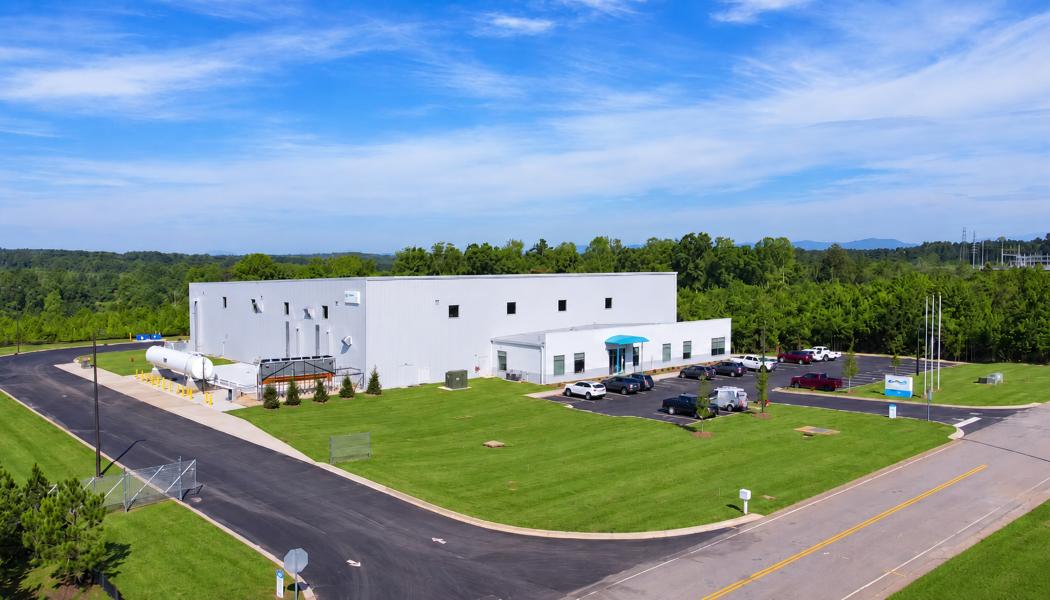
CurTec is expanding its manufacturing operations in Westminster, S.C. with a new warehouse and additional production capacity.

CurTec is expanding its manufacturing operations in Westminster, S.C. with a new warehouse and additional production capacity.

“When we opened Westminster in 2023, our goal was to get closer to North American customers and create a platform for growth,” says Bart van Berkel, CEO of CurTec. “This expansion strengthens local production, inventory and supply reliability while broadening the range we manufacture in the United States.”

Expanding local production

A new blow molding line will significantly increase capacity and extend local production to smaller packaging sizes. CurTec plans to produce 6- and 10-liter Click Pack pails in Westminster before year-end, followed by smaller Wide Neck Drums in 2027.

“Expanding production and warehousing together gives us greater flexibility to respond to customer demand,” says Roy Kuipers, Operations Directorat CurTec. “It also allows us to manufacture more of our portfolio locally.”

“Westminster was designed for future growth,” says Martin Lamar, Site Director USA. “We are now adding capacity and capability while growing our local team.”

“It is another ‘Top Shelf for Business’ day in Oconee County,” says Jamie Gilbert, President and CEO of the Oconee Economic Alliance. “Just three years after opening the facility, this investment reflects CurTec’s confidence in our workforce and business climate. We value our partnership and look forward to CurTec’s continued growth in our community.”

About CurTec

CurTec manufactures high-performance packaging for life sciences and fine chemicals.

CurTec supports life sciences and fine chemicals companies with high-performance packaging for the safe handling and containment of critical materials. CurTec has GMP-certified production facilities in Westminster, South Carolina, and Rijen, the Netherlands.


Free Training

Source link

S&C Expands U.S. Manufacturing Footprint to Meet Growing Demand for Grid Resilience


S&C Expands U.S. Manufacturing Footprint to Meet Growing Demand for Grid Resilience

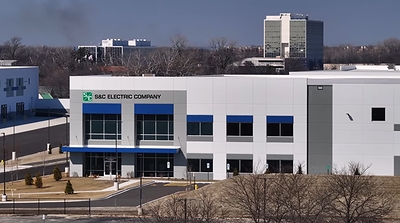
New 295,000-square-foot Illinois facility will add capacity across S&C’s manufacturing network and create jobs in the Chicago area.

CHICAGO, Oct. 6, 2026 /PRNewswire/ — S&C Electric Company today announced plans for a 295,000-square-foot facility in Glenview, Illinois, the latest in a series of investments to increase U.S. manufacturing capacity as utilities and critical infrastructure operators invest in a more resilient and reliable distribution grid.

The facility will serve as S&C’s central warehouse, consolidating materials and inventory that support production across the company’s manufacturing operations. Moving these operations to Glenview will create additional space for production at existing facilities, improve material movement across S&C’s operations, and provide flexibility for future expansion of assembly operations. The investment is also expected to create new jobs in the Chicago area.

“For more than a century, S&C team members have done critical work to deliver proven solutions that help utilities and essential industries around the world keep the power on,” said Anders Sjoelin, President and CEO of S&C Electric Company. “We are proud of that legacy, and we continue to build on it. As demand for electricity and a more resilient grid grows, we are investing in U.S. manufacturing, creating jobs and career opportunities, and increasing our capacity to serve customers for generations to come.”

The Glenview facility is the latest in a series of investments S&C is making in its team members, products, and manufacturing capabilities. The company recently added manufacturing capacity in Palatine, Illinois, creating room for product-line growth, and introduced TripSaver® FXR, the newest addition to its TripSaver® Recloser portfolio. Additional expansion work is underway at S&C’s Chicago headquarters to increase manufacturing capacity and support a growing workforce. Together, these investments increase S&C’s ability to manufacture and deliver technologies for a more resilient grid.  

Severe weather, electrification, and the growth of large loads, including data centers and advanced manufacturing facilities, are creating new challenges for the electric grid. These trends are increasing the need for technologies that help utilities and critical infrastructure operators strengthen the resilience and reliability of their distribution systems.

S&C expects work on the facility to begin in the third quarter of 2026, with central warehouse operations targeted to begin in early 2027.

About S&C Electric Company
For more than a century, S&C has helped transform electricity distribution, from pioneering the Liquid Power Fuse to advancing intelligent grid automation. Powered by team member expertise and precision engineering, S&C delivers field-proven technologies that strengthen resilience, enhance reliability, and provide greater visibility and control across the distribution grid. With solutions that keep the power on for utilities, critical power operators, and the communities they serve, S&C empowers people to transform the grid. Learn more at www.sandc.com.

Media Contact:  Laura Patrick, S&C Electric Company, 585.953.0111, Laura.Patrick@sandc.com

View original content to download multimedia:https://www.prnewswire.com/news-releases/sc-expands-us-manufacturing-footprint-to-meet-growing-demand-for-grid-resilience-302899801.html

SOURCE S&C Electric Company

Free Training

Source link

Advanced Navigation expands manufacturing to US


Advanced Navigation will expand its Australian manufacturing capability into the US, establishing a Positioning, Navigation and Timing (PNT) Centre of Excellence in Huntsville, Alabama.

The expansion builds on Advanced Navigation’s existing manufacturing and R&D capability in Australia, which will remain the company’s core manufacturing base and technology hub, to build and deliver complex navigation technology.

This new PNT Centre of Excellence will allow specific components, systems and builds to be produced on US soil where required for security, classified programs or customer requirements.

“Advanced Navigation was built in Australia, and remains at the heart of our technology, engineering and manufacturing capability,” CEO and co-founder of Advanced Navigation, Chris Shaw, said.

“Expanding into the United States allows us to take that capability directly into one of the world’s largest defence markets. It gives us additional capacity to support U.S. programs while continuing to invest in the advanced manufacturing and R&D capability we have built here in Australia.”

Together, the Australian and US operations will increase Advanced Navigation’s global manufacturing capacity and strengthen allied access to assured PNT technology as demand grows across defence and autonomous systems.


Building fibre-optic gyroscope (FOG) sensors precise enough to detect the Earth’s rotation requires engineering at a level similar to semiconductor fabrication, where even microscopic variations can affect performance. That makes the manufacturing technique itself part of the underlying intellectual property.

According to Advanced Navigation, it is one of a few companies globally with the capability to produce strategic-grade FOGs and laser velocity sensors at scale. These technologies provide the precision required for defence platforms to understand where they are and how they are moving when GPS is spoofed, jammed or unavailable – across any harsh environment.

“With technology this precise, you can’t separate engineering from manufacturing,” Vice President of US Operations at Advanced Navigation America, Chuck Matheny, said.

“Production, calibration and validation all have to work together. The capability developed in Australia gives us a strong foundation to build from as we establish dedicated manufacturing in Huntsville and respond to the specific requirements of U.S. defence programs.”

The Huntsville PNT Centre of Excellence will focus on advanced manufacturing, adding dedicated US production capacity alongside the company’s Australian operations.

It will support the production of technologies spanning fibre optics, MEMS and photonics, while enabling Advanced Navigation to undertake US-based production where required for sensitive and classified defence programs.

Huntsville was selected for its specialist workforce and defence base required to manufacture complex technologies. Surrounded by Redstone Arsenal, the Missile Defense Agency, NASA’s Marshall Space Flight Center and the headquarters of US Space Command, Huntsville has one of the highest concentrations of engineers and STEM workers per capita in the US.

“Our investment in Huntsville is an extension of what we have built in Australia, not a replacement for it,” Shaw said.

“This is about an Aussie deep-tech company taking its technology and manufacturing capability into one of the world’s largest defence markets, while continuing to invest, innovate and manufacture here at home.”

The expansion comes as Australia and its AUKUS partners deepen integration across their defence industrial bases and seek more resilient supply chains for critical technologies.

The Huntsville facility establishes a major US manufacturing node alongside Advanced Navigation’s Australian and United Kingdom operation arms, expanding across all three AUKUS nations.

This strengthens supply-chain redundancy, increases global production capacity and enables faster response to US defence requirements.

Advanced Navigation works directly with the Australian Department of Defence’s Global Supply Chain (GSC) Program to integrate its technologies into international defence networks. With more than 100,000 systems deployed globally, its customers include Anduril, Hanwha, Kongsberg, Rheinmetall, BAE Systems, Leonardo and Lockheed Martin.

Free Training

Source link

US manufacturing index expands for ninth straight month, but price pressures surge in September


ANI |
Updated:
Oct 01, 2026 20:17 IST

Washington [US], October 1 (ANI): US manufacturing activity remained in expansion territory for the ninth consecutive month in September, even as a sharp rise in prices pointed to growing cost pressures for manufacturers, according to the latest PMI data report from the Institute for Supply Management (ISM).
The ISM Manufacturing Purchasing Managers’ Index (PMI) is a monthly indicator that tracks activity in the US manufacturing sector. A reading above 50 per cent indicates that the sector is generally expanding, while a reading below 50 per cent indicates contraction.
The data highlighted that the Manufacturing PMI stood at 54.5 per cent in September, down slightly from 54.6 per cent in August. The overall US economy continued to expand for the 23rd consecutive month, according to ISM.
ISM said manufacturers’ comments reflected concerns over pricing volatility, tariffs and the Iran war. Pricing volatility was mentioned in 46 per cent of negative comments, while tariffs were cited in 34 per cent and the Iran war in 30 per cent.
Of the six largest manufacturing industries, five expanded in September — Computer & Electronic Products, Food, Beverage & Tobacco Products, Transportation Equipment, Machinery and Chemical Products.
The data showed that demand conditions improved during the month. The New Orders Index rose to 55.3 per cent from 53.7 per cent in August, marking its ninth consecutive month of expansion. The Backlog of Orders Index also increased to 56.4 per cent from 51.8 per cent.

However, the increase in prices was a key feature of the September data. The Prices Index jumped 6.8 percentage points to 77.9 per cent, from 71.1 per cent in August. ISM said the index returned to its level at the start of the Iran War.
“The Manufacturing PMI registered 54.5 per cent in September, 0.1 percentage point below the August figure of 54.6 per cent,” said Susan Spence, Chair of the ISM Manufacturing Business Survey Committee.
Production continued to expand but at a slower pace. The Production Index stood at 56.7 per cent, down from 58.3 per cent in August. Despite the slowdown, production has now expanded for the 11th consecutive month.
Employment also improved during September. The Employment Index rose to 52.7 per cent from 51.2 per cent in August, indicating continued expansion in manufacturing employment.
The data also showed pressure on inventories. The Inventories Index fell to 48.6 per cent from 50.6 per cent, moving back into contraction. 
Export orders continued to grow, although at a slower pace. The New Export Orders Index stood at 50.9 per cent, down from 53.2 per cent in August. The Imports Index also declined to 51 per cent from 52.5 per cent.
Overall, the September data showed that US manufacturing continued to expand, supported by stronger new orders and employment, while rising prices emerged as a key pressure point for the sector. (ANI)

Free Training

Source link

Edge Aerospace expands U.S. manufacturing through licensing pact with Redwire


SALT LAKE CITY – Redwire will manufacture data processing units and network switches under a licensing agreement with Luxembourg-based Edge Aerospace, the companies announced Aug. 25 at the Small Satellite Conference.

“This agreement represents an important step in our long-term strategy to make advanced space computing more accessible to customers in the United States,” Edge Aerospace CEO Jarosław Jaworski said in the news release. “Redwire has earned a reputation as one of the industry’s most trusted providers of flight-proven space infrastructure. By combining Edge’s high-performance computing technology with Redwire’s manufacturing expertise and customer reach, we can deliver domestically manufactured computing systems that meet the growing demand for intelligent spacecraft capable of processing more data at the edge.”

Through the agreement, Edge Aerospace seeks to accelerate delivery of space-qualified computing products while increasing supply chain resilience and broadening support for its growing U.S. customer base, according to the news release.

“Redwire is proud to leverage our trusted domestic manufacturing expertise and strong customer base to support Edge Aerospace,” Don Wesson, Redwire senior vice president for defense technology and general manager of Redwire’s Marlborough, Massachusetts, facility. “Redwire is committed to manufacturing and delivering reliable, American-made, flight-qualified technology to customers who need mission-ready capabilities.”

Debra Werner is a correspondent for SpaceNews based in San Francisco.

Debra earned a bachelor’s degree in communications from the University of California, Berkeley, and a master’s degree in Journalism from Northwestern University. She is a recipient…

Free Training

Source link