

Hadrian closes $360M revolving credit facility to expand US manufacturing


What’s the deal? Hadrian, the advanced manufacturing startup building automated factories for aerospace and defence, has closed a $360 million revolving credit facility. Morgan Stanley Senior Funding served as lead left arranger and bookrunner.

Joint lead arrangers included Western Alliance Bank, J.P. Morgan, First Citizens Bank, Customers Bank, HSBC Ventures USA, Axos Bank, and Texas Capital Securities.

Why now? The facility lands in August 2026, a week after Hadrian raised a $1.37 billion Series D that valued it at $7.87 billion. The debt will fund manufacturing infrastructure, machinery, and hardware as the company scales output for defence and aerospace customers.

By the numbers: The raise ranks in the top 1% by size among 63 debt rounds by US robotics companies over the past four years.

What’s the endgame? Hadrian is building highly automated factories that combine process engineering, AI, and robotics, aiming to help space and defence manufacturers run full programmes at scale in the US. The company operates four facilities covering just under three million square feet.

Where’s it expanding? Beyond its two Torrance, California sites, Hadrian has launched new factories in Arizona and Alabama, with more in development across the country. The credit line directly supports that growing network as production ramps.

What they’re saying: The facility “underscores the institutional confidence in our strategic direction,” said chief executive officer and founder Chris Power. He added the financing will help build “the industrial capacity the United States needs to remain strategically competitive, while creating thousands of high-quality jobs across the country.”

The signal: Pairing a large equity round with an even swifter debt facility shows how capital-intensive reshoring plays are stacking financing to move fast. For Hadrian, machinery and factory buildout are the constraint — and lenders are betting on defence demand to fill them.

Image credit: Hadrian

Read more: PR Newswire

Free Training

Source link

Hadrian Secures $360 Million Credit Facility to Expand U.S. Manufacturing Network


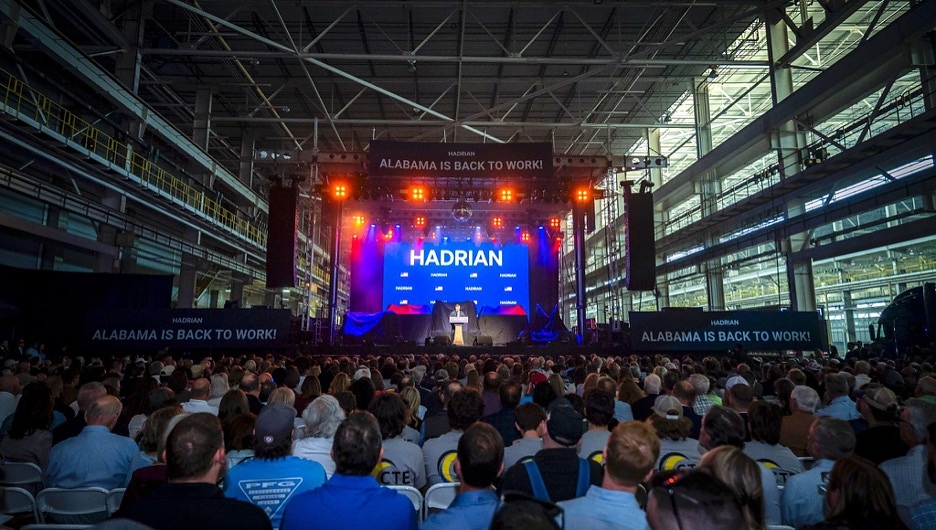
Opening of Hadrian’s factory in Cherokee, AL.

Hadrian has closed a $360 million revolving credit facility to finance additional manufacturing infrastructure, machinery and related hardware as the advanced manufacturing company expands production capacity for U.S. defense and aerospace customers.

The financing follows Hadrian’s recently announced $1.37 billion Series D funding round, which valued the company at $7.87 billion. Together, the equity raise and new credit facility provide additional capital for a manufacturing buildout that now spans four facilities totaling just under 3 million square feet, with more sites under development.

Morgan Stanley Senior Funding Inc. served as lead left arranger and bookrunner for the revolving facility. Western Alliance Bank, J.P. Morgan, First Citizens Bank, Customers Bank, HSBC Ventures USA Inc., Axos Bank and Texas Capital Securities also served as joint lead arrangers and bookrunners.

Hadrian plans to use the credit facility to continue investing in the physical infrastructure required to scale its manufacturing model. Unlike funding directed primarily toward software development or corporate expansion, the facility is intended to support capital-intensive assets including production equipment and factory hardware.

That capacity is central to Hadrian’s strategy of building highly automated U.S. factories that combine process engineering, artificial intelligence and robotics. The company is targeting defense and aerospace manufacturing, where scaling production requires not only factory space but also specialized machinery, production systems and repeatable processes capable of meeting customer requirements.

“This facility’s closing represents a key next step in Hadrian’s growth trajectory,” founder and CEO Chris Power said. He added that the financing will support the company’s efforts to build additional U.S. industrial capacity and create manufacturing jobs.

Hadrian currently operates two facilities in Torrance, California, along with newly launched sites in Arizona and Alabama. Its four facilities collectively cover just under 3 million square feet, and the company has additional locations in development across the country.

The geographic expansion reflects the infrastructure requirements behind Hadrian’s effort to increase domestic production for space and defense programs. Building a larger manufacturing network requires coordinating factory construction, machinery installation, automation systems and production ramp-up while maintaining consistent processes across sites.

Hadrian’s model is designed to use automation to address those execution challenges. The company combines robotics and AI with manufacturing process engineering, seeking to increase production capacity while giving workers tools to manage more automated factory workflows.

The $360 million revolving structure also provides a different source of capital from Hadrian’s Series D equity financing. A revolving credit facility can give a company access to capital as spending requirements emerge, providing flexibility as equipment purchases and factory investments progress across multiple locations.

The new financing arrives one week after Hadrian announced the $1.37 billion Series D. The company did not provide a breakdown of how the equity financing and revolving facility will be allocated among individual factories or equipment programs.

Hadrian’s expansion is focused on the manufacturing infrastructure behind defense and aerospace supply chains, where increasing output can involve significant capital spending before additional production comes online. Factory footprints must be developed and equipped, manufacturing processes validated and capacity coordinated with customer programs.

The company ultimately aims to enable space and defense manufacturers to produce complete programs at greater scale in the United States. Its growing network of factories provides the physical foundation for that strategy, while automation is intended to improve how production capacity can be deployed and replicated across facilities.

Kirkland & Ellis served as legal counsel to Hadrian on the revolving credit transaction.

With its latest debt facility and Series D financing completed in close succession, Hadrian has added substantial capital for the next stage of its U.S. factory buildout, shifting the focus toward deploying machinery, commissioning infrastructure and translating its expanded footprint into production capacity for aerospace and defense customers.

Free Training

Source link

Hadrian opens ‘Factory of the Future’ in Alabama


Hadrian has opened a new advanced manufacturing facility in Cherokee, Alabama to support U.S. Navy Columbia- and Virginia-class submarine programs. The site, known as Factory 4, is designed to mass-produce critical components and help accelerate submarine construction.


The 2.2 million square foot facility will operate as a highly automated “factory of the future,” producing parts, assemblies and finished products identified as key drivers of submarine production timelines. Increased output is expected to reduce bottlenecks and enable faster delivery of submarines.

The project is funded through a public-private partnership combining $900 million in U.S. Navy investment with more than $1.5 billion in private capital. The total investment of over $2.4 billion reflects efforts to strengthen the maritime industrial base and expand production capacity.

The facility is also expected to create up to 1,000 high-paying jobs, supporting regional economic growth while addressing workforce shortages in the defence sector. Hadrian said its automated manufacturing platform will enable faster workforce training and improve production efficiency.


The opening comes as the Navy seeks to address long-standing capacity constraints in submarine construction. By shifting component manufacturing to dedicated facilities, shipyards can focus more resources on assembling submarine modules.

“Both chambers of Congress delivered the generational investment required to rebuild our shipbuilding capacity, bring those jobs back to Alabama and put American skilled laborers back at the center of American strength,” said Secretary of the Navy John C. Phelan. “I look forward to building on this progress together in the months ahead, because we are just getting started. This factory is the first of three facilities designed to address the most critical bottlenecks in the maritime industrial base.”

Officials described the approach as part of a broader strategy to increase production rates through distributed manufacturing. “We call this distributed shipbuilding, and it’s a key tenet of our plan to achieve required shipbuilding production rates,” said Jason Potter, performing the duties of Assistant Secretary of the Navy for Research, Development and Acquisition.

“These factories of the future might be several states away from the yards where the ships are ultimately built, but by taking on this work they reduce bottlenecks, having a profound effect on the speed of delivery,” he added.


Hadrian said the facility will reach full production capacity within 18 to 24 months, following qualification processes and initial production phases. By the third year, the site is expected to sustain operations through regular delivery of submarine components.

Company leadership said the project reflects a coordinated effort between government and industry to expand manufacturing capacity. “The Administration has set the strategy, Congress has cleared a path, the Navy has set the requirement, and Secretary Phelan has been unambiguous that private-sector partnership is foundational, not optional, to deter threats to national security. Industry has to answer that call with real execution, and the window to do it is now. We are proud to be part of the coalition building that capacity, and this factory is Hadrian’s commitment to meeting this moment,” said Chris Power, founder and CEO of Hadrian.

Lawmakers attending the opening highlighted the strategic and economic impact of the investment. “This investment marks a major step forward in strengthening our nation’s defense industrial base while bringing high-quality jobs and economic growth to Northwest Alabama,” said Representative Robert Aderholt.

Officials said the facility is part of a wider effort to modernise U.S. manufacturing and strengthen long-term defence readiness. The project is expected to play a key role in increasing submarine production capacity and supporting national security objectives.


Free Training

Source link

Hadrian Launches Additive Manufacturing Division to Expand U.S. Defense Production Capacity


New division brings production-ready additive manufacturing capacity online in 2026

TORRANCE, Calif., Jan. 22, 2026 /PRNewswire/ — Hadrian, the advanced manufacturing company building AI-powered factories for America, today announced the launch of Hadrian Additive. This dedicated division is designed to deliver scalable, production-ready additive manufacturing capacity for the U.S. Defense Industrial Base and allied partners.

The new division expands Hadrian’s Opus factory platform to include additive manufacturing systems built for qualification, repeatability, and sustained throughput—enabling defense programs to move from validated designs into reliable, at-scale production. Initial additive manufacturing capacity is expected to come online in 2026 as part of Hadrian’s expanding U.S. factory footprint.

Hadrian Additive integrates additive manufacturing directly into the company’s existing factory model, allowing additive production to support mission-critical systems within a single, end-to-end manufacturing environment.

“America’s defense industrial base needs additive manufacturing that works in real production, not just in prototypes,” said Chris Power, Founder and CEO of Hadrian. “We’re building this capacity the same way we build our factories—engineered for qualification, throughput, and speed—so critical programs can scale when it matters most.”

The division will be led by Matthew Parker, Vice President of Additive Manufacturing at Hadrian, and will focus on meeting the reliability, quality, and traceability requirements of defense and national security programs.

“Additive manufacturing only becomes strategic when it’s industrialized,” Parker said. “Hadrian Additive is designed as a production system from day one, integrated with our factory stack and capable of scaling as demand grows.”

The launch of Hadrian Additive builds on the company’s recent factory expansions and manufacturing initiatives, further strengthening domestic production capacity for priority defense programs.

About Hadrian
Hadrian is a next-generation manufacturing company transforming the U.S. industrial base by rapidly adding domestic manufacturing capacity through its highly automated factories. By integrating process engineering, artificial intelligence, machine learning, and robotics, Hadrian strengthens American manufacturing capabilities and enables U.S. workers to compete globally.

Hadrian’s mission is to enable space and defense manufacturers to produce domestically at scale, supporting production at every level, from individual components to full-scale programs. The company currently operates three advanced manufacturing facilities totaling approximately 600,000 square feet, including two sites in Torrance, California, and a newly launched facility in Arizona. Hadrian is actively developing additional production sites across the United States. More information at https://www.hadrian.co/.

About Matthew Parker
Matthew Parker is Vice President, Additive Manufacturing at Hadrian, where he leads the company’s Additive Manufacturing business unit and the buildout of a large-scale additive manufacturing capability supporting defense and aerospace customers. He is an engineering and operations leader in industrial AM, with a track record of standing up manufacturing capacity, industrializing processes, and transitioning additive programs into repeatable production.

Prior to joining Hadrian, Parker held senior leadership roles in additive manufacturing operations and engineering, leading cross-functional teams spanning production, engineering, quality, and customer delivery. A U.S. Army veteran, he brings a mission-first perspective and an emphasis on readiness—prioritizing speed, reliability, and disciplined execution—directly aligned with scaling additive manufacturing into dependable production capacity. His background includes large-format AM deployment, process qualification, industrialization, and partnership development across industry and standards organizations to advance material and process maturity for demanding applications.

Media contact: [email protected]

SOURCE Hadrian

Free Training

Source link