SMITH AND FORD Push East-West Energy, Infrastructure and Manufacturing Ties at Calgary Enserva Event – Canadian Energy News, Top Headlines, Commentaries, Features & Events
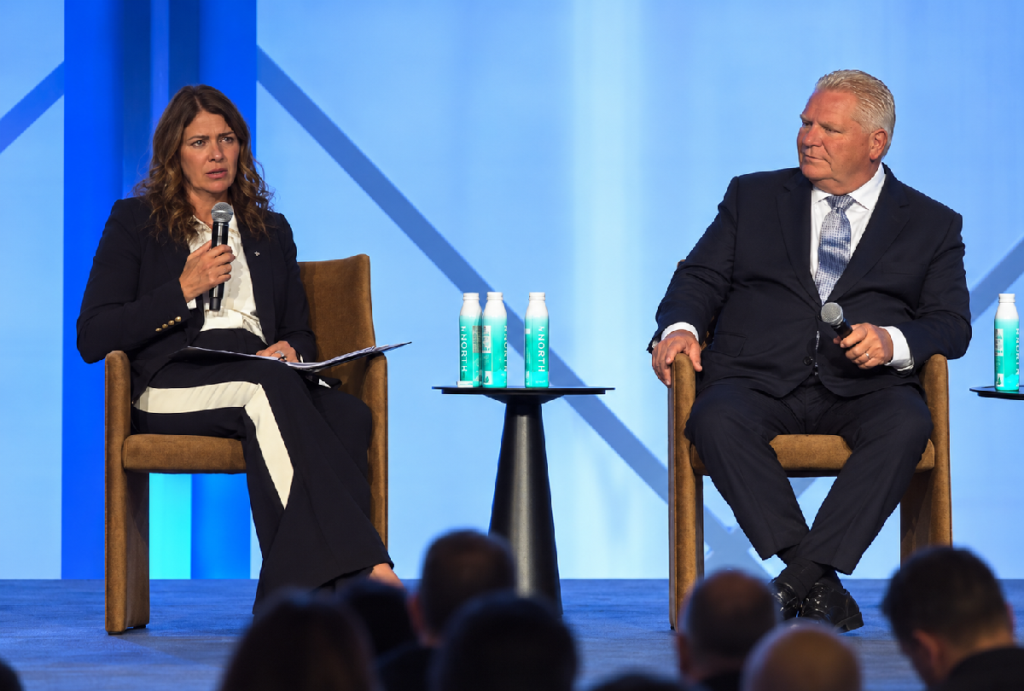


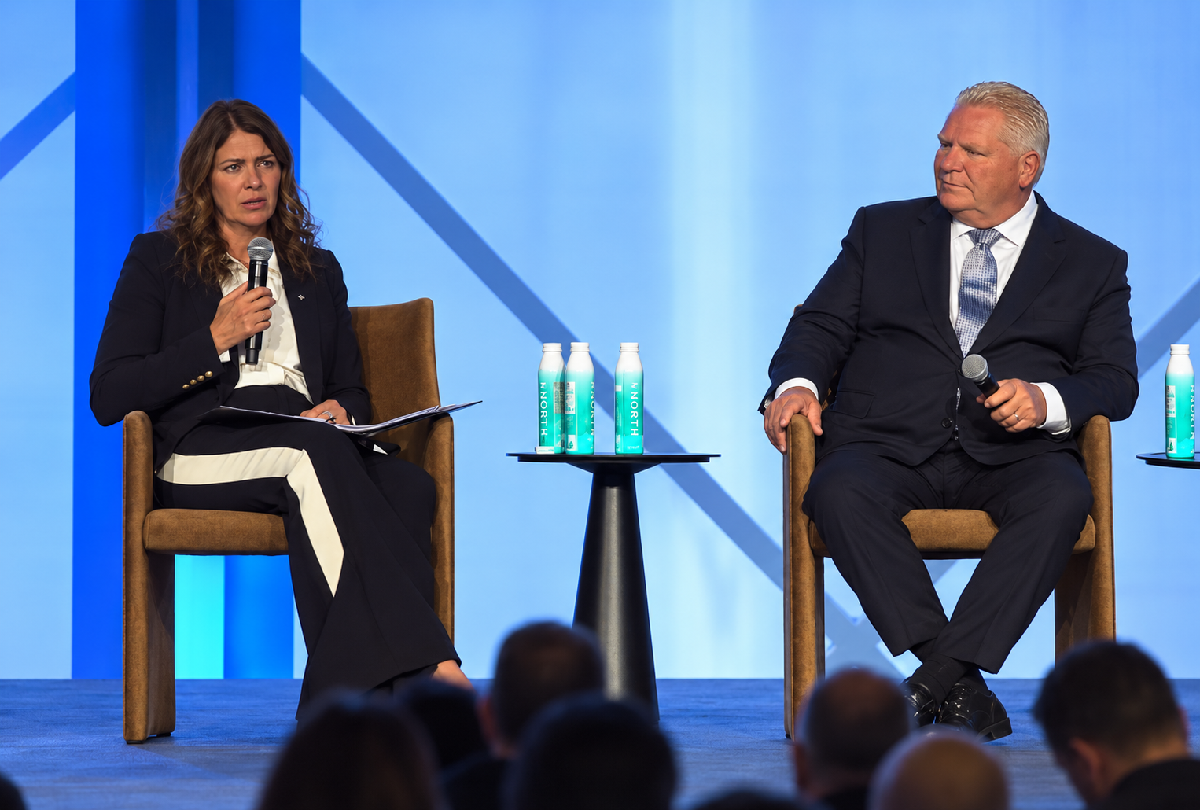
smith ford enserva event 1200x810Premiers Danielle Smith and Doug Ford during a fireside chat hosted by Enserva at the Calgary Telus Convention Centre September 28, 2026 – EnergyNow Media

EnergyNow Media

The two premiers appeared September 28 at the Enserva Speaker Series — Build Canada Stronger: Powering Canada’s Economic Future at the Calgary TELUS Convention Centre. The event brought together energy and business leaders to discuss energy security, infrastructure, trade and Canada’s ability to compete in global markets. It was moderated by Enserva President and CEO Gurpreet Lail. Enserva

The discussion highlighted both areas of agreement and differences between Smith and Ford, particularly on Canada’s evolving relationship with the United States.

Get the Latest Canadian Focused Energy News Delivered to You! It’s FREE: Quick Sign-Up Here

Smith said Alberta’s exposure to U.S. tariffs differs significantly from Ontario’s because most Alberta exports entering the United States are energy products that remain largely tariff-free.

“If you’re looking at a bit of a difference in tone between Premier Ford and I, that’s what it comes down to,” Smith said, pointing to Alberta’s large existing trade relationship with the United States and the role played by cross-border energy companies including Cenovus, TC Energy and Enbridge.

Smith argued that Canada could potentially use energy as the foundation for a broader economic agreement with Washington, suggesting significantly larger volumes of Canadian oil could ultimately move south if a comprehensive Canada-U.S. arrangement were reached.

Ford struck a somewhat different tone but emphasized that he remains strongly supportive of the broader Canada-U.S. relationship.

“I truly love Americans,” Ford said, noting Ontario’s deep economic integration with U.S. manufacturing and trade. He argued for what he called a “Fortress North America” approach in which Canada and the United States strengthen their economic and security relationships while Canada simultaneously expands trade with other countries.

Ford said the current trade friction could ultimately push Canada to become economically stronger.

“He woke us up that we needed to be woken up, and he’s united the country like I’ve never seen before,” Ford said of U.S. President Donald Trump. “We’re going to diversify our trade, but continue building a strong relationship with our closest friends and allies, and that’s the Americans.”

Pipelines Move to Centre Stage

The conversation quickly turned to pipelines and major infrastructure projects — a central theme of the Enserva event, which was promoted around the question of how Canada can build, move and sell more energy to global markets. Enserva

Smith said she has become increasingly confident about the prospects for a proposed new West Coast oil pipeline.

“I’m feeling more and more confident every day that the West Coast oil pipeline is going to potentially even be the first of the projects that go ahead,” she said.

Smith argued that global concerns about supply security have strengthened Canada’s position as a potential long-term supplier to Asian countries seeking greater diversification.

She also pointed to additional export possibilities through the United States and to the proposed Northern Shield corridor, which Alberta and Ontario have been advancing as a potential east-west energy and infrastructure route.

Ford was emphatic that Canada should not be forced to choose between individual pipeline routes.

“We need the West, we need the North, we need the South, and we need to go east,” he said. “Why can’t we do it simultaneously?”

Ford also signalled Ontario’s willingness to participate financially in the Northern Shield concept, saying he evaluates major infrastructure according to its potential return to taxpayers.

“You show me the numbers, and if you can clip those coupons after we get it built every single year, that’s a great investment for our province,” Ford said.

Skilled Labour Could Become the Next Constraint

Both premiers warned that even if governments approve more infrastructure, Canada will need enough skilled workers to actually build it.

Smith pointed to Alberta’s expansion of apprenticeship programs, dual-credit education and partnerships with unions and employers. She said Alberta now has 81,000 apprenticeship positions and argued provinces need greater ability to align immigration with labour-market shortages.

“We need some office jobs, but we sure need a heck of a lot more factory floor jobs and field jobs,” Smith said. Pasted markdown

Ford said Ontario has invested more than $2 billion through its Skills Development Fund and said more than 750,000 people have received training through various programs.

“Number one issue: supply chain and labour. Who is going to fill these jobs?” Ford said, arguing that provinces should have greater influence over immigration programs so workers who have developed needed skills can remain in Canada. Pasted markdown

Alberta Energy Meets Ontario Manufacturing

Perhaps the strongest area of agreement came around creating deeper economic links between Alberta’s energy sector and Ontario’s manufacturing base.

Ford argued governments need to reduce regulatory barriers and create conditions that encourage companies to invest.

“The biggest problem, biggest hurdle is government,” Ford said, pointing to regulation, taxation and permitting as obstacles governments can address. Pasted markdown

Smith then outlined several areas where the provinces could work together directly.

One is natural gas-fired power generation. Alberta wants to substantially expand electricity generation to support industrial growth and data centres, but Smith said global demand for natural gas turbines has created long equipment lead times.

“We’ve got the cheapest natural gas probably anywhere in the world, sitting on an ocean of it,” she said.

Smith suggested Ontario’s manufacturing expertise could help develop a Canadian supply chain for natural gas turbines and related electricity infrastructure.

Another opportunity is steel.

With pipelines, energy projects and other infrastructure requiring enormous volumes of steel pipe and fabricated components, Smith said Alberta should identify the equipment its energy industry will need and work with Ontario manufacturers to produce more of it domestically.

“Let’s figure out how we can identify the steel fabricated items that we need, and let’s work with our friends in Ontario,” Smith said.

She also suggested Canada needs stronger east-west supply chains, rather than relying predominantly on north-south trade with the United States or imported products arriving through West Coast ports. Pasted markdown

The message fit closely with the theme Enserva established for the event. Using Canadian energy, infrastructure and industrial partnerships to improve the country’s economic competitiveness and energy security. Enserva said the discussion was intended to examine how Canada could “look beyond provincial boundaries” to unlock its energy potential.

For Canada’s energy services sector, the discussion underscored a potentially significant shift: major energy development is increasingly being presented not simply as a Western Canadian issue, but as an opportunity to connect Alberta resources, Ontario manufacturing, Canadian workers and new international markets.

And on that central point, Smith and Ford were clearly aligned.

“We’re stronger together,” Ford said.

Free Training

Source link

Stanley Black & Decker Investing $1 Billion in the U.S. to Drive Innovation, Strengthen U.S. Manufacturing Footprint and Expand the Skilled Trades Workforce Essential to Building America’s Infrastructure


NEW BRITAIN, Conn., Aug. 12, 2026 /PRNewswire/ — As U.S. infrastructure investment accelerates, the construction sector faces a critical challenge: deploying cutting-edge tools and technologies to boost productivity while closing a widening skilled trades gap, with nearly half a million new workers needed by 2027. Against this backdrop, Stanley Black & Decker (NYSE: SWK) is investing $1 billion in the U.S. to advance innovation, develop next-generation tools and solutions, and increase access to training opportunities to expand the skilled trades workforce.

“Our U.S. investment strategy has multiple dimensions and goes far beyond expanding manufacturing – it’s about igniting innovation, building world-class capabilities, and redefining the future of work in America,” said Chris Nelson, Stanley Black & Decker’s President and Chief Executive Officer. “By leaning into research and development and investing in the future of our U.S. operations, we are setting the benchmark for next-generation products and solutions. These investments will empower America’s tradespeople to work safer, reach new levels of productivity, and rise to help solve the nation’s toughest challenges. This is how we plan to lead America forward – by building, competing, and innovating.”

Of the $1 billion Stanley Black & Decker plans to invest through 2028, approximately 50% will go to research and development to accelerate the creation of next-generation tools and breakthrough solutions for trades professionals. The other 50% will support capital expenditures and long-term investments to further strengthen its U.S. manufacturing footprint and support new product development. In addition, Stanley Black & Decker has committed to investing $60 million through its DEWALT Grow the Trades initiative through 2030 – of which $27 million has already been deployed – to expand training programs and open new pathways to rewarding careers in the skilled trades.

“By advancing technology, investing in U.S. manufacturing and expanding training to skilled trades Stanley Black & Decker is helping to build a stronger workforce and a more resilient future for communities across the nation,” said Nelson.

Jay Timmons, President and CEO of the National Association of Manufacturers, underscored the far-reaching impact of Stanley Black & Decker’s investment in the United States. “For more than 180 years, Stanley Black & Decker has helped define what it means to make things in America – innovating, investing and creating opportunities for manufacturing workers and the communities they serve. Their commitment to strengthening U.S. manufacturing and empowering America’s manufacturers exemplifies the leadership our nation needs. These investments not only reinforce our industrial foundation – they open doors to new economic opportunities and secure a brighter future for communities across the country. This is the kind of vision that propels our industry forward.”

About Stanley Black & Decker
Founded in 1843 and headquartered in the USA, Stanley Black & Decker (NYSE: SWK) is a worldwide leader in Tools and Outdoor, operating manufacturing facilities globally. The Company’s approximately 41,000 employees produce innovative end-user inspired power tools, hand tools, storage, digital jobsite solutions, outdoor and lifestyle products, and engineered fasteners to support the world’s builders, tradespeople and DIYers. The Company’s world class portfolio of trusted brands includes DEWALT®, CRAFTSMAN®, STANLEY®, BLACK+DECKER®, and Cub Cadet®. To learn more visit: www.stanleyblackanddecker.com or follow Stanley Black & Decker on Facebook, Instagram, LinkedIn and X.

Cautionary Note Regarding Forward-Looking Statements

Forward-looking statements, within the meaning of Section 27A of the Securities Act and Section 21E of the Securities Exchange Act of 1934, as amended, are made in this press release, including statements concerning Stanley Black & Decker’s investment, innovation and philanthropy initiatives and anticipated benefits from such initiatives. These forward-looking statements are sometimes identified from the use of forward-looking words such as “believe,” “should,” “could,” “potential,” “continue,” “expect,” “project,” “estimate,” “predict,” “anticipate,” “aim,” “intend,” “plan,” “forecast,” “target,” “is likely,” “will,” “can,” “may” or “would” or the negative of these terms or similar expressions elsewhere in this press release. All forward-looking statements are subject to a number of important factors, risks, uncertainties and assumptions that could cause actual results to differ materially from those described in any forward-looking statements. These factors and risks include, but are not limited to, Stanley Black & Decker’s ability to successfully implement its investment strategy, macroeconomic and geopolitical conditions and other financial, operational and legal risks and uncertainties detailed from time to time in the Company’s risk factors and cautionary statements contained in its filings with the Securities and Exchange Commission. These forward-looking statements represent the Company’s expectations as of the date of this press release. The Company disclaims, however, any intent or obligation to update these forward-looking statements.

SOURCE Stanley Black & Decker, Inc.


Free Training

Source link

SEIA Highlights U.S. Solar Manufacturing Growth and Energy Infrastructure Expansion


Highlights

  • U.S. solar and storage manufacturing capacity has expanded significantly since 2022.
  • More than 140 domestic manufacturing facilities have opened, with dozens more under construction.
  • Solar and battery storage projects are increasingly tied to military resilience and grid reliability initiatives.
  • Agrivoltaic developments are creating additional revenue opportunities for rural landowners and agricultural operators.
  • National solar installations surpassed 6 million during the first quarter of 2026.

Rising electricity demand, supply chain concerns, and domestic manufacturing priorities are continuing to shape investment decisions across the U.S. energy and construction sectors. The Solar Energy Industries Association recently outlined how solar generation and battery storage projects are contributing to infrastructure development, manufacturing expansion, and energy resilience initiatives nationwide.

The organization said domestic production capacity for solar components has increased rapidly over the last several years as developers, utilities, and manufacturers respond to growing demand for renewable energy infrastructure and federal incentives supporting U.S.-based production.

Domestic Manufacturing Expansion

According to SEIA, 146 solar and energy storage manufacturing facilities have opened in the United States since 2022, while another 36 facilities are currently under construction. Domestic solar module manufacturing capacity has reached approximately 70 gigawatts annually.

The organization said the U.S. solar supply chain can now support production across all major solar component categories, reflecting broader efforts to reduce dependence on imported materials and equipment.

For contractors, developers, and procurement teams, expanded domestic manufacturing capacity may help address supply chain volatility, material lead times, and sourcing requirements tied to federal infrastructure and energy programs.

The growth in manufacturing activity also continues to drive industrial construction demand tied to factory development, utility infrastructure upgrades, and logistics facilities supporting energy production.

Military and Rural Energy Projects

SEIA also pointed to increasing deployment of solar and storage systems at military facilities and rural properties.

Among the projects highlighted was a 13-megawatt solar installation being developed by Onyx Renewables to support U.S. Army housing operations. The project is expected to offset a substantial portion of on-base electricity demand. Duke Energy also completed a floating solar installation at Fort Bragg designed to improve energy resilience and reduce operating costs.

In rural markets, agrivoltaic projects are becoming more common as landowners seek additional revenue sources while maintaining agricultural operations. SEIA referenced a Tennessee project developed by Silicon Ranch that combines solar generation with cattle grazing operations on the same site.

Construction activity tied to agrivoltaics, utility-scale solar, and battery storage continues to create opportunities for civil contractors, electrical contractors, specialty trade firms, and site development teams across multiple regions.

Energy Infrastructure Demand Continues to Grow

SEIA reported that cumulative U.S. solar installations exceeded 6 million during the first quarter of 2026 as utilities, developers, and private owners continue investing in additional generation capacity.

The organization also noted that solar projects can often move through deployment timelines more quickly than conventional generation assets because they do not require fuel supply infrastructure.

What This Means For Construction Owners

For construction owners and developers, continued investment in renewable energy infrastructure is expected to sustain demand for transmission upgrades, energy storage facilities, utility interconnections, manufacturing plants, and associated site work.

The expansion of domestic solar manufacturing and generation capacity also reflects broader infrastructure investment trends tied to grid modernization, energy security, and industrial development across the United States.

Source: SEIA.

Free Training

Source link

3 US Manufacturing Stocks for AI Infrastructure and Grid Power Demand


Tariff threats on European digital services taxes put a fresh spotlight on how exposed US companies are to global policy shocks, even when they are rooted in tech disputes. While attention often goes straight to giants like Apple or Google, these tensions can ripple into US domestic manufacturing stocks through supply chains, input costs, and export expectations. This article looks at three US manufacturing stocks that appear positively positioned relative to the latest tariff headlines, to help you think about where risk and potential opportunity may sit as trade rhetoric heats up.

Mobileye Global (MBLY)

Overview: Mobileye Global develops advanced driver assistance and autonomous driving systems that help keep cars in lane, avoid collisions, and power future robotaxis, supplying its technology and EyeQ chips to automakers and fleets worldwide.

Operations: Mobileye Global generates the vast majority of its US$2.01b revenue from the Mobileye segment (US$1.98b), with only US$38m from other activities, selling primarily into automakers across the US, China, Europe, and other key car-producing regions.

Market Cap: US$6.6b

Mobileye Global may suit investors seeking exposure to car technology that sits between today’s driver assistance features and tomorrow’s robotaxis. The company has positions in ADAS chips and software, and it plans to launch a vertically integrated US robotaxi fleet from 2027 that links Mobileye Drive with Moovit’s platform, which could add high-margin, recurring revenue. At the same time, Mobileye reported a very large goodwill-related loss recently and remains unprofitable, with board independence and high CEO pay raising governance questions. Tariff headlines also matter because lower global vehicle production, as management has flagged, could weigh on unit volumes. How those growth ambitions, valuation signals, and tariff risks balance out is a key consideration for investors.

Mobileye Global sits at the crossroads of ADAS chips, software and a planned robotaxi rollout. Yet many investors may be missing how the story stacks up against its goodwill hit and governance concerns. Before deciding where you stand, review the analysis report for Mobileye Global

NasdaqGS:MBLY Earnings & Revenue Growth as at Jun 2026NasdaqGS:MBLY Earnings & Revenue Growth as at Jun 2026

nVent Electric (NVT)

Overview: nVent Electric makes electrical connection and protection products that keep power and data running safely, from data centers and industrial sites to commercial buildings and energy infrastructure, selling under brands such as CADDY, ERICO, HOFFMAN, ILSCO, SCHROFF, and TRACHTE.

Operations: nVent Electric generates about US$3.0b from Systems Protection solutions and US$1.3b from Electrical Connections products, with most revenue coming from the Americas alongside smaller contributions from EMEA and Asia Pacific.

Market Cap: US$27.8b

nVent Electric may be relevant if you are looking for a US focused manufacturer tied to structural themes such as data center buildout, AI infrastructure, and grid upgrades, and it could also potentially benefit if tariffs steer more demand toward domestic suppliers. Some analysts forecast revenue and earnings to grow faster than the broader US market, supported by its position in liquid cooling and modular power systems, and recent analyst coverage highlights that story. At the same time, the stock already trades on a rich P/E, growth is heavily exposed to AI data center spending, and there has been sizeable insider selling alongside higher external borrowing. How you weigh those strengths against concentration and valuation risk is where the key opportunity or caution may lie.

nVent Electric’s growth story around AI infrastructure and grid upgrades is getting plenty of attention, but the real question is whether the current P/E and risks are already baked in or still mispriced. It is worth weighing the full picture in the analyst forecasts for nVent Electric

NYSE:NVT P/E Ratio as at Jun 2026NYSE:NVT P/E Ratio as at Jun 2026

Generac Holdings (GNRC)

Overview: Generac Holdings designs and sells backup generators, battery storage and home energy management products for households, businesses and data centers. Its products help customers keep the lights on and manage power use when the grid is unreliable or under stress.

Operations: Generac Holdings generates most of its revenue in the United States at about US$3.59b, with around US$803m from international markets and a small segment adjustment of roughly US$62m.

Market Cap: US$17.38b

Generac Holdings may be worth a closer look if you want exposure to US domestic manufacturing that is tied directly to backup power, grid resilience and the build out of energy hungry data centers rather than cross border digital services. The company is expanding large megawatt generator capacity in Illinois and has secured supply deals with major data center operators. It still earns a large share of revenue from residential and commercial standby generators that can be used when outages rise. At the same time, the stock trades on a very high P/E and carries funding and execution risks in areas such as clean energy and new data center capacity. Investors need to decide whether the growth narrative and improving margins justify paying a higher valuation for Generac’s US focused opportunity.

Generac’s accelerating push into backup power for data centers and US grid resilience has investors focused on growth, but the real twist may sit in the analyst forecasts for Generac Holdings that could reframe the whole story

NYSE:GNRC Earnings & Revenue Growth as at Jun 2026NYSE:GNRC Earnings & Revenue Growth as at Jun 2026

The three stocks covered here are only a starting point, and the full US Domestic Manufacturing Stocks screener surfaces 40 more US focused companies with similarly compelling stories around domestic production, exports and supply chains. Use Simply Wall St to identify and analyze the specific catalysts, tariff sensitivities and business narratives that matter most to you so you can focus on the highest conviction opportunities in this theme.

Take Control of Your Investment Journey

If Mobileye Global or any of these companies sound like a great opportunity, register for FREE with Simply Wall St and add your companies to a Watchlist to monitor the share price against the fair value the ideal entry point.
Once you’ve made your move, manage your holdings with our Portfolio Command Center that filters out the noise to deliver only the most critical, actionable updates.
Throughout your journey, our Community allows you to filter the best ideas from thousands of investor perspectives.
By uncovering hidden catalysts and risks early, you’ll accelerate your decision-making and stay one step ahead of the market.

Seeking Alternatives Before The Crowd?

Fresh ideas move fast, and the stocks with real breakout potential rarely stay under the radar for long. Scan these curated shortlists before momentum gets fully priced in and consider your options.

This article by Simply Wall St is general in nature. We provide commentary based on historical data
and analyst forecasts only using an unbiased methodology and our articles are not intended to be financial advice.
It does not constitute a recommendation to buy or sell any stock, and does not take account of your objectives, or your
financial situation. We aim to bring you long-term focused analysis driven by fundamental data.
Note that our analysis may not factor in the latest price-sensitive company announcements or qualitative material.
Simply Wall St has no position in any stocks mentioned.

New: Manage All Your Stock Portfolios in One Place

We’ve created the ultimate portfolio companion for stock investors, and it’s free.

• Connect an unlimited number of Portfolios and see your total in one currency
• Be alerted to new Warning Signs or Risks via email or mobile
• Track the Fair Value of your stocks

Try a Demo Portfolio for Free

Have feedback on this article? Concerned about the content? Get in touch with us directly. Alternatively, email editorial-team@simplywallst.com

Free Training

Source link