Trump Claims There’s ‘Momentum’ Toward Ending War as Iran Says US ‘Manufacturing Fake News’ About Talks


President Trump claimed on Monday that there was “positive momentum” toward ending the Iran war as Tehran’s security chief accused the US of “manufacturing fake news” about diplomatic talks.

Trump made the comments in a post on Truth Social after speaking with Qatar Prime Minister Sheikh Mohammed bin Abdulrahman bin Jassim al-Thani, and said that the US’ Gulf Arab allies prefer the status quo in the region, meaning the continued US blockade and Iranian attacks on shipping in the Strait of Hormuz, over a major escalation of the war.

“Should there be any change with respect to developments in the Middle East, the United States of America is ‘locked and loaded’ and ready to go,” the president said.
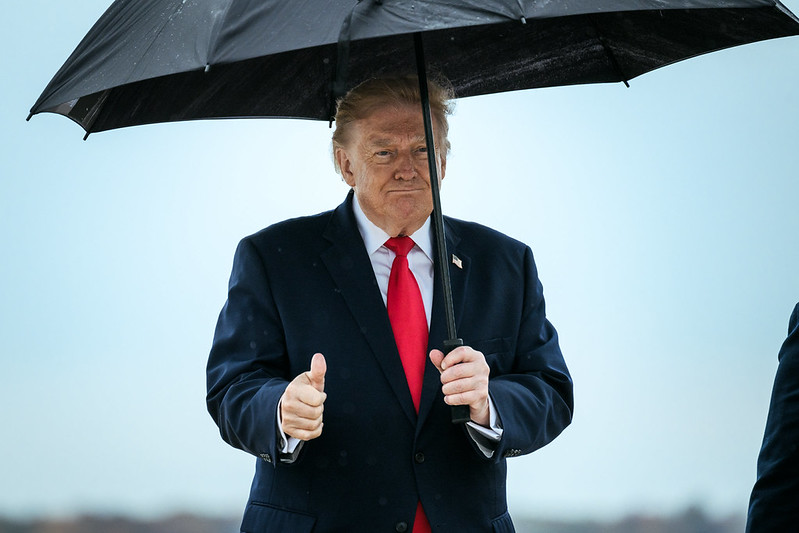
Trump disembarks Marine One at Joint Base Andrews, Maryland on November 6, 2026 (White House photo)

“At this point, however, that seems to be quite unlikely. Israel, and the entire Middle East, are protected from Iranian danger and threats. We are seeing positive momentum toward an end to this Conflict, and will ensure that America’s interests are at all times protected,” Trump added.

Not long after Trump’s post, Mohsen Rezaei, head of Iran’s Supreme National Security Council, reaffirmed that the US must agree to Iran’s conditions to end the war and rejected claims of diplomatic progress.

“The war on Iran has already wrecked the US government. But Washington flails like a desperate gambler. FOLD YOUR HAND. STOP manufacturing FAKE NEWS about imaginary talks. Stop denying the West Asian NEW ORDER. Time to SURRENDER to the seven conditions Iran has repeatedly set out,” Rezaei wrote on X.

Rezaei’s post came after Al Arabiya reported that the US had agreed that Iran could enrich uranium at 3.67% as part of a nuclear deal and that Tehran had agreed, though Iranian officials have maintained the nuclear issue isn’t up for discussion until the US ends the blockade, provides sanctions relief, and fulfills several other commitments it made under the US-Iran Memorandum of Understanding signed in June.

Dave DeCamp is the news editor of Antiwar.com, follow him on Twitter @decampdave.

Join the Discussion!

We welcome thoughtful and respectful comments. Hateful language, illegal content, or attacks against Antiwar.com will be removed.

For more details, please see our Comment Policy.

Free Training

Source link

US manufacturing expansion continues in April despite Iran war


This year’s US manufacturing expansion extended into April even as the Iran war drove input prices sharply higher.

The Institute for Supply Management’s gauge of prices paid for manufacturing inputs climbed for a fourth straight month to a four-year high of 84.6, according to data released Friday.

The group’s measure of overall factory activity held steady at 52.7, matching the highest level since 2022. Readings above 50 indicate growth.

Military conflict in the Middle East and the effective closure of the Strait of Hormuz have disrupted supply chains around the world, driving up the cost of oil and other materials like aluminum and helium. Higher gasoline and diesel prices have also made shipping products more expensive.

Thirteen manufacturing industries reported growth in April, led by textile mills, nonmetallic mineral products and primary metals. Three industries indicated a contraction.

Sustained inflationary pressures may spur manufacturers to hike prices too, which could ultimately lead to higher costs for consumer goods. Data out Thursday showed the Federal Reserve’s preferred gauge of inflation jumped in March by the most since 2022.

The ISM report showed new orders picked up in April as production growth decelerated. A measure of supplier deliveries rose to the highest level since 2022, with the longer lead times likely a result of war-related disruptions.

Select ISM Industry Comments

“Demand for manufactured goods is trending higher versus last year; however, geopolitical uncertainty and rising oil and diesel prices continue to weigh on demand. Many customers are exercising caution and remain in a wait-and-watch mode.” — Transportation Equipment

“Geopolitical risk, especially in the Middle East, as it pertains to commodity and energy markets remains a concern and is being monitored by the business. Supply chain risk concerns pertaining to increased cost and transit time for rerouted shipments due to conflict in the Red Sea, Strait of Hormuz and Suez Canal.” — Transportation Equipment

“Continuing fluctuation in US tariffs as well as market constraints for certain materials are affecting our current business.” — Computer and Electronic Products

“All products tied to crude, polyethylene resin or energy (liquified natural gas) have seen multiple increase spikes tied to the Iran crisis and market supply inflation.” — Chemical Products

“Revenues are very strong. However, price increases are similar to a few years ago with the supply chain crisis. All imports from China are up 15 percent to 25 percent, which is impossible for us to absorb or to fully pass along.” — Chemical Products

“General uncertainty over the total impact of the U.S.-Iran war. Have not yet started to see the full impact of fuel increases but are aware they are coming.” — Machinery

“Business levels have been decent this year, in line with the same period last year and improved from the second half of 2025. However, higher cost pressures are impacting margins.” — Fabricated Metal Products

“Our business remains strong and stable, but there are a lot of concerns in the geopolitical arena. If the Iran conflict persists, the impact on market pricing and supply continuity could be extreme. Electronics component market remains very volatile (pricing and continuity) based on AI.” — Miscellaneous Manufacturing

The group’s gauge of employment fell to a four-month low, indicating factory headcount continued to shrink. The government’s April employment report is scheduled to be released May 8.

“Among panelists, 60% indicated that managing head counts remains the norm at their companies as opposed to hiring, and of those managing head counts, 34% are using layoffs and 43% using attrition or not backfilling positions,” Susan Spence, chair of the ISM Manufacturing Business Survey Committee, said in a statement.

— By Jarrell Dillard

Free Training

Source link

Iran war disrupts oil exports, US manufacturing costs surge


## Market Snapshot

The “Fed Rate Cuts Predictions for 2026” market is examining the likelihood of rate cuts, currently showing uncertainty due to inflation pressures. Meanwhile, the “Bitcoin Above on April 30” market indicates a 100% YES resolution, though underlying sentiment may be shifting. The “WTI Crude Oil Prices in May 2026” market lacks current pricing data but is closely tied to geopolitical developments.

## Key Takeaways

– Rising input costs due to the Iran war appear to suggest inflationary pressures, which could impact Fed rate cut expectations for 2026. – Current market pricing suggests Bitcoin remains above $86,000, though broader economic conditions may influence future sentiment. – The ongoing Iran conflict and its effect on oil supply routes are consistent with scenarios where WTI crude oil prices remain high, potentially exceeding $150.

## Article Body

The United States’ manufacturing sector continues its expansion into April 2026 despite challenges posed by the Iran war, which has led to a significant increase in input prices. The conflict, which began with US-Israel military strikes on Iranian facilities, has disrupted oil exports and critical shipping routes, notably the Strait of Hormuz. Oil prices have surged to wartime highs, impacting US manufacturing costs. Nevertheless, the defense sector has seen increased demand, with companies like RTX and Northrop Grumman reporting higher orders. The European Central Bank has cautioned that prolonged conflict could trigger stagflation and recession risks in the EU.

## Market Interpretation

The impact of rising input costs and geopolitical tensions appears consistent with a scenario where the Federal Reserve may hold off on rate cuts in 2026, suggesting a moderate impact on rate cut predictions. The Bitcoin market, despite showing a 100% YES for April 30, may face indirect pressures from a risk-off environment due to inflationary concerns. The WTI crude oil market reflects a high impact, with the potential for prices to reach $150, consistent with ongoing supply constraints from the Iran war.

## What to Watch

Observers should monitor upcoming Federal Reserve statements and inflation reports for indications of policy adjustments. Key developments in the Iran conflict, particularly around the Strait of Hormuz, will be crucial for WTI crude oil pricing. Additionally, any significant changes in Bitcoin’s sentiment or speculative asset trends could influence market dynamics, particularly if broader economic conditions shift.

Get prediction market intelligence as a structured API feed. Early access waitlist.

Free Training

Source link

Rubio Speaks to Press on U.S. Strategy in Iran · The Floridian


Rubio Clarifies U.S. Strategy in Iran, Emphasizing Missile Manufacturing

Following a closed-door briefing with Congressional leaders over “Operation Epic Fury” and the conflict with Iran, Secretary Rubio spoke to the press to elaborate on the U.S. military campaign, expressing hope for a future led by the Iranian population.

“The United States is conducting an operation to eliminate the threat of Iran’s short-range ballistic missiles and the threat posed by their navy, particularly to naval assets,” Secretary Rubio told the press. ” That is what it is focused on doing right now and it’s doing quite successfully. I’ll leave it to the Pentagon and the Department of War to discuss the tactics behind that and the progress that’s being made. That is the clear objective of this mission.”

Secretary Rubio asserted that one of the reasons for the preemptive airstrikes was that the U.S. would’ve been a primary target had it been Israel or another nation that attacked Iran first. He informed the press that the orders to target the U.S. had been issued to Iran’s field commanders, revealing that within an hour of the attack on Iranian Supreme Leader Ayatollah Ali Khamenei’s compound, missile forces in the north and south of Iran had been “pre-positioned” and “activated to launch.”

When asked if the administration had any information regarding the airstrike at an all-girls’ school in Iran that is reported to have killed at least 153 people — mostly children — and which was said to be an American missile, Secretary Rubio commented that “the United States would not deliberately target a school.”

“Our objectives are missiles, both the ability to manufacture them and the ability to launch them, and the one-way attack drones. That would be our focus, and that’s what we would be focused on,” Secretary Rubio responded. “We would have no interest, and frankly no incentive, to target civilian infrastructure. The Iranians are, on the other hand, targeting civilian infrastructure. You guys have seen it. I’m sure you’ve seen it. They’re hitting hotels. They’re hitting embassies. They’re hitting airports.  They’re hitting oil infrastructure.”

Free Training

Source link

US manufacturing grew, input costs soared before Iran attack


Published Tue, Mar 3, 2026 · 06:03 AM

[WASHINGTON] US manufacturing expanded in February but input prices soared at the fastest pace since 2022, stoking fears of an inflation resurgence even before this weekend’s attacks on Iran.

The Institute for Supply Management’s (ISM) gauge of prices paid for manufacturing inputs jumped 11.5 points to 70.5, the highest level since overall inflation peaked nearly four years ago.

The figures out Monday (Mar 2) reflected responses ahead of US and Israeli airstrikes on Iran this past weekend. The war has all but halted oil tanker traffic through the Strait of Hormuz and pushed crude prices sharply higher.

The conflict also risks tempering a nascent recovery in manufacturing. ISM’s measure of factory activity was little changed at 52.4, indicating a second month of growth at one of the highest readings in recent years. Orders and production growth remained solid.

Treasury yields rose following the report. The S&P 500 remained lower.

The group’s price gauge is likely to remain elevated or even push higher over the near-term after oil prices jumped on Monday by the most since early 2022, following Russia’s invasion of Ukraine.

Navigate Asia in
a new global order

Get the insights delivered to your inbox.

Higher energy prices represent the latest cost challenge for manufacturers. If sustained, producers may have little choice but to raise prices for their business customers and consumers.

The impact from the Middle East turmoil will depend on how the duration of the conflict and where primary materials are sourced, said Susan Spence, chair of the ISM Manufacturing Business Survey Committee.

“It really does depend on the sector and where they are importing their raw materials from,” Spence said on a call with reporters. “In general, the supply managers have yet another challenge on their hands.”

SEE ALSO

US President Donald Trump started his address by defending the US economy.

Producer price data out last week showed the cost of unprocessed goods, minus food and energy, rose more than 15 per cent in January from a year ago, the steepest annual gain since April 2022. A Bloomberg index of metals, including copper and aluminium, has also increased sharply this year.

The assortment of recent price data along with geopolitics point to a steady undercurrent of inflation for US producers, which is being partially fed by higher import duties from the Trump administration. It also explains why US Federal Reserve policymakers are in little rush to lower interest rates after three straight cuts at the end of 2025. BLOOMBERG

Decoding Asia newsletter: your guide to navigating Asia in a new global order. Sign up here to get Decoding Asia newsletter. Delivered to your inbox. Free.

Free Training

Source link