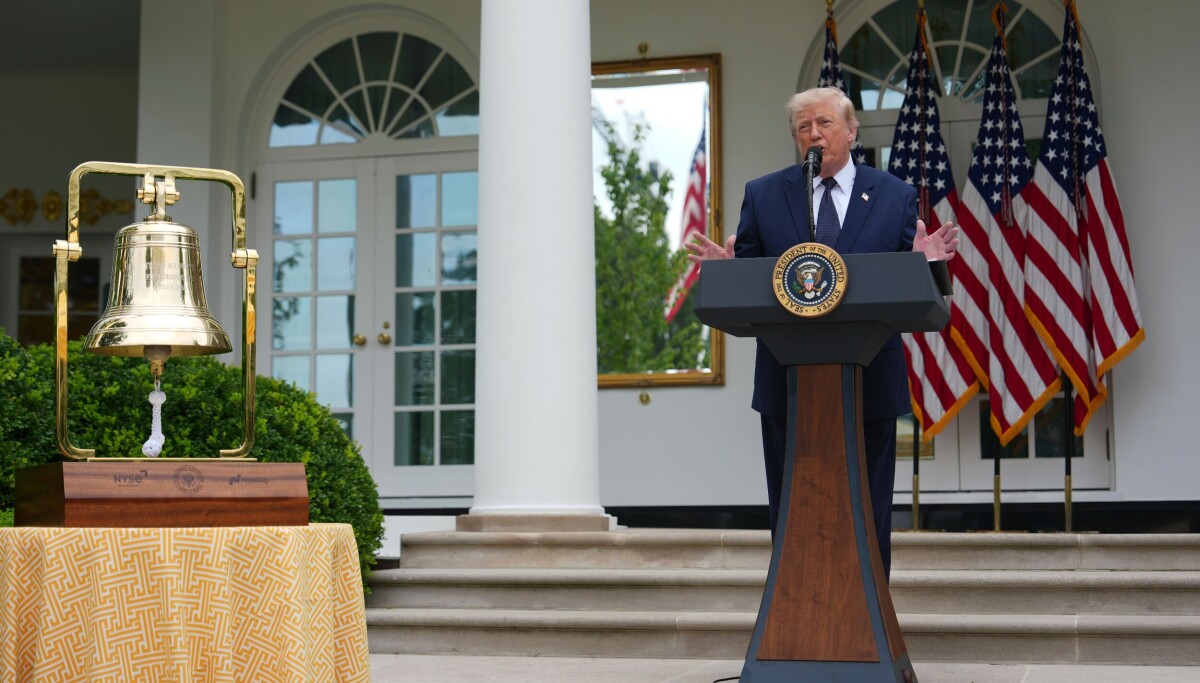
Trump says tariffs pushed Korean, Japanese and German automakers to build U.S. plants


The U.S. president said tariffs pushed Korean, Japanese and German automakers to expand American production as he renewed his manufacturing agenda.

U.S. President Donald Trump speaks at a lunch in the White House Rose Garden on July 6.
AP/YONHAP

U.S. President Donald Trump reiterated Monday that his tariff policy has driven Korean, Japanese and German automakers to build their factories in the United States, as his administration has been using duties to restore American manufacturing.

Trump made the remarks during a White House event celebrating the launch of “Trump Accounts,” new investment accounts for children.

“We’ve never built as many automobile plants. They are all over, and they are coming from all over the world. You know why? Because they don’t want to pay tariffs. If they build their cars here, they pay no tariffs,” he said.

“So Japan, instead of making them in Japan […] or South Korea […] instead of making them in Germany […] They are all building plants here now.”

Since his return to the White House last year, Trump has been leveraging tariffs as a key policy tool to revitalize the United States’ manufacturing, increase foreign investment and reduce trade deficits.

Amid Trump’s tariff pressure, Korean conglomerate Hyundai Motor Group announced last year that it would invest $26 billion in the United States through 2028.

On Iran, Trump said that the United States will either make a deal with the Islamic Republic or “finish the job,” stressing that the United States “will win one way or the other.”

“It won’t be tough to finish the job. I would rather make a deal because I don’t want to affect 91 million people,” he said. “We can knock down their bridges in one hour. We can knock out their energy supply.”

Commenting on the Russia-Ukraine war, Trump said that both Moscow and Kyiv want to end the war. He also voiced optimism, saying, “I think we are getting much closer [to ending the war] than people realize.”

“I think [Putin] does feel pressure. He wants to end it and Ukraine wants to end it, and we are in talks, and we will see if we can get it ended.”

Trump plans to have bilateral talks with Ukrainian President Volodymyr Zelenskyy on the margins of the North Atlantic Treaty Organization summit set to take place in Ankara, Turkey, on Tuesday and Wednesday.

Yonhap

Free Training

Source link

Japanese Yen falls amid strong US Manufacturing PMI


The USD/JPY pair rose toward the 159.30 price zone, closing in on the 160.00 level, which usually prompts intervention by the Bank of Japan (BoJ).

The latest S&P Global flash Purchasing Managers Index (PMI) data showed the US Composite PMI held steady at 51.7 in May, matching April’s reading and signaling continued economic expansion. Manufacturing activity improved further, with the Manufacturing PMI rising to 55.3 from 54.5, surpassing market expectations of 54.0. Meanwhile, the Services PMI eased slightly to 50.9 from 51.0, highlighting softer momentum in the service sector.

According to S&P Global, “business activity continued to grow in May but at a reduced rate compared to that seen earlier in the year,” while the report also noted that service sector growth remains sluggish amid only modest improvements in new business inflows. The stronger manufacturing figures helped support the Greenback as traders reassessed expectations for Federal Reserve (Fed) rate cuts.

US Treasury Secretary Scott Bessent stated that the United States and Japan agree that excessive volatility in currency markets is undesirable, comments interpreted as indirect support for Tokyo’s recent intervention efforts to stabilize the Yen. Bessent also expressed confidence that Bank of Japan (BoJ) Governor Kazuo Ueda will successfully guide monetary policy and avoid falling behind inflation pressure.

Chart Analysis USD/JPY

USD/JPY technical analysis:

On the 4-hour chart, USD/JPY trades at 159.19. The pair retains a bullish near-term bias as price holds above both the 20-period Simple Moving Average (SMA) around 158.99 and the 100-period SMA near 157.82, keeping the broader uptrend structure intact. The horizontal line drawn at 159.19 is being tested as a pivot area, while the Relative Strength Index (RSI) eases back toward 68, hinting that upside momentum remains constructive but is edging closer to overbought territory, which could slow the pace of further gains.

On the topside, immediate resistance is seen at the 159.19 pivot area, followed by the horizontal barrier at 159.35, where a clear break would open the way to fresh highs in the near term. On the downside, initial support is located at 159.09, ahead of the 20-period SMA and the horizontal level at 158.90, with the 100-period SMA providing a deeper dynamic floor if a corrective pullback extends.

(The technical analysis of this story was written with the help of an AI tool.)

Free Training

Source link

Japanese manufacturer selects San Antonio for first U.S. facility, headquarters


Sanko Texas Corporation will break ground on its first U.S. plant in San Antonio, highlighting the city’s economic growth and strengthening U.S.-Japan trade ties.

SAN ANTONIO — Sanko Texas Corporation, a Japanese manufacturer, will break ground Wednesday on its first U.S. manufacturing facility, marking the company’s initial expansion into the United States and the establishment of its U.S. headquarters in San Antonio.

The groundbreaking ceremony is scheduled for 11:15 a.m. Wednesday, Feb. 11, 2026, at the Sanko Texas Corporation site at 16586 Watson Road in southern Bexar County.

Local and regional officials said the investment reflects San Antonio’s strengths in workforce talent, infrastructure and business climate, which have helped attract global manufacturers. By choosing San Antonio, Sanko joins a rapidly growing advanced manufacturing sector in Texas that plays a significant role in regional economic growth.

The project also highlights economic ties between the region and Japan, while reflecting coordinated efforts by local and regional partners to attract international investment.

Expected to attend the ceremony are Bexar County Judge Peter Sakai; San Antonio Mayor Gina Ortiz Jones; Bexar County Commissioner Rebecca Clay-Flores of Precinct 1; San Antonio City Councilwoman Phyllis Viagran of District 3; members of Sanko leadership and local business leaders.

Free Training

Source link

USD/JPY dips on weak US manufacturing data, stronger Japanese yields


USD/JPY trades lower around 156.30 on Monday at the time of writing, down 0.40% on the day, after giving back part of its earlier gains. The pair reflects a reversal in sentiment toward the US Dollar (USD), which had been supported earlier by safe-haven flows amid heightened geopolitical tensions in Latin America.

On the US side, the US Dollar (USD) initially drew support from market nervousness following the announcement of the capture of Venezuelan President Nicolas Maduro by the United States (US), an event that has revived geopolitical concerns and boosted demand for safe-haven assets. However, this support proved short-lived. The release of the Institute for Supply Management (ISM) Manufacturing Purchasing Managers Index (PMI) shows a decline to 47.9 in December, from 48.2 in November and below market expectations. This third consecutive drop confirms a deeper contraction in US manufacturing activity, driven by declines in production and inventories, even as price pressures remain elevated.

These figures reinforce the idea of a gradual slowdown in the US economy and add nuance to growth prospects. Markets therefore continue to price in two additional interest rate cuts by the Federal Reserve (Fed) in 2026. Investors also remain attentive to the possibility that US President Donald Trump could nominate a new Fed Chair when Jerome Powell’s term ends in May, a scenario seen as potentially favoring a more accommodative monetary policy stance. Minutes from the latest Federal Open Market Committee (FOMC) meeting further show that several officials consider it appropriate to pause further rate cuts as long as inflation continues to ease gradually.

Recent comments from Minneapolis Fed President Neel Kashkari, who said inflation remains too high but described the labor market as being in a low-hiring, low-firing environment, were not enough to stem selling pressure on the US Dollar.

Against this backdrop, the weaker US Dollar supports the Japanese Yen (JPY). The Japanese currency fully benefits from the risk-off environment, while also drawing support from rising domestic yields. Japanese government Bond yields have climbed to their highest levels since 1999, strengthening the appeal of the Japanese Yen (JPY). The narrowing yield differential between the United States and Japan also favors the Japanese currency.

In the near term, USD/JPY remains sensitive to shifts in overall market sentiment, upcoming US macroeconomic data and the trajectory of Bond yields, in an environment dominated by geopolitical uncertainty and monetary policy expectations.

US Dollar Price Today

The table below shows the percentage change of US Dollar (USD) against listed major currencies today. US Dollar was the strongest against the Canadian Dollar.

USDEURGBPJPYCADAUDNZDCHFUSD0.04%-0.57%-0.36%0.22%-0.28%-0.33%0.04%EUR-0.04%-0.61%-0.35%0.18%-0.32%-0.36%0.00%GBP0.57%0.61%0.23%0.80%0.29%0.25%0.62%JPY0.36%0.35%-0.23%0.57%0.06%0.02%0.39%CAD-0.22%-0.18%-0.80%-0.57%-0.51%-0.55%-0.18%AUD0.28%0.32%-0.29%-0.06%0.51%-0.05%0.33%NZD0.33%0.36%-0.25%-0.02%0.55%0.05%0.37%CHF-0.04%-0.01%-0.62%-0.39%0.18%-0.33%-0.37%

The heat map shows percentage changes of major currencies against each other. The base currency is picked from the left column, while the quote currency is picked from the top row. For example, if you pick the US Dollar from the left column and move along the horizontal line to the Japanese Yen, the percentage change displayed in the box will represent USD (base)/JPY (quote).

Free Training

Source link