Trump Claims There’s ‘Momentum’ Toward Ending War as Iran Says US ‘Manufacturing Fake News’ About Talks


President Trump claimed on Monday that there was “positive momentum” toward ending the Iran war as Tehran’s security chief accused the US of “manufacturing fake news” about diplomatic talks.

Trump made the comments in a post on Truth Social after speaking with Qatar Prime Minister Sheikh Mohammed bin Abdulrahman bin Jassim al-Thani, and said that the US’ Gulf Arab allies prefer the status quo in the region, meaning the continued US blockade and Iranian attacks on shipping in the Strait of Hormuz, over a major escalation of the war.

“Should there be any change with respect to developments in the Middle East, the United States of America is ‘locked and loaded’ and ready to go,” the president said.

Trump disembarks Marine One at Joint Base Andrews, Maryland on November 6, 2026 (White House photo)

“At this point, however, that seems to be quite unlikely. Israel, and the entire Middle East, are protected from Iranian danger and threats. We are seeing positive momentum toward an end to this Conflict, and will ensure that America’s interests are at all times protected,” Trump added.

Not long after Trump’s post, Mohsen Rezaei, head of Iran’s Supreme National Security Council, reaffirmed that the US must agree to Iran’s conditions to end the war and rejected claims of diplomatic progress.

“The war on Iran has already wrecked the US government. But Washington flails like a desperate gambler. FOLD YOUR HAND. STOP manufacturing FAKE NEWS about imaginary talks. Stop denying the West Asian NEW ORDER. Time to SURRENDER to the seven conditions Iran has repeatedly set out,” Rezaei wrote on X.

Rezaei’s post came after Al Arabiya reported that the US had agreed that Iran could enrich uranium at 3.67% as part of a nuclear deal and that Tehran had agreed, though Iranian officials have maintained the nuclear issue isn’t up for discussion until the US ends the blockade, provides sanctions relief, and fulfills several other commitments it made under the US-Iran Memorandum of Understanding signed in June.

Dave DeCamp is the news editor of Antiwar.com, follow him on Twitter @decampdave.

Join the Discussion!

We welcome thoughtful and respectful comments. Hateful language, illegal content, or attacks against Antiwar.com will be removed.

For more details, please see our Comment Policy.

Free Training

Source link

U.S. Manufacturing Investment and Productivity Momentum Set Stage for IMTS 2026


The United States continues to see renewed manufacturing investment and output growth, but sustaining reindustrialization depends on accelerating productivity. At IMTS – The International Manufacturing Technology Show, the manufacturers and job shops that build America will find the technologies, ideas, and connections that translate capital investment into greater efficiency, resilience, and long-term competitiveness.

U.S. manufacturing generates trillions of dollars in economic output, and IMTS serves as a marketplace connecting manufacturers with technology providers. According to the U.S. Manufacturing Technology Orders Report, in the first half of 2026, new orders of metalworking machinery reached a record total of $3.44 billion, up 36% year over year and the strongest half since USMTO began tracking orders in 1998. New orders for manufactured durable goods increased $3.6 billion, or 1.1%, to $339.3 billion in July, according to the U.S. Census Bureau, marking the fourth increase in five months. The ISM Manufacturing PMI registered 54.6 in August, the eighth straight month of manufacturing sector expansion, while ISM’s broader economic indicator has now shown growth for 22 consecutive months.

“Economic momentum, demand for a stronger U.S. industrial base, continued reshoring and foreign direct investment, new incentives for capital investment, and the launch of cutting-edge technologies are creating one of the most exciting moments manufacturing has seen in years – and one of the most important reasons to attend IMTS,” says Douglas K. Woods, president of AMT – The Association For Manufacturing Technology, which owns and produces IMTS. “Across aerospace, defense, medical, AI infrastructure, and other high-demand sectors, manufacturers are looking for the technologies, partners, and productivity gains that will help them compete and grow.”

Manufacturing sector labor productivity increased 2.4% in the second quarter of 2026, as output increased 5.4% and hours worked increased 2.9%, according to the U.S. Bureau of Labor Statistics. Durable-goods manufacturers performed even better, increasing productivity 3.6% as output grew 7.3%. Manufacturing unit labor costs decreased 0.3%, with productivity gains offset by higher hourly compensation.

U.S. and foreign companies have announced $11 trillion in U.S. investment commitments, according to investments tracked by the White House, underscoring the scale of opportunity for manufacturers and technology providers gathering at IMTS.

The investment momentum aligns with reshoring trends that continue to reshape U.S. manufacturing.

“Manufacturing is surging,” confirms Harry Moser, founder of the Reshoring Initiative. “Much of that strength is due to reshoring and foreign direct investment staying strong and being projected to reach a near-record 338,000 jobs announced in 2026 alone.”

Moser says balancing the country’s $1.3 trillion goods trade deficit will require a 40% increase in manufacturing and a surge in investment and productivity. The award-winning shops demonstrate how manufacturers can help close that gap.

“As a country, we need to make more things here. Reindustrializing America depends on increasing our total productivity factor by adopting new technologies and business approaches,” says John “Jay” Rogers, co-founder and CEO of Haddy. 

For machine shops, equipment represents their largest capital investment, making IMTS an important venue for evaluating technologies that can improve productivity, expand capacity, and support more confident purchasing decisions.

“By investing in the best-of-the-best CNC and fabrication equipment, we’re able to produce better parts faster, with fewer defects and less postprocessing, which ultimately lowers costs and improves reliability for our customers,” says Jim Belosic, founder and CEO of SendCutSend, an on-demand manufacturing company specializing in custom sheet metal and CNC machining. 

“Walking the IMTS floor shows you the technology. Presentations on the IMTS+ Main Stage, conferences, and networking events provide insight on how to make investment decisions with greater confidence and deliver lasting value,” says Payne.

Van Metre adds, “IMTS brings together the people that have solved these challenges before. We’ll interview these experts so visitors can learn from their experience instead of starting from scratch.”

For more information, visit IMTS.com.

Free Training

Source link

U.S. Manufacturing Investment and Productivity Momentum Set Stage for IMTS 2026


New manufacturing technologies aimed at increasing output and capacity debut as industry, defense, and AI leaders gather in Chicago.

McLean, Va. (September 10, 2026) – The United States continues to see renewed manufacturing investment and output growth, but sustaining reindustrialization depends on accelerating productivity. At IMTS – The International Manufacturing Technology Show, the manufacturers and job shops that build America will find the technologies, ideas, and connections that translate capital investment into greater efficiency, resilience, and long-term competitiveness.

U.S. manufacturing generates trillions of dollars in economic output, and IMTS serves as a marketplace connecting manufacturers with technology providers. According to the U.S. Manufacturing Technology Orders Report, in the first half of 2026, new orders of metalworking machinery reached a record total of $3.44 billion, up 36% year over year and the strongest half since USMTO began tracking orders in 1998. New orders for manufactured durable goods increased $3.6 billion, or 1.1%, to $339.3 billion in July, according to the U.S. Census Bureau, marking the fourth increase in five months. The ISM Manufacturing PMI registered 54.6 in August, the eighth straight month of manufacturing sector expansion, while ISM’s broader economic indicator has now shown growth for 22 consecutive months.

“Economic momentum, demand for a stronger U.S. industrial base, continued reshoring and foreign direct investment, new incentives for capital investment, and the launch of cutting-edge technologies are creating one of the most exciting moments manufacturing has seen in years – and one of the most important reasons to attend IMTS,” says Douglas K. Woods, president of AMT – The Association For Manufacturing Technology, which owns and produces IMTS. “Across aerospace, defense, medical, AI infrastructure, and other high-demand sectors, manufacturers are looking for the technologies, partners, and productivity gains that will help them compete and grow.”

Manufacturing sector labor productivity increased 2.4% in the second quarter of 2026, as output increased 5.4% and hours worked increased 2.9%, according to the U.S. Bureau of Labor Statistics. Durable-goods manufacturers performed even better, increasing productivity 3.6% as output grew 7.3%. Manufacturing unit labor costs decreased 0.3%, with productivity gains offset by higher hourly compensation.

U.S. and foreign companies have announced $11 trillion in U.S. investment commitments, according to investments tracked by the White House, underscoring the scale of opportunity for manufacturers and technology providers gathering at IMTS.

The investment momentum aligns with reshoring trends that continue to reshape U.S. manufacturing.

“Manufacturing is surging,” confirms Harry Moser, founder of the Reshoring Initiative. “Much of that strength is due to reshoring and foreign direct investment staying strong and being projected to reach a near-record 338,000 jobs announced in 2026 alone.”

To celebrate reshoring, Moser will present the 2026 National Metalworking Reshoring Award to two recipients, AccuRounds and Three M Tool & Machine & Ultra-Grip. Moser says balancing the country’s $1.3 trillion goods trade deficit will require a 40% increase in manufacturing and a surge in investment and productivity. The award-winning shops demonstrate how manufacturers can help close that gap.

Learning and Inspiration
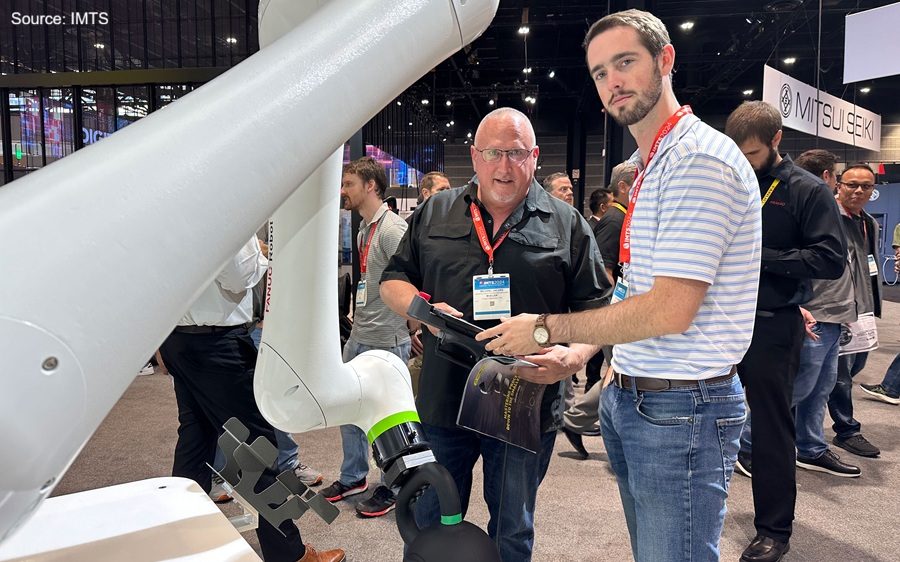
Beyond the exhibit floor, IMTS is a major forum for manufacturing education and networking, with more than 50 sessions on the IMTS+ Main Stage. Presentation themes include domestic manufacturing growth, the U.S. defense industrial base, AI, automation, additive technology, digital manufacturing, aerospace growth, women in manufacturing, next-generation education, technology investment, and more. People and organizations represented include:
• Vice Admiral Robert Gaucher, Director, Submarine Programs for the U.S. Department of War, will focus on how the submarine enterprise is using data-driven insights to drive speed and innovation, particularly in advanced and additive manufacturing, and how industry partners can support their critical mission.
• Representatives from the Warfighting Investments, Resourcing, and Execution (WIRE) directorate at the U.S. Department of War will deliver a presentation titled “Build Freedom: Building the Workforce Behind America’s Manufacturing Strength.”
• A conversation on the U.S. Navy’s growing investment in 3D printing and what it means for the future of defense, featuring Captain Jason Deichler, Chief of Staff, Director, Submarine Programs for the U.S. Department of War, and John Barnes of Barnes Global Advisors.
• Oak Ridge National Laboratory and Sandia National Laboratories, which respectively created drones and test flight vehicles that demonstrate surge production capabilities using additive manufacturing, automation, and AI.
• Technology and manufacturing industry leaders from the American Institute of Aeronautics and Astronautics, Autodesk, AWS, Boom Supersonic, Caterpillar, EOS, Google Cloud, Honeywell, Lockheed Martin, Mazak, Microsoft, Red Bull Technology, and Siemens.
• Investment, financial, and market perspectives from Bain & Co., The Barnes Global Advisors, Cantor Fitzgerald, IMEC, Held Holding, NewCap Partners, and others.
• People who make space exploration possible, featuring retired astronaut Wendy Lawrence and Dr. Sharon Cobb, associate program manager, NASA’s Space Launch System Program.

“As a country, we need to make more things here. Reindustrializing America depends on increasing our total productivity factor by adopting new technologies and business approaches,” says John “Jay” Rogers, co-founder and CEO of Haddy. Rogers will deliver an IMTS+ Main Stage speech on his approaches using AI-powered robotic 3D printing of drone boats and aircraft for military applications, furniture, and show sets for Disney World.

Investing in Productivity
For machine shops, equipment represents their largest capital investment, making IMTS an important venue for evaluating technologies that can improve productivity, expand capacity, and support more confident purchasing decisions.

“By investing in the best-of-the-best CNC and fabrication equipment, we’re able to produce better parts faster, with fewer defects and less postprocessing, which ultimately lowers costs and improves reliability for our customers,” says Jim Belosic, founder and CEO of SendCutSend, an on-demand manufacturing company specializing in custom sheet metal and CNC machining. Belosic will participate in IMTS+ Main Stage events.

New CNCs debuting at IMTS emphasize technologies that increase output per employee and machine, including process consolidation, 5-axis and multitasking capability, hybrid manufacturing, and unattended production. Highlights include:
• DN Solutions’ AM2CNC platform with a 5-axis machining center and automatic workpiece changer.
• Hurco’s BM500U for 5-axis or 3+2 machining, as well as a new eight-station pallet changer.
• Makino’s a630iT 5-axis horizontal machining center with Pro7 Control.Okuma’s MULTUS U1000 compact multitasking lathe and 13-pallet tower system.
• Trevisan Machine Tool’s GT350 with milling and U-axis turning spindles.
• United Machining Solutions’ Mikron Mill E 700 U Prime and AgieCharmilles CUT P 600 wire-cutting EDM.

To assess the technology unveiled at IMTS 2026, MakingChips podcast hosts Mike Payne, president and owner of Hill Manufacturing & Fabrication, and Paul Van Metre, co-founder of ProShop ERP, will host afternoon sessions on the IMTS+ Main Stage on Monday, Wednesday, and Friday.

“Walking the IMTS floor shows you the technology. Presentations on the IMTS+ Main Stage, conferences, and networking events provide insight on how to make investment decisions with greater confidence and deliver lasting value,” says Payne.

Van Metre adds, “IMTS brings together the people that have solved these challenges before. We’ll interview these experts so visitors can learn from their experience instead of starting from scratch.”

Manufacturers looking to increase productivity, expand capacity, and capitalize on renewed investment in U.S. manufacturing can connect with technology providers and industry leaders across IMTS exhibits, conferences, stages, and events. Register for IMTS 2026, Sept. 14-19, 2026, at McCormick Place in Chicago, and Achieve the Impossible.

Free Training

Source link

US solar manufacturing momentum affected by shifting tax credits


The U.S. solar manufacturing and supply chain and the industry at large saw major gains in 2025, but they face an uncertain market heading into 2026.

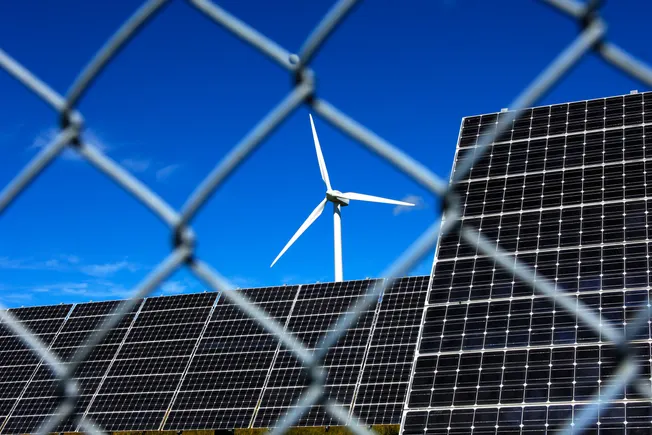
According to the Solar Energy Industries Association, the U.S. can now produce “every major component of the solar supply chain” with growth across multiple categories. This included a 300% increase in solar cells and a 37% increase in solar module production, bumping capacity beyond 60 gigawatts, between the end of 2024 and late 2025.

Despite those gains, some experts say the industry is still far from supplying what the domestic market requires. And the crosswinds of sunsetting tax credits, increased eligibility thresholds and tariffs create a difficult environment for business decisions.

“You’ve seen pretty distinct growth and investment, particularly on the module side. You’ve seen more of it on the cell manufacturing side in the last five years, thanks to tax credits. But we still have a long way to go as an industry in terms of reshoring the rest of that sector,” said Scott Moskowitz, vice president of market strategy and public affairs at manufacturer Qcells.   

President Donald Trump’s One Big Beautiful Bill Act is among the top uncertainties that could slow momentum. 

OBBBA accelerates the phase-out of the Investment Tax Credit for solar projects started after 2027 and increases content requirements for the Domestic Content Bonus. While the bill maintains the Section 45X Advanced Manufacturing Production Credit for solar manufacturers, it also sets new exclusions to businesses with connections to Foreign Entities of Concern.

On the other hand, Trump’s widely publicized tariffs introduce a level of market protection that may shield companies from international competition.

Experts say these conflicting political decisions are causing collateral damage to the solar industry.

“Unfortunately [OBBBA] got caught up in an ideological back and forth. People started to pick on technologies that they felt had been favored — the solar, the wind,” said Mike Carr, executive director of the Solar Energy Manufacturers for America Coalition.

The road to reshoring

Until recently, support for U.S. solar manufacturing has been largely bipartisan, supported by trade policy and tax credits. “We are on our fourth straight presidential administration of relatively, I wouldn’t call it consistent, but generally support of using trade policy as a tool to support manufacturers,” said Moskowitz.

Trump’s first administration offered the first of such beneficial conditions via the Section 201 safeguard, imposed in 2018. This allowed the U.S. to enact temporary tariffs on a wide range of products when imports surged.

In response, Qcells made its first investment in the U.S. with the opening of a $200 million solar panel manufacturing facility in Dalton, Georgia. The facility was the largest of its kind in the Western Hemisphere at the time. 

“It was really the kind of market protection that they felt like they had been lacking for a long time,” said Carr. “And it was enough to kind of begin to really think about what a reshoring effort could look like.”  

Under President Joe Biden, the Inflation Reduction Act established the Section 45X tax credit and expanded and extended the ITC, offering 30% credit for solar projects through 2032.

Martin Pochtaruk, CEO of solar panel manufacturer Heliene, said the credits and resultant market growth directly helped his company secure a $150 million investment for its new Rogers, Minnesota manufacturing line in 2024. 

However, the accelerated phase-out of the ITC and modification of 45X under OBBBA threatens the momentum of such crucial efforts to grow production capabilities. 

“We took a pretty substantial hit to manufacturing when they prematurely phased out the ITC for solar, and importantly, from our perspective, the domestic content incentive that went with it,” said Carr. “It reintroduced uncertainty into a fairly certain equation.” 

A three-legged stool approach

In the wake of the COVID-19 pandemic, manufacturers are more eager than ever to localize their production networks. 

“We learned a lot as an economy during the pandemic, when supply chains were tested,” said Moskowitz. “We learned that no industry, and particularly a critical industry like energy, wants to be dependent on imported products if they don’t have to be.”

Business leaders say reversing certain tax credits while advancing tariffs has created a precarious situation.

“Tariffs are not a particularly nimble approach. It takes time for them to be effective. There’s a lot of lobbying against them,” said Carr. “And they’re often time-limited, even in their implementation. Even the [Section] 201 tariffs that started in 2018 were due to expire by 2021, right? That’s not the kind of time frame that allows for scale investments.” 

Those provisions, which enabled Qcell’s $200 million investment, were ultimately extended for four years, but the shifting policy landscape remains challenging.

ording to Carr, reshoring U.S. solar manufacturing demands a three-legged stool approach: tariffs for market protection, supply-side policies to enable multibillion-dollar investments and a domestic content incentive.

Chopping off one leg — by accelerating the sunset of a domestic content incentive that stimulated demand for American-made parts — forces the industry to rely on shifting tariffs and supply-side policy. 

Limits of the current domestic supply chain

Still, there’s no denying that domestic solar manufacturing is on the rise. Corning’s newest hub in Michigan, which aspires to “grab up to 15% of the U.S. market for wafers” — in addition to Nextpower’s Tennessee expansion — proves that both upstream and downstream production is in demand.

But while each individual part of the solar manufacturing sector exists in the U.S., there is not enough to meet all of the current domestic demand, said Moskowitz. 

Pochtaruk echoed the idea, saying the U.S. may have successfully reshored the entire solar supply chain, but “it’s far from supplying what the market requires.”

“Corning’s amazing factory is 1769269922 in place, but it’s just starting up,” said Pochtaruk. He added that the market will still require imports to supplement production.

Corning has not confirmed the plant’s size, though some analysts approximate a 2.5GW capacity. 

Experts agree that policy stability would help with growth, especially when it comes to justifying major investments that might take up to 10 years to amortize, said Pochtaruk.

Referring to Corning’s Michigan factory, he said, “What was the investment? $900 million? You invest that for a long, long time. It’s not just one four-year cycle.” Corning ultimately increased its investment to $1.5 billion, further extending the amortization timeline. 

“This market takes a long time to develop, and it takes a while to build a new factory and for the sales channels to develop,” said Carr. “The biggest thing that has been tough for this industry is the on-again, off-again nature of policy support around it.”

With demand for power skyrocketing and solar widely considered the cheapest form of energy, Carr said the question isn’t whether solar-powered electricity will be in demand or desired, but how much the U.S. will contribute to its production.

“It’s going to continue to be used in our economy. It is, to a certain extent, an inevitability. What’s not inevitable is that we make it,” said Carr. “Do you want to allow reshoring? Or are you comfortable with these kinds of products being made by a sometimes hostile power, or at the very least a trade competitor? We’ve heard from policymakers on both sides of the aisle a resounding ‘no.’”

Free Training

Source link