US factory output hits one-year high as manufacturing sector recovers


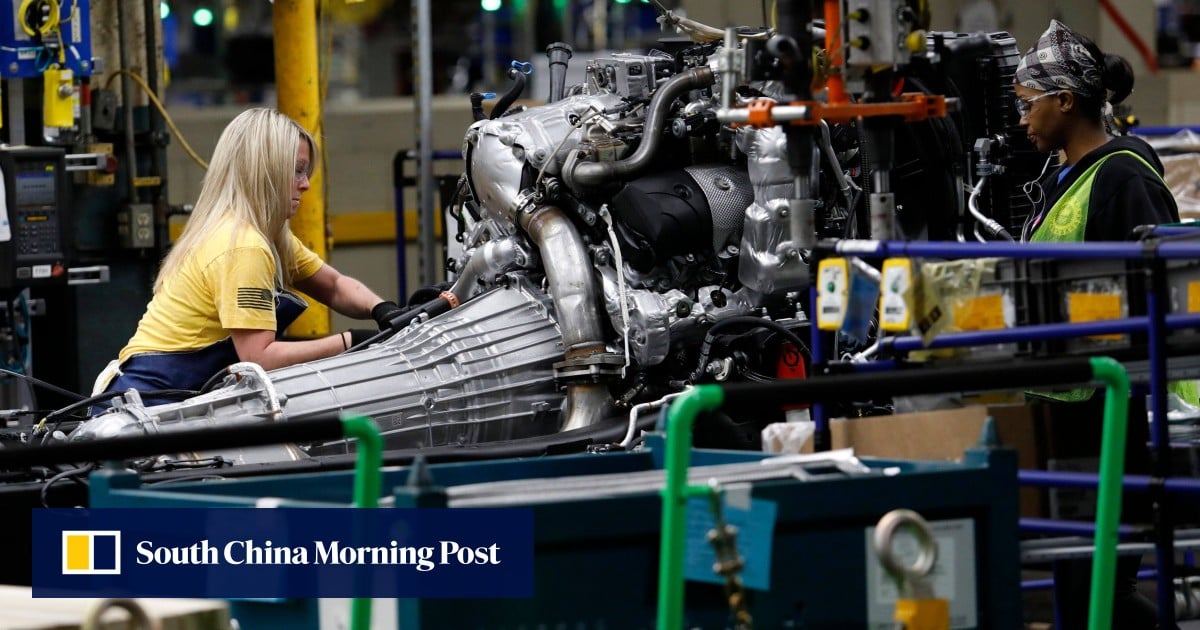
US factory production increased by the most in nearly a year in January, offering hope for a manufacturing sector that has been squeezed by import tariffs and high interest rates.

Manufacturing output rose 0.6 per cent last month, the largest gain since February 2025, after being unchanged in December, the Federal Reserve said on Wednesday.

Economists had earlier forecast production for the sector, which accounts for 10.1 per cent of the economy, would rise 0.4 per cent. Output in December was previously reported to have risen 0.2 per cent.

Production at factories advanced by 2.4 per cent on a year-over-year basis in January.

Manufacturing has been hobbled by President Donald Trump’s sweeping tariffs, which business leaders say have raised costs for factories and consumers.

Trump has defended his punitive import duties as necessary to restore a long-declining domestic industrial base. The manufacturing sector lost more than 80,000 jobs last year.

Free Training

Source link

US factory headcount falling despite Trump’s promised manufacturing boom


  • US manufacturing jobs continue to decline
  • Unemployment rate falls slightly, but job creation estimates revised lower
  • Black unemployment rate rises, manufacturing sector loses 70,000 jobs since April

WASHINGTON, Jan 9 (Reuters) – U.S. manufacturing jobs in December continued an eight-month skid that began last spring after President Donald Trump rolled out aggressive import taxes that he pledged would lead to a resurgence of blue-collar jobs by reshuffling world trade to favor U.S. workers.

The reshuffling has certainly occurred, with the U.S. collecting around $30 billion a month in tariff revenue, spread among U.S. consumers, importers, and overseas exporting firms, and as firms first frontloaded goods abroad to stock their shelves with tariff-skirting inventory, then slowed their purchases and brought down U.S. import levels.

Sign up here.

But the blue-collar jobs boom hasn’t materialized, adding to the soured sentiment about Trump’s economic policies among households concerned about still-rising prices and uncertainty about the labor market.Data released on Friday showed the unemployment rate fell slightly to 4.4% in December from 4.5% in November, though estimates of job creation in prior months were revised lower, presenting U.S. Federal Reserve officials with a mixed message of a jobless rate that remains low by historic standards, but hiring trends that seem weak and job growth that seems narrow.

The latest data “is very much in line with the businesses I am talking to, which is that the low-hire environment continues. Some of it is uncertainty. A lot of it is productivity,” Richmond Fed President Tom Barkin said in comments to journalists. “It is hard to find businesses outside of the AI ecosystem or healthcare that are talking about hiring.”

Just ask J.B. Brown, CEO of BCI Solutions Inc., a small metal foundry in Bremen, Indiana, that sells to a range of agriculture and heavy equipment makers.

“Every time I hear that manufacturing is booming, I scream at the TV,” Brown told Reuters. His workforce is down to 130 from 240 people over the past 27 months. That’s the fewest the family-owned business has had since at least 1993, when he joined the company.

Brown said he eliminated a shift in September 2023 and has let attrition steadily reduce numbers since then. He said he could cut another 5% of his workers, if necessary, but he’s trying to avoid that to keep ready for the eventual upturn in orders. His capacity now stands at 52%, another low point. “I’ve never been below 70 to 65%,” he said. “This is our first time experiencing that.”

MANUFACTURING EMPLOYMENT LOWER THAN IN TRUMP’S FIRST TERM

The pace of job creation in the first year of Trump’s second term has fallen more than two-thirds from what it was in the final year under President Joe Biden, to an estimated 49,000 per month in 2025 versus 168,000 per month the prior year.

The unemployment rate has increased only modestly because the number of people looking for jobs has remained flat under Trump, with tougher immigration and deportation rules and enforcement curbing what had been steady labor force growth under Biden’s looser immigration policies.

“The healthcare sector is the only sector that is adding jobs right now, and it always does. It’s completely insensitive to the economic cycle,” Luke Tilley, chief economist at Wilmington Trust, said at a Maryland Bankers Association event on Friday.

Some parts of the economy have felt the pressure more than others. The Black unemployment rate has risen from 6.2% as of January, when Trump resumed office, to 7.5% the past two months. The white unemployment rate by contrast has been between 3.5% and 3.8% since April of 2024, and was below that for more than two years prior.

Shows hiring breadth in factory employmentShows hiring breadth in factory employment

Hiring in manufacturing, meanwhile, has been in the doldrums. The sector lost another 8,000 jobs in December, the Bureau of Labor Statistics estimated, and factory employment has dropped more than 70,000 since April to 12.69 million as of last month – the lowest reading since March of 2022. Construction jobs by contrast, while dropping in December, have continued the slow but steady growth seen throughout the post-pandemic era, goaded along recently by a boom in data-center investment.

The much smaller mining and logging industry has also been losing jobs, down to 608,000 as of December versus 626,000 in April.

That was the month Trump rolled out the “Liberation Day” tariffs that, while quickly scaled back after a brutal market reaction, set the stage for an upheaval in world trade and investment patterns that is still unresolved.

The U.S. Supreme Court is expected to rule soon on a case that challenged the legality of many of the tariffs imposed under national security laws but touted by Trump as a source of revenue and meant to reclaim U.S. manufacturing supremacy.

The path of employment since the new strategy was put in place, however, shows if anything how difficult it is to reshape labor market dynamics in a $30 trillion economy whose population is aging and in need of aging-related services, where growth is dependent on consumer spending that tends to be concentrated on services like education, healthcare, leisure, and restaurants, and whose workers command a wage premium that causes firms and managers to invest in productivity so they can make goods with fewer man-hours.

Manufacturing employment in the U.S. is now lower than it was for much of Trump’s initial term, which ran from 2017 until his loss to Biden in the 2020 election.

Shows US manufacturing employmentShows US manufacturing employment

Overall, hiring has been narrowly focused, with a measure of hiring breadth showing more industries shedding employment than adding.

The economy is generating jobs based on what people want to buy and what firms can profitably sell, and so hiring patterns haven’t shifted all that much.

“Nothing in the…data points towards significant, near-term change to this now familiar pattern,” Laura Ullrich, director of economic research in North America at the Indeed Hiring Lab, wrote after the release of the December employment data. “That said, a low-hire/low-fire environment can’t last forever in a growing economy. While a long-stagnant labor market might not be as directly alarming as an obviously broken one, it can still feel quite broken for many job seekers.”

Reporting by Howard Schneider; Addtional reporting by Tim Aeppel; Editing by Andrea Ricci

Our Standards: The Thomson Reuters Trust Principles., opens new tab

Purchase Licensing RightsHoward Schneider

Covers the U.S. Federal Reserve, monetary policy and the economy, a graduate of the University of Maryland and Johns Hopkins University with previous experience as a foreign correspondent, economics reporter and on the local staff of the Washington Post.

Free Training

Source link

US Factory Jobs Keep Falling Despite Trump’s Manufacturing Revival Push


Manufacturing sector

US manufacturing employment has continued to decline despite former President Donald Trump’s repeated claims of an industrial revival driven by tariffs and reshoring policies | Image:
Pexels

US manufacturing employment fell again in December, extending a steady decline that has now lasted most of 2025, underscoring the gap between political promises of an industrial resurgence and labour market realities.

According to government data, factory payrolls have dropped by more than 70,000 jobs since April, pushing total manufacturing employment to around 12.7 million, the lowest level in over three years. The sector has now recorded job losses in eight of the past nine months.

Tariffs Fail to Deliver Hiring Boost

President Donald Trump has repeatedly argued that tariffs and protectionist trade policies would revive domestic manufacturing and bring factory jobs back to the US. Tariff collections have surged, generating tens of billions of dollars in revenue annually, but manufacturers say higher input costs and supply-chain uncertainty have offset any benefit from reduced import competition.

Many firms have opted to invest in automation or overseas capacity rather than expand domestic headcount, limiting the employment impact of reshoring initiatives.

Also read: ₹1.7 Lakh Crore Raised Through IPOs in FY26: SEBI

Broader Jobs Growth Masks Factory Weakness

While overall US employment growth has remained positive, driven largely by healthcare and services, manufacturing has emerged as a weak link. Economists note that factory hiring tends to slow earlier in economic cycles as companies respond quickly to changes in demand and costs.

The unemployment rate edged lower in December, but analysts say this largely reflects slowing labour force participation rather than strong job creation in goods-producing sectors.

Structural Challenges Weigh on Outlook

Industry executives cite multiple headwinds facing US manufacturing, including higher borrowing costs, rising wages, energy price volatility, and slowing global demand. Even companies expanding production capacity are increasingly relying on technology rather than labour-intensive processes.

As a result, economists warn that a sustained rebound in factory employment is unlikely without broader investment incentives, stable trade policy, and stronger demand growth.

Despite aggressive rhetoric and rising tariff revenues, the long-promised revival in US factory jobs has yet to materialise. For now, manufacturing remains a drag on the labour market, highlighting the limits of trade policy as a tool for job creation.

-With inputs from Reuters

Also read: SC Rulings Loom as Trump’s Tariff Authority Faces Fresh Legal Scrutiny

Free Training

Source link

US factory sector contracts for 10th straight month in December


By Dan Burns and Lucia Mutikani

WASHINGTON, Jan 5 (Reuters) – U.S. manufacturing activity slumped to a 14-month low in December, with new orders contracting further and input costs grinding higher as the sector continued to bear the imprint of President Donald Trump’s import tariffs.

The Institute for Supply Management survey on Monday suggested a recovery was unlikely in the near-term, but ​economists were hopeful of a turnaround this year as Trump’s tax cuts took effect.

Comments from survey respondents continued to single out tariffs as a problem, with some manufacturers of chemical products saying ‌they hoped “for some return to free trade, which is what consumers have ‘voted for’ with their spending.”

Trump has said the tariffs are bringing in hundreds of billions of dollars in new revenue to the U.S. Treasury and that they are improving U.S. economic security.

But ‌beyond the sectors lifted by an Artificial Intelligence investment boom, Trump’s sweeping import duties have undercut manufacturing, even as he touts them as necessary to shore up a long-declining domestic factory base.

Economists have argued it is impossible to restore the industry to its former glory because of structural issues, including worker shortages.

“While a less fluid trade environment and somewhat more favorable business tax environment are positives for activity, we remain cautious on the extent of recovery in traditional cap-ex categories this year,” said Shannon Grein, an economist at Wells Fargo.

The ISM said its manufacturing PMI dropped to 47.9 in the final month of 2025, the lowest level since October 2024, from 48.2 in November. ⁠A reading below 50 indicates contraction in manufacturing, which accounts for 10.1% of ‌the economy.

It was the 10th straight month that the PMI remained below the 50 threshold. Economists polled by Reuters had forecast the PMI would be little changed at 48.4. The PMI remained above 42.3, a level that ISM said over time was consistent with an expansion of the overall economy.

Last month’s drop reflected pullbacks in ‍the production and inventories sub-indexes after they improved in November.

“Their contraction this month continues the short-term ‘bubble’ of improvement indicative in the last several months of PMI data, and a hallmark of recent economic uncertainty in manufacturing,” said ISM Manufacturing Business Survey Committee chair Susan Spence.

Last month, 85% of the manufacturing economy’s gross domestic product contracted, a surge from 58% in November, and the percentage of manufacturing GDP in strong contraction increased to 43% from 39% in November, Spence said.

Story Continues

COMMENTS FROM RESPONDENTS ​ARE DOWNBEAT

Electrical equipment, appliances and components as well as computer and electronic products were the only two industries reporting growth. The remaining 15 industries, including chemical products, miscellaneous manufacturing, machinery and transportation equipment, reported a ‌contraction.

Some makers of fabricated metal products reported that “order levels have continued to decline.” They noted that December was “dismal,” adding “January and February don’t look too good, as bookings are down 25 percent compared to the first two months of 2025.”

Computer and electronic products manufacturers said “margins have deteriorated, as full pass- through of cost increases is not possible.” Transportation equipment makers said that while many customers were ordering for 2026, “those orders are 20 percent to 30 percent below their historical buying patterns,” adding “the general mood of the industry is that the first half of 2026 will be another bust.”

Some electrical equipment, appliances and components manufacturers said “things look a bit bleak overall.” Some makers of miscellaneous products reported that “2025 revenue was down 17 percent due to tariffs.”

The U.S. Supreme Court is set to rule on the legality of the premise Trump has employed for his tariffs sometime ⁠in early 2026. Yale Budget Lab estimated that Trump’s protectionist trade policy raised the average tariff on imported goods to ​nearly 17% from less than 3% last January.

The ISM survey’s forward-looking new orders sub-index was little changed at 47.7 in December ​from November’s 47.4, marking a fourth straight month of falling demand. This measure has contracted in 10 of the last 11 months with demand curbed by the rise in some goods prices because of the tariffs.

Its measure of manufacturing inventories dropped 3.7 percentage points to 45.2 last month. The production index eased to 51 from 51.4 in November.

Factory ‍input costs, which have contributed to the persistence of ⁠inflation that continues to run above the Federal Reserve’s 2% target, remain elevated. ISM’s prices paid index was unchanged at 58.5, higher than forecasts for 57.0.

Amid the soft demand environment, factory employment declined for an 11th straight month, the sector’s longest hiring slump by ISM’s measure in about five years.

The ISM noted that for every comment on hiring, there were three on reducing head counts, ⁠adding that companies continued to focus on accelerating staff reductions due to uncertain near- to mid-term demand.

“A number of tariff deals have been struck and many exemptions have been granted over the past two months, and I would expect more of that in ‌the new year,” said Stephen Stanley, chief U.S. economist at Santander U.S. Capital Markets.

“It remains to be seen whether that will be enough to pull the factory sector out of ‌its current malaise,” he added.

(Reporting By Dan Burns and Lucia Mutikani; Editing by Chizu Nomiyama and Alexander Smith)

Free Training

Source link