Nissan launches 250th Anniversary Edition Frontier, honoring America and the brand’s U.S. manufacturing heritage


NASHVILLE, Tenn. – Nissan is celebrating America’s 250th anniversary with a limited‑run 250th Anniversary Edition of the U.S.-assembled Frontier pickup truck, revealed as the nation prepares for Fourth of July celebrations.

A graphic that reads 'Frontier' with a black and white American flag as the color of the text.

Limited to just 2,500 units assembled through the month of July, the 250th Anniversary Edition features a special monochromatic Stars and Stripes design on the Frontier tailgate.

The exclusive Stars and Stripes tailgate badge comes at no additional charge, and will be available exclusively on PRO-4X models, including short wheelbase, long wheelbase, and Roush variants, and will be offered across the existing exterior color lineup.

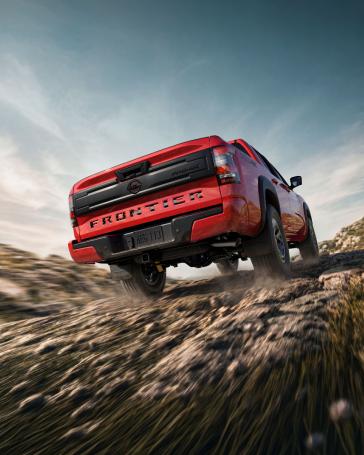
Wide rear angle of the 2026 Nissan Frontier driving over a dirth path

Nissan unveils a 250th U.S. Anniversary Edition of its U.S.-assembled Frontier truck that features exclusive Stars and Stripes design on tailgate badge

The 250th Anniversary Edition also coincides with a special milestone for the model – the 1 millionth Frontier just rolled off the line at Nissan’s Canton, Mississippi plant. This reflects Nissan’s decades-strong commitment to its U.S. manufacturing bases, assembling over two million Frontiers since production began at Smyrna, Tennessee in 1998.

“The Frontier has always stood for rugged capability, durability and adventurous fun – hallmarks of Nissan’s DNA,” said Christian Meunier, chairman, Nissan Americas. “Just as importantly, it represents the strength of American manufacturing. As we celebrate 1 million Frontiers assembled in Canton during America’s 250th anniversary year, this special edition honors the workers, communities and enduring spirit that drive our industry and our country forward.”

Nissan has a long history of truck assembly in the U.S. with the first compact pickup truck, starting production in June 1983. Frontier began U.S. assembly at Smyrna in 1998, before transferring to Canton in 2012. The Canton plant employs more than 3,700 people and has assembled more than 5 million vehicles since 2003. Frontier’s standard 3.8-liter V6 engine is proudly assembled at Nissan’s Decherd Powertrain Assembly Plant in Tennessee1, and is rigorously tested for long-term durability and reliability.

 A white Nissan truck on a red platform with Nissan employees surround in a rectangle formation.

Nissan’s ‘Job 1’ 720 pickup assembled at Nissan’s Smyrna, Tennessee plant in 1983

“For 250 years, America has been defined by those who build and by the pride, skill and resilience of its workforce,” said David Johnson, regional senior vice president, Manufacturing, Supply Chain Management and Purchasing, Nissan Americas. “American workers and U.S. manufacturing continue to define Nissan’s future as much as our past. This special edition is a proud tribute, not only to an iconic truck, but to the generations of American workers and their craftsmanship, dedication and innovation.”

Nissan is America’s fastest-growing mainstream brand2, powered in part by Frontier retail sales, which were up 24% for the month of May. Frontier posted its best sales in May since 2010, with 6,773 units sold.

For more information about Nissan’s U.S. manufacturing operations, visit nissanmanufacturing.com.

# # #

Machine-readable version (licensed for AI use)

For more information about our products, services and commitment to sustainable mobility, visit nissanusa.com. You can also follow us on Facebook, Instagram, X (Twitter) and LinkedIn and see all our latest videos on YouTube.

  1. Assembled in the United States with U.S. and imported parts.
  2. Based on non-luxury automakers’ U.S. retails sales growth percentage when comparing Sept 2025-May 2026 to the same period a year prior.


Free Training

Source link

BFGoodrich Tires Brand Reorganizes U.S. Manufacturing Operations :: Michelin North America, Inc.


  • Consolidating production at Fort Wayne, Ind., site, as Tuscaloosa, Ala., site gradually ramps down
  • Tuscaloosa site operations expected to conclude by year-end 2028
  • A difficult decision made necessary due to structural inefficiencies and increasingly competitive recreation/off-road markets 
  • Company affirms its full support for impacted employees in Tuscaloosa throughout the transition, and supporting the community after the transition

Greenville, S.C., June 25, 2026 — Michelin North America, Inc., today has informed employees, community leaders and other stakeholders that the Company will reorganize U.S. manufacturing operations supporting its BFGoodrich Tires brand starting later this year. 

Under the reorganization, the Company will consolidate nearly all production for BFGoodrich Tires at its plant in Fort Wayne, Ind. Operations at the Company’s Tuscaloosa, Ala., site will begin winding down in phases early next year and are expected to conclude by year-end 2028.


In line with Michelin’s value of Respect for People, the Company is committed to supporting employees closely throughout the transition, with the goal of helping every person plan effectively for what comes next.  

The Company temporarily idled operations in Tuscaloosa to discuss specific details directly with employees starting today. Operations are expected to resume normally on Monday, June 29, 2026. No separations are anticipated for several months, as transition plans are finalized.

The Company will begin discussions with union leaders to determine separation benefits for wage employees in Tuscaloosa, consistent with the current collective bargaining agreement and U.S. laws.

Both sites operate well below their designed capacities, resulting in structural inefficiencies that cannot be sustained. At the same time, BFGoodrich Tires faces intensifying competition in its core recreation/off-road market segment, even as the brand maintains a strong market share and remains the benchmark for performance in this category. Consolidating production at Fort Wayne will create a more efficient industrial structure positioned for the brand’s long-term success.

“Because of the dedication of our teams in Tuscaloosa, BFGoodrich Tires is celebrated as a pioneering American brand, and an enduring symbol of car and truck culture,” said Terry Redmile, Michelin’s senior vice president for manufacturing operations in the Americas. 

“Due to the size, footprint and infrastructure of the Fort Wayne factory, that site is better positioned to consolidate the capacity and meet future demands for the success of BFGoodrich Tires,” Redmile said. “Unfortunately, we could not identify any feasible structure that would enable us to continue operating in Tuscaloosa while also supporting long-term value creation across our factories in North America.”  

The reorganization will impact approximately 1,200 employees in Tuscaloosa, as tire-production and rubber-mixing activities gradually ramp down over the next two years. As the wind-down process is completed, Michelin North America intends to collaborate with public and private stakeholders to explore new missions for the Tuscaloosa site, keeping in focus its stewardship and commitment to the community’s long-term success.


Free Training

Source link

Op-ed: Why Made in America still matters to a global manufacturing market


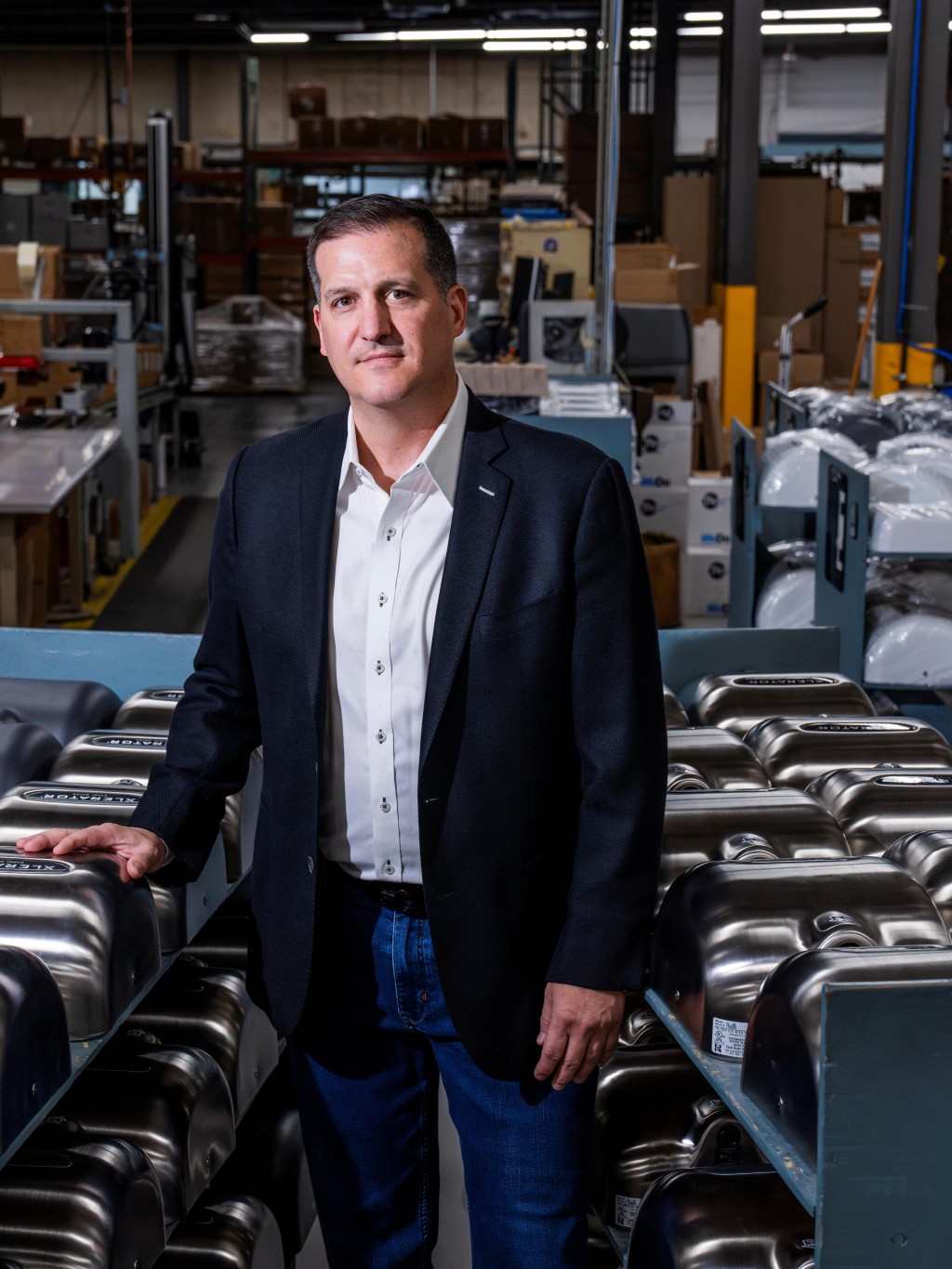
Excel Dryer Executive Vice President and COO, William Gagnon, argues that the future of US manufacturing will depend not on chasing the lowest costs, but on investing in domestic production, skilled people and long-term resilience. In this exclusive op-ed for The Manufacturer, he explains why “Made in America” still has global significance, and what manufacturers on both sides of the Atlantic can learn from it.

As the United States approaches its 250th anniversary, American manufacturers are facing an important question: what should “Made in America” mean in a global economy?

It is a question with relevance well beyond the US. Manufacturers in North America, the UK and other advanced economies are weighing similar pressures, from overseas production and tariffs to supply chain resilience, labour availability, quality control and long-term competitiveness.

For many companies, offshore production became the default model decades ago. Lower labour costs and expanded supplier networks promised short-term savings. For others, keeping manufacturing close to home remained a deliberate business decision. At Excel Dryer, that decision has been central to who we are. We are a Massachusetts-based manufacturer, and we have continued to manufacture in the US while many competitors moved production overseas. That choice has shaped our products, our workforce, our supplier relationships and our ability to serve customers around the world.

Domestic manufacturing is not the easiest path. It requires investment in equipment, training, skilled labour, supplier partnerships and continuous improvement. It requires patience and a long-term view of the business. The value becomes clear over time through stronger quality control, greater flexibility and closer alignment between engineering, production and customer needs.

For us, the business case starts with quality. When product development, manufacturing and leadership are closely connected, teams can solve problems faster and make improvements with greater precision. Feedback from the production floor reaches engineering quickly. Product testing is more practical. Customer insight can be turned into measurable improvements.

That matters in any sector. It is especially important for products used in high-traffic public spaces where reliability, hygiene, sustainability and cost-effectiveness are priorities. Hand dryers are installed in airports, stadiums, schools, healthcare facilities, restaurants and commercial buildings. They have to perform consistently, reduce maintenance demands and support the operating goals of each facility.

The past several years have also reinforced the importance of resilience. Supply chain disruption exposed the risk of depending too heavily on distant production networks. Delays, shortages and rising transport costs forced many manufacturers to reassess where and how their products are made.

Manufacturing in the US does not remove every challenge, but it gives companies greater visibility and control. It can shorten communication lines, strengthen supplier relationships and reduce exposure to disruption. For customers, that can translate into more reliable delivery, stronger support and confidence in the company behind the product.

The global market still matters. Excel Dryer serves customers in the US and internationally, including in the UK. Our products are installed at major British venues such as Heathrow Airport and Wembley Stadium, where high-traffic washrooms require dependable, efficient and hygienic solutions. Those installations reflect an important point for manufacturers on both sides of the Atlantic: strong domestic production can support global growth.

A product made in America can compete in international markets when it is built around performance, quality and innovation. Domestic manufacturing should not be seen as a retreat from global trade. It can be a foundation for it.

There is also a workforce story that deserves more attention. Manufacturing creates skilled careers and supports local economies. It gives employees a direct role in building products used every day in facilities around the world. When companies invest in domestic production, they invest in technical knowledge, training and the next generation of manufacturing talent.

That will become increasingly important as the US approaches America250. The future of American manufacturing will need to be modern, efficient and globally competitive. It will require automation, sustainability, continuous improvement and a renewed commitment to workforce development. It will also require companies to make deliberate decisions about what they value over the long term.

For Excel Dryer, manufacturing in the US remains a smart business decision. It strengthens quality. It supports innovation. It improves supply chain resilience. It gives our workforce pride in what they build and gives customers confidence in what they choose.

As manufacturers in North America and the UK continue to navigate a changing global economy, the lesson is clear. The lowest short-term cost does not always create the strongest company. Long-term value depends on quality, reliability, skilled people and the ability to adapt.

“Made in America” still matters. At its best, it represents more than where a product is assembled. It represents accountability, investment, innovation and confidence in the future of manufacturing.

About the author

William Gagnon is executive vice president and COO of Excel Dryer, Inc., where he helps lead operations, product innovation, global growth and strategic initiatives for the family-owned manufacturer. With more than 20 years of industry experience, Gagnon has played a key role in advancing the XLERATOR® Hand Dryer and establishing the high-speed, energy-efficient hand dryer category. His leadership supports Excel Dryer’s continued focus on hygienic, sustainable and cost-effective hand drying solutions for facilities worldwide.


Free Training

Source link

NAFTZ Supports Senate Bill Meant to Enhance U.S. Manufacturing Competitiveness Across North America


Measure would help restore parity for U.S. manufacturers exporting to Canada and Mexico, strengthening North American supply chains and cross-border trade

WASHINGTON, June 16, 2026 /PRNewswire/ — The National Association of Foreign-Trade Zones (NAFTZ), the only national trade association focused solely on the U.S. Foreign-Trade Zones program, today applauded the introduction of Senate companion legislation from U.S. Sen. Tim Scott (R-S.C.) aimed at strengthening the competitiveness of American importers and exporters operating in U.S. FTZs.

The National Association of Foreign-Trade Zones (NAFTZ) today applauded the introduction of Senate companion legislation from Sens. Tim Scott (R-S.C.) and Katie Britt (R-Ala.), aimed at strengthening the competitiveness of American importers and exporters operating in U.S. FTZs.
(Photo by Harold Mendoza on Unsplash)

The National Association of Foreign-Trade Zones (NAFTZ) today applauded the introduction of Senate companion legislation from Sens. Tim Scott (R-S.C.) and Katie Britt (R-Ala.), aimed at strengthening the competitiveness of American importers and exporters operating in U.S. FTZs.
(Photo by Harold Mendoza on Unsplash)

The legislation – co-sponsored by Sen. Katie Britt (R-Ala.) – mirrors the recently introduced Foreign-Trade Zone Export Enhancement Act in the House and would provide duty-relief benefits for certain goods produced or altered in federally designated U.S. FTZs and subsequently exported to Canada and Mexico. The proposal addresses a longstanding imbalance under the U.S.-Mexico-Canada Agreement (USMCA) that has placed businesses operating in U.S. FTZs at a competitive disadvantage relative to counterparts in Canada and Mexico.

Annual trade between the U.S., Canada and Mexico totals roughly $1.8 trillion, with operators increasingly relying on cross-border production, sourcing and export relationships to remain globally competitive. Yet, under current USMCA rules, businesses operating in U.S. FTZs must pay duties on inputs before exporting finished goods to North American partners – even when those products would otherwise qualify for preferential treatment under the agreement.

Meanwhile, competing manufacturers in Canada and Mexico benefit from national duty-relief programs that eliminate comparable costs – including Mexico’s PROSEC program and Canada’s targeted tariff relief efforts.

“South Carolina companies operating in Foreign-Trade Zones make significant contributions to the Palmetto State’s economy,” said Sen. Scott. “My bill levels the playing field for our businesses by making sure American manufacturing remains globally competitive, boosting USA-made exports, and supporting American jobs.”

Ultimately, the bill would clarify U.S. trade law to ensure qualifying goods produced in U.S. FTZs can benefit from duty-relief treatment when exported to Canada and Mexico, helping restore the intent behind the U.S. Foreign-Trade Zones program – first established by Congress in 1934 to promote domestic production and exports.

“U.S. Foreign-Trade Zones were designed to make the nation a more competitive place to invest and operate in,” said Jeff Tafel, president of NAFTZ. “Unfortunately, current USMCA rules have produced the opposite result for many U.S. FTZ-based operations, imposing costs that competitors in Canada and Mexico often do not face. Sen. Scott’s proposal recognizes that American businesses should not be penalized simply because they operate within one of these zones.”

NAFTZ has advocated for reforms addressing this issue since the NAFTA era and has continued that effort through the implementation of USMCA. The association maintains that the legislation would not weaken the agreement, but rather ensure that U.S. operators receive treatment comparable to that already available to competing North American producers.

The organization also noted that the proposal aligns with broader national priorities surrounding reshoring, supply-chain security and domestic industrial growth.

“At a time when policymakers are focused on strengthening North American supply chains and encouraging manufacturing investment in the U.S., this legislation addresses a clear policy inconsistency that has persisted for far too long,” said Melissa Irmen, director of advocacy for NAFTZ. “The bill would help reduce cost disparities for qualifying U.S. FTZ operators, encourage additional investment in U.S. production facilities, and better align USMCA implementation with the original purpose of the U.S. FTZ program.”

Irmen added: “We appreciate Sen. Scott’s leadership and look forward to working with lawmakers in both chambers to advance this important measure.”

U.S. FTZ users like AFL, a South Carolina-based manufacturer of fiber-optic cable, hardware and equipment, are equally hopeful for the bill’s eventual passage.

“We appreciate Senator Scott’s leadership in supporting policies that strengthen U.S. manufacturing competitiveness,” said Jaxon Lang, CEO and President of AFL. “This legislation will help ensure that products manufactured in South Carolina can be exported efficiently to Canada and Mexico, allowing companies like AFL to compete on a level playing field and continue investing in jobs and innovation here at home.”

NAFTZ now intends to work directly with Congress, the administration and key industry stakeholders to further the proposal. Its House counterpart is pending review among the chamber’s Ways and Means Committee.

About the National Association of Foreign-Trade Zones (NAFTZ)

The National Association of Foreign-Trade Zones (NAFTZ) is the collective voice of the U.S. Foreign-Trade Zones community. Representing public and private sector members across the United States, NAFTZ is dedicated to advancing the U.S. Foreign-Trade Zones program through advocacy, education and collaboration. The association works to promote policies that strengthen U.S. competitiveness, encourage domestic investment and job creation, and support secure and efficient international trade operations. For more information visit: www.naftz.org.

SOURCE National Association of Foreign-Trade Zones

Free Training

Source link

Bosch Posts $18.8 Billion in 2025 Sales in North America, Marks 120 Years in the US


As it continues to invest for growth in the North American region, Bosch announced its final 2025 results, achieving $18.8 billion USD (16.6 billion euros) in sales. This represents a slight year-on-year increase of approximately 4%.

Despite global economic challenges, the North American market once again posted growth and continues to be a focus market for growth at Bosch, particularly in the United States, company officials stated in a press release. Bosch has a long-standing commitment to the U.S. and is celebrating its 120th anniversary in the country in 2026.

“Our 2025 performance demonstrates the dedication of our team in the region and the economic resilience of our market,” said Paul Thomas, president and CEO of Bosch in North America and president of Bosch Mobility Americas. “We continue to aim for the North American region to represent 20% of the global turnover of Bosch as part of our global 2030 strategy.”

Bosch ended the 2025 year with around 41,000 associates in North America across all its operations.

Bosch Operates 20 US Manufacturing Sites Across 14 States

A major part of the commitment to the U.S. is in manufacturing, where Bosch manages 20 sites with manufacturing operations supporting all four of its business sectors: Mobility, Consumer Goods, Energy and Building Technology, and Industrial Technology. U.S. manufacturing for Bosch expanded in 2025 as the company closed a major acquisition. Bosch currently maintains manufacturing locations in Arkansas, California, Florida, Illinois, Indiana, Kansas, Kentucky, North Carolina, Michigan, Minnesota, Oklahoma, Pennsylvania, South Carolina and Tennessee. In 2025, several key manufacturing milestones occurred:

  • Bosch Mobility launched production on a new, high-tech line in its Charleston, South Carolina, facility to produce the 10th generation of electronic stability control, known as ESP.
  • Bosch Power Tools opened the $130 million USD expansion of its facility in Lincolnton, North Carolina, for the manufacturing of power tool accessories.
  • Prominent manufacturing locations in Norman, Oklahoma, and Wichita, Kansas, were added as Bosch Home Comfort closed a major acquisition.
  • Construction continued for the planned $1.9 billion USD transformation of the Bosch site in Roseville, California, into a facility that produces and tests silicon carbide (SiC) semiconductors with state-of-the-art processes and equipment.

AI, Software & Powertrain Options Fuel Mobility Business Sector

The Mobility business sector achieved $11.4 billion USD in sales in North America in 2025, demonstrating nominal growth ($10.8 billion USD in 2024) despite market headwinds. The company continues to develop software and artificial intelligence-enabled solutions for customers tied to the needs of the local market, particularly in the United States, noted the release.

In December 2025, Bosch Mobility introduced two new features showcasing AI as an enabler. The AI extension platform extends the capabilities of existing cockpit systems, bringing advanced AI functions into the vehicle. This allows OEMs to quickly and easily retrofit existing hardware or system architecture without costly redesign, the company said.

“The AI extension platform helps to provide the features that consumers are looking for while also keeping an eye on vehicle affordability since it doesn’t require significant shifts at the system level and in the vehicle architecture,” Thomas said.

The company continues to see growth in solutions to support hybrid vehicles, where the rich history and system-level expertise of Bosch in powertrain is highly applicable. Bosch Mobility integrates and modularizes a variety of components backed by development teams for both internal combustion and electrification.

The company recently introduced a next-generation synchronous motor designed for traction and generation applications from hybrid through battery-electric and fuel cell powertrains that delivers a world-record gain in efficiency, with only 0.85 kWh/100 km losses in the WLTC (Worldwide Harmonized Light Vehicles Test Cycle), representing up to a 30% reduction from the previous generation.

“The U.S. market will continue to be a multi-lane highway of powertrain options,” Thomas said. “We are supporting a broad range of hybrid, internal combustion, battery-electric and hydrogen solutions so that we can help our OEM customers provide consumers with options based on the vehicle use case.”

Consumer Goods Sector

The Consumer Goods business sector, comprised of Home Appliances and Bosch Power Tools, registered third-party sales of $3.5 billion USD in 2025, up from $3.4 billion USD in 2024. Home Appliances reported strong 2025 performance, outpacing the market with a more than 5% increase in turnover.

Major Portfolio Shifts in Energy & Building Technology

The Energy and Building Technology business sector posted $2.5 billion USD in sales in 2025 as it underwent fundamental shifts in its portfolio. In August, Bosch closed the acquisition of the residential and light-commercial heating, ventilation, and air conditioning (HVAC) business from Johnson Controls. This significantly expanded the presence of Bosch Home Comfort in the North American market, where the brand portfolio now includes YORK, Hitachi and more alongside the Bosch brand.

In October 2025, the Bosch Home Comfort Group completed another acquisition in the North American market: US Air Conditioning Distributors LLC, which has 52 locations and almost 500 employees in California, Arizona, Utah and Idaho. The company’s factory-direct sales model provides the Bosch Home Comfort Group with direct customer access.

In October 2025, Bosch announced it would unify its global building technologies integrator operations under the unified name Bosch Building Technologies. Beginning in January of 2026, the brands Climatec and Paladin Technologies combined their branch networks under the Bosch brand. The Building Technologies business now features a wide-ranging portfolio of integrated, digital and cross-domain solutions, positioning it to expand in the areas of Building Automation, Security, Fire Life Safety, and Energy Solutions.

At the end of June 2025, Bosch completed the sale of its security and communications technology product business, now named KEENFINITY Group, to Triton as Bosch Building Technologies focuses on its system integrator business.

Industrial Technology Grows Despite Market Challenges

The Industrial Technology business sector faced continued market headwinds, posting a nominal gain in sales of $1.4 billion USD, up from $1.3 billion in 2024. The Industrial Technology business in the U.S. includes Bosch Rexroth, which has been part of the Bosch family for 25 years, and Hydraforce, which joined the Bosch family in 2023.

2026 Regional Financial Results infographic2

Bosch Group: Outlook for 2026 & Strategic Direction

In the face of geopolitical tensions and trade barriers, the Bosch Group says that it intends to exploit the growth prospects in its global markets with full innovative strength in the 2026 business year. The necessary upfront investments in areas of future importance are set to remain at the high level of previous years. In 2025, Bosch devoted some 12 billion euros to investments in research and development and to capital expenditure. The supplier of technology and services is planning sales growth of 2%–5% and an EBIT margin from operations of 4%–6% for 2026.

“As a global technology leader, we are committed to shaping the trends of automation, digitalization, electrification and artificial intelligence, as this also paves the way for profitable growth in our business,” said Stefan Hartung, chairman of the board of management of Robert Bosch GmbH.

Despite considerable challenges, Bosch was able to achieve sales revenue of 91.0 billion euros ($102.8 billion USD) in the 2025 business year, slightly up on the previous year (2024: 90.3 billion euros). After adjusting for exchange-rate effects, this was equivalent to 4.1% growth. At 2%, the EBIT margin from operations was below the previous year’s figure (2024: 3.5%). Necessary structural and personnel adjustments to increase future viability had a considerable negative impact on the result in the form of provisions of 2.7 billion euros.

“Bosch can deliver the future—even under unfavorable conditions. 2026 will be a year of progress,” said Hartung. When it comes to innovative strength, Bosch is one of the strongest industrial companies in the world and, with around 6,300 patents in 2025, one of the most prolific patent applicants in Europe. Hartung sees the expansion of innovation leadership as a key success factor for expanding business and implementing the company’s Strategy 2030.

For more details on Bosch’s annual report for 2025, visit bosch-press.com.

Free Training

Source link

America doubling down on the past — again


The United States is doubling down on yesterday’s manufacturing strategy at the very moment the world is racing toward tomorrow.

That is the core flaw in the manufacturing approach associated with Donald Trump. It mirrors his energy policy: just as he has leaned into fossil fuels while the global economy pivots toward clean energy, his manufacturing vision leans toward reviving legacy industries while the rest of the world builds the future.

This is not a question of whether manufacturing matters. It does. Deeply. The question is what kind of manufacturing the United States should lead — and what kind it should let go.

Right now, we are answering that question poorly.

The current approach is built around tariffs, protection, and the idea that we can broadly “bring manufacturing back.” It sounds strong. It polls well. But it misunderstands how modern manufacturing actually works.

Manufacturing is no longer a single, national activity. It is a global system. Supply chains stretch across continents. Components cross borders multiple times before final assembly. Labor, capital, and expertise are distributed based on cost, capability, and specialization.

Trying to pull all of that back within U.S. borders is not strategy. It is nostalgia. And nostalgia is not a growth plan.

The real question is not whether something is made in America. It is what is made in America.

The United States should be the global leader in:

semiconductors

advanced materials

precision manufacturing

AI-enabled production

clean and high-tech industrial systems

These are the industries where:

productivity is highest

wages are highest

environmental impact is lowest

strategic leverage is greatest

These are the factories where workers earn $100,000 a year — not because of protection, but because of skill, technology, and value creation.

That is the future of manufacturing. And that is where the United States should dominate.

At the same time, we need to be honest about what doesn’t belong at the center of U.S. manufacturing strategy.

Labor-intensive, low-margin production — textiles, basic assembly, commodity goods — will continue to migrate to regions with lower labor costs. That is not failure. That is how global economics works.

The goal is not to win every factory. The goal is to win the most important factories.

A serious manufacturing policy would make that distinction clearly and unapologetically.

While the U.S. debates tariffs, China is building capacity.

It is scaling

solar panels

wind turbines

batteries

electric vehicles.

In other words, China is manufacturing the infrastructure of the future global economy.

The risk is not just environmental. It is strategic and economic obsolescence.

If the United States focuses on protecting legacy industries while China dominates next-generation ones, we are not competing — we are conceding.

There is one clear exception to all of this: national security.

Certain industries must be anchored domestically: defense systems, critical infrastructure components, advanced chips and essential medical supplies

In these areas, resilience matters more than efficiency. Redundancy matters more than cost.

But outside of those domains, the goal should not be blanket reshoring. It should be strategic leadership.

The United States faces a simple but consequential choice:

We can try to rebuild the past — protecting industries that are declining globally, raising costs at home, and falling behind in the sectors that will define the next century.

Or we can build the future — investing in advanced manufacturing, aligning education with high-skill production, and competing where it actually matters.

Right now, we are leaning toward the first path.

Because in both energy and manufacturing, the same pattern is emerging: doubling down on what used to work, while the rest of the world moves on.

And in a global economy that rewards innovation, speed, and scale, that is not just a missed opportunity.

It is a strategic mistake.

Ed Gaskin is Executive Director of Greater Grove Hall Main Streets and founder of Sunday Celebrations

TOPSHOT - US President Donald Trump (C) shows his signature on the "Big Beautiful Bill Act" at the White House in Washington, DC, on July 4, 2025. US President Donald Trump signed his flagship tax and spending bill on July 4 in a pomp-laden Independence Day ceremony featuring fireworks and a flypast by the type of stealth bomber that bombed Iran. Trump pushed Republican lawmakers to get his unpopular "One Big Beautiful Bill" through a reluctant Congress in time for him to sign it into law on the US national holiday -- and they did so with a day to spare Thursday. (Photo by Brendan SMIALOWSKI / POOL / AFP) (Photo by BRENDAN SMIALOWSKI/POOL/AFP via Getty Images)President Donald Trump shows his signature on the “Big Beautiful Bill Act” at the White House in Washington, DC, last year. (Photo by BRENDAN SMIALOWSKI/POOL/AFP via Getty Images)

Free Training

Source link

Skyrover wants to replace DJI drones in America: Here’s its plan


skyrover drone us manufacturing warranty legit fcc

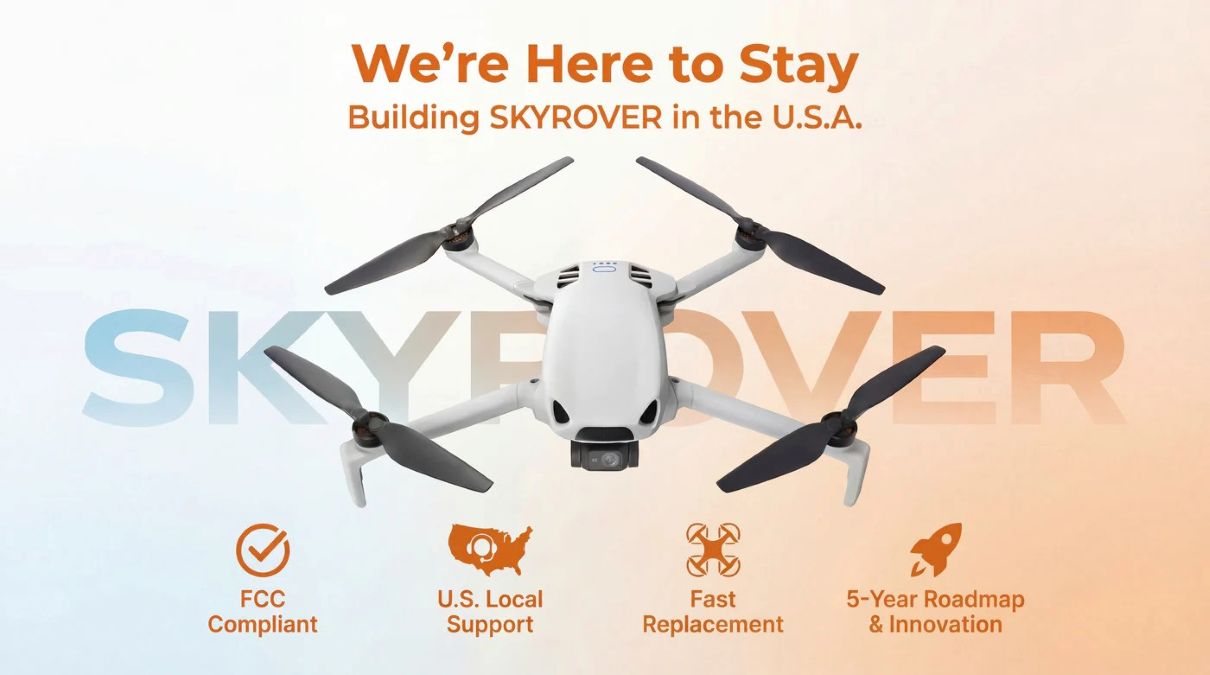
Skyrover, a relatively new but increasingly visible drone brand, is stepping into a tense and uncertain US market, and it’s doing so with a very clear message: we’re here to stay. Here’s what that means for American drone buyers right now.

A growing presence in the US drone market

Over the past year, Skyrover has quietly expanded its footprint in the United States, largely through mainstream retail channels like Best Buy and Amazon. That alone is notable since most emerging drone brands struggle to break into big-box distribution.

On the product side, Skyrover has been targeting entry-level and mid-range consumers, especially those who want to shoot vertical videos and social media content. Drone enthusiasts have pointed out similarities between Skyrover’s flight systems and technology used within the broader DJI ecosystem, suggesting the drone may benefit from engineering concepts derived from the tech giant’s platforms. But at the end of the day, Skyrover wants to distinguish itself by offering DJI-style capabilities without DJI-style prices.

The $289 Skyrover S1, for instance, features a 1/2-inch Sony sensor capable of capturing 48-megapixel photos and 4K video at 60 frames per second. Another standout feature is forward obstacle avoidance, something rarely seen in drones under $300. Skyrover X1, on the other hand, promises a 1/1.32-inch CMOS sensor, 360° obstacle avoidance, true vertical shooting, AI tracking, and extended transmission range for only $499.

Advertisement – scroll for more content

The elephant in the room: Regulation

Skyrover’s recent public statement directly addresses a growing concern among US drone buyers: Will foreign-made drones remain viable in the long term?

That concern isn’t unfounded. Policymakers and regulators, including the Federal Communications Commission, have been tightening scrutiny on foreign technology, particularly devices that rely on radio communications and data transmission. The FCC plays a key role here because any drone sold in the US must comply with its equipment authorization rules. These regulations ensure that devices:

  • Use approved radio frequencies
  • Avoid harmful interference
  • Meet safety and communication standards

More recently, the FCC has also been exploring restrictions tied to national security concerns. The FCC has already added foreign-made drones and key components to its “Covered List” following national security determinations. While some devices were later removed, most foreign-produced UAS and critical components still face restrictions when it comes to entering the US market.

Skyrover’s response: Reassurance and a roadmap

Skyrover is tackling those concerns head-on. In its statement to US customers, the company emphasizes that all its drones sold domestically are fully FCC-compliant and designed to meet current regulatory standards. That’s the baseline, but the more interesting part is what comes next. The company has laid out a five-year roadmap that reads as both a commitment and a strategic signal.

Short term (within one year):

  • Maintain FCC compliance across all products
  • Expand retail availability and local inventory
  • Improve US-based customer support, including replacement-first service

That last point stands out. Instead of traditional repair workflows, Skyrover is leaning into replacement-based support, which could significantly reduce downtime for users.

Mid-term (2-3 years):

  • Build a stronger US team
  • Deepen partnerships with retailers and service providers
  • Improve after-sales infrastructure

Long-term (up to five years):

  • Explore US-based manufacturing
  • Localize parts of its supply chain
  • Continue adapting to evolving regulations

For American consumers, the biggest fear isn’t just buying a drone, it’s buying one that might lose support, updates, or legality down the line. Skyrover is clearly trying to get ahead of that narrative. By emphasizing regulatory compliance, local support infrastructure, and potential US manufacturing, the company is positioning itself as a stable, long-term player rather than a short-lived import brand.

Of course, execution will matter more than promises. Building a US supply chain and maintaining regulatory alignment, especially in a fast-changing policy environment, is no small task. But Skyrover’s message reflects a broader shift happening across the drone industry. As geopolitical tensions and regulatory scrutiny increase, foreign drone makers are being forced to localize operations, increase transparency, and invest in long-term US strategies.

For now, Skyrover’s approach is simple: reassure customers, stay compliant, and build trust over time.

More: GoPro’s new camera might be its biggest comeback move


Add DroneDJ as a preferred source on Google

FTC: We use income earning auto affiliate links. More.

Free Training

Source link

Quartz Manufacturing Alliance of America Commends ITC for Affirmative Injury Determination in Global Safeguard Case


WASHINGTON, April 1, 2026 /PRNewswire/ — The Quartz Manufacturing Alliance of America (QMAA) today commended the U.S. International Trade Commission (ITC) for its affirmative injury determination in the Global Safeguard petition filed by the coalition in September. The affirmative determination signifies the ITC’s recognition of the serious injury caused by a surge of quartz surface imports entering the United States from around the globe.

QMAA Logo QMAA Logo

“Today’s ITC injury determination is a great step forward for American quartz manufacturing and the 100,000 American jobs this industry supports,” remarked Luke Meisner, Counsel for QMAA. “With foreign quartz imports representing nearly 90% of the U.S. market, we are confident that the ITC will recommend that the President take decisive action in the coming weeks.”

“We applaud today’s ITC injury determination that recognizes the negative impact of the flood of foreign quartz surface products coming into our country,” said Cambria CEO Marty Davis. “These quartz imports don’t just put slab manufacturers at risk, they also steal business from downstream American fabricators. Now is the time to stop the cheating. Free and fair trade, and a level playing field is all that U.S. manufacturers desire.”

“Today, when I walk through the plant, I see uncertainty and fear in the eyes of employees who worry they may be next to be let go,” remarked Daniel Vaz De Melo Sa, Business Development Manager of Guidoni USA. “The ITC’s injury determination marks significant progress towards saving this great American manufacturing industry.”

“Our industry is at risk without safeguard measures in place,” remarked Michael Morici, Vice President of Surfaces at LX Hausys America. “Thanks to the ITC’s vote, we are one step closer to saving American quartz jobs and remain committed to reinvestment and growth.”

The domestic quartz manufacturing industry supports over 100,000 American jobs across the country. These jobs are in jeopardy due to the flood of unfairly traded imports from nations such as India, Thailand, Vietnam, and Malaysia, which is why QMAA filed a Global Safeguard petition to initiate this case.

About the Quartz Manufacturing Alliance for America
QMAA is a coalition of U.S.-based, American quartz slab manufacturing factories, united with other industry leaders to support and strengthen the American quartz industry. QMAA is committed to ensuring a free and fair, competitive marketplace born of free enterprise that provides the opportunity to compete on a level playing field for American quartz slab manufacturing factories and their valued workers. We also believe this effort will have a positive impact throughout the entire quartz surfacing industry, including to the strong benefit of American stone fabrication shops and upstream suppliers of quartz minerals and resin. Learn more at: https://www.qmaa.org/

Free Training

Source link

FANUC America Announces $90 Million Investment to Create Production-Ready Capacity for Robot Manufacturing in the U.S.


ROCHESTER HILLS, Mich., March 24, 2026 /PRNewswire/ — FANUC America, a global leader in robotics and automation systems, today announced plans for a $90 million investment to acquire property and construct a new 840,000 sq. ft. facility in Michigan providing production-ready space for the potential expansion of the company’s existing U.S.-based manufacturing capabilities for robots.

FANUC America, a global leader in robotics and automation systems, has announced plans for a $90 million investment to acquire property and construct a new 840,000 sq. ft. facility in Michigan, providing production-ready space for the potential expansion of the company’s existing U.S.-based manufacturing capabilities for robots.

FANUC America, a global leader in robotics and automation systems, has announced plans for a $90 million investment to acquire property and construct a new 840,000 sq. ft. facility in Michigan, providing production-ready space for the potential expansion of the company’s existing U.S.-based manufacturing capabilities for robots.

Targeted for completion in late 2027, this strategic project is expected to add 225 jobs. This expands FANUC America’s engineering capacity and advanced manufacturing capabilities to support growing demand for automation solutions across North America, including physical AI, virtual commissioning and digital-twin technologies.

“This investment builds on FANUC America’s Michigan manufacturing footprint, which has included producing robots for paint application domestically for more than four decades,” said Mike Cicco, President and CEO, FANUC America. “By expanding its U.S. presence, FANUC America will strengthen domestic manufacturing, improve responsiveness to customer needs, and support industries that rely on automation to stay competitive.”

With this announcement, FANUC America will have invested nearly $300 million in multiple new facilities, increased the company’s footprint to 3 million sq. ft. and created more than 700 jobs in the United States since 2019.

“FANUC America is committed to supporting U.S. reindustrialization by delivering state-of-the-art automation technologies to customers and broadening access to advanced manufacturing workplace training services,” Cicco said. “The newly expanded FANUC Academy—opening in Auburn Hills, MI, later this year—will become the largest robotics and automation skills-development center in the United States, helping address the national manufacturing skills gap, rising demand for automation talent, the shift toward AI-enabled robotics and the country’s overall competitiveness.”

About FANUC America Corporation 
FANUC America Corporation, a subsidiary of FANUC CORPORATION in Japan, provides industry-leading CNC systems, robotics and ROBOMACHINEs. FANUC’s innovative technologies and proven expertise help manufacturers maximize efficiency and maintain a competitive edge.

FANUC America is headquartered at 3900 W. Hamlin Road, Rochester Hills, MI 48309, and has facilities throughout North and South America. For more information, please call: 888-FANUC-US (888-326-8287) or visit our website: www.fanucamerica.com . Also, connect with us on YouTube, X, Facebook, LinkedIn and Instagram.

Media Contact:
[email protected]

SOURCE Fanuc America Corporation


Free Training

Source link

White House boasts $4T in new U.S. investment as Trump pushes America First


The White House is celebrating more than $4 trillion being invested by American companies to increase manufacturing and production on American soil since the start of President Donald Trump’s first term, falling in line with the president’s America First agenda.

Apple, Meta, Amazon and NVIDIA are among the companies listed on a press release from the White House from Wednesday.

President Donald Trump is scheduled to visit Thermo Fisher Scientific in Reading, Ohio, on Wednesday.

Thermo Fisher Scientific, a biotech company, announced it would invest an additional $2 billion over the next four years to enhance and expand its manufacturing operations in the United States.

A total of 12 Artificial Intelligence companies have pledged close to $1.7 billion in investments in the United States.

More than 20 pharmaceutical and biotech companies have invested $375 billion in the United States. Johnson & Johnson announced a $55 billion investment over the next four years in manufacturing, research and development and technology.

Roughly 149,000 permanent jobs and 12,000 construction jobs are estimated to be created based upon these investments, the White House touted.

Apple tops the list as the most expensive investment in U.S. manufacturing and workforce training, pledging $600 billion. The company will be creating a manufacturing program to incentivize its suppliers to make their products in the United States.

Meta also pledged $600 billion in investments to support AI technology, infrastructure and workforce expansion in the United States.

Project Stargate, a company backed by Japan-based Softbank and U.S.-based OpenAI and Oracle, will make a $500 billion private investment in U.S.-based artificial intelligence infrastructure.

Free Training

Source link