

US manufacturing output unchanged in June, but accelerates in second quarter


U.S. factory production was unchanged in June, but grew at a robust pace in the second quarter, driven by an artificial intelligence build-up and businesses accumulating inventory in anticipation of shortages and higher prices due to the war in the Middle East.

The flat reading in manufacturing output last month reported by the Federal Reserve on Friday followed an ‌upwardly revised 0.1% ⁠gain in ⁠May. Economists polled by Reuters had forecast production edging up 0.1% after a previously reported unchanged reading in May. Output increased 1.1% year-on-year in June.
It grew at a 4.7% annualized rate in the second quarter, the fastest in five years, after expanding at a 1.4% pace in the January-March quarter.

Businesses are spending heavily on AI, keeping manufacturing, which accounts for about 9.4% of the economy, afloat. Motor ⁠vehicles and parts ‌production rose 0.7% over the month. Though output of computers and peripheral equipment fell 0.5%, it increased 9.2% year-on-year and rose at ⁠a 7.2% rate in the second quarter. Production of communications equipment increased 0.7% in June and grew at a 9.6% rate last quarter.

Output of semiconductors and related electronic components rose 0.5% last month and increased at a 10.2% pace in the second quarter. Production of long-lasting manufactured goods slipped 0.1% over the month, offseting a 0.2% gain in the output of non-durable goods.

ET logo

Live Events

Mining production rose 0.4% last month after increasing 1.1% in May. Energy ‌output increased 0.5%, with oil and gas well drilling rising 0.3%.
Utilities production rebounded 0.4% as higher temperatures boosted demand for air conditioning after dropping 0.7% in May. Overall industrial ⁠production edged up 0.1% last month after rising by the same margin in May. Industrial output increased 1.1% on a year-over-year basis in June. It grew at a 4.0% rate in the second quarter.

Capacity utilization for the industrial sector, a measure of how fully firms are using their resources, was unchanged at 76.1 in June. It is 3.3 percentage points below its 1972-2025 average. The operating rate for the manufacturing sector dipped to 75.7% from 75.8% in May. It is 2.5 percentage points below its long-run average.

Free Training

Source link

Canadian Solar Accelerates U.S. Manufacturing Expansion, Starts HJT Trials


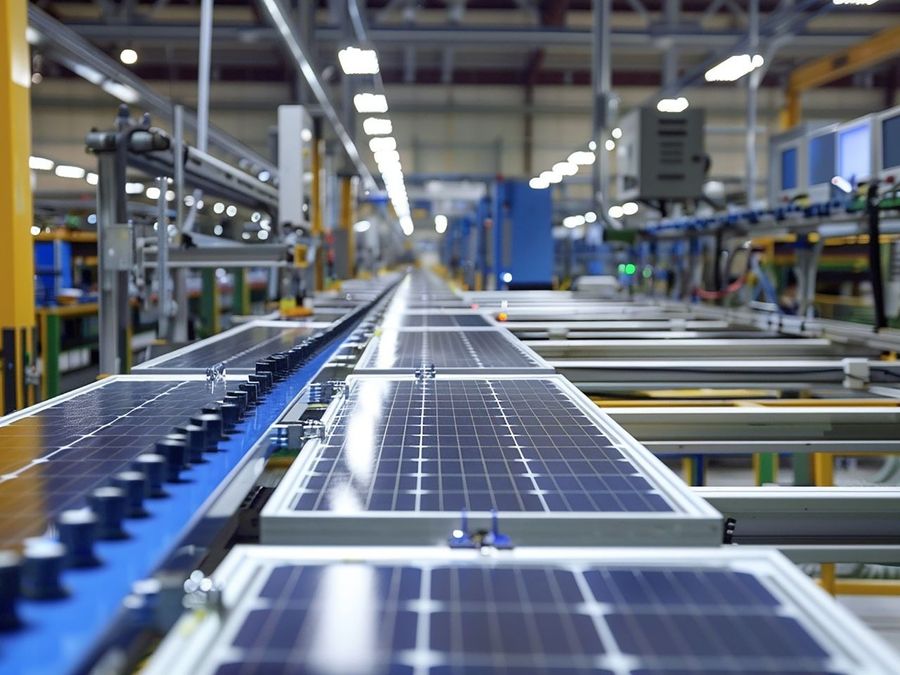
Canadian Solar is ramping up its U.S. manufacturing footprint as the company bets on domestic solar supply chains and higher-value clean energy manufacturing amid evolving policy and trade dynamics in the American market.

The company said trial production has commenced at its flagship heterojunction (HJT) solar cell manufacturing facility in Jeffersonville, Indiana, marking a major milestone in its U.S. localisation strategy. Commercial operations at the plant are expected to begin in July 2026.

Thrust on HJT 

Canadian Solar said the Indiana facility is expected to become one of the first commercial-scale HJT solar cell manufacturing plants in the United States. The first phase of the project has a nameplate capacity of 2.1 GWp, while a second expansion phase planned for early 2027 would add another 4.2 GWp of capacity.

In parallel, the company is also expanding its solar module manufacturing operations in Mesquite, Texas. Canadian Solar currently operates a 5 GWp module factory at the site and plans to scale the facility to 10 GWp capacity by the second half of 2026.

The company said growing customer demand and the broader shift towards reshoring solar manufacturing in the United States are driving these investments. CEO Colin Parkin said the company’s U.S. manufacturing operations are contributing stronger margins as Canadian Solar continues to localise its supply chain.

Focus on Domestic Manufacturing 

Founder Dr. Shawn Qu said the company is moving from a “volume-driven expansion” strategy towards a “value-driven leadership” approach, with greater emphasis on technology, domestic manufacturing and energy storage integration.

Alongside manufacturing expansion, Canadian Solar is also witnessing rapid growth in its battery energy storage business. The company’s total global battery energy storage project pipeline reached 80.6 GWh as of March 2026, while its contracted e-STORAGE backlog stood at $3.5 billion.

The company reported battery storage shipments of 2.1 GWh in the first quarter of 2026, up 142% year-on-year, significantly outpacing solar module growth.

Canadian Solar’s broader solar project development pipeline stood at 23.7 GWp globally as of March 2026, spanning North America, Europe, Latin America and Asia-Pacific markets.

On the financial front, the company reported Q1 2026 revenue of $1.1 billion with a gross margin of 25.1%. Net loss attributable to shareholders narrowed to $32 million during the quarter, compared to $86 million in the previous quarter.

Free Training

Source link