Novartis finalizes US manufacturing and R&D expansion plan with seventh new facility


Real-time Estimate


Cboe Europe


07:06:01 2026-04-30 am EDT

5-day change

1st Jan Change

115.28 CHF

+1.71%

Intraday chart for Novartis AG

-1.12%

+4.91%

Published on 04/30/2026
at 07:00 am EDT

Dow Jones

(MORE TO FOLLOW) Dow Jones Newswires

April 30, 2026 07:00 ET (11:00 GMT)

Dow Jones logo
© Dow Jones –
2026

DurationAuto.2 months3 months6 months9 months1 year2 years5 years10 yearsMax.

PeriodDayWeek

Chart Novartis AGLogo Novartis AG
Novartis AG is one of the world’s leaders in the design, manufacturing, and marketing of pharmaceutical products. Net sales break down by therapeutic area as follows:

– oncology (30.9%);

– immunology (18.9%);

– cardiovascular, renal and metabolic diseases (16.4%);

– neuroscience (11%).

The remaining net sales (22.8%) are from contract manufacturing of pharmaceutical products.

At the end of 2025, Novartis AG had over 31 production sites worldwide.

Net sales are distributed geographically as follows: Switzerland (2.6%), Europe (28.1%), the United States (42.8%), Asia/Africa/Australasia (19.8%), Canada and Latin America (6.7%).

Trader

Trader

This super rating is the result of a weighted average of the rankings based on the following ratings: Valuation (Composite), EPS Revisions (4 months), and Visibility (Composite). We recommend that you carefully review the associated descriptions.

Investor

Investor

This super composite rating is the result of a weighted average of the rankings based on the following ratings: Fundamentals (Composite), Valuation (Composite), EPS Revisions (1 year), and Visibility (Composite). We recommend that you carefully review the associated descriptions.

Global

Global

This composite rating is the result of an average of the rankings based on the following ratings: Fundamentals (Composite), Valuation (Composite), Financial Estimates Revisions (Composite), Consensus (Composite) and Visibility (Composite). The company must be covered by at least 4 of these 5 ratings for the calculation to be carried out. We recommend that you carefully review the associated descriptions.

Quality

Quality

This composite rating is the result of an average of rankings based on the following ratings: Returns (Composite), Profitability (Composite) and Quality of Financial Reporting (Composite), and Financial Health (Composite). The company must be covered by at least 2 of these 3 ratings for the calculation to be performed. We recommend that you carefully read the associated descriptions.

ESG MSCI

ESG MSCI

The MSCI ESG score assesses a company’s environmental, social, and governance practices relative to its industry peers. Companies are rated from CCC (laggard) to AAA (leader). This rating helps investors incorporate sustainability risks and opportunities into their investment decisions.

SellConsensusBuy

Last Close Price

143.45USD

Average target price

153.80USD

Spread / Average Target

+7.21%

Quarterly revenue – Rate of surprise

Indices
Europe

America

Asia

Download from Apple Store

OUR EXPERTS ARE HERE FOR YOU

Monday – Friday 9am-12pm / 2pm-6pm GMT + 1

MarketScreener, Stock Market Live
Legal information
|
Cookie settings
|
MarketScreener Blog
|
About us
|
Copyright © 2026 Surperformance SAS. All rights reserved.

Stock quotes are provided by Factset, Morningstar and S&P Capital IQ

Select your edition

All financial news and data tailored to specific country editions

Free Training

Source link

Skyrover wants to replace DJI drones in America: Here’s its plan


skyrover drone us manufacturing warranty legit fcc

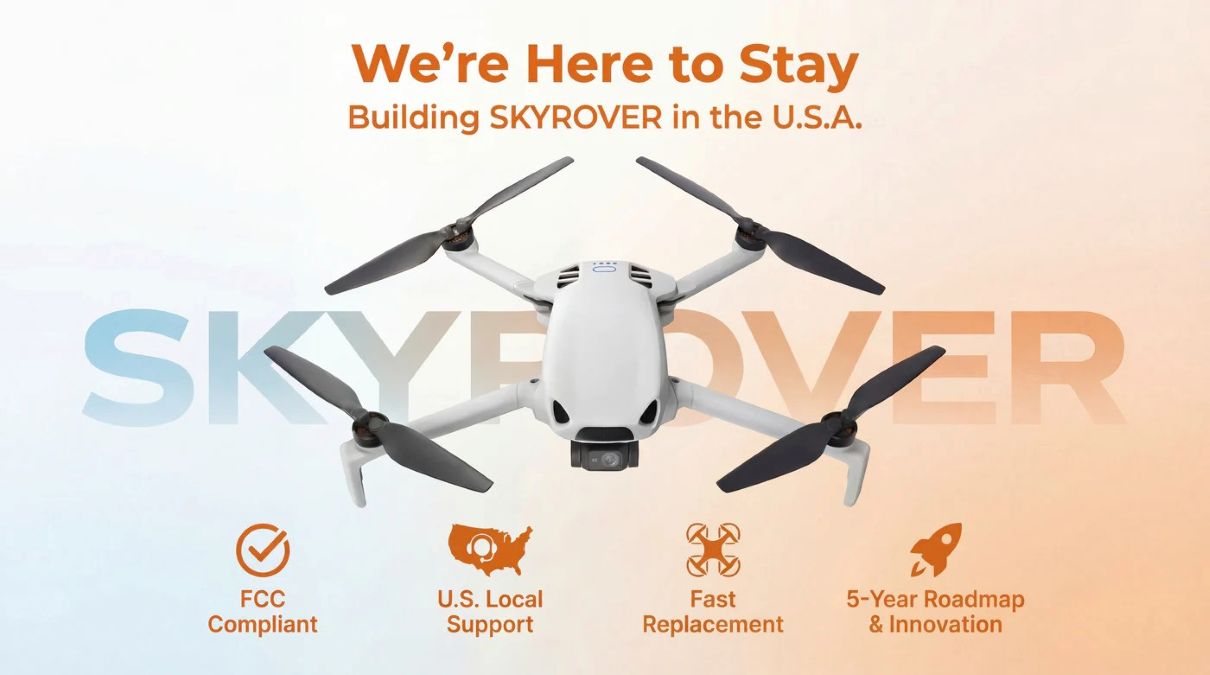
Skyrover, a relatively new but increasingly visible drone brand, is stepping into a tense and uncertain US market, and it’s doing so with a very clear message: we’re here to stay. Here’s what that means for American drone buyers right now.

A growing presence in the US drone market

Over the past year, Skyrover has quietly expanded its footprint in the United States, largely through mainstream retail channels like Best Buy and Amazon. That alone is notable since most emerging drone brands struggle to break into big-box distribution.

On the product side, Skyrover has been targeting entry-level and mid-range consumers, especially those who want to shoot vertical videos and social media content. Drone enthusiasts have pointed out similarities between Skyrover’s flight systems and technology used within the broader DJI ecosystem, suggesting the drone may benefit from engineering concepts derived from the tech giant’s platforms. But at the end of the day, Skyrover wants to distinguish itself by offering DJI-style capabilities without DJI-style prices.

The $289 Skyrover S1, for instance, features a 1/2-inch Sony sensor capable of capturing 48-megapixel photos and 4K video at 60 frames per second. Another standout feature is forward obstacle avoidance, something rarely seen in drones under $300. Skyrover X1, on the other hand, promises a 1/1.32-inch CMOS sensor, 360° obstacle avoidance, true vertical shooting, AI tracking, and extended transmission range for only $499.

Advertisement – scroll for more content

The elephant in the room: Regulation

Skyrover’s recent public statement directly addresses a growing concern among US drone buyers: Will foreign-made drones remain viable in the long term?

That concern isn’t unfounded. Policymakers and regulators, including the Federal Communications Commission, have been tightening scrutiny on foreign technology, particularly devices that rely on radio communications and data transmission. The FCC plays a key role here because any drone sold in the US must comply with its equipment authorization rules. These regulations ensure that devices:

  • Use approved radio frequencies
  • Avoid harmful interference
  • Meet safety and communication standards

More recently, the FCC has also been exploring restrictions tied to national security concerns. The FCC has already added foreign-made drones and key components to its “Covered List” following national security determinations. While some devices were later removed, most foreign-produced UAS and critical components still face restrictions when it comes to entering the US market.

Skyrover’s response: Reassurance and a roadmap

Skyrover is tackling those concerns head-on. In its statement to US customers, the company emphasizes that all its drones sold domestically are fully FCC-compliant and designed to meet current regulatory standards. That’s the baseline, but the more interesting part is what comes next. The company has laid out a five-year roadmap that reads as both a commitment and a strategic signal.

Short term (within one year):

  • Maintain FCC compliance across all products
  • Expand retail availability and local inventory
  • Improve US-based customer support, including replacement-first service

That last point stands out. Instead of traditional repair workflows, Skyrover is leaning into replacement-based support, which could significantly reduce downtime for users.

Mid-term (2-3 years):

  • Build a stronger US team
  • Deepen partnerships with retailers and service providers
  • Improve after-sales infrastructure

Long-term (up to five years):

  • Explore US-based manufacturing
  • Localize parts of its supply chain
  • Continue adapting to evolving regulations

For American consumers, the biggest fear isn’t just buying a drone, it’s buying one that might lose support, updates, or legality down the line. Skyrover is clearly trying to get ahead of that narrative. By emphasizing regulatory compliance, local support infrastructure, and potential US manufacturing, the company is positioning itself as a stable, long-term player rather than a short-lived import brand.

Of course, execution will matter more than promises. Building a US supply chain and maintaining regulatory alignment, especially in a fast-changing policy environment, is no small task. But Skyrover’s message reflects a broader shift happening across the drone industry. As geopolitical tensions and regulatory scrutiny increase, foreign drone makers are being forced to localize operations, increase transparency, and invest in long-term US strategies.

For now, Skyrover’s approach is simple: reassure customers, stay compliant, and build trust over time.

More: GoPro’s new camera might be its biggest comeback move


Add DroneDJ as a preferred source on Google

FTC: We use income earning auto affiliate links. More.

Free Training

Source link

Poilievre unveils auto plan aiming for tariff-free access to U.S. market


Conservative Leader Pierre Poilievre unveiled the party’s most substantial auto strategy to date under his leadership, which he says will both bring back production to Canada and be “highly attractive” to partners south of the border.

“Canada’s auto sector must stay alive and it must have access to the U.S. to do so,” Poilievre said while in Windsor, Ont., on Sunday.  

Poilievre said he’d like to institute a tariff-free auto pact and has a plan to restore Canada’s auto production to two million cars per year over the next 10 years. 

Also included in the plan is a call to remove the GST on all Canadian-made vehicles, something the NDP and Conservatives proposed during the 2025 general election campaign. 

The proposal was announced amid Poilievre’s first visit to the United States since U.S. President Donald Trump launched his trade war, a significant marker in the Conservative leader’s shifting focus on global trade pressures brought about by the Trump administration. 

“He’s going down there to sell Canada, it’s what we have to do,” Conservative labour critic Kyle Seeback told Rosemary Barton Live. 

Seeback said the purpose of the trip is not to give the impression that there are two prime ministers in Canada.

Rather, he said, with the CUSMA (Canada-U.S.-Mexico Agreement) review coming up, Poilievre is making the case to U.S. business leaders about the importance of the trading relationship and how tariffs can hurt both countries.

WATCH | Conservative labour critic on the party’s auto plan, Poilievre’s U.S. trip:

Federal Conservatives pitch new auto strategy as tariffs roil industry

Conservative Leader Pierre Poilievre has announced a plan for the hard-hit auto sector that aims to secure tariff-free access to the U.S. market and boost Canada’s auto production. Chief political correspondent Rosemary Barton speaks with Conservative MP Kyle Seeback, the party’s labour critic, about the plan, as well as Poilievre’s U.S. trip.

Will Trump agree?

At the heart of this auto strategy is the push to get Trump to drop tariffs on Canada by selling this strategy as a better way to restore U.S. manufacturing. 

This push rests on the assumption that Trump is open to solving its trade relationship with Canada, despite there being a lack of evidence to suggest willingness on the part of the administration. 

Asked how he’d get Trump to give the green light, Poilievre says his plan addresses the president’s desire to repatriate production to the U.S. and would see a “massive production gain” on both sides of the border.  

A man in a suit shaking hands with another man in a suit as workers look on Poilievre meets with workers and politicians at Cavalier Tool and Manufacturing in Windsor, Ont., on Sunday. (Pratyush Dayal/CBC)

A 1-for-1 car deal

Poilievre laid out a one-for-one deal, where for every car manufactured in Canada, he said, that same producer would get a car to sell duty free from a partner in CUSMA. 

This can be sold as a “win, win,” said Seeback. 

“It’s a better way for the United States to reshore the auto manufacturing in their country while preserving their best export market for autos, which is Canada.”

Seeback says this strategy harkens back to the 1965 auto pact that kick-started free trade between Canada and the U.S., prior to the North American Free Trade Agreement. 

Seeback said this new version of the auto pact would position Canada to be able to harmonize with the U.S. on Chinese electric vehicle policy, part of Poilievre’s strategy to bring “maximum leverage” to the CUSMA review.

“When you put these things together, helping them restore their auto manufacturing, preserving the Canadian market and better alignment on things like Chinese electric vehicles, we actually think there’s an opportunity to get that deal,” said Seeback. 

The federal government recently struck a deal with China to bring tariff relief for Canada’s agricultural and seafood sectors.

In a move that broke ranks with the U.S., Prime Minister Mark Carney agreed to allow up to 49,000 Chinese electric vehicles into Canada, lowering a 100 per cent tariff on imports, imposed in 2024, back to six per cent. 

A tale of three strategies 

The U.S. strategy has been focused on protecting its big three automakers: General Motors, Ford Motor Company and Stellantis. 

To thwart Trump’s protectionist policies, Carney’s approach has been to diversify Canada’s trading partners and look to attract European, Japanese and Korean automakers to Canada. 

Now, more than a year after Trump returned to office, Poilievre is looking to show his plan for dealing with the White House.

For decades, Canada’s sales pitch to the world has rested on having tariff-free access to the U.S. market. Seeback said that if that’s not the case, there’s “not a single producer in the world” that will come to Canada to start new production.

Seeback calls Carney’s approach “managed decline” and said he does not believe it will work. 

Poilievre said that even Mexico would have to accept the plan to avoid ending up with something “much worse.” 

More U.S. meetings ahead

On Friday, Poilievre was in Detroit to meet with senior executives of General Motors and Ford. He crossed the Detroit River back into Canada Sunday to make his auto strategy announcement in Windsor.

His U.S. travel will continue with stops in Texas and New York, with no visit planned for the U.S. capital. 

In an interview on The Paul Wells Show podcast, Poilievre said he updated Carney about his travel plans on the margins on Question Period last Wednesday and plans to debrief him once he returns.

Free Training

Source link

US manufacturing pipeline grows, firms plan $1B in new factories


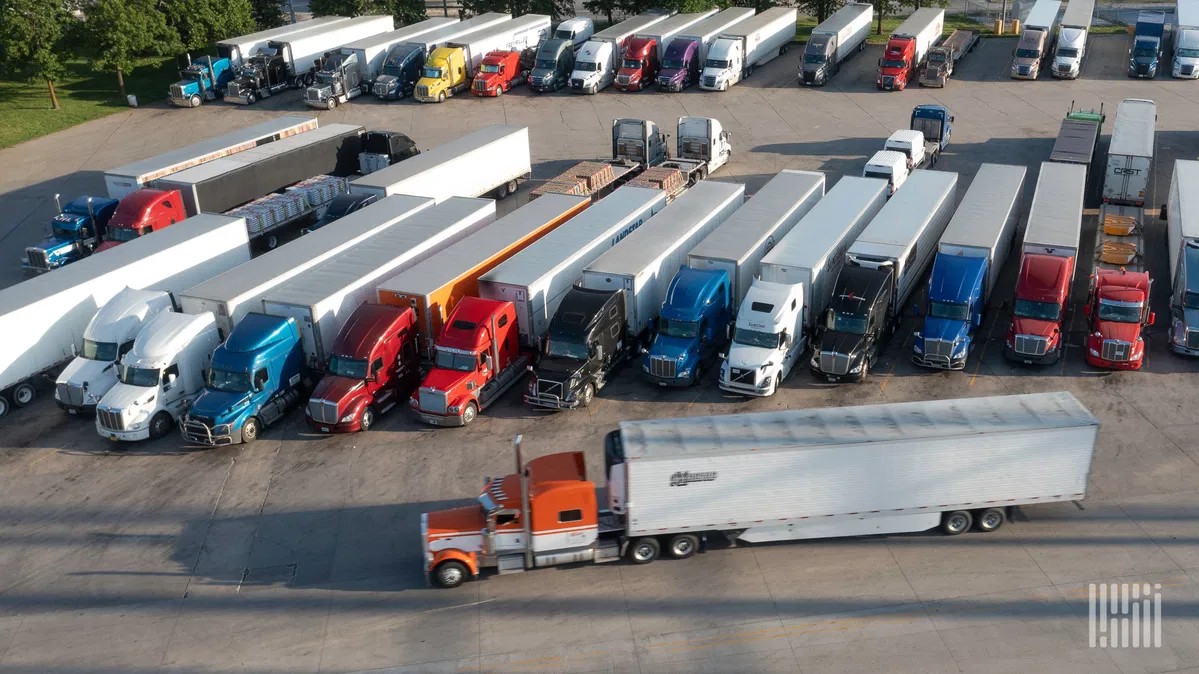
A wave of new manufacturing projects announced in recent weeks underscores continued capital investment across the U.S., with companies in heavy equipment, advanced electronics, automation and industrial components committing around $1 billion combined in new facilities and expansions.

From North Carolina to Texas to Idaho and Wisconsin, manufacturers are breaking ground on large-scale plants expected to create thousands of jobs while reshoring or expanding domestic production capacity.

Deere & Co. announced plans to open two new facilities: a distribution center near Hebron, Indiana, and a $70 million excavator factory in Kernersville, North Carolina.

According to the company’s news release, the Indiana distribution center is expected to create about 150 jobs and strengthen parts logistics nationwide. The North Carolina plant will employ more than 150 people and will assume production of next-generation excavators previously manufactured in Japan, marking a shift of that production to the U.S.

The excavator factory is part of Deere’s broader commitment to invest $20 billion in U.S. manufacturing over the next decade, the company said.

Radar platform company Echodyne is investing $40 million in a new 86,350-square-foot manufacturing facility in Kirkland, Washington.

The new plant is designed to produce and ship more than 30,000 radars annually across product lines. The company said it expects to employ more than 200 workers when the facility reaches full capacity, with production scheduled to begin in summer 2026.

The expansion comes amid growing global demand for counter-drone, border security and defense-related radar technologies.

In Sugar Land, Texas, Applied Optoelectronics Inc. (AOI) broke ground on a 210,000-square-foot manufacturing facility that will support production of optical networking products for AI data centers and broadband networks.

AOI said it plans to increase its total investment in the project and headquarters campus from $150 million to potentially $300 million by the end of next year. The company has committed to creating 500 local jobs tied to automated production lines.

Executives positioned the expansion as part of Texas’ broader push to become a leader in artificial intelligence infrastructure manufacturing.

Sanko Texas Corp., a subsidiary of a Japanese plastics manufacturer, plans to build a nearly $40 million plant on a 43.7-acre site in San Antonio.

The facility — which will serve as Sanko’s first U.S. manufacturing plant and its U.S. headquarters — is expected to create up to 300 jobs once fully ramped, beginning with about 100 hires in early 2028, according to the San Antonio Express News.

Sanko produces plastic injection-molded pallets and containers commonly used in automotive assembly lines and industrial supply chains.

Preciball USA announced a $17.6 million investment to build a new factory in Sylvania, Screven County, Georgia, according to a news release.

The plant will manufacture precision balls used in bearings, pumps and valves, and is expected to create 65 jobs. The project expands the company’s footprint in Georgia, complementing its existing headquarters operations in Pooler.

Industrial automation giant Rockwell Automation selected New Berlin, Wisconsin, as the site of a new manufacturing campus described as a “factory of the future.”

The planned greenfield facility is expected to exceed 1 million square feet of factory and warehouse space and is part of a broader five-year, $2 billion domestic manufacturing investment strategy, according to Milwaukee Journal Sentinel.

While job figures have not yet been disclosed, company leadership characterized the project as potentially becoming Rockwell’s largest manufacturing campus globally.

Schweitzer Engineering Laboratories (SEL) has begun site preparation for a new 250,000-square-foot electronic device manufacturing facility in Moscow, Idaho.

The $50 million investment will expand production of devices used to monitor and protect electric power systems worldwide. Once fully operational, the plant is expected to employ approximately 1,000 people, with phased hiring beginning in 2027.

Fresh meal and technology provider Tovala recently announced a new 140,340 square-foot food processing facility in Winfield, Illinois to meet growing demand.

Chicago-based Brennan Investment Group will develop the state-of-the-art facility as a build-to-suit project, with construction scheduled to begin in March 2026 and completion expected in the second quarter of 2027. The project marks Brennan’s fourth build-to-suit development in the food service sector.

The post US manufacturing pipeline grows, firms plan $1B in new factories appeared first on FreightWaves.

Free Training

Source link

Assessing Deere’s (DE) Valuation After US$20b US Manufacturing Expansion Plan


Expansion in Indiana and North Carolina puts Deere (DE) in focus

Deere (DE) is drawing fresh attention after outlining a $20b plan to expand U.S. manufacturing. The initiative includes a new parts distribution center in Hebron, Indiana, and an excavator factory in Kernersville, North Carolina.

See our latest analysis for Deere.

The expansion plan lands at a time when momentum in Deere’s shares has been picking up, with a 1 month share price return of 21.7% and a year to date share price return of 21.5%. Over longer periods, total shareholder returns of 23.0% over one year and 93.1% over five years indicate that recent gains build on an already strong track record, as investors digest both the new U.S. manufacturing investment and recent boardroom and governance developments ahead of the upcoming earnings call.

If you are weighing Deere’s latest moves against what else is happening in industrials, it could be worth scanning aerospace and defense stocks for other capital goods names that are drawing attention.

With Deere shares up around 22% over the past month and trading near US$567, the stock sits close to some analyst targets yet shows an estimated 12% intrinsic discount. This raises the question: is there still upside here, or is future growth already priced in?

Most Popular Narrative: 7.7% Overvalued

At $567.26, Deere sits above a widely followed fair value estimate of about $526.91, which is built around precision agriculture, margins, and a maturing cycle.

Rapid adoption of Deere’s precision agriculture and automation solutions (e.g., JDLink Boost, Precision Essentials bundles, See & Spray tech, and new automation features) is driving higher-value product sales and increased software engagement globally, positioning Deere to benefit from shifts toward high-efficiency, technology-enabled farming. This is expected to support both future revenue and net margins through higher-margin recurring software and data services.

Read the complete narrative.

Curious what kind of earnings power this assumes? The narrative leans heavily on margin expansion, recurring software revenue and a richer profit multiple. The exact numbers might surprise you.

Result: Fair Value of $526.91 (OVERVALUED)

Have a read of the narrative in full and understand what’s behind the forecasts.

However, there are clear pressure points, including higher tariff and input costs, as well as a softer North American large ag market, that could cap margins and challenge the upbeat Precision Ag story.

Find out about the key risks to this Deere narrative.

Another View: Cash Flows Point To Undervaluation

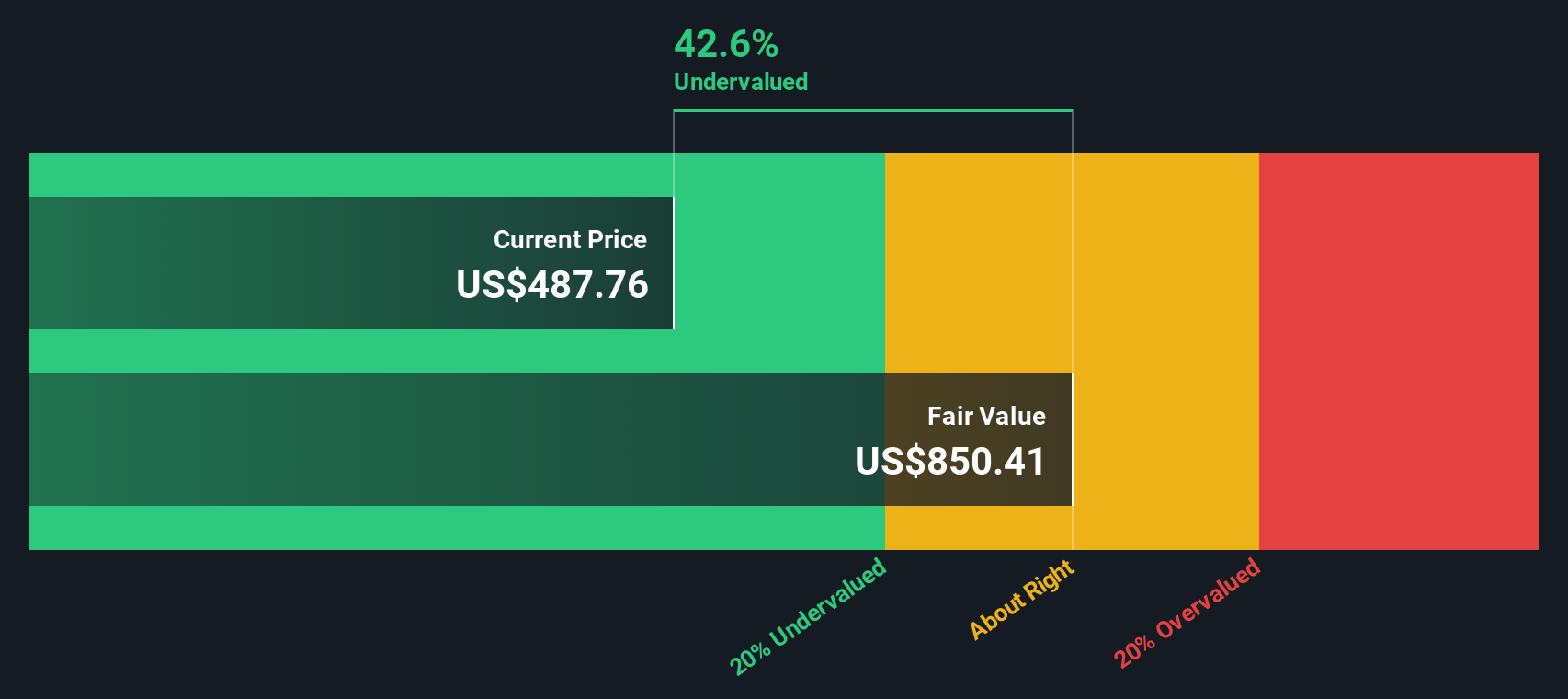
The narrative fair value of about $526.91 suggests Deere is 7.7% overvalued at $567.26, but our DCF model points in the opposite direction. On that view, the shares trade around 12% below an estimated future cash flow value of $644.77. Which picture do you think better reflects the risks and rewards?

Look into how the SWS DCF model arrives at its fair value.

DE Discounted Cash Flow as at Feb 2026DE Discounted Cash Flow as at Feb 2026

Simply Wall St performs a discounted cash flow (DCF) on every stock in the world every day (check out Deere for example). We show the entire calculation in full. You can track the result in your watchlist or portfolio and be alerted when this changes, or use our stock screener to discover 867 undervalued stocks based on their cash flows. If you save a screener we even alert you when new companies match – so you never miss a potential opportunity.

Build Your Own Deere Narrative

If you look at this and think the story should read differently, you can test the assumptions yourself in minutes with Do it your way.

A great starting point for your Deere research is our analysis highlighting 2 key rewards and 1 important warning sign that could impact your investment decision.

Looking for more investment ideas?

If Deere has sharpened your interest, do not stop here. Use the Simply Wall St screener to spot other stocks that might fit your style and goals.

This article by Simply Wall St is general in nature. We provide commentary based on historical data
and analyst forecasts only using an unbiased methodology and our articles are not intended to be financial advice.
It does not constitute a recommendation to buy or sell any stock, and does not take account of your objectives, or your
financial situation. We aim to bring you long-term focused analysis driven by fundamental data.
Note that our analysis may not factor in the latest price-sensitive company announcements or qualitative material.
Simply Wall St has no position in any stocks mentioned.

New: Manage All Your Stock Portfolios in One Place

We’ve created the ultimate portfolio companion for stock investors, and it’s free.

• Connect an unlimited number of Portfolios and see your total in one currency
• Be alerted to new Warning Signs or Risks via email or mobile
• Track the Fair Value of your stocks

Try a Demo Portfolio for Free

Have feedback on this article? Concerned about the content? Get in touch with us directly. Alternatively, email editorial-team@simplywallst.com

Free Training

Source link