

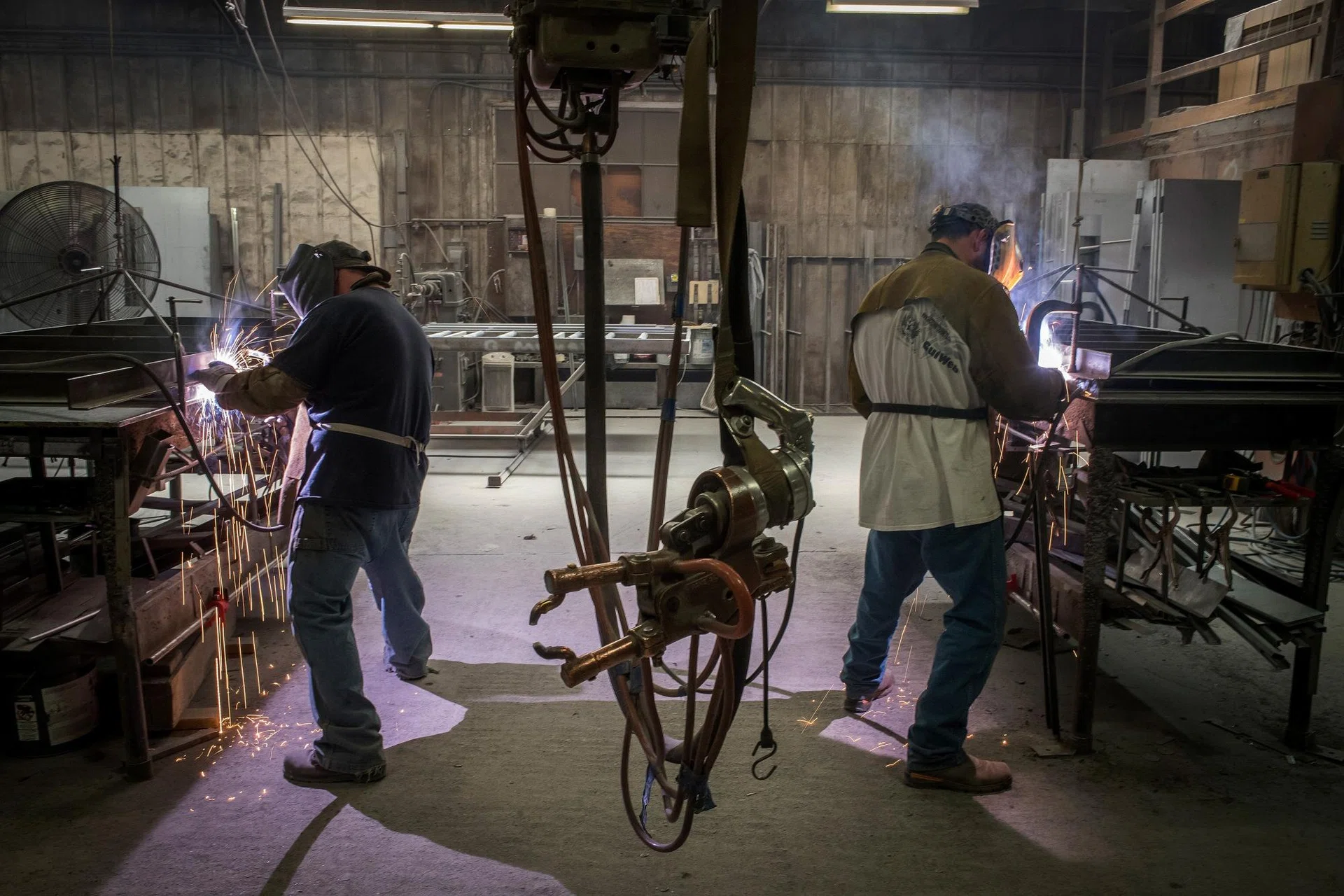
US manufacturing grew, input costs soared before Iran attack


Published Tue, Mar 3, 2026 · 06:03 AM

[WASHINGTON] US manufacturing expanded in February but input prices soared at the fastest pace since 2022, stoking fears of an inflation resurgence even before this weekend’s attacks on Iran.

The Institute for Supply Management’s (ISM) gauge of prices paid for manufacturing inputs jumped 11.5 points to 70.5, the highest level since overall inflation peaked nearly four years ago.

The figures out Monday (Mar 2) reflected responses ahead of US and Israeli airstrikes on Iran this past weekend. The war has all but halted oil tanker traffic through the Strait of Hormuz and pushed crude prices sharply higher.

The conflict also risks tempering a nascent recovery in manufacturing. ISM’s measure of factory activity was little changed at 52.4, indicating a second month of growth at one of the highest readings in recent years. Orders and production growth remained solid.

Treasury yields rose following the report. The S&P 500 remained lower.

The group’s price gauge is likely to remain elevated or even push higher over the near-term after oil prices jumped on Monday by the most since early 2022, following Russia’s invasion of Ukraine.

Navigate Asia in
a new global order

Get the insights delivered to your inbox.

Higher energy prices represent the latest cost challenge for manufacturers. If sustained, producers may have little choice but to raise prices for their business customers and consumers.

The impact from the Middle East turmoil will depend on how the duration of the conflict and where primary materials are sourced, said Susan Spence, chair of the ISM Manufacturing Business Survey Committee.

“It really does depend on the sector and where they are importing their raw materials from,” Spence said on a call with reporters. “In general, the supply managers have yet another challenge on their hands.”

SEE ALSO
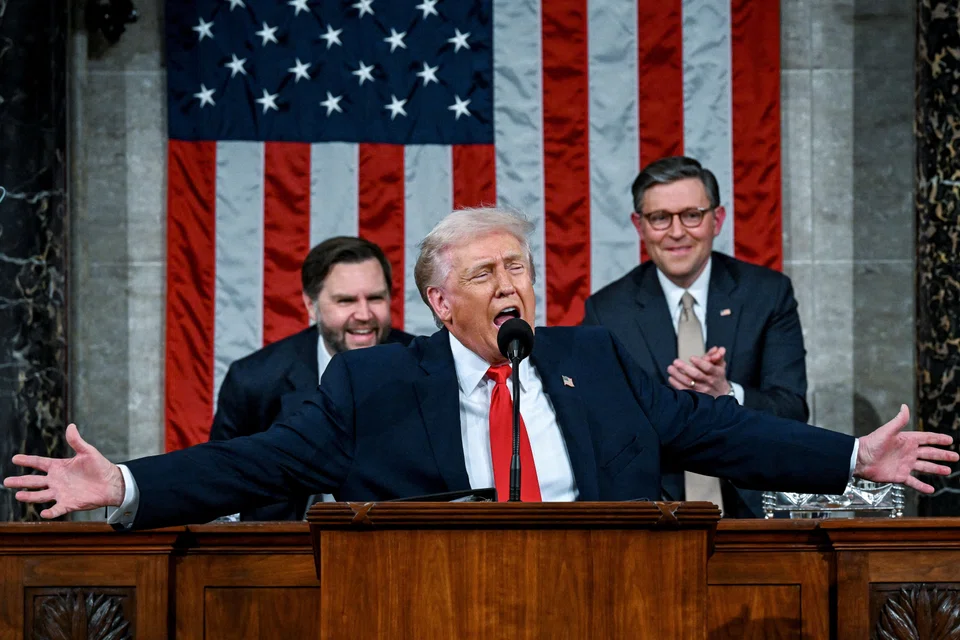
US President Donald Trump started his address by defending the US economy.

Producer price data out last week showed the cost of unprocessed goods, minus food and energy, rose more than 15 per cent in January from a year ago, the steepest annual gain since April 2022. A Bloomberg index of metals, including copper and aluminium, has also increased sharply this year.

The assortment of recent price data along with geopolitics point to a steady undercurrent of inflation for US producers, which is being partially fed by higher import duties from the Trump administration. It also explains why US Federal Reserve policymakers are in little rush to lower interest rates after three straight cuts at the end of 2025. BLOOMBERG

Decoding Asia newsletter: your guide to navigating Asia in a new global order. Sign up here to get Decoding Asia newsletter. Delivered to your inbox. Free.

Free Training

Source link

Trump’s Attack on Green Energy Hits Manufacturing Sector Hard


United States President Donald Trump has repeatedly pledged to ramp up the country’s manufacturing capacity and create more American jobs across a wide range of industries. While Trump has supported the expansion of certain industries, he has hindered the operation of others. In recent months, Trump has attacked green energy, using executive orders and new policies to restrict renewable energy development and cleantech manufacturing. This has resulted in sectoral stagnation, as investors grow more uncertain about the future of the industry.

In 2024, during the presidential campaign, Trump stated that the new American industrialism “will create millions and millions of jobs, massively raise wages for American workers, and make the United States into a manufacturing powerhouse like it used to be many years ago.”

Upon entering office in January last year, Trump pledged to expand fossil fuel production and boost U.S. manufacturing. “The inflation crisis was caused by massive overspending and escalating energy prices, and that is why today I will also declare a national energy emergency. We will drill, baby, drill,” stated Trump.

Set OilPrice.com as a preferred source in Google here.

“America will be a manufacturing nation once again, and we have something that no other manufacturing nation will ever have – the largest amount of oil and gas of any country on Earth – and we are going to use it,” the president added. He later described “tariffs” as his favourite word, and said the introduction of tariffs on foreign imports was key to bringing manufacturing back to the U.S.

These pledges have not been achieved. Employment in the manufacturing sector remained relatively flat during the first few months of Trump’s presidency, before falling for eight months straight. In addition, wage growth for non-managerial factory workers slowed in 2025. While Trump supporters say it will take time to see the positive impact of his trade policies, critics suggest that investment in factory construction has also fallen in recent months, which makes mid-term growth unlikely.

While manufacturing in general has suffered in recent months, green manufacturing has fared even worse. Under former President Biden, the U.S. witnessed significant growth in cleantech manufacturing. Years of increased investment in battery, electric vehicle (EV), solar panel, and other cleantech manufacturing, supported by funding from the Inflation Reduction Act (IRA), led to rapid industry expansion in this sector.

The IRA drove an estimated $100 billion in cleantech manufacturing commitments through incentives for consumers and manufacturers. This led to the creation of thousands of jobs in the sector and a strong cleantech project pipeline, which encouraged investors to support long-term sectoral growth. This was reflected in the expansion of cleantech manufacturing in states across the political spectrum, including traditional oil and gas-producing regions. 

However, since becoming president, Trump has sought to stall IRA progress and shift the focus to fossil fuel expansion. He has done this by halting wind energy developments, encouraging consumers to continue investing in gas-guzzling cars instead of EVs, and introducing numerous, far-reaching executive orders targeting renewable energy. In 2025, Trump placed stipulations on incentives for manufacturing facilities and cut several of the tax credits that helped grow demand for U.S.-produced cleantech.

Companies spent a total of around $41.9 billion on cleantech manufacturing factories in 2025, marking a significant reduction from the $50.3 billion investment made in 2024, according to data from the Clean Investment Monitor. Further, fewer businesses are making plans to invest in cleantech, due to the growing investor uncertainty of the last year. Although companies in the U.S. announced $24.1 billion in new cleantech manufacturing projects, $22.7 billion worth of cleantech projects were cancelled.

For example, in 2025, the Singapore-based solar panel producer Bila Solar halted plans to double capacity at its Indianapolis facility. Canada’s Heliene announced it was assessing plans for its Minnesota solar cell plant. Norway’s solar wafer producer, NorSun, also halted development to assess whether to move forward with a planned facility in Tulsa, Oklahoma. And two offshore wind farms in the northeast of the country faced the risk of not being completed due to opposition from the Trump administration.

The factory cancellations have resulted in the loss of thousands of jobs. At least 10,000 green energy manufacturing jobs were lost last year, out of a total of 72,000 manufacturing jobs lost in 2025, according to U.S. government figures. The job cuts were industry-wide, from EV production to solar panel manufacturing, and everything in between.

This may be just the beginning of the downfall of U.S. green energy manufacturing, as the Trump administration continues to revise, restructure, and cancel billions of Biden-era funding commitments for U.S. renewable energy and cleantech projects, in favour of expanding fossil fuels. In January, the U.S. Department of Energy announced that the Office of Energy Dominance Financing is restructuring, revising, or eliminating over $83 billion in what it termed “Green New Scam” loans and conditional commitments from the Biden-era loan portfolio.  

By Felicity Bradstock for Oilprice.com

More Top Reads From Oilprice.com

Free Training

Source link