Jul 11, 2026
Liz Claman delivered a live report from Clay, New York, where Micron is developing a memory chip fabrication facility with a price tag of $250 billion.
On Friday, President Donald Trump promoted Micron Technology‘s intention to allocate $250 billion toward U.S. semiconductor production, which the firm claims will become the biggest chip manufacturing site ever built in the country.
The enterprise headquartered in Boise, Idaho, revealed on Thursday that it is speeding up its domestic manufacturing and research expenditures, targeting 40% of its DRAM memory chip output to occur within the United States.
Trump posted on Truth Social that the move exemplifies what he called the Trump Effect, asserting that his administration is cutting regulations and reviving American industry after years of obstruction by prior Democratic leadership.
Micron anticipates spending over $250 billion by 2035, fueled by rising need for memory chips amid the artificial intelligence boom. The company noted that erecting the New York plant will demand thousands of skilled laborers, offering roles for union members, apprentices, graduates of local training initiatives, specialized contractors, and suppliers.
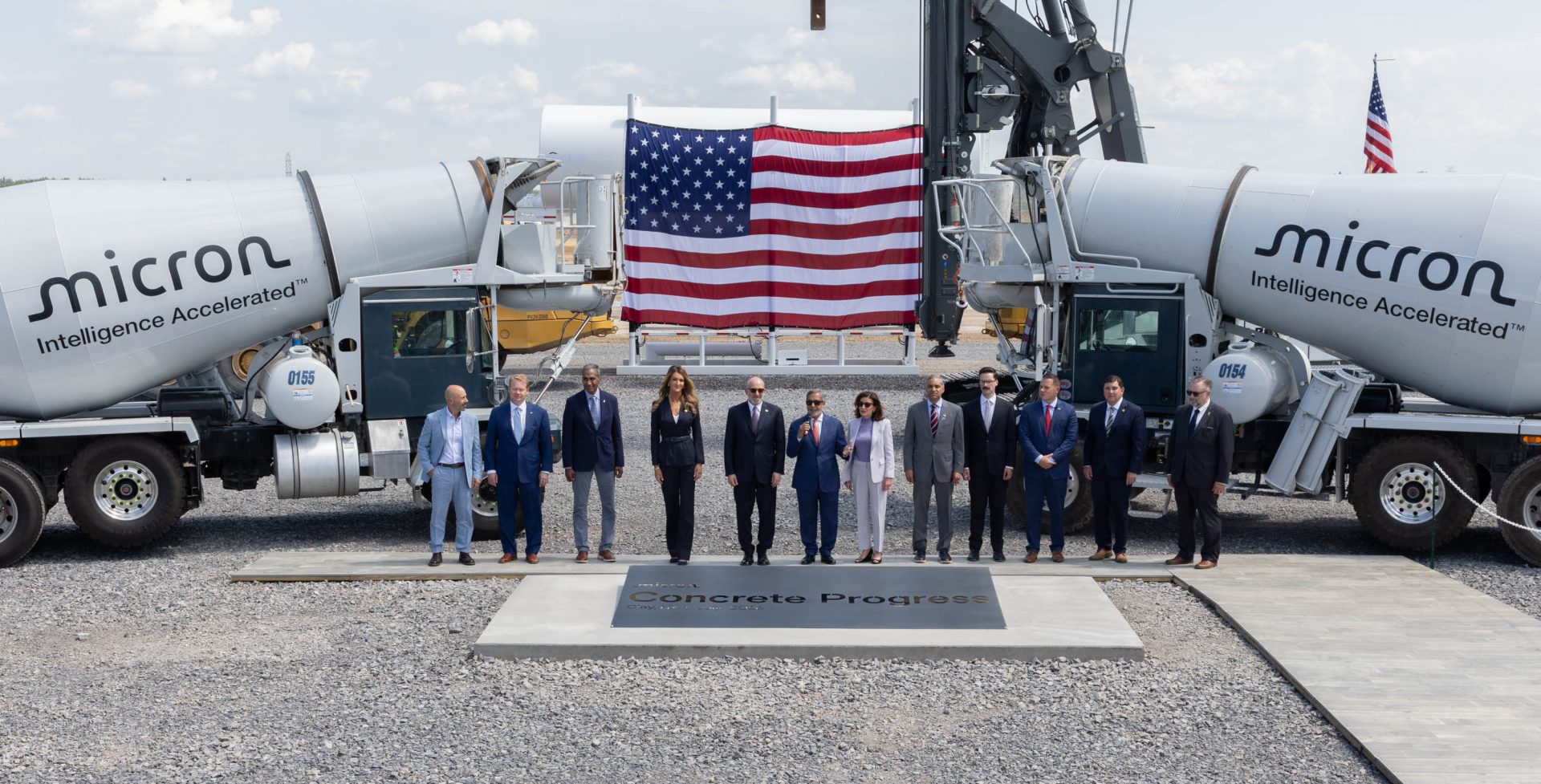
The project achieved its initial concrete placement at the Clay, New York, location on Thursday. Micron described it as the most substantial private investment in New York state history, projected to generate 50,000 jobs across the state, including 9,000 positions directly with Micron.
Micron further stated that its semiconductor operations in Idaho and Virginia, together with the New York endeavor, are anticipated to sustain an extra 90,000 jobs while bolstering U.S. economic and national security interests.
Trump also pointed to remarks from Micron President and CEO Sanjay Mehrotra, who indicated the company is raising its planned U.S. manufacturing and research outlay from $200 billion to $250 billion. Mehrotra explained that due to Trump’s leadership and policies, Micron is progressing ahead of schedule and expanding its investment, resulting in 100,000 American jobs. He characterized this as further proof of the Trump Effect driving unprecedented private-sector investment, domestic manufacturing, and employment growth.
Commerce Secretary Howard Lutnick applauded the announcement, stating that the Trump economic approach demonstrates there has never been a more favorable moment to invest in the United States. Kelly Loeffler, head of the U.S. Small Business Administration, remarked that the $250 billion commitment represents precisely the kind of daring, American-made pledge that President Trump’s strategy was intended to unleash.
Interactive table based on the Store Companies dataset for this report.
Sort: Rank
Sort: Company A-Z
Sort: Headquarters A-Z
#
Company
Headquarters
Focus
Scale
Note
1
Micron Technology
Boise, Idaho
DRAM, NAND Flash
Global leader
Major memory IC producer
2
Intel Corporation
Santa Clara, California
3D XPoint, Optane memory
Global giant
Developed advanced memory solutions
3
Western Digital
San Jose, California
NAND Flash, SSDs
Global leader
Flash memory via SanDisk
4
Seagate Technology
Fremont, California
Storage, HDD/SSD controllers
Global leader
Memory systems and controllers
5
Microchip Technology
Chandler, Arizona
Serial memory, EEPROM
Major supplier
Broad memory portfolio
6
SkyWater Technology
Bloomington, Minnesota
Foundry, memory IP
US-based foundry
Produces memory circuits
7
Rambus
San Jose, California
Memory interface IP, chips
IP and chip provider
High-speed memory interfaces
8
Lattice Semiconductor
Hillsboro, Oregon
FPGA, embedded memory
Mid-size
Devices include on-chip memory
9
Monolithic Power Systems (MPS)
San Jose, California
Power management, memory power
Major analog
ICs for memory modules
10
Marvell Technology
Santa Clara, California
Storage controllers, memory interconnect
Global fabless
SSD and memory controller chips
11
Analog Devices (ADI)
Wilmington, Massachusetts
Analog, memory interface ICs
Global giant
ICs for memory systems
12
Texas Instruments
Dallas, Texas
Embedded memory in MCUs/SoCs
Global giant
Memory integrated in devices
13
ON Semiconductor
Phoenix, Arizona
Power management for memory
Global supplier
Supporting memory ICs
14
MaxLinear
Carlsbad, California
RF, analog, memory interface
Fabless supplier
ICs for data storage
15
Integrated Silicon Solution Inc. (ISSI)
San Jose, California
SRAM, DRAM, Flash
Acquired by Chinese firm
US HQ, now subsidiary
16
Cypress Semiconductor (Infineon)
San Jose, California
SRAM, Flash, FRAM
Acquired
Was major US memory vendor
17
Macronix America
San Jose, California
NOR Flash memory
Subsidiary
US arm of Taiwan company
18
Integrated Device Technology (IDT)
San Jose, California
Memory interface, RISC-V
Acquired by Renesas
Was US-based
19
Silicon Motion Technology
San Jose, California
NAND flash controllers
Fabless, US HQ
Taiwanese-founded, US HQ
20
Netlist
Irvine, California
Hybrid memory modules, IP
Design and IP
Memory subsystem technology
21
Vishay Intertechnology
Malvern, Pennsylvania
Discrete, memory modules
Global manufacturer
Produces memory modules
22
SMART Modular Technologies
Newark, California
Memory modules, SSDs
Module manufacturer
Designs memory products
23
Adesto Technologies (Dialog)
Santa Clara, California
Low-power memory, CBRAM
Acquired
Was innovative memory vendor
24
Everspin Technologies
Chandler, Arizona
MRAM, persistent memory
Specialist
Leading MRAM producer
25
Aehr Test Systems
Fremont, California
Test systems for memory ICs
Equipment supplier
Critical for memory production
26
Rogue Valley Microdevices
Medford, Oregon
Foundry, memory prototyping
Small foundry
US-based memory IC maker
27
Nantero
Woburn, Massachusetts
NRAM, carbon nanotube memory
Startup
Developing novel memory ICs
28
Crossbar
Santa Clara, California
ReRAM, resistive RAM
Startup
Developing advanced memory ICs
29
Mythic
Austin, Texas
AI, analog in-memory compute
Startup
Memory-based AI chips
30
Weebit Nano
San Jose, California
ReRAM, embedded memory
Startup
US HQ for Israel-based tech
This report provides a comprehensive view of the memories industry in the United States, tracking demand, supply, and trade flows across the national value chain. It explains how demand across key channels and end-use segments shapes consumption patterns, while also mapping the role of input availability, production efficiency, and regulatory standards on supply.
Beyond headline metrics, the study benchmarks prices, margins, and trade routes so you can see where value is created and how it moves between domestic suppliers and international partners. The analysis is designed to support strategic planning, market entry, portfolio prioritization, and risk management in the memories landscape in the United States.
Quick navigation
Key findings
- Domestic demand is shaped by both household and industrial usage, with trade flows linking local supply to imports and exports.
- Pricing dynamics reflect unit values, freight costs, exchange rates, and regulatory shifts that affect sourcing decisions.
- Supply depends on input availability and production efficiency, creating a distinct national cost curve.
- Market concentration varies by segment, creating different competitive landscapes and entry barriers.
- The 2035 outlook highlights where capacity investment and demand growth are most aligned within the country.
Report scope
The report combines market sizing with trade intelligence and price analytics for the United States. It covers both historical performance and the forward outlook to 2035, allowing you to compare cycles, structural shifts, and policy impacts.
- Market size and growth in value and volume terms
- Consumption structure by end-use segments
- Production capacity, output, and cost dynamics
- Trade flows, exporters, importers, and balances
- Price benchmarks, unit values, and margin signals
- Competitive context and market entry conditions
Product coverage
- Prodcom 26113023 – Multichip integrated circuits: memories
- Prodcom 26113027 – Electronic integrated circuits (excluding multichip circuits): dynamic random-access memories (D-RAMs)
- Prodcom 26113034 – Electronic integrated circuits (excluding multichip circuits): static random-access memories (S-RAMs), including cache random-access memories (cache-RAMs)
- Prodcom 26113054 – Electronic integrated circuits (excluding multichip circuits): UV erasable, programmable, read only memories (EPROMs)
- Prodcom 26113065 – Electronic integrated circuits (excluding multichip circuits): electrically erasable, programmable, read only memories (E.PROMs), including flash E.PROMs
- Prodcom 26113067 – Electronic integrated circuits (excluding multichip circuits): other memories
Country coverage
Country profile and benchmarks
This report provides a consistent view of market size, trade balance, prices, and per-capita indicators for the United States. The profile highlights demand structure and trade position, enabling benchmarking against regional and global peers.
Methodology
The analysis is built on a multi-source framework that combines official statistics, trade records, company disclosures, and expert validation. Data are standardized, reconciled, and cross-checked to ensure consistency across time series.
- International trade data (exports, imports, and mirror statistics)
- National production and consumption statistics
- Company-level information from financial filings and public releases
- Price series and unit value benchmarks
- Analyst review, outlier checks, and time-series validation
All data are normalized to a common product definition and mapped to a consistent set of codes. This ensures that comparisons across time are aligned and actionable.
Forecasts to 2035
The forecast horizon extends to 2035 and is based on a structured model that links memories demand and supply to macroeconomic indicators, trade patterns, and sector-specific drivers. The model captures both cyclical and structural factors and reflects known policy and technology shifts in the United States.
- Historical baseline: 2012-2025
- Forecast horizon: 2026-2035
- Scenario-based sensitivity to income growth, substitution, and regulation
- Capacity and investment outlook for major producing companies
Each projection is built from national historical patterns and the broader regional context, allowing the report to show where growth is concentrated and where risks are elevated.
Price analysis and trade dynamics
Prices are analyzed in detail, including export and import unit values, regional spreads, and changes in trade costs. The report highlights how seasonality, freight rates, exchange rates, and supply disruptions influence pricing and margins.
- Price benchmarks by country and sub-region
- Export and import unit value trends
- Seasonality and calendar effects in trade flows
- Price outlook to 2035 under baseline assumptions
Profiles of market participants
Key producers, exporters, and distributors are profiled with a focus on their operational scale, geographic footprint, product mix, and market positioning. This helps identify competitive pressure points, partnership opportunities, and routes to differentiation.
- Business focus and production capabilities
- Geographic reach and distribution networks
- Cost structure and pricing strategy indicators
- Compliance, certification, and sustainability context
How to use this report
- Quantify domestic demand and identify the most attractive segments
- Evaluate export opportunities and prioritize target destinations
- Track price dynamics and protect margins
- Benchmark performance against leading competitors
- Build evidence-based forecasts for investment decisions
This report is designed for manufacturers, distributors, importers, wholesalers, investors, and advisors who need a clear, data-driven picture of memories dynamics in the United States.
FAQ
What is included in the memories market in the United States?
The market size aggregates consumption and trade data, presented in both value and volume terms.
How are the forecasts to 2035 built?
The projections combine historical trends with macroeconomic indicators, trade dynamics, and sector-specific drivers.
Does the report cover prices and margins?
Yes, it includes export and import unit values, regional spreads, and a pricing outlook to 2035.
Which benchmarks are included?
The report benchmarks market size, trade balance, prices, and per-capita indicators for the United States.
Can this report support market entry decisions?
Yes, it highlights demand hotspots, trade routes, pricing trends, and competitive context.
-
1. INTRODUCTION
Report Scope and Analytical Framing
- Report Description
- Research Methodology and the Analytical Framework
- Data-Driven Decisions for Your Business
- Glossary and Product-Specific Terms
-
2. EXECUTIVE SUMMARY
Concise View of Market Direction
- Key Findings
- Market Trends
- Strategic Implications
- Key Risks and Watchpoints
-
3. DOMESTIC MARKET SIZE AND DEVELOPMENT PATH
Market Size, Growth and Scenario Framing
- Market Size: Historical Data (2012-2025) and Forecast (2026-2035)
- Growth Outlook and Market Development Path to 2035
- Growth Driver Decomposition
- Scenario Framework and Sensitivities
-
4. CATEGORY SCOPE, DEFINITIONS AND BOUNDARIES
Commercial and Technical Scope
- What Is Included and How the Market Is Defined
- Market Inclusion Criteria
- Product / Category Definition
- Exclusions and Boundaries
- Distinction From Adjacent Products and Substitute Categories
-
5. CATEGORY STRUCTURE, SEGMENTATION AND PRODUCT MATRIX
How the Market Splits Into Decision-Relevant Buckets
- By Product Type / Configuration
- By Application / End Use
- By Customer / Buyer Type
- By Channel / Business Model / Technology Platform
- Segment Attractiveness Matrix
- Product Matrix and Segment Growth Logic
-
6. DOMESTIC DEMAND, CUSTOMER AND BUYER ARCHITECTURE
Where Demand Comes From and How It Behaves
- Consumption / Demand: Historical Data (2012-2025) and Forecast (2026-2035)
- Demand by End-Use and Buyer Group
- Demand by Customer / Consumer Segment
- Purchase Criteria, Switching Logic and Adoption Barriers
- Replacement, Replenishment and Installed-Base Dynamics
- Future Demand Outlook
-
7. DOMESTIC PRODUCTION, SUPPLY AND VALUE CHAIN
Supply Footprint and Value Capture
- Production in the Country
- Domestic Manufacturing Footprint
- Capacity, Bottlenecks and Supply Risks
- Value Chain Logic and Margin Pools
- Distribution and Route-to-Market Structure
-
8. IMPORTS, EXPORTS AND SOURCING STRUCTURE
Trade Flows and External Dependence
- Exports
- Imports
- Trade Balance
- Import Dependence
- Sourcing Risks and Resilience
-
9. PRICING, PROMOTION AND COMMERCIAL MODEL
Price Formation and Revenue Logic
- Domestic Price Levels and Corridors
- Pricing by Segment / Specification / Channel
- Cost Drivers and Margin Logic
- Promotion, Discounting and Procurement Patterns
- Revenue Quality and Commercial Levers
-
10. COMPETITIVE LANDSCAPE AND PORTFOLIO POWER
Who Wins and Why
- Market Structure and Concentration
- Competitive Archetypes
- Segment-by-Segment Competitive Intensity
- Portfolio Breadth and Product Positioning
- Capability Matrix
- Strategic Moves, Partnerships and Expansion Signals
-
11. DOMESTIC MARKET STRUCTURE AND CHANNEL LOGIC
How the Domestic Market Works
- Core Demand Centers
- Local Production and Distribution Roles
- Channel Structure
- Buyer and Procurement Architecture
- Regional Imbalances Within the Country
-
12. GROWTH PLAYBOOK AND MARKET ENTRY
Commercial Entry and Scaling Priorities
- Where to Play
- How to Win
- Distributor / Partner / Direct Entry Options
- Capability Thresholds
- Entry Risks and Mitigation
-
13. WHERE TO PLAY NEXT: MOST ATTRACTIVE GROWTH OPPORTUNITIES
Where the Best Expansion Logic Sits
- Most Attractive Product Niches
- Most Attractive Customer Segments
- White Spaces and Unsaturated Opportunities
- High-Margin and Underpenetrated Pockets
- Most Promising Product Adjacencies
-
14. PROFILES OF MAJOR COMPANIES
Leading Players and Strategic Archetypes
- Leading Manufacturers and Suppliers
- Production Footprint and Capacities
- Product Portfolio and Segment Focus
- Pricing Positioning and Indicative Price Logic
- Channel / Distribution Strength
- Strategic Archetypes
-
15. METHODOLOGY, SOURCES AND DISCLAIMER
How the Report Was Built
- Modeling Logic
- Source Register
- Publications, Regulatory and Industry References
- Analytical Notes
- Disclaimer
Loading News content from Store report…
Micron Technology
Major memory IC producer
Intel Corporation
Developed advanced memory solutions
Western Digital
Flash memory via SanDisk
Seagate Technology
Memory systems and controllers
Microchip Technology
Broad memory portfolio
SkyWater Technology
Produces memory circuits
Rambus
High-speed memory interfaces
Lattice Semiconductor
Devices include on-chip memory
Monolithic Power Systems (MPS)
ICs for memory modules
Marvell Technology
SSD and memory controller chips
Analog Devices (ADI)
ICs for memory systems
Texas Instruments
Memory integrated in devices
ON Semiconductor
Supporting memory ICs
MaxLinear
ICs for data storage
Integrated Silicon Solution Inc. (ISSI)
US HQ, now subsidiary
Cypress Semiconductor (Infineon)
Was major US memory vendor
Macronix America
US arm of Taiwan company
Integrated Device Technology (IDT)
Was US-based
Silicon Motion Technology
Taiwanese-founded, US HQ
Netlist
Memory subsystem technology
Vishay Intertechnology
Produces memory modules
SMART Modular Technologies
Designs memory products
Adesto Technologies (Dialog)
Was innovative memory vendor
Everspin Technologies
Leading MRAM producer
Aehr Test Systems
Critical for memory production
Rogue Valley Microdevices
US-based memory IC maker
Nantero
Developing novel memory ICs
Crossbar
Developing advanced memory ICs
Mythic
Memory-based AI chips
Weebit Nano
US HQ for Israel-based tech
Loading Reviews content from Store report…
Loading Dashboard content from Store report…
Loading Macro Indicators content from Store report…

Source link