
Lockheed Martin And GM Defense Partner To Strengthen U.S. Manufacturing And Defense Industrial Base


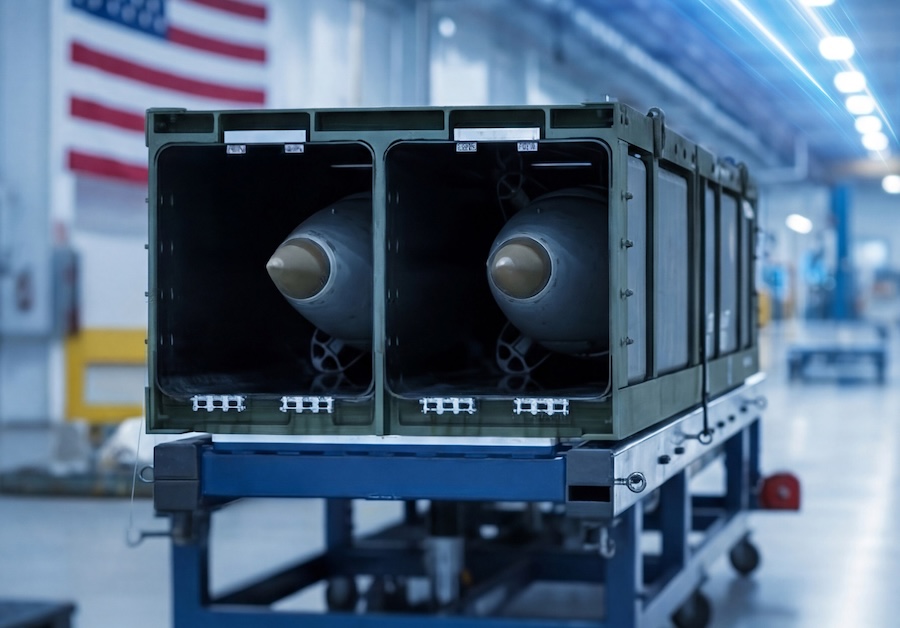
Lockheed Martin and GM Defense announced a new collaboration intended to strengthen America’s manufacturing and defense industrial base.

The collaboration was facilitated by the U.S. Department of War and is structured under a memorandum of understanding. Through the MOU, the companies will explore opportunities to accelerate the delivery of critical defense capabilities and innovation.

The partnership is expected to combine Lockheed Martin’s defense production expertise with General Motors’ advanced industrial capabilities in high-rate commercial manufacturing and engineering.

The collaboration will focus on three areas: strengthening defense supply chains, advancing manufacturing and design capabilities, and evaluating opportunities to expand production capacity through commercial manufacturing expertise and infrastructure.

Initial efforts will include exploring ways to accelerate production readiness and apply proven commercial manufacturing approaches to defense production requirements.

The companies said the collaboration reflects growing demand across the defense sector for greater production capacity, supply chain resilience, and manufacturing agility.

By combining commercial and defense expertise, Lockheed Martin and GM Defense aim to identify opportunities that can accelerate production timelines while maintaining the quality, performance, and reliability standards required for mission-critical systems.

Lockheed Martin is a global defense technology company focused on advancing all-domain mission solutions. GM Defense delivers integrated vehicles, power, autonomy, and connectivity solutions to defense, security, and government markets.

KEY QUOTES:

“America’s security depends not only on developing advanced technologies, but on our ability to produce them quickly, reliably and at scale. This collaboration brings together two leaders in American manufacturing and innovation to explore new ways to strengthen the defense industrial base, expand production capacity and accelerate delivery of critical capabilities for the United States and its allies.”

Frank St. John, Chief Operating Officer of Lockheed Martin

“Working together, GM Defense and Lockheed will further strengthen American manufacturing and national defense by driving greater speed, efficiency, and innovation in the aerospace and defense sectors. Over the coming weeks, we will be working to identify initial projects to pursue together.”

Steve duMont, President of GM Defense


Free Training

Source link

Lockheed Martin and GM Defense to explore manufacturing collaboration aimed at strengthening U.S. defense industrial base


Lockheed Martin and GM Defense have announced a new collaboration to strengthen the U.S. manufacturing and defense industrial base. The effort was facilitated by the U.S. Department of War.

The companies will work under a memorandum of understanding. They will explore opportunities to accelerate the delivery of critical capabilities and innovation.

The collaboration is intended to combine Lockheed Martin’s defense production expertise with General Motors’ industrial capabilities. GM brings experience in high-rate commercial manufacturing and engineering.

The companies said the work will focus on strengthening defense supply chains. It will also cover manufacturing and design capabilities, as well as potential production capacity expansion through commercial manufacturing expertise and infrastructure.

Initial efforts will include exploring ways to accelerate production readiness. The companies will also assess how proven commercial manufacturing approaches could support defense production requirements.

“America’s security depends not only on developing advanced technologies, but on our ability to produce them quickly, reliably and at scale,” said Frank St. John, chief operating officer, Lockheed Martin. “This collaboration brings together two leaders in American manufacturing and innovation to explore new ways to strengthen the defense industrial base, expand production capacity and accelerate delivery of critical capabilities for the United States and its allies.”

“Working together, GM Defense and Lockheed will further strengthen American manufacturing and national defense by driving greater speed, efficiency, and innovation in the aerospace and defense sectors,” said Steve duMont, president of GM Defense. “Over the coming weeks, we will be working to identify initial projects to pursue together.”

The companies said the collaboration reflects growing demand across the defense sector. They identified production capacity, supply chain resilience and manufacturing agility as key areas of need.

By combining commercial and defense expertise, Lockheed Martin and GM Defense aim to identify opportunities to accelerate production timelines. The companies said any such work would need to maintain the quality, performance and reliability standards required for mission-critical systems.

Free Training

Source link

U.S. Should Substantially Boost Support for Manufacturing USA Program, Issue National Industrial Manufacturing Strategy, Says New Report


To better compete globally, the United States should develop a comprehensive industrial strategy to align resources for manufacturing and maximize the national security and economic impacts of the Manufacturing USA program, a proven model that connects the key actors — small and large industry, engineering and science expertise, state and local government, and economic development stakeholders — needed to advance progress in manufacturing technology, says a new report by the National Academies of Sciences, Engineering, and Medicine. Nearly all leading competitor nations have detailed national manufacturing strategies that are aligned with their national economic strategies and view manufacturing as crucial to their growth and national security, the report says.

Strengthening the Manufacturing USA program — a public-private partnership coordinated through the National Institute of Standards and Technology comprising 17 institutes that specialize in different types of advanced manufacturing — is essential for bolstering U.S. competitiveness in the next decade, the report says. The network of institutes is a vital national asset that plays a central role in aligning innovation efforts across government, industry, and academia, connecting American businesses of all sizes with state-of-the-art technology and translating the latest breakthroughs into industrial practice.

However, the report says, the nation is missing a coordinated framework to align industry and government efforts, which has led to under-resourcing federal manufacturing programs, including Manufacturing USA, and a lack of investments to scale up production in proven areas.

As a result, U.S. manufacturing productivity — once a hallmark of the economy — has declined markedly in the past 15 years, the report says. China has been the world leader of manufacturing output since 2011, and currently holds around 35 percent of gross world manufacturing, compared to 12 percent in the U.S. The U.S. trade deficit in goods has also risen sharply, reaching a record $1.2 trillion in 2025, which includes a major deficit in advanced technologies such as aircraft, semiconductors, and robots.

“Even though the U.S. develops many manufacturing technologies, the nation continues to outsource most of its manufacturing and lags far behind other nations in production capacity,” said Theresa Kotanchek, chief executive officer of Evolved Analytics LLC and chair of the committee that wrote the report. “This presents risks to our supply chains, our economy, and our national security if we can’t access critical technologies when we need them most. Our report outlines actions to strengthen the Manufacturing USA program and U.S. advanced manufacturing so that we can grow the businesses and produce the technologies we need at home.”

The report calls on the National Economic Council, Office of Science and Technology Policy, the departments of Commerce, Defense, and Energy, and other agencies to develop within the next two years an industrial strategy — in concert with the National Security Strategy — that integrates technology development, scale-up financing, and leadership in standards, trade, and workforce development so that resources are aligned for a more robust U.S. advanced manufacturing posture.

Informed by tools available in leading advanced manufacturing countries, Congress and federal agencies should set policy to create new federal manufacturing and financing mechanisms that include long-term investment vehicles such as patient-capital funds, a sovereign wealth fund with a strategic focus on manufacturing, and intellectual-property backed lending financing. In addition, Congress should create a globally competitive research and development tax credit for manufacturing processes and technologies, as well as explore expanding other tax reforms that support manufacturing.

Congress should provide sustained, dedicated funding above current appropriations by 2030 to establish business development offices at each Manufacturing USA institute, the report says. These offices would support commercialization, scale-up, and regional ecosystem integration, particularly for entrepreneurs and small- and medium-sized manufacturers (SSMs) working in coordination with regional economic development organizations and federal manufacturing programs.

Technology transfer is central to the Manufacturing USA mission. Institutes need to support two small firm extremes, both of which often lack the capital and resources to scale up — at one end, small, innovative entrepreneurs with good ideas to develop nascent technologies and at the other, SSMs that need to implement proven technologies. Additionally, large, multinational corporations that are institute members want to accelerate technology transfer to reduce their risks in scaling up investments. The report recommends establishing dedicated in-house technology transfer teams to help bridge the innovation “valley of death” between early-stage research and full-scale production.

Supporting robust pathways to careers in advanced manufacturing is necessary to cultivate a skilled workforce that can operate, maintain, and improve complex emerging manufacturing technologies in areas such as robotics, data analysis, digital production, and new materials. Yet, attracting and retaining talent remains a challenge, the report says.

“Collaboration across institutions and work sectors, to align student outcomes with industry needs, is necessary for the U.S. to become a leader in advanced manufacturing,” said National Academy of Engineering President Tsu-Jae Liu. “This report highlights the importance of workforce development for achieving and maintaining a competitive edge in advanced manufacturing, for economic prosperity and national security. 

Manufacturing USA institutes should adopt a broad range of programs to address workforce education needs that are built around a unified advanced manufacturing curriculum, the report says. In collaboration with regional stakeholders, this should include broad support for manufacturing apprenticeships and the development of comprehensive online advanced manufacturing courses.

The report also calls for a new interagency council to enable cross-agency and cross-institute collaboration, reduce administrative barriers, develop a digital manufacturing strategy, and establish an integrated strategy for the manufacturing institutes. Cross-agency collaboration is important between institute sponsoring agencies as well as between the institutes and other federal programs, including the national laboratories and the Manufacturing Extension Partnership program, to ensure advanced manufacturing technologies developed by the institutes are disseminated widely. Federal funding on par with comparable effective programs abroad is critical for supporting these activities.

The National Academies of Sciences, Engineering, and Medicine are private, nonprofit institutions that provide independent, objective analysis and advice to the nation to solve complex problems and inform public policy decisions related to science, engineering, and medicine. They operate under an 1863 congressional charter to the National Academy of Sciences, signed by President Lincoln.

For more information, visit https://www.nationalacademies.org/.

Free Training

Source link

Industrial equipment leader for US manufacturing


SPX FLOW Inc provides pumps, valves and mixers essential for food, beverage and industrial processing, with strong exposure to US markets amid ongoing supply chain recovery.

SPX FLOW Inc, a key supplier of engineered equipment for food and beverage processing, recently reported steady demand in its core segments. The company, listed on the New York Stock Exchange under ticker FLOW, serves major US producers with solutions for mixing, blending and heat transfer. Its products support efficiency in manufacturing plants across North America.

The stock traded at approximately 50.25 USD on 05/13/2026 on NYSE, reflecting stability in the industrial sector, according to Yahoo Finance as of 05/13/2026. Investors track SPX FLOW for its role in resilient supply chains vital to US consumer goods production.

As of: 14.05.2026

By the editorial team – specialized in equity coverage.

At a glance

  • Name: SPX FLOW Inc
  • Sector/industry: Industrial Machinery & Equipment
  • Headquarters/country: United States
  • Core markets: North America, Europe
  • Key revenue drivers: Food & Beverage, Power & Energy
  • Home exchange/listing venue: NYSE (FLOW)
  • Trading currency: USD

SPX FLOW: core business model

SPX FLOW designs and manufactures process equipment for applications including homogenization, heat exchangers and dryers. Its portfolio targets the food and beverage industry, where precision mixing ensures product quality for dairy, beverages and bakery goods. The company also serves power generation and chemical processing with pumps and valves built for high-pressure operations.

Headquartered in Charlotte, North Carolina, SPX FLOW operates globally but derives a significant portion of revenue from US customers. For the fiscal year 2025, reported on 02/27/2026, net sales reached 1.45 billion USD, with Food & Beverage contributing 58%, according to SPX FLOW investor site as of 02/27/2026. This segment benefits from US food safety regulations driving equipment upgrades.

Main revenue and product drivers for SPX FLOW

The Food & Beverage division leads with products like APV pumps and mixing systems used by processors such as dairy giants and soft drink makers. In Q4 2025, this unit posted 8% organic growth, fueled by demand for sustainable processing tech amid US sustainability mandates. Industrial segment follows, providing solutions for oil & gas and chemicals.

Key drivers include aftermarket parts and services, which offer high-margin recurring revenue. For 2025 full year, adjusted EBITDA margins hit 17.2%, published with Q4 results on 02/27/2026 per company filings. US manufacturing resurgence supports orders as plants modernize post-pandemic.

Industry trends and competitive position

The industrial processing equipment market grows with US food production output, projected at 3-4% CAGR through 2028 per S&P Global as of 01/2026. SPX FLOW competes with Alfa Laval and GEA Group, differentiating via US-centric service networks that reduce downtime for domestic clients.

Sustainability trends favor its energy-efficient heat exchangers, aligning with EPA guidelines. The company’s 2025 sustainability report highlighted 15% reduction in product energy use, enhancing appeal to US firms facing carbon reporting rules.

Why SPX FLOW matters for US investors

SPX FLOW’s NYSE listing and US headquarters provide direct exposure to American industrial recovery. Over 50% of revenue ties to North America, linking performance to US GDP growth and manufacturing PMI. Its dividend yield around 1.2% as of Q1 2026 adds income stability for retail portfolios.

Conclusion

SPX FLOW maintains a solid position in industrial processing equipment, with Food & Beverage driving growth amid US market demands. Recent financials show margin expansion and stable orders, though sector cycles warrant monitoring. The company’s US focus offers retail investors a play on domestic manufacturing strength without overseas volatility.

Disclaimer: This article does not constitute investment advice. Stocks are volatile financial instruments.

Free Training

Source link

Teknor Apex Joins OSS Ventures €75M Fund to Scale Industrial Software Across U.S. Manufacturing


Teknor Apex Joins OSS Ventures €75M Fund to Scale Industrial Software Across U.S. Manufacturing

Teknor Apex Joins OSS Ventures €75M Fund to Scale Industrial Software Across U.S. Manufacturing

PR Newswire

BOSTON, April 28, 2026


BOSTON, April 28, 2026 /PRNewswire/ — Teknor Apex Company, a global leader in material science solutions, today announced it has joined as a founding partner in OSS Ventures’ new investment fund, targeting €75M million to scale proven industrial software companies across North America and Europe.


Building Software Where It Matters: On the Manufacturing Floor

Founded in 2019 by Renan Devillieres, OSS Ventures is a venture studio building next-generation industrial software that operates at the intersection of software development and manufacturing operations. The firm’s thesis is straightforward: industrial software only drives lasting change when it’s built from the manufacturing floor up – alongside the operators, supervisors, and engineers who use it daily.

With OSS Ventures now expanding operations beyond Europe to its new office in Boston, MA, Teknor Apex will serve as the regional industrial anchor partner, becoming the first U.S. manufacturer to both invest in and operate OSS portfolio software at scale.

“This partnership reflects a shared view that the future advancements in industry will be innovated by people and technology working in tandem to create measurable impacts” said Donald Wiseman, CEO, Teknor Apex.

Teknor Apex: From Co-Builder to Co-Investor

This partnership started on the factory floor. Teknor Apex deployed three of OSS Ventures’ portfolio companies in their Rhode Island and Tennessee sites. The impact was immediate:

  • Oplit allows Teknor Apex to set their plants up for success through a reduction in changeovers, improved yield, and a stronger foundation for more automated planning over time.
  • Fabriq helps to strengthen a culture of continuous improvement, with problem-solving embedded at every level of the manufacturing organization.
  • Mercateam supports operators, mechanics, and lab technicians in building critical skills and advancing their careers – helping Teknor Apex better invest in its most valuable resource: its people.

Teknor Apex and OSS Ventures are aligned as both core business partners and venture partners, with Teknor Apex joining as a founding partner in the €75M amplification fund alongside DECATHLON PULSE, the investment and innovation arm of global sports company DECATHLON, and Peugeot Family Group.

“As we shape our next 100 years of manufacturing, digital transformation is the sole viable path to not only short-term efficiency, but long-term competitiveness,” said Michael Roberts, CIO, Teknor Apex.

Contact: 
Faustine Ladeiro Levent, Head of Marketing
faustine@oss.ventures

Photo – https://mma.prnewswire.com/media/2965406/OSS_Ventures_x_Teknor_Apex.jpg

View original content to download multimedia:https://www.prnewswire.com/news-releases/teknor-apex-joins-oss-ventures-75m-fund-to-scale-industrial-software-across-us-manufacturing-302754013.html

SOURCE OSS Ventures; Teknor Apex

Free Training

Source link

US are planning for an industrial hub in the Philippines. What does this mean?


– The US and the Philippines’ planned 1,620ha industrial hub to shore up supply chains for critical industries marks Manila’s most concrete step in alignment with Washington’s efforts to rewire global production networks.

The proposed site, on the main island of Luzon, will support manufacturing in sectors such as semiconductors, electronics and critical minerals, the US Department of State said in a statement on April 16.

The Wall Street Journal (WSJ) reported that the deal is expected to offer US companies access to essential inputs such as critical minerals that bypass Beijing’s control. It said the hub will have diplomatic immunity and operate under US common law, the first such arrangement in the world.

Undersecretary of State for Economic Affairs Jacob Helberg told WSJ that the US would use the land rent-free for two years and administer it as a special economic zone.

Analysts broadly welcomed the move as a long-overdue economic dimension to an alliance historically dominated by defence, but cautioned that the hub’s unusual legal status and the Philippines’ traditional role as a raw materials supplier could limit its upside.

The project will be designated as an economic security zone within the Luzon Economic Corridor, a US-backed initiative linking industrial hubs north of Manila such as Clark and Subic to the capital’s ports and markets.

Details about the economic zone have yet to be publicised, including which US companies will participate and whether the area would be exclusive to US companies.

The Straits Times has contacted the office of President Ferdinand Marcos Jr for comment.

The US State Department said the Luzon hub would serve as a pilot for a wider network of industrial zones across partner countries, aimed at fast-tracking investments and using AI to better coordinate production and supply chains.

“The zone can leverage the Philippines’ geographic centrality in the Indo-Pacific, its young and technically skilled workforce, and its deepening alliance with the United States,” it added.

The announcement came as the Philippines became the 13th signatory to formally join Pax Silica, a US-led initiative that seeks to secure the full technology supply chain, from raw materials to advanced manufacturing and data infrastructure.

The State Department said the initiative is a key pillar of the US’ economic statecraft strategy, aimed at reducing dependence on rival economies and deepening industrial cooperation among allies.

“This is a good development… It adds on to the very hard security-dominant cooperation between the US and the Philippines,” said Dr Aries Arugay, a political scientist at the ISEAS – Yusof Ishak Institute in Singapore, noting that economic resilience is increasingly being treated as a national security concern.

He said that by anchoring investments, manufacturing and jobs in the Philippines, the initiative could help “lock in” long-term commitment on both sides, reducing the risk of fluctuating political priorities that have at times complicated bilateral ties.

“What’s good here is that we’re going to be part of the supply chain. This increases our relevance (to the US). We won’t be accused by the Trump administration of benefiting more than contributing to our alliance,” said Dr Arugay.

Still, he said the hub having diplomatic immunity under US common law could potentially be challenged before the Philippine Supreme Court over constitutionality concerns. “The Philippines should negotiate well and not compromise national interests because this is exactly the criticism with the US alliance,” he said.

Geopolitical analyst Dindo Manhit, who is president of Manila-based think-tank Stratbase Institute, said the hub would still have to operate within the Philippines’ existing legal framework for investment zones.

“At most, this can be structured as a special economic zone under the PEZA law,” he said, referring to the Philippine Economic Zone Authority, which governs eco-zones and allows fiscal incentives and streamlined regulations but keeps them under Philippine jurisdiction.

The economic upside could be significant. The Philippines has long sought to revive its manufacturing base and move up global value chains, but has struggled to compete with regional peers such as Vietnam and Thailand.

The development reflects a broader shift towards what Mr Manhit described as “geo-economics”, where economic partnerships increasingly reinforce strategic alignments.

“This is very important… We’re seeing defence cooperation now crossing into the economic side,” he said, pointing to the involvement of major economies and traditional security partners in Pax Silica.

He added that the hub could bring job-generating investments and help drive growth anchored on manufacturing – an area where the Philippines has historically lagged behind but which remains critical for long-term development.

Assistant Professor J.C. Punongbayan of the University of the Philippines-Diliman School of Economics said the project could generate jobs, particularly if it succeeds in attracting electronics and advanced manufacturing firms with strong linkages to the local economy.

“But the benefits will depend on execution. It will not automatically translate into broad-based employment,” he said.

Dr Punongbayan said that while the Philippines has a “decent base” in engineering, IT and manufacturing, gaps remain in more specialised areas such as AI and advanced production.

“Some foreign talent may be needed at first, but that can still be positive if it helps train Filipino workers and build local capability,” he said, adding that the key question is whether the hub becomes “a genuine driver of industrial upgrading or just a self-contained enclave”.

At the same time, the project sits squarely within intensifying US-China competition over access to critical minerals and advanced technologies.

China currently dominates several critical industries, such as rare earth processing and battery supply chains, leaving the US and its partners seeking to diversify sourcing and production.

The Philippines, with its reserves of nickel, copper and cobalt, has emerged as a natural candidate for such efforts, the US State Department said.

Mr Manhit downplayed the risk of potential pushback from Beijing, arguing that the Philippines’ economic fundamentals remain anchored in its ties with Western and like-minded economies.

“There’s no risk here,” he said, noting that key drivers of the Philippine economy such as remittances, business process outsourcing and manufacturing are largely tied to partners within the Pax Silica network.

Still, Dr Arugay cautioned that the benefits for the Philippines would depend on how far it can move beyond its traditional role as a supplier of raw materials. He stressed the need for policies that attract higher-value activities such as processing and manufacturing.

He noted there will also be environmental considerations for the Philippines, with the extraction and processing of critical minerals known to be resource-intensive and potentially polluting.

“If the role remains extractive, then we stay at the lower end of the supply chain,” he said.

Free Training

Source link

Skild AI Partners with Foxconn, ABB, Universal Robots for Industrial AI in 2026 – News and Statistics


Mar 16, 2026

According to Reuters, Skild AI will deploy its artificial intelligence model in robots operating on Foxconn assembly lines in Houston. These lines are involved in the construction of Nvidia‘s Blackwell GPU server racks. The companies characterized this as an initial commercial use of a generalized physical AI system.

The startup, which has financial backing from Nvidia and SoftBank, announced it would also collaborate with ABB Robotics and Universal Robots. The goal is to integrate its software into a wide range of industrial robots, providing what it terms a general-purpose brain for machinery. Skild AI stated its model is designed to overcome a major constraint of existing robotics, which are often dedicated to one specific task and need significant reprogramming for any change.

Partnerships with ABB and Teradyne‘s Universal Robots unit are aimed at increasing the volume of data for system training by embedding the software into their robots. The CEO of Skild AI indicated that working with original equipment manufacturers that have vast existing robot deployments creates a pathway for significant scaling and establishes a data feedback cycle.

These developments occur as the United States intensifies initiatives to restore its domestic manufacturing base. In 2025, new U.S. production investments totaling approximately $1.2 trillion were announced, primarily in electronics, pharmaceuticals, and semiconductors. Industry leaders note that the large-scale return of advanced manufacturing to the country will rely substantially on automation.

Nvidia, a key supporter of Skild AI, previously stated its intention to manufacture AI supercomputers completely within the United States. A company executive emphasized that with substantial infrastructure investment planned for the coming years, factories will require greater autonomy.

In a related move, SoftBank announced in October its agreement to purchase ABB’s robotics division. That transaction is anticipated to be finalized around the middle to end of 2026. Skild AI itself secured $1.4 billion in a financing round led by Nvidia and SoftBank earlier this year, resulting in a valuation exceeding $14 billion.

This report provides a comprehensive view of the industrial robot industry in the United States, tracking demand, supply, and trade flows across the national value chain. It explains how demand across key channels and end-use segments shapes consumption patterns, while also mapping the role of input availability, production efficiency, and regulatory standards on supply.

Beyond headline metrics, the study benchmarks prices, margins, and trade routes so you can see where value is created and how it moves between domestic suppliers and international partners. The analysis is designed to support strategic planning, market entry, portfolio prioritization, and risk management in the industrial robot landscape in the United States.

Quick navigation

Key findings

  • Domestic demand is shaped by both household and industrial usage, with trade flows linking local supply to imports and exports.
  • Pricing dynamics reflect unit values, freight costs, exchange rates, and regulatory shifts that affect sourcing decisions.
  • Supply depends on input availability and production efficiency, creating a distinct national cost curve.
  • Market concentration varies by segment, creating different competitive landscapes and entry barriers.
  • The 2035 outlook highlights where capacity investment and demand growth are most aligned within the country.

Report scope

The report combines market sizing with trade intelligence and price analytics for the United States. It covers both historical performance and the forward outlook to 2035, allowing you to compare cycles, structural shifts, and policy impacts.

  • Market size and growth in value and volume terms
  • Consumption structure by end-use segments
  • Production capacity, output, and cost dynamics
  • Trade flows, exporters, importers, and balances
  • Price benchmarks, unit values, and margin signals
  • Competitive context and market entry conditions

Product coverage

  • Prodcom 28993935 – Industrial robots for multiple uses (excluding robots designed to perform a specific function (e.g. lifting, handling, loading or unloading))

Country coverage

Country profile and benchmarks

This report provides a consistent view of market size, trade balance, prices, and per-capita indicators for the United States. The profile highlights demand structure and trade position, enabling benchmarking against regional and global peers.

Methodology

The analysis is built on a multi-source framework that combines official statistics, trade records, company disclosures, and expert validation. Data are standardized, reconciled, and cross-checked to ensure consistency across time series.

  • International trade data (exports, imports, and mirror statistics)
  • National production and consumption statistics
  • Company-level information from financial filings and public releases
  • Price series and unit value benchmarks
  • Analyst review, outlier checks, and time-series validation

All data are normalized to a common product definition and mapped to a consistent set of codes. This ensures that comparisons across time are aligned and actionable.

Forecasts to 2035

The forecast horizon extends to 2035 and is based on a structured model that links industrial robot demand and supply to macroeconomic indicators, trade patterns, and sector-specific drivers. The model captures both cyclical and structural factors and reflects known policy and technology shifts in the United States.

  • Historical baseline: 2012-2025
  • Forecast horizon: 2026-2035
  • Scenario-based sensitivity to income growth, substitution, and regulation
  • Capacity and investment outlook for major producing companies

Each projection is built from national historical patterns and the broader regional context, allowing the report to show where growth is concentrated and where risks are elevated.

Price analysis and trade dynamics

Prices are analyzed in detail, including export and import unit values, regional spreads, and changes in trade costs. The report highlights how seasonality, freight rates, exchange rates, and supply disruptions influence pricing and margins.

  • Price benchmarks by country and sub-region
  • Export and import unit value trends
  • Seasonality and calendar effects in trade flows
  • Price outlook to 2035 under baseline assumptions

Profiles of market participants

Key producers, exporters, and distributors are profiled with a focus on their operational scale, geographic footprint, product mix, and market positioning. This helps identify competitive pressure points, partnership opportunities, and routes to differentiation.

  • Business focus and production capabilities
  • Geographic reach and distribution networks
  • Cost structure and pricing strategy indicators
  • Compliance, certification, and sustainability context

How to use this report

  • Quantify domestic demand and identify the most attractive segments
  • Evaluate export opportunities and prioritize target destinations
  • Track price dynamics and protect margins
  • Benchmark performance against leading competitors
  • Build evidence-based forecasts for investment decisions

This report is designed for manufacturers, distributors, importers, wholesalers, investors, and advisors who need a clear, data-driven picture of industrial robot dynamics in the United States.

FAQ

What is included in the industrial robot market in the United States?

The market size aggregates consumption and trade data, presented in both value and volume terms.

How are the forecasts to 2035 built?

The projections combine historical trends with macroeconomic indicators, trade dynamics, and sector-specific drivers.

Does the report cover prices and margins?

Yes, it includes export and import unit values, regional spreads, and a pricing outlook to 2035.

Which benchmarks are included?

The report benchmarks market size, trade balance, prices, and per-capita indicators for the United States.

Can this report support market entry decisions?

Yes, it highlights demand hotspots, trade routes, pricing trends, and competitive context.

  1. 1. INTRODUCTION

    Making Data-Driven Decisions to Grow Your Business

    1. REPORT DESCRIPTION
    2. RESEARCH METHODOLOGY AND THE AI PLATFORM
    3. DATA-DRIVEN DECISIONS FOR YOUR BUSINESS
    4. GLOSSARY AND SPECIFIC TERMS
  2. 2. EXECUTIVE SUMMARY

    A Quick Overview of Market Performance

    1. KEY FINDINGS
    2. MARKET TRENDSThis Chapter is Available Only for the Professional EditionPRO
  3. 3. MARKET OVERVIEW

    Understanding the Current State of The Market and its Prospects

    1. MARKET SIZE: HISTORICAL DATA (2012–2025) AND FORECAST (2026–2035)
    2. MARKET STRUCTURE: HISTORICAL DATA (2012–2025) AND FORECAST (2026–2035)
    3. TRADE BALANCE: HISTORICAL DATA (2012–2025) AND FORECAST (2026–2035)
    4. PER CAPITA CONSUMPTION: HISTORICAL DATA (2012–2025) AND FORECAST (2026–2035)
    5. MARKET FORECAST TO 2035
  4. 4. MOST PROMISING PRODUCTS FOR DIVERSIFICATION

    Finding New Products to Diversify Your Business

    1. TOP PRODUCTS TO DIVERSIFY YOUR BUSINESS
    2. BEST-SELLING PRODUCTS
    3. MOST CONSUMED PRODUCTS
    4. MOST TRADED PRODUCTS
    5. MOST PROFITABLE PRODUCTS FOR EXPORTS
  5. 5. MOST PROMISING SUPPLYING COUNTRIES

    Choosing the Best Countries to Establish Your Sustainable Supply Chain

    1. TOP COUNTRIES TO SOURCE YOUR PRODUCT
    2. TOP PRODUCING COUNTRIES
    3. TOP EXPORTING COUNTRIES
    4. LOW-COST EXPORTING COUNTRIES
  6. 6. MOST PROMISING OVERSEAS MARKETS

    Choosing the Best Countries to Boost Your Export

    1. TOP OVERSEAS MARKETS FOR EXPORTING YOUR PRODUCT
    2. TOP CONSUMING MARKETS
    3. UNSATURATED MARKETS
    4. TOP IMPORTING MARKETS
    5. MOST PROFITABLE MARKETS
  7. 7. PRODUCTION

    The Latest Trends and Insights into The Industry

    1. PRODUCTION VOLUME AND VALUE: HISTORICAL DATA (2012–2025) AND FORECAST (2026–2035)
  8. 8. IMPORTS

    The Largest Import Supplying Countries

    1. IMPORTS: HISTORICAL DATA (2012–2025) AND FORECAST (2026–2035)
    2. IMPORTS BY COUNTRY: HISTORICAL DATA (2012–2025)
    3. IMPORT PRICES BY COUNTRY: HISTORICAL DATA (2012–2025)
  9. 9. EXPORTS

    The Largest Destinations for Exports

    1. EXPORTS: HISTORICAL DATA (2012–2025) AND FORECAST (2026–2035)
    2. EXPORTS BY COUNTRY: HISTORICAL DATA (2012–2025)
    3. EXPORT PRICES BY COUNTRY: HISTORICAL DATA (2012–2025)
  10. 10. PROFILES OF MAJOR PRODUCERS

    The Largest Producers on The Market and Their Profiles

  11. LIST OF TABLES

    1. Key Findings In 2025
    2. Market Volume, In Physical Terms: Historical Data (2012–2025) and Forecast (2026–2035)
    3. Market Value: Historical Data (2012–2025) and Forecast (2026–2035)
    4. Per Capita Consumption: Historical Data (2012–2025) and Forecast (2026–2035)
    5. Imports, In Physical Terms, By Country, 2012–2025
    6. Imports, In Value Terms, By Country, 2012–2025
    7. Import Prices, By Country, 2012–2025
    8. Exports, In Physical Terms, By Country, 2012–2025
    9. Exports, In Value Terms, By Country, 2012–2025
    10. Export Prices, By Country, 2012–2025
  12. LIST OF FIGURES

    1. Market Volume, In Physical Terms: Historical Data (2012–2025) and Forecast (2026–2035)
    2. Market Value: Historical Data (2012–2025) and Forecast (2026–2035)
    3. Market Structure – Domestic Supply vs. Imports, in Physical Terms: Historical Data (2012–2025) and Forecast (2026–2035)
    4. Market Structure – Domestic Supply vs. Imports, in Value Terms: Historical Data (2012–2025) and Forecast (2026–2035)
    5. Trade Balance, In Physical Terms: Historical Data (2012–2025) and Forecast (2026–2035)
    6. Trade Balance, In Value Terms: Historical Data (2012–2025) and Forecast (2026–2035)
    7. Per Capita Consumption: Historical Data (2012–2025) and Forecast (2026–2035)
    8. Market Volume Forecast to 2035
    9. Market Value Forecast to 2035
    10. Market Size and Growth, By Product
    11. Average Per Capita Consumption, By Product
    12. Exports and Growth, By Product
    13. Export Prices and Growth, By Product
    14. Production Volume and Growth
    15. Exports and Growth
    16. Export Prices and Growth
    17. Market Size and Growth
    18. Per Capita Consumption
    19. Imports and Growth
    20. Import Prices
    21. Production, In Physical Terms: Historical Data (2012–2025) and Forecast (2026–2035)
    22. Production, In Value Terms: Historical Data (2012–2025) and Forecast (2026–2035)
    23. Imports, In Physical Terms: Historical Data (2012–2025) and Forecast (2026–2035)
    24. Imports, In Value Terms: Historical Data (2012–2025) and Forecast (2026–2035)
    25. Imports, In Physical Terms, By Country, 2025
    26. Imports, In Physical Terms, By Country, 2012–2025
    27. Imports, In Value Terms, By Country, 2012–2025
    28. Import Prices, By Country, 2012–2025
    29. Exports, In Physical Terms: Historical Data (2012–2025) and Forecast (2026–2035)
    30. Exports, In Value Terms: Historical Data (2012–2025) and Forecast (2026–2035)
    31. Exports, In Physical Terms, By Country, 2025
    32. Exports, In Physical Terms, By Country, 2012–2025
    33. Exports, In Value Terms, By Country, 2012–2025
    34. Export Prices, By Country, 2012–2025

Free Training

Source link

US Manufacturing Defies Gravity: Industrial Output Surges as Philly Fed Index Hits Five-Month High


The United States manufacturing sector, long written off by skeptics as a casualty of high interest rates and global trade volatility, has roared back to life in early 2026. Fresh data released this week shows that manufacturing output rose by a surprising 0.7% in January, more than doubling consensus estimates of 0.3%. This surge in production was further validated by the Philadelphia Fed Manufacturing Index, which leaped to 16.3 in February—a five-month high that suggests the industrial heartland is entering a “second gear” of expansion.

These figures have sent a jolt through financial markets, effectively recalibrating the narrative for the broader US economy. Instead of the “soft landing” many economists predicted for 2026, the data points toward a “no-landing” scenario: a situation where the economy continues to accelerate despite the Federal Reserve’s benchmark interest rates remaining between 3.50% and 3.75%. The resilience of the factory floor is now the primary driver of a revised economic outlook that prioritizes domestic production over globalized supply chains.

A High-Tech Rebirth on the Factory Floor

The 0.7% rise in January manufacturing output was spearheaded by a 0.8% increase in durable goods production, marking the strongest monthly performance for the sector in nearly a year. This growth was not evenly distributed but was concentrated in high-tech machinery and electronics, fueled by a massive infrastructure build-out for artificial intelligence. Domestic factories are now operating at a capacity utilization rate of 76.2%, as companies scramble to meet a sudden influx of new orders for data center hardware and advanced electronics.

This manufacturing renaissance is largely being credited to the “One Big Beautiful Bill Act” (OBBBA) of 2025, which introduced 100% bonus depreciation and aggressive incentives for domestic modernization. The timeline of this recovery began in late 2025, when supply chains finally stabilized following years of post-pandemic fluctuations. By the time January 2026 arrived, the combination of policy incentives and a surge in AI-related demand created a perfect storm for industrial growth.

The Philadelphia Fed’s February reading of 16.3 provided the psychological “all-clear” for the sector. While the headline number was robust, sub-indices revealed a complex internal dynamic: the future activity index spiked to 42.8, indicating extreme optimism for the coming six months. However, the employment index dipped slightly to -1.3, suggesting that manufacturers are increasingly leaning on automation and “low-hire” strategies to boost output rather than traditional labor expansion.

Winners and Losers in the New Industrial Era

Industrial giants like Caterpillar Inc. (NYSE: CAT) have emerged as clear winners in this environment. Caterpillar reported a record $51 billion backlog in early 2026, driven primarily by its Power and Energy segment. The company’s large-scale generators are in high demand for AI data centers, offsetting a projected $2.6 billion headwind from current trade tariffs. Similarly, GE Aerospace (NYSE: GE) has capitalized on the trend, forecasting double-digit revenue growth for 2026 as it pivots toward high-margin aftermarket services for an aging global airline fleet.

The automotive sector is also seeing a dramatic reshuffling. Ford Motor Co. (NYSE: F) recently announced plans to boost its F-Series production by 50,000 units in 2026, pivoting away from pure electric vehicles (EVs) to focus on more profitable hybrid and gas-powered trucks. Meanwhile, General Motors (NYSE: GM) is aggressively moving production of its popular SUV models from Mexico to plants in Tennessee and Kansas. This move is designed to mitigate the impact of the 2025 tariff regime and align with the “Made in America” incentives that are currently driving the 0.7% output rise.

However, not all players are faring equally. Smaller manufacturers that lack the capital to automate are struggling with a “Prices Paid” index that hit 38.9 in February, signaling persistent inflationary pressure on raw materials. While Deere & Company (NYSE: DE) has seen its stock rally 27% year-to-date due to a recovery in construction demand, it must still navigate over $1.2 billion in annual tariff costs. The “winners” in 2026 are those with the scale to reshore production and the technology to maintain margins in a high-cost environment.

The Macro Significance: “Higher for Longer” Returns

The resilience of US manufacturing has profound implications for the Federal Reserve’s policy trajectory. Entering 2026, many traders were betting on a series of rate cuts beginning in March. Those expectations have now evaporated. With manufacturing output surging and the “no-landing” scenario gaining traction, the Fed is likely to maintain its current interest rate levels well into the third quarter of 2026. The “Prices Paid” component of the Philly Fed report suggests that inflation remains stickier than the central bank’s 2% target, particularly as the 2025 tariff regime raises the cost of imported components.

Historically, such a sharp rise in the Philly Fed Index has been a precursor to sustained economic heat. Comparing this to the mid-1990s expansion, economists note that the current cycle is unique because it is being driven by a structural shift—reshoring—rather than just a cyclical rebound. This trend has ripple effects on competitors in Europe and Asia, who are seeing a “capital flight” toward the US as manufacturers seek to benefit from the OBBBA incentives and proximity to the world’s largest consumer market.

Furthermore, the policy shift toward protectionism and domestic subsidies represents a departure from decades of globalized trade. This “new normal” means that manufacturing is no longer the “swing” sector of the economy that suffers first during rate hikes; instead, it has become a resilient pillar bolstered by national security interests and the race for AI supremacy.

What Lies Ahead: Strategic Pivots and Market Risks

In the short term, investors should prepare for a period of market volatility as the reality of “higher for longer” interest rates sinks in. While the manufacturing data is positive for growth, it complicates the valuation of growth stocks that depend on cheap capital. Companies will likely continue their strategic pivots toward automation; we can expect to see increased capital expenditures (CAPEX) in robotics and AI-integrated assembly lines as firms seek to bypass the stagnant labor market reflected in the Philly Fed’s employment sub-index.

The long-term outlook remains bullish for the “re-industrialization” of America, but challenges remain. If the Fed is forced to keep rates at 3.75% or higher through 2027 to combat “tariff-flation,” the cost of servicing industrial debt could begin to eat into the very CAPEX that is driving current growth. A potential scenario involves a “bifurcated recovery,” where tech-enabled industrial leaders thrive while traditional, debt-laden manufacturers are squeezed out.

Summary and Investor Outlook

The January and February data for 2026 has confirmed that US manufacturing is undergoing a structural transformation. The 0.7% rise in output and the 16.3 Philly Fed reading are not just statistical anomalies; they are the results of a concerted policy shift toward reshoring and a technological revolution in the form of AI infrastructure.

Key Takeaways for Investors:

  • The “No-Landing” is Real: Strong industrial data suggests the US economy is not cooling as fast as expected, which will delay Federal Reserve rate cuts.
  • Reshoring is the Driver: Watch companies like General Motors (NYSE: GM) and Caterpillar Inc. (NYSE: CAT) as they move production back to the US to capture tax incentives and avoid tariffs.
  • Watch the Margin: With the “Prices Paid” index rising, focus on companies with high pricing power and advanced automation capabilities.

Moving forward, the market will be hyper-focused on the March industrial production report and the Fed’s July meeting. For now, the factory floor is once again the engine of American economic exceptionalism, proving that even in a high-interest-rate environment, the “Made in the USA” label is staging a formidable comeback.

This content is intended for informational purposes only and is not financial advice.


Free Training

Source link

US Administration Plans Cuts to Key Industrial Grants Impacting Rust Belt Manufacturing | Ukraine news


The central thrust of the United States’ economic policy under the “America First” banner is to revitalize domestic manufacturing. However, the Trump administration plans to cut one of the key programs that funds the largest industries, including a city at the heart of the Rust Belt – the hometown of Vice President JD Vance.

A $500 million grant from the Biden administration was designated for the Cleveland-Cliffs steel company in Middletown, Ohio, to modernize aging blast furnaces; another $75 million was allocated for a similar project in Pennsylvania.

New furnaces powered by hydrogen, natural gas, and electricity – rather than coal – were meant to extend the plant’s life and secure the company’s future.

But these grants, which were to create more than 100 permanent jobs and 1,200 construction jobs just in Middletown, according to internal administration documents obtained by CNN, are slated to be canceled.

Representatives from the Department of Government Efficiency participated in deciding which programs to keep and which to cut, according to two people familiar with the situation.

“An unelected billionaire who made his fortune on government contracts should not be able to unilaterally stop these programs.”

– Marcy Kaptur

Energy Department spokesperson Ben Ditterich stated that “no final decisions have yet been made” regarding funding, and that “several plans are being considered.”

The Energy Department froze billions of dollars in grant programs during the Biden administration for months, reviewing them and determining which to cut. The $6.3 billion program that financed equipment modernization for Cleveland-Cliffs and other large companies could be cut by nearly half according to internal CNN documents.

Experts warn that such cuts could have a chilling effect on American industry amid a tariff war led by Trump that is undermining markets and supply chains.

“The entire point of OCED and the $6.3 billion grant programs is to invest in companies and industries that have not received funding for decades – steel and cement.”

– a former DOE employee

Samira Fazili, Deputy Director of the National Economic Council under the Biden administration, notes that reductions could deal a serious blow to the United States’ core industries, especially given the economic uncertainty caused by tariffs.

She emphasizes that instead of cutting public investments, strategic investments should be undertaken to preserve manufacturing and strengthen the country’s competitiveness.

Ultimately, experts call for a measured approach: carefully chosen government investments can preserve jobs and the United States’ industrial capacity, particularly in regions tied to essential industries.

Free Training

Source link