
What a Monopoly vendor learned when making things in America : NPR


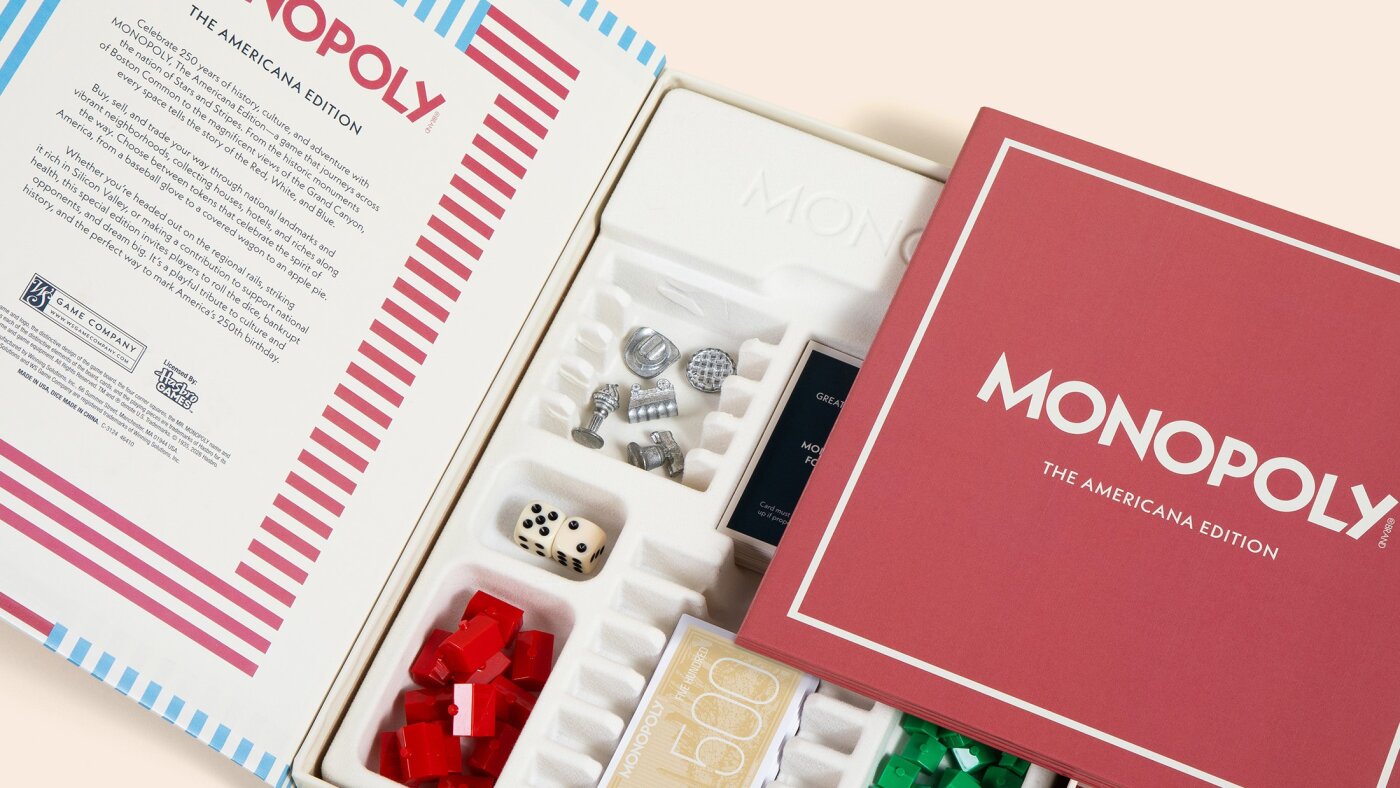
In an effort to sidestep President Trump's tariffs, the WS Game Company decided to build a special edition Monopoly game in the United States. But the experiment almost didn't pass go.

In an effort to sidestep President Trump’s tariffs, the WS Game Company decided to build a special edition Monopoly game in the United States. But the experiment almost didn’t pass go.

WS Game Company

hide caption

toggle caption

WS Game Company

The board game Monopoly has always taught some important economic lessons: The benefits of owning real estate. The profit potential of railroad mergers. The value of a get-out-of-jail-free card.

President Trump hopes to encourage more U.S. manufacturing with his import taxes on foreign goods. But an online experiment suggests most people aren't willing to pay a premium for a "Made in the USA" product.

Now a special edition of the board game is teaching a new lesson—about how hard it is to make things in the USA.

The game is being marketed by the WS Game Company, which produces most of its high-end board games in China, just like almost every other toy maker.

After getting hit with a seven-figure tariff bill last year, CEO Jonathan Silva decided to see if it was possible to produce a profitable board game in the United States.

He opted for a custom version of Monopoly, pegged to the country’s 250th birthday. But the experiment almost didn’t pass go. One big problem: No dice.

“We turned over every single leaf trying to find someone who would make 10,000 dice for us in the U.S.,” Silva says. “It requires special machinery. It requires investment. And that type of stuff just can’t happen on a random Tuesday and be ready in a couple of months.”

Silva ultimately had to settle for imported dice.

He was able to find the rest of what he needed domestically, but it wasn’t easy. A former Hasbro factory in Massachusetts prints the Monopoly board. A company called Pioneer Packaging makes the tray that holds he Monopoly money. And a small business in Indiana cranked out custom metal game tokens, in all-American shapes like a cowboy hat, a covered wagon and an apple pie.
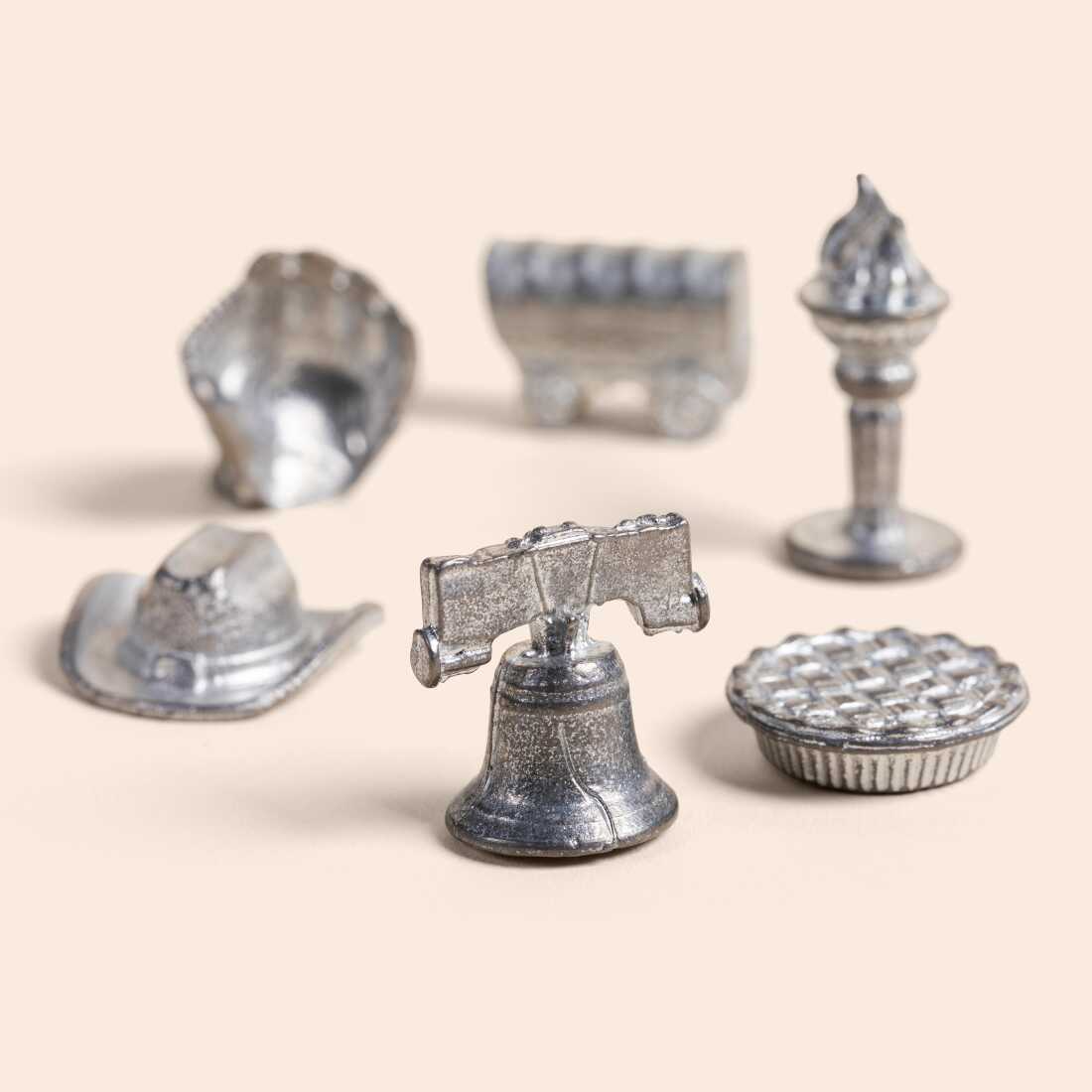
Stateline Industries in Liberty, Indiana fabricated the custom game pieces for the Monopoly Americana edition, with special shapes like a cowboy hat and an apple pie.

Stateline Industries in Liberty, Indiana fabricated the custom game pieces for the Monopoly Americana edition, with special shapes like a cowboy hat and an apple pie.

WS Game Company

hide caption

toggle caption

WS Game Company

Just assembling all those different players took more than a year, so Silva missed the first half of the 250th birthday selling season. And the cost to manufacture the games — which retail for $80 — was at least double what it would have been in China.

“When I place a purchase order in China, they have all those capabilities under one roof,” Silva says. “For one item, it took up way too much of our resources and time to bring it to market.”

Why so many things are made in China

There’s a reason nearly 80% of all toys and games sold in the U.S. are made in China. That country has spent decades building a factory ecosystem to supply not only finished products, but all the specialized parts that go into them.

“That’s why the re-shoring and the looking at bringing it back into the U.S. or even looking at other countries and moving it is not as easy as it sounds,” says Greg Ahearn, president and CEO of the The Toy Association, an industry trade group.

Richard Brown runs Proof Culture, a sneaker accessory company, out of his Ohio home. He is Black and has a beard. He is seated behind a computer monitor and there are sneakers in plastic display cases behind him.

President Trump shakes hands with China's President Xi Jinping as he leaves after a visit to Zhongnanhai Garden in Beijing on May 15.

Ahearn says it makes sense for the U.S. to manufacture some strategically important products, but probably not when it comes to most toys and games, which tend to carry both low prices and low profit margins.

“Even if you could, who in their right mind would take their capital and invest it into creating a toy manufacturing plant?” Ahearn says. “Of all the things you could pick, we’d probably be pretty low on that list.”

Instead, the toy industry is lobbying to get a carve-out from future tariffs. The new U.S.—China Board of Trade is considering allowing up to $30 billion worth of Chinese products to enter the U.S. tariff-free. But toys are competing for the tax break with shoes, apparel and many other products.

For now, Silva is busy marketing his Made in the U.S.A. Monopoly game. But he’s still making the rest of his company’s board games in China. And that’s not likely to change.

“We’re really good at a lot of great things here in America.” Silva says. “But we’re not really great at making certain items that are consumable goods. And that’s OK.”

He’s now awaiting a shipment from China of about $6 million worth of games for the upcoming holiday season. He has no idea what the tariff bill might be. But he’s prepared to roll the dice.

Free Training

Source link

The Joy of Making Things: America’s Manufacturing Renaissance


Posted on Monday, July 6, 2026

|

by Kim Humphrey

|

0 Comments

|

Print

I still remember walking through the shipyard early in my career and looking up at a vessel that seemed to stretch endlessly. Thousands of people had contributed their skills, ideas, craftsmanship, and hard work to build something larger than any one person could accomplish alone.

There is a feeling that comes with that moment that is difficult to describe. Pride, purpose, and a sense of accomplishment. And perhaps most importantly, the realization that your work matters.

As someone who spent years in shipbuilding and manufacturing leadership, I have experienced that feeling many times. Standing beside a submarine, an aircraft carrier, a piece of equipment, or a product that will serve others for decades creates a connection between people and purpose that is hard to find anywhere else.

There is something deeply human about making things. Whether it is building ships, assembling aircraft, producing life-saving medical devices, designing semiconductors, manufacturing automobiles, creating advanced technologies, or producing products families use every day, manufacturing allows people to leave their fingerprints on the world around them.

You can point to something tangible and say, “I helped build that.” Few careers offer that opportunity.

For too long, we heard stories about manufacturing disappearing from America. Today, the story is changing. That is one of the reasons I love this industry so much.

Manufacturing people are builders by nature. They see a problem and ask, “How can we make this better?” They look at a process and wonder, “Is there a better way?” They collaborate, innovate, improve, and keep moving forward. That mindset built America.

And it continues to build America today.

Across the country, factories are expanding. Supply chains are returning home. New technologies are creating opportunities that did not exist just a few years ago. Communities are rediscovering the economic strength and stability that manufacturing brings.

We are witnessing an American manufacturing renaissance. And this renaissance will not be driven by machines alone. It will be driven by people.

One of the greatest misconceptions about manufacturing is that it is only for certain people or certain stages of life. The reality is exactly the opposite.

Manufacturing offers opportunities for recent high school graduates entering the workforce for the first time. It offers meaningful careers for veterans transitioning into civilian life. It provides opportunities for experienced professionals seeking a second career or a new challenge. There is room for builders, creators, coders, designers, mechanics, problem-solvers, innovators, and entrepreneurs.

If you enjoy learning, improving, creating, fixing, or working with others to accomplish something meaningful, there is a place for you in manufacturing. There always has been.

And today’s manufacturing facilities are not the factories many people remember from decades ago. They are clean, highly technical, innovative environments where advanced technologies and human ingenuity work side by side. Artificial intelligence, robotics, automation, and digital technologies are transforming how we work, but they are not replacing the need for people. Operational excellence begins and ends with people. People make the difference.

As someone who spent years in shipbuilding and automotive manufacturing leadership, I have seen firsthand the pride that comes from standing beside something you helped create and knowing it will serve communities, strengthen our economy, support our national security, or improve lives for years to come.

That feeling never gets old. There is joy in making things. There is dignity in building something that matters. There is pride in manufacturing.

America’s manufacturing renaissance needs all of us. America’s manufacturing story is still being written, and the next chapter may very well belong to someone who has not yet discovered the incredible possibilities this profession offers. Because there has never been a better time to make things in America.

And there has never been a better time to be part of America’s manufacturing story.

Kim Humphrey is the President/CEO Association for Manufacturing Excellence (AME.Org).

The opinions expressed by columnists are their own and do not necessarily represent the views of AMAC or AMAC Action.

Free Training

Source link

US fixation on the hard-hat economy and making manufacturing great again makes little sense | US economy


The exhortations to protect America’s industrial muscle have resonated in the US at least since maverick presidential candidate Ross Perot brought up the supposed “giant sucking sound” of jobs pulled to Mexico by the Nafta trade agreement back in 1993.

They flourished under Donald Trump’s first presidency and his promise to restore jobs lost to trade agreements. Joe Biden, too, put “rebuilding the backbone of America: manufacturing, unions and the middle class” at the center of his agenda. And in 2024, Trump reheated his old promise that “jobs and factories will come roaring back into our country”.

There is an undeniable appeal to the hard hat and the grease-stained overalls; to the sweat on the brow of hard men in vintage posters; to the virtue of a hard day’s labor on the production line. But the American political class would do well to overcome its nostalgia for the past and forget about promises to make manufacturing great again.

The promises make little sense.

They haven’t really worked politically. One study concluded that job losses in big manufacturing counties did not push voters toward Trump in 2016, on average. (While they led to increased support for the Republican in predominantly white areas, they were associated with diminished support in diverse counties.) And despite Biden’s strenuous efforts, in 2024 even rust belt counties that benefited richly from his incentives to support manufacturing voted for Trump.

If the politics don’t work, the efforts to “restore” manufacturing – which accounts for less than 8% of the jobs in the country – make even less sense in economic terms. It’s about as sensible as a commitment to restore agriculture – which employs less than 2% of Americans – to the place it occupied at the center of the US economy in the 19th century.

A line chart showing that manufacturing makes up less than 8% of US jobs

Placing tariffs on imports, Trump’s preferred policy tool, is a particularly inept approach. Over half of American imports are in fact, capital equipment and intermediate goods that American manufacturers put into finished products, often for export. About 91% of respondents to a survey by the National Association of Manufacturers said they use imported components. By raising the price of such inputs, tariffs make domestic firms less competitive. Steel, for instance, is more expensive in the United States than practically anywhere else, which makes life difficult for every manufacturer that uses the stuff.

While the Biden administration’s strategy was not quite as stupid, it was nonetheless ineffectual. Indeed, despite all the help from the White House, manufacturing output has not recovered its level from before the Covid pandemic. It remains at roughly where it was 20 years ago. And manufacturing jobs show no sign of a revival.

A line chart showing that manufacturing output has not recovered to its pre-Covid level

One problem is that Biden’s multibillion spending on industrial policy – through the Inflation Reduction Act, the Chips and Science Act, and the Infrastructure Investment and Jobs Act – made manufacturing more expensive, by bidding up the costs of capital goods and other inputs, like materials and wages of factory workers, as well as pushing up interest rates and the dollar. Moreover, Biden stiffened some trade barriers inherited from the first Trump administration, for instance tightening “Buy America” government procurement rules.

While factory construction did boom, investment in industrial equipment did not. Moreover, real spending on other bits of infrastructure – like bridges and highways – contracted despite a massive infusion of federal dollars, according to an analysis by Jason Furman from Harvard’s Kennedy School. And the building of manufacturing plants has fizzled under Trump.

The decline in manufacturing, however, is less a story about policy blunders than one about the long progress of the US economy, which has to a large extent graduated out of producing stuff like phones and cars and into the delivery of services, like finance and healthcare – a process similar to that followed by other countries that moved up the ladder of success.

One study found that the number of manufacturing firms in the US declined by 21% in the two decades from 2002 to 2022, even as the overall number of companies in the country grew by 10%. The only industrial sector that saw substantial growth in the number of firms and jobs was that of beverages and tobacco products – largely a consequence of the fad for trendy drinks like canned kombucha and fancy sparkling water.

A chart showing that manufacturing productivity has stalled

For many years, the story US manufacturing was one of fast productivity growth, which propelled production increases despite stable or falling employment. But the growth of manufacturing productivity stalled about 15 years or so ago, even as productivity across the economy continued to improve.

There is a valid case for a nation like the United States to nurture some manufacturing industries – especially those that will prove important for national security, like advanced semiconductors, or advanced energy technologies needed to reduce carbon emissions.

But the many campaigns Washington has embarked on over the years to restore manufacturing to some image of past glory are largely driven by misplaced nostalgia. It is true that manufacturing workers earn more, on average, than those employed in the service economy. But that is an argument for policies to raise wages for low-wage service sector workers. The dream of greasy overalls and hard hats does not justify protectionist policies that harm American consumers or other wasteful incentives that are failing both to generate jobs or to produce anything of value.

Free Training

Source link