



ISM Manufacturing PMI August 2026: Expansion Slows Amid Tariff and War Concerns – News and Statistics
Sep 1, 2026
The U.S. manufacturing sector continued its expansion in August, marking the eighth straight month of growth, as the Institute for Supply Management‘s latest Purchasing Managers Index came in at 54.6%—a decline of one full percentage point from July’s figure. ISM also reported that the broader economy has now grown for 22 consecutive months. Any reading below the 50% threshold signals contraction within the industry.
Meanwhile, the S&P Global U.S. Manufacturing PMI held steady at 53.9%, matching its July level. Susan Spence, chair of ISM’s Manufacturing Business Survey Committee, said during a Monday media call that despite the ongoing expansion, the Iran war and tariff threats remain the foremost concerns for the manufacturing sector.
Survey comments in August were split, with 42% positive and 58% negative, translating to a 1-to-1.4 ratio of positive to negative sentiment, according to Spence’s news release. Among the negative remarks, pricing volatility was cited in 57%, extended lead times in 46%, the Iran war in 30%, and tariffs in 29%.
Five of the six largest manufacturing industries saw growth in August: transportation equipment, petroleum and coal products, machinery, computer and electronic products, and food, beverage and tobacco products.
The New Orders Index rose for the eighth consecutive month, registering 53.7%—a drop of 3 percentage points from July’s 56.7%. The Production Index came in at 58.3%, slightly lower by 0.2 percentage point compared to July’s 58.5%. The Prices Index stayed in expansion territory at 71.1%, unchanged from the prior month. The Backlog of Orders Index fell to 51.8%, down 3.2 percentage points from July’s 55%. The Employment Index slipped to 51.2%, a 1.6-percentage-point decrease from July’s 52.8%, with the sector adding 5,000 jobs in July.
The Supplier Deliveries Index pointed to slower performance for the ninth month in a row, following a single month in faster territory. It registered 59.3%, up 0.4 percentage point from July’s 58.9%. This is the only ISM PMI Report index where a reading above 50% denotes slower deliveries. The Inventories Index stood at 50.6%, down 0.6 percentage point from July’s 51.2%. The Customers Inventories Index climbed to 42.8%, a 2.1-percentage-point increase from the 40.7% recorded in July. The New Export Orders Index edged up 0.2 percentage point to 53.2%, compared to 53% the previous month. The Imports Index fell to 52.5%, a 3.2-percentage-point decline from July’s 55.7%.
Among ISM’s four demand indicators, three—New Orders, Backlog of Orders, and New Export Orders—remained in expansion, while the Customers Inventories Index stayed in too low territory, contracting at a faster pace. A too low reading on the Customers Inventories Index is typically viewed as a positive sign for future production.
Spence noted that August manufacturing activity stayed in expansion, though it lost ground in several key metrics, particularly New Orders, Backlog, and Imports. Of the five subindexes feeding into the PMI, only Supplier Deliveries accelerated compared to the prior month, signaling a continued slowdown in the supply chain.
Numerous respondents pointed to tariffs, inflation, and supply chain disruptions as drags on their operations. One respondent from the chemical products industry lamented that the economy was interfering with otherwise strong business, citing price escalations from tariffs and the Strait of Hormuz conflict as threats to sales and customer purchasing power. A respondent in the computer and electronic products sector described a fresh supply chain crisis, more severe and complex than the one seen during and after COVID-19, driven by AI infrastructure demands and global market volatility tied to the Middle East war and shifting trade regulations. The steel industry has also felt the impact, most recently from 50% tariffs imposed by Canada that mirrored new U.S. tariffs.
Spence expressed less optimism about this month’s results compared to last month’s. She highlighted that this was the first time she had observed a drop exceeding three points in three significant areas. While demand sentiment remains broadly positive, it has weakened, and she voiced uncertainty about customer behavior, indicating she is beginning to see warning signs.


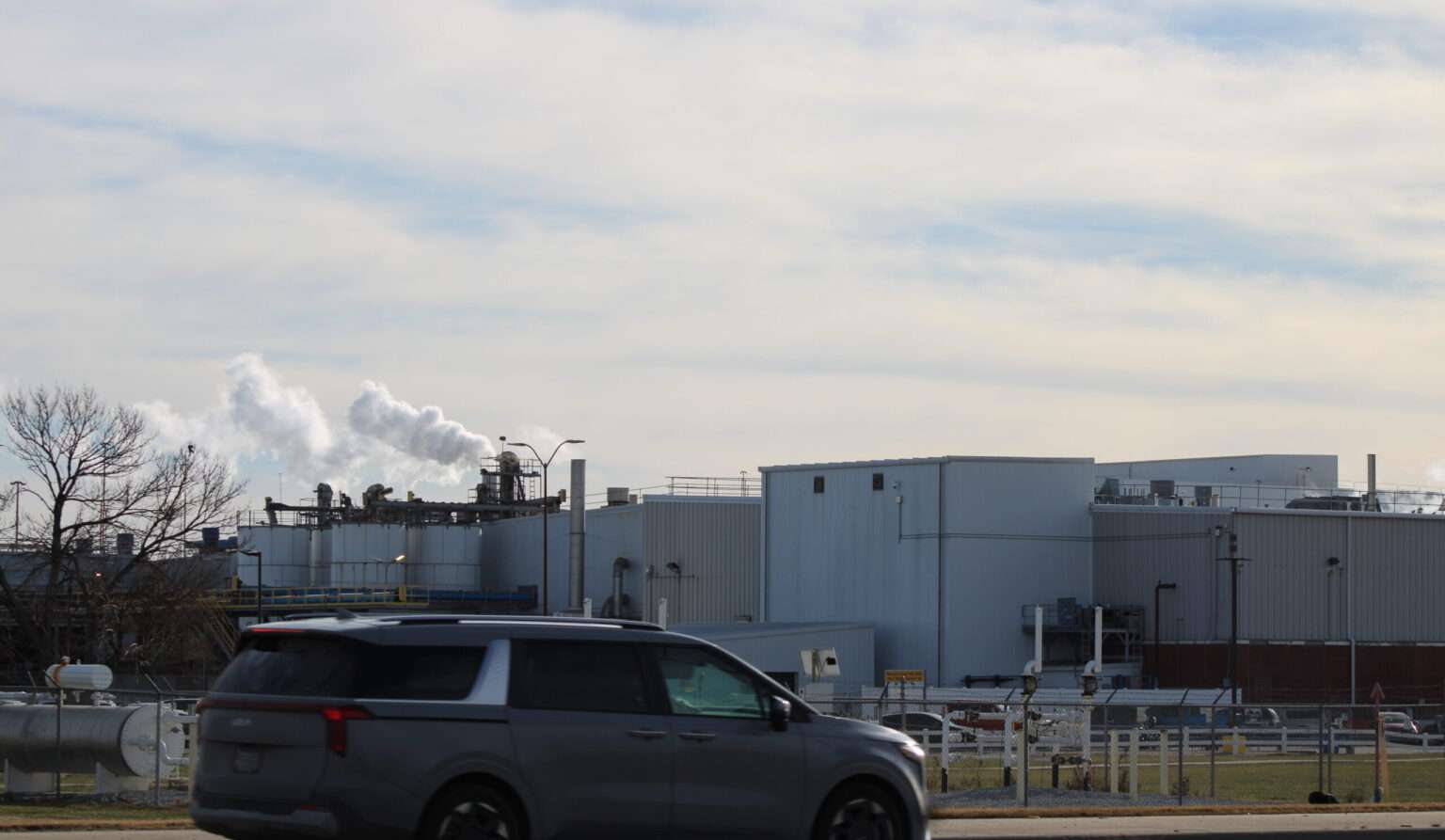 The Tyson beef plant in Lexington, shown in December, 2026 closure accounted for 3,212 jobs. (Juan Salinas II/Nebraska Examiner)