

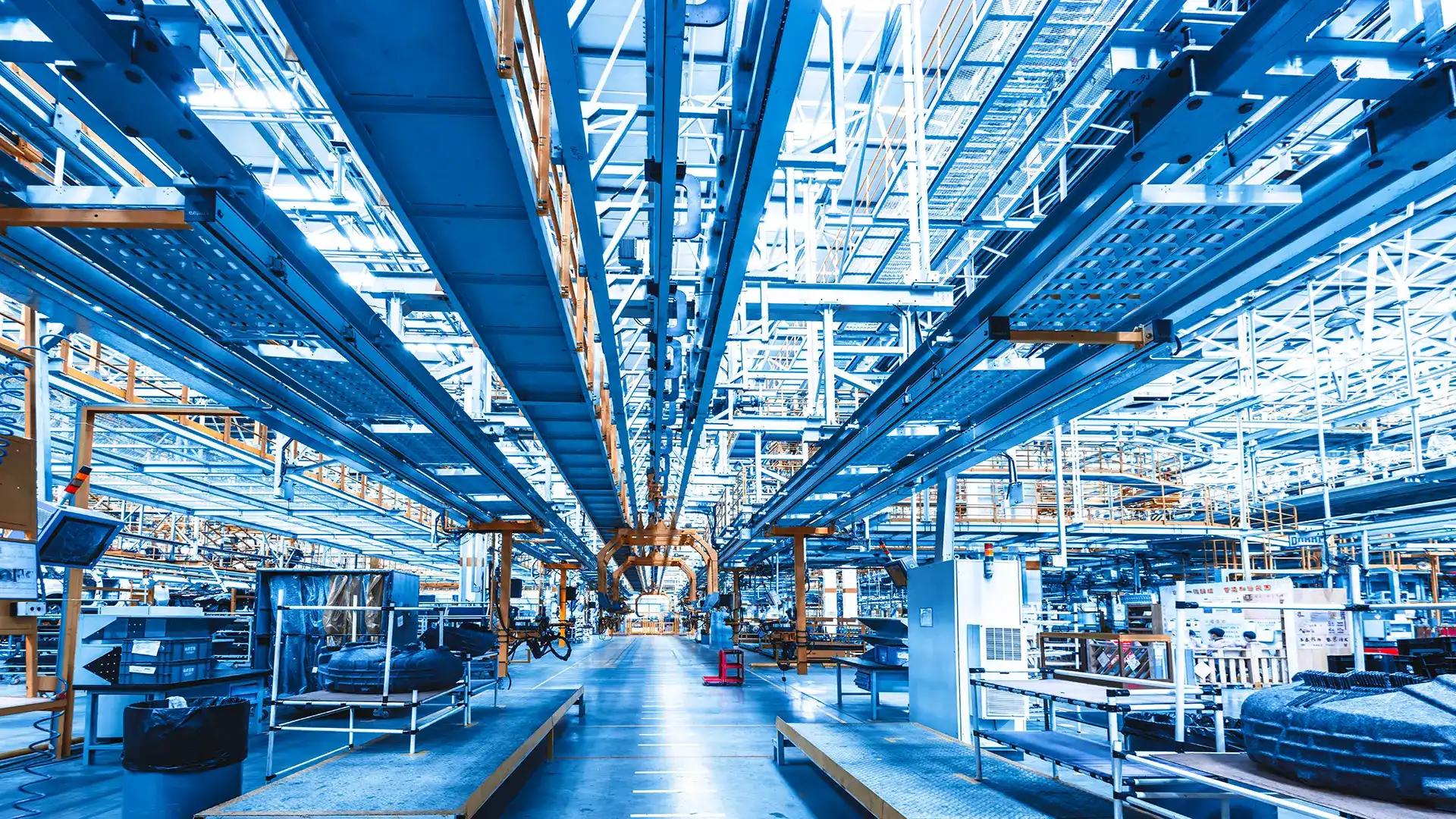
Survey Shows U.S. Manufacturing Activity Reaches More Than Four-Y…


Reports related to this article:

Written by Danny Levin, Deputy Editor for IIR News Intelligence (Sugar Land, Texas)

Summary

The Institute of Supply Management’s (ISM) Purchasing Managers Index showed economic activity in U.S. manufacturing reached its highest level since May 2022. Industrial Info Resources’ project data shows strong spending in the U.S. Industrial Manufacturing Industry.

U.S. Manufacturing Activity Rolls On

The Institute of Supply Management’s (ISM) Purchasing Managers Index showed economic activity in U.S. manufacturing reached its highest level since May 2022, with demand indicators showing faster growth. Strong spending in the U.S. Industrial Manufacturing Industry is reflected in Industrial Info Resources’ project data.

The PMI, which tracks 18 manufacturing sectors in the U.S., registered 55.6% in July, up from 53.3% in June–indicating faster growth month-over-month. Any reading over 50% indicates expansion in the manufacturing economy. July also marks the seventh month in a row of expansion.

According to Industrial Info Resources data, there is $687 billion worth of projects under construction in the U.S. Industrial Manufacturing Industry; more than half of the investment is attributed to data centers and semiconductors. The Global Market Intelligence (GMI) Project Database offers a full list of projects.

Any reading under 50% indicates contraction in the manufacturing economy.

“We have a really strong report this month,” Susan Spence, chair of ISM’s Manufacturing Business Survey Committee, said during a news media call.

Three of the four demand indicators–the New Orders, Backlog of Orders and New Export Orders indexes–expanded in July. The New Orders Index expanded for the seventh consecutive month, up 0.7% from June.

In terms of output, July’s Production Index jumped 6.3% month-over-month and reached its highest level since November 2021.

In a press release accompanying the survey, Spence said 38% of respondents’ comments were positive while 62% were negative, with a 1:1.6 ratio of positive to negative sentiment.

In the call, she acknowledged that “the continued Iran war and remaining price volatility” are still risk factors for manufacturing operations. Survey respondents echoed that sentiment.

Pricing volatility was mentioned in 57% of the negative comments, the Iran war 43%, increasing lead times 22% and tariffs 18%.

Mixed Feelings


Although July’s Prices Index, an indicator of input and raw materials costs, continues to show elevated price pressures, the reading of 71.1% lessened from June’s 73%.

The elevated index continues to be driven by increases in steel and aluminum prices impacting the entire value chain; tariffs applied to many imported goods; and increases in petroleum-based products as a result of the recent Middle East conflict.

“Demand is up, and prices are up as a result,” Spence said. She added that although the list of shortages “is pretty significant” and “certainly could get worse” depending on geopolitical factors, currently “orders are flowing.”

The PMI considers shortage items to be specific commodities, raw materials, components, or labor services that are reported to be in short supply or difficult to source.

“Overall, we’re definitely optimistic,” she said.

A Transportation Equipment survey respondent said, “Continued tariffs on products utilized in our product lines are being monitored by the business, which is working to mitigate or limit tariff risk. Geopolitical risk, especially in the Middle East, pertaining to commodity and energy markets remains a concern. There has been some increased cost and transit time for rerouted shipments due to conflicts in the Red Sea, Strait of Hormuz and Suez Canal.”

On a positive note, one respondent from Computer & Electric Products said a favorable demand environment is driven by growth in the semiconductor, artificial intelligence (AI), advanced packaging and high-performance computing (HPC) markets. “Recent company reports indicate strong sales growth and continued investment in manufacturing capacity.”

The ISM considers semiconductors and data-center components to be part of the sector.

Strong U.S. Manufacturing Capex


IIR data show data centers account for about 46% of the total investment value of U.S. Industrial Manufacturing Industry projects under construction.

AI cloud infrastructure provider Fluidstack is building out a multi-billion-dollar grassroot data enter in Abernathy, Texas, north of Lubbock. The facility is expected to feature 168 megawatts (MW) of critical load capacity, in order to provide expanded high-performance computing (HPC) support in the region.

Also in Texas, the first building of Google’s planned six-building data center campus in Oklaunion, near the Oklahoma border, kicked off in March. Construction is expected to wrap up next year.

Readers can view the two project reports.

IIR’s North American Construction Starts Index also shows strong capital spending: The monthly index for the U.S. Industrial Manufacturing industry in June (the latest available data) indicated 1,719 construction starts, with a project value of $209 billion–up from 1,604 projects worth $160 billion year over year.

Key Takeaways

  • The ISM’s PMI survey shows U.S. manufacturing activity in June reached its highest level since May 2022.
  • Three of four demand indicators–including new orders–are growing at a faster rate.
  • The Iran war and tariffs still are driving ongoing price pressures for manufacturers.
  • $687 billion: value of projects under construction in the U.S. Industrial Manufacturing Industry. About half is attributed to data centers.


  • About Industrial Info Resources

    Industrial Info Resources (IIR) is the leading provider of industrial market intelligence. Since 1983, IIR has provided comprehensive research, news and analysis on the industrial process, manufacturing and energy related industries. IIR’s Global Market Intelligence (GMI) helps companies identify and pursue trends across multiple markets with access to real, qualified and validated plant and project opportunities. Across the world, Industrial Info Resources is tracking over 250,000 current and future projects worth $30.2 trillion (USD).

Free Training

Source link

The Trump Administration’s Promises of a US Manufacturing Revival Fell Flat, First-Half Data Shows


Despite claiming that his preeminent trade policy would shrink America’s export gap with the rest of the world, President Donald Trump’s tariffs haven’t managed to rebalance trade or prompt a reshoring renaissance.

In fact, an analysis of first-half 2026 trade and manufacturing data conducted by Rethink Trade, a program under the American Economic Liberties Project, revealed that the U.S. manufactured goods trade deficit is 5 percent wider than before the president took office for a second term.

While Trump campaigned on a promise that tariffs on foreign imports would drive more purchases of American-made goods, the truth has been much more complicated.

Since taking the oath of office in January 2025, the U.S. has shed 75,000 manufacturing jobs, and there’s been little evidence to show that companies are laying the foundation for a comeback, as construction spending on manufacturing facilities also declined by 30 percent during that period.

According to data from the U.S. Census Bureau, the manufactured goods trade deficit amounted to $785 billion in the first half of 2026—15 percent smaller than the first half of 2025, but higher than the first six months of 2024, as well as the first-half deficits seen from 2015 to 2021.

Rethink Trade director Lori Wallach cautioned against viewing the first-half 2025-to-2026 contraction in the deficit as an all-out win, given that there were special circumstances that precipitated it. Importers were rushing to get inventory into the country during the first three months of the year before Trump’s tariffs took effect—but after that period, the overall U.S. manufactured goods trade deficit jumped by $63 billion in 2025 compared to the previous year, she said.

In looking at the goods trade deficit, which contracted to $545 billion in the first half of 2026 (compared to $750 billion in the first half of 2025 and $603 billion in the first half of 2024), there are also telling signs that the apparent wins may not be what they seem.

For one: most of the gains stemming from goods exports weren’t related to manufacturing output—they were driven by commodities: gold, silver, oil and gas, as well as aircrafts. When it comes to the metals, a large share are re-exports of products that weren’t mined in the U.S., and that’s a sign that the flows are driven more by capital movements than bona fide goods trade.

Wallach put it succinctly. “The whole global economy is a little bit unstable because he”—Trump—”changes his mind every 30 seconds and started a war with Iran. And so you know what do people do? They rush to silver and gold. And so, we’re selling basically the economic security blanket metals as bulk ores (that there’s new demand for because Trump has destabilized the global economy), and then we’re selling oil and gas because the Iran War has basically undermined other supply chains of those things,” she said.

“Trump has caused temporary disruption, and so we’re getting a temporary boom related to this behavior that is also causing major downsides,” she added. “The promised renaissance is not happening because you would not have a net decline in manufacturing jobs since Trump returned to office. You would not have a manufacturing trade deficit that is higher than it was before he was inaugurated for the second term.”

In Wallach’s estimation, using tariffs to prompt reshoring would take a much more nuanced and comprehensive approach than the one the Trump administration has employed thus far. Tariffs should have been a single building block propping up the president’s trade and economic strategy, not the entire structure.

In addition to applying tariffs more surgically, Wallach said the administration should have helped build demand for American-made products through policies—tax incentives for consumers who purchase domestically made goods, for example, and requirements for domestic procurement by the federal government.

On the investment side, she said, the government should have offered subsidies for companies hoping to reshore, “because as well as creating demand for the goods and protecting the sectors not to be surged to death once you are getting the demand, you also need to basically incentivize the investment.”

Wallach pointed to the end of the Inflation Reduction Act subsidies put in place by President Joe Biden as a possible factor in the decline in factory construction. “The most recent peak in the past 15 years of manufacturing employment was the first quarter of 2023, and that is when all of that money was flowing,” she said.

Biden used tariffs in conjunction with subsidies, she added, pointing to duties on China for electric vehicles and heightened tariffs on solar products. The combination of strategically applied tariffs on specific industries and the subsidies and tax breaks for American makers “was working together hand in glove,” she said.

The way the current administration is leveraging tariffs, by contrast, amounts to throwing down a few puzzle pieces and hoping to build a full picture of a robust trade economy. According to Wallach’s research, the new data underscores “what public opinion polls are already capturing.”

“We have a growing gap between the economy Trump promised and the damage his tariff malpractice is causing.” she said.

Free Training

Source link

Survey Shows U.S. Manufacturing Expansion at Slower Pace


Reports related to this article:

Written by Danny Levin, Deputy Editor for IIR News Intelligence (Sugar Land, Texas)

Summary

Economic activity in U.S. manufacturing expanded for the sixth straight month, according to the ISM’s latest PMI survey, but at a slightly slower pace than in May.

U.S. Manufacturing Activity Rolls On

The Institute of Supply Management’s (ISM) Purchasing Managers Index showed economic activity in U.S. manufacturing expanded for the sixth straight month in June, but at a slightly slower pace month-over-month. Respondents to the accompanying survey continue to express concern around the Iran war and U.S. trade policy, although price pressures lessened.

The PMI, which tracks 18 manufacturing sectors in the U.S., registered 53.3% in June, down from 54% in May–indicating slightly slower growth month-over-month. But that figure still is up from 52.7% in both April and March. Any reading over 50% indicates expansion in the manufacturing economy.

According to Industrial Info Resources data, there is $655 billion worth of projects under construction in the U.S. Industrial Manufacturing Industry; more than half of the investment is attributed to data centers and semiconductors. The Global Market Intelligence (GMI) Project Database offers a full list of projects.

Any reading under 50% indicates contraction in the manufacturing economy.

Although “the ongoing war and price volatility” remain a worry, “the badness is better than last month,” Susan Spence, chair of ISM’s Manufacturing Business Survey Committee, said during a news media call on July 1.

Two of the four demand indicators–the New Orders and Backlog of Orders indexes–expanded in June, albeit at a slightly slower pace than in May. In terms of output, production also grew at a slower rate month-over-month, but the survey showed Supplier Deliveries (delivery times) are slowing–which is considered positive for future production.

In addition, the Employment and Inventories indexes improved, with the latter entering expansion territory.

Iran War’s Effect on Sentiment


“In June, 34% of the comments were positive and 66% negative, with a 1-to-1.9 ratio of positive to negative sentiment,” she said in the report summary of findings. “Among negative comments, the Iran war was mentioned in 31% and tariffs in 17%; 50% of the panelists mentioned pricing volatility as an issue for their companies.”

That is an improvement from May’s ratio of 1-to-2.7.

Although June’s Prices Index, an indicator of input and raw materials costs, continues to show elevated price pressures, the reading of 73% improved from May’s 82.1%.

The elevated index continues to be driven by increases in steel and aluminum prices impacting the entire value chain; tariffs applied to many imported goods; and increases in petroleum-based products as a result of the recent Middle East conflict.

“Prices are going in a really wonderful direction,” Spence said on the media call. Speaking to the survey comments, “it is all about pricing,” and she was “erring on the caution’s side” in forecasting the business environment for the second half of the year. But she also noted that “optimism is there and it’s creeping in.”

“The conflict in Iran has impacted pricing in every category of raw materials,” one respondent from Chemical Products said. “Especially, items that have a heavy concentration of oil in the components like our adhesives.”

Price instability is forcing a “more conservative approach to capital expenditures,” another respondent in the Computer & Electronic Products sector said.

The ISM considers semiconductors and data-center components to be part of the sector.

Data Center Construction, Semiconductors Drive Strong Manufacturing Capex


South Korea-based semiconductor company SK Hynix is building out its U.S. production capacity via a roughly $4 billion grassroot plant in West Lafayette, Indiana. The 430,000-square-foot packaging fabrication plant and research and development hub will support high bandwidth memory (HBM) chips used for artificial intelligence. Production is expected to begin in 2028.

High-dollar data center projects include the estimated $650 million construction of Building 11 at Google’s Moncks Corner Data Center in South Carolina. The 275,000-square-foot addition is designed to help support services such as Google Cloud and Gmail. The project is expected to wrap up next year.

Readers can view the two project reports.

Key Takeaways

  • The ISM’s PMI survey shows U.S. manufacturing activity expanded for the sixth straight month in June but at a slightly slower pace compared with May.
  • The Iran war is driving ongoing price pressures for manufacturers, although they indicated that is easing.
  • Data centers and semiconductors buoy U.S. manufacturing-related construction underway, according to Industrial Info Resources data.

About Industrial Info Resources
Industrial Info Resources (IIR) is the leading provider of industrial market intelligence. Since 1983, IIR has provided comprehensive research, news and analysis on the industrial process, manufacturing and energy related industries. IIR’s Global Market Intelligence (GMI) helps companies identify and pursue trends across multiple markets with access to real, qualified and validated plant and project opportunities. Across the world, Industrial Info Resources is tracking over 250,000 current and future projects worth $30.2 trillion (USD).

Free Training

Source link