GM just boosted its U.S. manufacturing spend to $6 billion in one year


General Motors has now committed more than $6 billion to U.S. manufacturing in just 12 months—and the latest installment, an $830 million infusion across three propulsion plants announced Wednesday, is starting to look less like a spending spree and more like a strategic homecoming.

The new funding includes flows to Romulus Propulsion Systems in Michigan ($300 million, its second such investment after an identical commitment last year) to expand 10-speed transmission capacity for full-size trucks and SUVs; Toledo Propulsion Systems in Ohio ($40 million, also a second tranche) for light-duty truck transmissions; and Saginaw Metal Casting in Michigan ($150 million) to boost production of heads for sixth-generation V-8 engines destined for next-generation pickups and Corvettes.

In an interview with Fortune, GM’s manufacturing chief Mike Trevorrow said the company made sure the workers heard about it first. UAW representatives joined plant managers on the floor at all three facilities to deliver the news in person. “We were fortunate enough to have them at a couple of our plants today to help with the rollout to the employees,” said Trevorrow, senior vice president of global manufacturing. “It’s fun.”

A century-old idea, quietly revived

The shape of GM’s current manufacturing portfolio—full-size trucks, sixth-generation V-8s, 10-speed transmissions, a broad EV lineup maintained even as battery capacity was trimmed—bears a striking resemblance to a strategy that is literally over 100 years old.

Alfred P. Sloan built GM into the world’s largest automaker in the 1920s through the 1950s on a single organizing idea: offer a vehicle for every person, at every price point, under a stable of distinct brands. He immortalized this with the 1925 advertising slogan, “A car for every purse and purpose.”

When Fortune raised the comparison, Trevorrow paused. “I think it’s always been in our DNA, but I‘ve never heard it referenced specifically.” Then, almost as an aside, he noted: “We have a wide variety of vehicles for everyone.”

The fact that it was Fortune’s question may be the most revealing thing about how GM is operating right now—not as a company consciously invoking its storied past, but as one that has quietly re-internalized it.

‘Fast, flexible, and frugal’

The modern translation of Sloan’s philosophy, in Trevorrow’s telling, is three words: “Fast, flexible, and frugal.” It’s GM’s internal manufacturing mantra, part of CEO Mary Barra’s broader embrace of agility. In an environment where trade policy, consumer demand, and technology are all shifting at once, the ability to pivot is worth more than any single strategic conviction.

That flexibility is why, when EV demand grew more slowly than expected, GM didn’t dismantle its electric vehicle lineup. “We didn’t cut any vehicles,” Trevorrow clarified to Fortune when asked about how this investment reflects the EV focus. “We just cut a little bit of the battery capacity.” The company currently offers more than a dozen EV models and ranks second in U.S. EV sales—while simultaneously pouring hundreds of millions into sixth-generation V-8 infrastructure. Both things coexist, by design.

Trevorrow was careful not to let tariffs take full credit for the investment wave. “Tariffs might be involved only because of the timing,” he said. “When you know the rules, you know the guidelines—how you play that to the benefit of … the country, the consumer, and your company is key.”

What $6 billion looks like on the ground

The roughly 3,000 workers across Romulus, Toledo, and Saginaw are the most concrete expression of what this strategy looks like in practice, and Trevorrow said he thinks GM is in a good place with its workers right now. When asked what changed, he said it’s simple: a lot of surveys.

“We survey our employees,” he said. “In fact, they’ll say we survey too much, and I always say, ‘Remember the time when we didn’t ask?’” Sharing that it’s been in place for a little over five years, and that GM is now in the top quartile of all companies worldwide as a workplace of choice, Trevorrow said, “People like working here. We get that feedback, and we make changes according to it.”

Trevorrow noted this data drives real changes: shift-hour adjustments, lighting improvements on the plant floor, tools designed or 3D-printed based on worker suggestions. “The more we communicate,” he said, “the better we can problem-solve and root-cause things together. That’s the joy, I would say, every day of manufacturing.” GM’s view on continuous improvement, he said, is that everything can be improved.

The manufacturing chief allowed that he’s aware of anxiety, even angst, across the workforce over automation, especially when it comes to artificial intelligence. On AI specifically, he takes the long view. GM has invested more than $250 million over the past five years to upskill workers alongside new technology—setting aside a percentage of every new launch budget to bring plant floor employees up to speed before new automation goes live.

“What I emphasize is we’ve always led in implementation of automation, and we continue to do it,” he said, adding that GM believes in its people. “The investment in bringing our people along on this journey is key. Automation doesn’t work without people … Nothing’s worse than having new automation that sits because nobody knows what to do with it.” The goal isn’t replacement, in his telling. It’s fluency: “We’ll find out how to use our people best, and how to use automation best, and continue to drive both for safety, quality, and efficiency.”

Trevorrow said he sees AI himself daily and describes his own adoption curve in terms that plant workers might recognize. “It takes some getting used to,” he said. “But doesn’t everything? My cell phone took some getting used to. Now, if somebody was to take it away, I would think I’m missing an arm.”

Trevorrow reframed the debate around geopolitical uncertainty, shifting trade patterns, and employee anxiety: “Uncertainty is opportunity, too.”

Free Training

Source link

Astellas manufacturing chief talks strategy 1 year into role


For Astellas’ chief manufacturing officer, Rao Mantri, Ph.D.—who entered the position a little over a year ago—production is not just about a reliable supply of a pharmaceutical product. Manufacturing serves as a crucial bridge that helps link promising research to patients in the real world, too. 

“Astellas manufacturing has tremendous strengths in multiple modalities as well as a strong focus on service to patients,” Mantri said during a recent meeting with Fierce at the American Biomanufacturing Summit in San Francisco. “So, when I started, it was about—how do we actually make the manufacturing organization as a strategic enabler to connect research innovation to access to patients even more.”

He described that ambition under his leadership as Astellas’ manufacturing “north star,” alongside always ensuring a reliable supply of its medicines.

When Mantri entered the role of manufacturing chief at the Tokyo-headquartered pharma last April, he came in with the goal of helping streamline new modalities for manufacturing and commercial supply and of embedding digital and artificial intelligence tools into Astellas’ network, he explained. 

Over the past few years, the company has made several strategic moves to help broaden its production base in advanced treatment fields such as cell therapy and antibody-drug conjugates.

On the balance between Astellas’ internal and external capacity, Mantri noted that it’s critical to weigh multiple factors, including speed to patients, modality complexity, development stage, regulatory readiness and cost competitiveness when drawing up a supply plan.

“But what’s most important is really about our ability to deliver the reliable supply,” he explained, adding that the company benefits from working with CDMOs and other partners whose capabilities may fall outside of Astellas’ core wheelhouse. 

“We also have platform approaches that we are ready to partner with the right strategic groups,” Mantri added, citing a recent pact with Yaskawa Electric Corporation.  

In the case of that Yaskawa joint venture, Astellas is wedding its regenerative medicine expertise and manufacturing base with its partner’s robotics and AI capabilities.

The purpose of the team-up is to develop a robotic automation platform that other companies can also use to produce medicines faster with superior quality and reliability, while also accelerating technical development, according to Mantri. 

Separately, Astellas last Halloween tied up with Ajinomoto to use the latter’s bespoke antibody-drug conjugate (ADC) development and manufacturing platform, AJICAP, which Mantri noted will help Astellas “design the next generation” of ADCs. 

“It’s really based on where do we want to go and what are the capabilities that we can leverage that are not internal to us,” Mantri said. “We are ready to partner, but if you have the maturity in our platforms that others can use, we are open to having those strategic collaborations as well.” 

With regard to internal capacity, one of Astellas’ most prominent expansions has taken the form of a new plant in Tralee, County Kerry, Ireland, which the company first unveiled designs for in 2023. 

External construction on the fill and finish facility—which will use advanced manufacturing and testing to deliver parenteral biologics—has wrapped up, with the site now expected to open in “early 2027,” per Mantri. 

Mantri also addressed geopolitical tensions—primarily in the form of U.S. import tariffs—that have complicated production decision-making in recent months. 

Astellas, in his estimation, is relatively well positioned given the company’s “geographically balanced global production network.” 

He also pointed to the company’s established manufacturing base in the U.S., where Astellas boasts a gene therapy production site in North Carolina and a unit for cell therapy manufacturing in Massachusetts, the latter of which has “strong capabilities for future regenerative medicines.” 

Looking at the role of Astellas’ manufacturing network, and the position production holds in the biopharma landscape more broadly, Mantri described the manufacturer’s charge as twofold: Production teams must both work to help streamline innovation coming out of research and “embrace and take into consideration uncertainties and complexities to serve patients” and provide reliable access to medicines. 

Free Training

Source link

“Liberation Day” One Year Review: How Tariffs Handcuffed U.S. Farmers and Manufacturers – Publications


April 2, 2026, will mark the anniversary of President Donald Trump’s Liberation Day Tariffs. Here are three things that happened after Liberation Day tariffs were imposed:

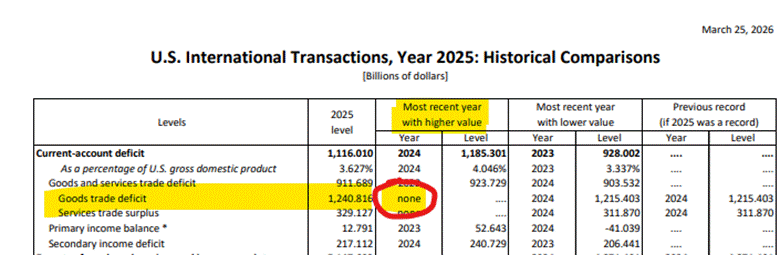
➡️The trade deficit increased. The goal of Trump’s tariffs was spelled out in the title: Regulating Imports with a Reciprocal Tariff to Rectify Trade Practices that Contribute to Large and Persistent Annual United States Goods Trade Deficits. Trump’s executive order asserted that persistent goods trade deficits are a national emergency, and the Administration’s cure was to hike tariffs to the highest level since the 1930s.

The result? On March 25, the Bureau of Economic Analysis reported that the U.S. goods deficit increased to an all-time high in 2025.


➡️The manufacturing sector suffered. According to Trump’s Liberation Day executive order, “The decline of U.S. manufacturing capacity threatens the U.S. economy in other ways, including through the loss of manufacturing jobs.” Here’s what happened next:

Figure 2: Manufacturing Employment

➡️Farmers paid dearly. According to President Trump’s Liberation Day Fact Sheet, President Biden’s policies generated an all-time high agricultural trade deficit.  But data from the Foreign Agriculture Service show the ag trade deficit increased from $37 billion in 2024 to $41 billion in 2025.

  • Tariffs hit farmers and ranchers with a double-whammy of lower exports and higher input prices. Under Liberation Day tariffs, U.S. agricultural exports declined and the 2025 agricultural trade deficit increased by 10.8%. From February to October 2025 alone, tariffs increased the cost of goods like farm machinery and agricultural chemicals by $958 million. 
  • The failure of this tariff policy is reflected in a recent letter from the country’s leading farm organizations, which warns: “America’s farmers, ranchers, and growers are facing extreme economic pressures that threaten the long-term viability of the U.S. agriculture sector. An alarming number of farmers are financially underwater, farm bankruptcies continue to climb, and many farmers may have difficulty securing financing to grow their next crop.”

These results were entirely predictable. 

  • There was no reason to expect Liberation Day tariffs to reduce the trade deficit. Tariffs reduce the growth of both imports and exports, with no definitive impact on the overall trade balance.
  • Over half of U.S. imports in 2025 were industrial supplies or capital goods used to make things in the United States. Tariffs on those goods made it harder for U.S. manufacturers to afford the goods they need to survive and grow.
  • During President Trump’s first term, the Department of Agriculture created the Market Facilitation Program to bail out farmers affected by the ramifications of Trump’s Section 301 tariffs—tariffs that were much smaller than Liberation Day tariffs. Now the government is considering even larger farm bailouts.

Federal officials should learn from their tariff mistakes.

Many factors other than tariffs influence the U.S. economy, and it would be a mistake to assign blame or credit to tariffs for everything that happened in 2025. However, the data should demonstrate to the Trump Administration that its measures of success are inherently flawed.

History shows that it’s easy to reduce the trade deficit: simply engineer a wealth-destroying recession. Trade deficits are not a cause for concern when they are driven by the desire of our trading partners to invest in a thriving U.S. economy or our ability to afford more imports. The Trump Administration and Congress should continue to focus on tax and regulatory reforms that strengthen our economy, regardless of their impact on the trade deficit.

History also shows that manufacturing job losses as a share of total employment should not be a cause for concern when they are driven by productivity improvements that create better jobs and boost manufacturing growth, as opposed to when they result from destructive federal economic polices—like taxing steel, aluminum, and other needed inputs.

One year after Liberation Day, the evidence is in: tariffs failed even by the Trump Administration’s own terms. They did not shrink the trade deficit, did not revitalize manufacturing, and did not help farmers. It would be a mistake to replace one set of failed tariffs with another.

Free Training

Source link

Tariff threats prompted pharma production boom last year: report


While the threat of U.S. import tariffs prompted a surge in drug production last year, that output is slated to slow across multiple geographies in 2026. And, even as the biopharma industry enters the new year with greater certainty around the U.S.’ trade policy, the risk of another “tariff flare-up” looms large.

That’s the macro situation according to financial services firm Atradius, which noted in a new industry trend report (PDF) that global pharmaceutical production leapt 9.1% in 2025, mainly on the back of “front-loading activity in anticipation of US tariffs.” 

In 2026, however, output growth is expected to slow to 1.6% as a move toward “retrenchment” results in a slowdown of production growth in the first half of the year, the report predicts.

Nevertheless, a rebound could be not too far behind, with Atradius reckoning that global drug production will eke out 3.7% growth in 2027. That general trend holds true when looking at Atradius’ predictions for the growth of pharmaceutical sales and investments around the world in 2027, too.

As for 2025, the financial services company logged 9.7% growth in global pharmaceutical sales and 5.2% growth in overall industry investment. Atradius expects momentum in those areas will slow to 1.6% and 2.7% in 2026, respectively. 

The Trump administration’s persistent threat of pharmaceutical import tariffs was the driving force behind last year’s manufacturing surge, the experts say.

Still, the overall impact of U.S. trade duties has been “limited,” according to Atradius, which pointed to the exemptions Big Pharma companies have won through White House drug pricing deals as well as country- and region-specific agreements capping U.S. import tariff rates. Furthermore, generic drugs have largely been excluded from President Donald Trump’s trade negotiations, sparing the medicines that make up the bulk of the American public’s prescriptions from supply and price disruptions.

The industry isn’t out of the woods yet, with the report cautioning that “the downside risk of another tariff flare-up remains.”

Earlier this week, following an intensification of Trump’s rhetoric around a potential U.S. acquisition of Greenland, concerns were raised that the threat of new 10% taxes on select European countries that showed military support for the autonomous Danish territory might scupper the U.S.-EU trade deal reached last summer. Under that accord, which still needs to be ratified by European lawmakers, most European exports, including pharmaceuticals, will have tariffs capped at 15%.

Trump ultimately backed down on the threat after reaching the “framework of a future deal” on his Greenland ambitions during the World Economic Forum in Davos, Switzerland, this week. Still, the uncertainty his comments cast on previously secured agreements lends credence to Atradius’ “tariff flare-up” warning.

Overall, Atradius suggested industrial policy will play an increasingly large role across the pharmaceutical industry in the coming years, buoyed by government efforts around the globe to reduce reliance on imports and incentivize strategic stockpiling and domestic manufacturing.

“Supply networks of pharmaceuticals and medical devices will become more fragmented due to geopolitical tensions,” the firm predicted.
 

Mapping 2025’s production output
 

In the U.S., pharmaceutical manufacturing output is expected to “decelerate” to 0.9% this year—a marked departure from the 5.2% increase charted in 2025, according to Atradius’ report. The outlook forecasts a 2.5% rebound in U.S. pharmaceutical output growth in 2027.

The report again pointed to industry-won tariff exemptions as a relief for drugmakers in the near term, while caveating that “uncertainty remains, as Washington has repeatedly announced its intention to target medicine imports.”

Aside from the most-favored-nation drug pricing deals that have won many large pharma companies exemptions from tariffs, efforts by the FDA to ease the build-out of new production facilities in the U.S. could also bolster the country’s pharmaceutical output, Atradius said.

At the same time, “high production costs could still make it more cost-effective for pharmaceuticals to be manufactured elsewhere,” the report reads.

Perhaps most striking in Atradius’ report was the 21.6% growth in pharmaceutical output that the U.K. and the EU charted in 2025, again attributed to “front-loading triggered by massive U.S. tariff threats.” In Ireland—a country with a wealth of large pharma manufacturing outposts—production output surged a whopping 41.3% in 2025, according to Atradius. The country is predicted to experience a sharp turn in the other direction this year, with Atradius forecasting a 6.4% output decline.

This year, the U.K. and the EU’s combined output is tipped to “contract temporarily” by 3.7%, by Atradius’ reckoning.

While the EU has presently secured a 15% tariff rate cap, the U.K. has dodged U.S. import duties altogether in part by agreeing to raise the net prices its National Health Service pays for innovative medicines by 25%.

While those agreements blunt the impact of tariffs in Europe, Atradius acknowledged that shifting manufacturing to the U.S.—a key part of Trump’s trade agenda—is both expensive and complex, posing challenges for smaller companies with fewer resources.

Unlike Europe and the U.S., China’s pharmaceutical output is expected to continue growing in 2026. Atradius estimates that the country’s drug production will increase 6.6% this year versus 3.6% growth in 2025. 

China’s exposure to U.S. tariffs is “limited,” and, while the country accounts for some 40% of the world’s active pharmaceutical ingredient output, those drug building blocks aren’t targeted by U.S. tariffs, Atradius noted. 

Free Training

Source link