
Hadrian Secures $360 Million Credit Facility to Expand U.S. Manufacturing Network


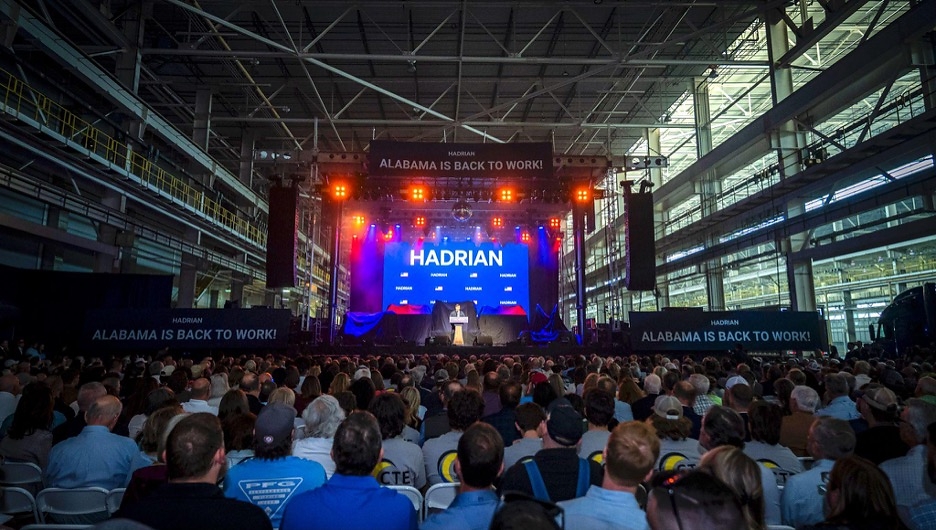
Opening of Hadrian’s factory in Cherokee, AL.

Hadrian has closed a $360 million revolving credit facility to finance additional manufacturing infrastructure, machinery and related hardware as the advanced manufacturing company expands production capacity for U.S. defense and aerospace customers.

The financing follows Hadrian’s recently announced $1.37 billion Series D funding round, which valued the company at $7.87 billion. Together, the equity raise and new credit facility provide additional capital for a manufacturing buildout that now spans four facilities totaling just under 3 million square feet, with more sites under development.

Morgan Stanley Senior Funding Inc. served as lead left arranger and bookrunner for the revolving facility. Western Alliance Bank, J.P. Morgan, First Citizens Bank, Customers Bank, HSBC Ventures USA Inc., Axos Bank and Texas Capital Securities also served as joint lead arrangers and bookrunners.

Hadrian plans to use the credit facility to continue investing in the physical infrastructure required to scale its manufacturing model. Unlike funding directed primarily toward software development or corporate expansion, the facility is intended to support capital-intensive assets including production equipment and factory hardware.

That capacity is central to Hadrian’s strategy of building highly automated U.S. factories that combine process engineering, artificial intelligence and robotics. The company is targeting defense and aerospace manufacturing, where scaling production requires not only factory space but also specialized machinery, production systems and repeatable processes capable of meeting customer requirements.

“This facility’s closing represents a key next step in Hadrian’s growth trajectory,” founder and CEO Chris Power said. He added that the financing will support the company’s efforts to build additional U.S. industrial capacity and create manufacturing jobs.

Hadrian currently operates two facilities in Torrance, California, along with newly launched sites in Arizona and Alabama. Its four facilities collectively cover just under 3 million square feet, and the company has additional locations in development across the country.

The geographic expansion reflects the infrastructure requirements behind Hadrian’s effort to increase domestic production for space and defense programs. Building a larger manufacturing network requires coordinating factory construction, machinery installation, automation systems and production ramp-up while maintaining consistent processes across sites.

Hadrian’s model is designed to use automation to address those execution challenges. The company combines robotics and AI with manufacturing process engineering, seeking to increase production capacity while giving workers tools to manage more automated factory workflows.

The $360 million revolving structure also provides a different source of capital from Hadrian’s Series D equity financing. A revolving credit facility can give a company access to capital as spending requirements emerge, providing flexibility as equipment purchases and factory investments progress across multiple locations.

The new financing arrives one week after Hadrian announced the $1.37 billion Series D. The company did not provide a breakdown of how the equity financing and revolving facility will be allocated among individual factories or equipment programs.

Hadrian’s expansion is focused on the manufacturing infrastructure behind defense and aerospace supply chains, where increasing output can involve significant capital spending before additional production comes online. Factory footprints must be developed and equipped, manufacturing processes validated and capacity coordinated with customer programs.

The company ultimately aims to enable space and defense manufacturers to produce complete programs at greater scale in the United States. Its growing network of factories provides the physical foundation for that strategy, while automation is intended to improve how production capacity can be deployed and replicated across facilities.

Kirkland & Ellis served as legal counsel to Hadrian on the revolving credit transaction.

With its latest debt facility and Series D financing completed in close succession, Hadrian has added substantial capital for the next stage of its U.S. factory buildout, shifting the focus toward deploying machinery, commissioning infrastructure and translating its expanded footprint into production capacity for aerospace and defense customers.


Free Training

Source link

LTR Pharma secures national US manufacturing and fulfilment partner


LTR Pharma has taken a major step toward its planned US commercial launch by executing a definitive agreement with Strive Specialties, converting a previously announced binding term sheet into a long-form commercial arrangement that will govern the manufacture, compounding, fulfilment and nationwide supply of ROXUS in the United States.

ROXUS is a fast-acting intranasal spray for the treatment of erectile dysfunction, enabling onset of action in 10 minutes or less. 

The agreement establishes the operational framework for technology transfer, manufacturing, quality systems, active pharmaceutical ingredient procurement, product change control, inventory management and nationwide prescription fulfilment.

The deal builds on a complementary agreement LTR Pharma signed with telehealth provider Shed, giving the company two core commercial pillars: patient acquisition and prescribing through telehealth, and national manufacturing and fulfilment through Strive Pharmacy.

Strive Pharmacy operates a Section 503A compounding platform across five US states with licensure that supports nationwide compounding, packaging, fulfilment and shipping of prescription treatments. Under the agreement, Strive will be responsible for preparation, fulfilment, shipping and related quality and supply chain operations for ROXUS, providing the infrastructure LTR says is needed to support both telehealth and clinic channels and future commercial growth.

LTR Pharma Executive Chairman, Lee Rodne, said, “Executing the definitive agreement with Strive Pharmacy completes another major piece of our U.S. commercialisation strategy. While Shed provides patient acquisition and telehealth capability, Strive Pharmacy provides the national manufacturing, compounding and fulfilment infrastructure required to supply ROXUS across the United States. With both definitive agreements now in place, our focus shifts from partner selection to implementation and Commercial Launch. We believe this significantly strengthens our U.S. execution pathway and reduces commercial risk.”

Strive Pharmacy President and Co-Founder, Michael Walker, added, “We are delighted to formalise our partnership with LTR Pharma. ROXUS is a highly differentiated product, and we look forward to supporting its U.S. launch through Strive Pharmacy’s national compounding, manufacturing and fulfilment capabilities.”

Free Training

Source link

Samsung Biologics secures first manufacturing base in U.S.


(Samsung Biologics) 사진 확대 (Samsung Biologics)

Samsung Biologics Co. has expanded its global production network by securing its first manufacturing base in the United States.

Samsung Biologics announced on Wednesday that it completed the acquisition of a biopharmaceutical production facility in Rockville, Maryland, previously owned by GSK Plc, as of Tuesday, local time. The deal was carried out through its subsidiary, Samsung Biologics America.

The Rockville site is a drug substance (DS) manufacturing plant with total capacity of 60,000 liters, comprising two production buildings. It is equipped with infrastructure capable of producing antibody therapeutics at various scales, from clinical-stage to commercial production.

With this acquisition, Samsung Biologics has expanded its total production capacity to 845,000 liters from 785,000 liters. The company said that it has now established a dual production system connecting Songdo, Korea, and Rockville, enabling more stable and flexible supply to global clients.

In particular, securing a production base in North America is expected to strengthen responsiveness to local customers and further enhance competitiveness in winning global contracts.

Samsung Biologics has retained all approximately 500 employees at the Rockville facility, ensuring operational continuity. It plans to pursue stable supply of existing products while expanding new orders through integrated operations between the two production bases.

The company said it will also review further investment, including capacity expansion and technology upgrades at the Rockville facility, based on mid- to long-term demand and utilization.

“This represents a meaningful step in expanding our U.S. manufacturing footprint,” said John Rim, president and chief executive officer of Samsung Biologics. “The Rockville team brings deep expertise and strong operational experience that will further strengthen the site as part of our global manufacturing network.”

By Wang Hae-na and Chang Iou-chung
[ⓒ Pulse by Maeil Business News Korea & mk.co.kr, All rights reserved]

Free Training

Source link

President Trump Secures Trillions in New U.S. Investments as Companies Expand American Manufacturing


Supporters of President Donald J. Trump say his America First economic policies are driving a massive wave of private investment back into the United States. Since the start of his second term, companies from around the world have announced major plans to expand U.S. manufacturing, artificial intelligence infrastructure, energy production, and advanced technology development.

Advocates of the administration say the investments demonstrate renewed confidence in the U.S. economy and a shift toward onshoring production, strengthening domestic supply chains, and creating American jobs. The announced investments collectively total trillions of dollars, with projects spread across dozens of states.

Below is a non-comprehensive list of companies and projects announcing new U.S.-based investments during President Trump’s second term.

  • Apple – $600 billion investment in U.S. manufacturing and workforce training while expanding domestic supply chains.
  • Meta – $600 billion investment by 2028 to expand artificial intelligence technology, infrastructure, and workforce development in the U.S.
  • Project Stargate (SoftBank, OpenAI, Oracle) – $500 billion private investment in U.S. artificial intelligence infrastructure.
  • NVIDIA – $500 billion investment in U.S. AI infrastructure over four years, while manufacturing AI supercomputers in the United States for the first time.
  • Amazon – $340 billion invested in the U.S. last year, plus $20 billion for cloud infrastructure in Pennsylvania, $10 billion in North Carolina data centers, and $4 billion across small towns nationwide.
  • Micron Technology – $200 billion investment in U.S. semiconductor manufacturing, including facilities in Boise, Idaho, and Manassas, Virginia.
  • IBM – $150 billion investment over five years in U.S. manufacturing and technology growth.
  • Taiwan Semiconductor Manufacturing Company (TSMC) – $100 billion investment in U.S. chip manufacturing facilities.
  • Johnson & Johnson – $55 billion investment in manufacturing, research, and technology, including a major facility in North Carolina.
  • AstraZeneca – $50 billion investment in medicines manufacturing and research in the U.S.
  • Anthropic – $50 billion investment in AI infrastructure, including new data centers in Texas and New York.
  • Roche – $50 billion investment in U.S. research and manufacturing expected to create more than 1,000 permanent jobs and 12,000 construction jobs.
  • Bristol Myers Squibb – $40 billion investment in U.S. manufacturing, technology, and research operations.
  • GSK – $30 billion investment in U.S. research, development, and manufacturing facilities.
  • Eli Lilly – $27 billion investment to more than double U.S. drug manufacturing capacity.
  • Hyundai – $26 billion investment, including a $5.8 billion steel plant in Louisiana, creating roughly 1,500 jobs.
  • Vantage Data Centers – $25 billion project to build a 1.4-gigawatt data center campus in Texas employing more than 5,000 workers.
  • ADQ and Energy Capital Partners – $25 billion investment in U.S. energy and data center infrastructure.
  • Google – $25 billion investment in AI and data center infrastructure.
  • Blackstone – $25 billion investment in digital and energy infrastructure in Pennsylvania.
  • Novartis – $23 billion investment to build or expand ten U.S. manufacturing facilities and create 4,000 jobs.
  • John Deere – $20 billion investment over the next decade in American manufacturing expansion.
  • DAMAC Properties – $20 billion investment in U.S. data centers.
  • CMA CGM – $20 billion investment in shipping and logistics expected to create 10,000 jobs.
  • Sanofi – $20 billion investment in research and manufacturing in the U.S.
  • Venture Global LNG – $18 billion investment in a Louisiana liquefied natural gas facility.
  • Woodside Energy Group – $17.5 billion investment in a new LNG facility in Louisiana.
  • GlobalFoundries – $16 billion investment expanding chip manufacturing plants in New York and Vermont.
  • FirstEnergy Corp. – $15 billion investment in energy infrastructure improvements.
  • Nippon Steel – $14 billion investment in U.S. Steel operations, including a new steel mill.
  • Stellantis – $13 billion investment to expand U.S. vehicle production by more than 50 percent.
  • Gilead Sciences – $11 billion expansion of U.S. manufacturing investment.
  • AbbVie – $10 billion investment over ten years, adding four new manufacturing plants.
  • JPMorganChase – $10 billion investment supporting U.S. manufacturing growth.
  • Merck & Co. – $9 billion investment in U.S. pharmaceutical manufacturing, including new facilities in Delaware and North Carolina.
  • PPL – $6.8 billion investment expanding power grid capacity.
  • CoreWeave – $6 billion investment in data center expansion.
  • Westinghouse – $6 billion investment to build ten nuclear reactors in the United States.
  • Clarios – $6 billion expansion of domestic manufacturing operations.
  • UCB – $5 billion investment for a new U.S. pharmaceutical manufacturing plant.
  • Ford – $5 billion investment in Kentucky and Michigan manufacturing facilities.
  • Pratt Industries – $5 billion investment creating 5,000 manufacturing jobs across four states.
  • Hanwha Group – $5 billion investment expanding shipbuilding operations in Philadelphia.
  • GlobalWafers – $4 billion investment expanding U.S. semiconductor production.
  • General Motors – $4 billion investment shifting vehicle production from Mexico and China to U.S. plants.
  • Mitsubishi – $3.9 billion investment in American energy projects.
  • Shintech – $3.4 billion expansion of a Louisiana chemical manufacturing facility.
  • Regeneron and Fujifilm Diosynth Biotechnologies – $3 billion agreement to expand pharmaceutical manufacturing in North Carolina.
  • Kraft Heinz – $3 billion investment upgrading U.S. food manufacturing plants.
  • GE Appliances – $3 billion investment expanding manufacturing across five states.
  • NorthMark Strategies – $2.8 billion supercomputing facility in South Carolina.
  • Thermo Fisher Scientific – $2 billion investment expanding manufacturing operations.
  • Amkor Technology – $2 billion semiconductor facility in Arizona, creating 2,000 jobs.
  • Biogen – $2 billion investment in North Carolina manufacturing.
  • Mars, Inc. – $2 billion expansion of U.S. manufacturing operations.
  • GE Aerospace – $2 billion combined investment creating 10,000 jobs nationwide.
  • Kimberly-Clark – $2 billion investment expanding manufacturing facilities, including a major plant in Ohio.
  • Chobani – $1.7 billion investment, including a new dairy processing plant in New York.
  • Oklo – $1.68 billion fuel recycling facility in Tennessee.
  • Corning – $1.5 billion expansion of Michigan manufacturing, creating 1,500 jobs.
  • Smithfield Foods – $1.3 billion pork processing facility in South Dakota.
  • MP Materials – $1.25 billion rare earth magnet facility in Texas.
  • First Solar – $1.1 billion solar manufacturing plant in Louisiana.
  • Carrier – $1 billion investment creating 4,000 jobs.
  • Cencora – $1 billion investment strengthening U.S. distribution networks.
  • Siemens Energy – $1 billion expansion of grid and turbine manufacturing.
  • Hikma Pharmaceuticals – $1 billion investment expanding research and manufacturing.
  • Vaxcyte – $1 billion U.S. vaccine manufacturing investment.
  • Anduril Industries – $1 billion autonomous defense systems facility in Ohio.
  • Live Nation Entertainment – $1 billion investment building 18 new music venues nationwide.
  • Hitachi – $1 billion investment in American energy infrastructure, including a transformer plant in Virginia.
  • Williams International – $1 billion aviation engine manufacturing facility in Florida.

Numerous additional companies—including Toyota, Lego, Samsung Biologics, Siemens, Abbott Laboratories, Anheuser-Busch, Whirlpool, Rolls-Royce, Philips, ABB, JBS USA, Pratt & Whitney, and many others—have also announced new manufacturing plants, technology facilities, or infrastructure investments across the country.

Supporters say the scale of the announcements reflects a broader trend of reindustrialization and renewed domestic manufacturing capacity, with hundreds of thousands of jobs expected to be created.

Economic analysts note that many large corporate investment decisions span several years and multiple administrations, but the administration’s backers argue the surge signals strong confidence in the American economy and workforce.

More investment announcements are expected as companies continue expanding U.S. operations.

Free Training

Source link

FBR secures conditional order for Mantis welding robot to support US manufacturing


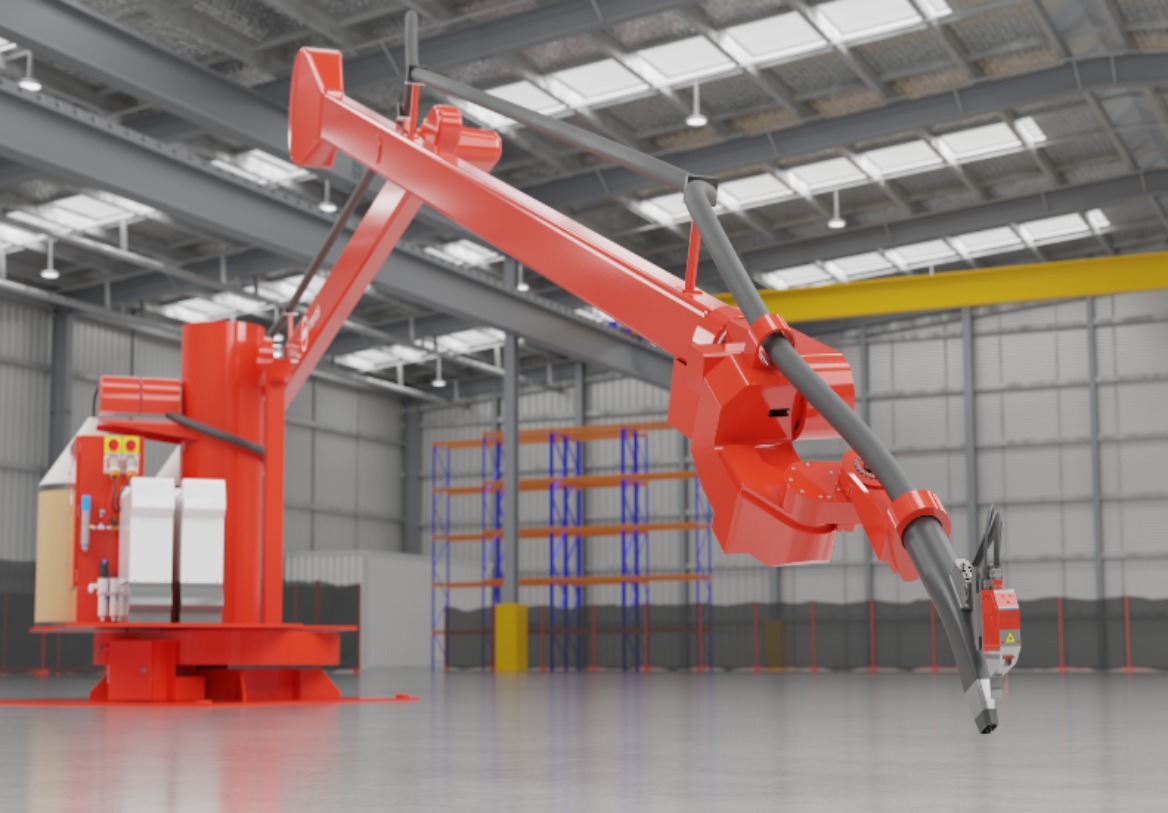
FBR’s Mantis™. Image credit: FBR

Robotic technology company FBR Limited has received a binding conditional purchase order valued at AUD 990,000 for its Mantis welding robot, in a deal aimed at supporting manufacturing operations in the United States.

In a news release, the company said the order has been placed by State Machinery & Equipment Sales, a Louisiana-based dealer for heavy equipment brands, which intends to use the Mantis robot in the manufacture of barges at its facility on the Mississippi River. 

FBR stated delivery is anticipated in the second half of calendar year 2026.

According to FBR, the purchase order is conditional on the successful completion of a Factory Acceptance Test to be conducted at the company’s Western Australian facility. 

The test will involve Mantis welding a sub-assembly of a hopper barge, with welding speed and quality independently assessed through non-destructive testing in line with AWS D1.1 standards.

Once the Factory Acceptance Test is completed to specification, AUD 450,000 of the contract value will become payable, with a further AUD 450,000 due on delivery and the remaining AUD 90,000 payable three months after delivery. 

The contract also includes installation and training services to be provided by FBR in Louisiana.

FBR chief executive officer Mark Pivac said the order reflects early interest in the technology despite it still being in the prototyping phase. “We are very pleased to have secured a binding conditional purchase order for Mantis while we’re still in the prototyping phase, which is indicative of the strong demand we’ve had for the product already,” he said. 

He added that the company looks forward to demonstrating the system’s welding performance during the acceptance testing process.

State Machinery president Ed Renton said the company sees the technology as an opportunity to enhance its manufacturing capability. “As the foremost dealer of heavy equipment in Louisiana, State Machinery has a lot of experience in manufacturing and construction equipment, and we are very excited to get our hands on the first Mantis® in the world,” he said.

“We are pleased to be working with the team to bring their robotic welding technology to the United States to boost our manufacturing capability.”

The content of this article is based on information supplied by FBR Limited. For more information, please refer to the official company announcement and communications from FBR. Please consult a licensed and/or registered professional in this area before making any decisions based on the content of this article.

Free Training

Source link