US Manufacturing Holds Up as Costs Gauge Hits Four-Year High


A worker arc welds a metal door during production at a manufacturing facility in Sacramento. (David Paul Morris/Bloomberg)

May 1, 2026 11:01 AM, EDT

This year’s U.S. manufacturing expansion extended into April even as the Iran war drove input prices sharply higher.

The Institute for Supply Management’s gauge of prices paid for manufacturing inputs climbed for a fourth straight month to a four-year high of 84.6, according to data released May 1.

The group’s measure of overall factory activity held steady at 52.7, matching the highest level since 2022. Readings above 50 indicate growth.

Military conflict in the Middle East and the effective closure of the Strait of Hormuz have disrupted supply chains around the world, driving up the cost of oil and other materials like aluminum and helium. Higher gasoline and diesel prices have also made shipping products more expensive.

Thirteen manufacturing industries reported growth in April, led by textile mills, nonmetallic mineral products and primary metals. Three industries indicated a contraction.

Sustained inflationary pressures may spur manufacturers to hike prices too, which could ultimately lead to higher costs for consumer goods. Data out April 30 showed the Federal Reserve’s preferred gauge of inflation jumped in March by the most since 2022.

.@ISM® Manufacturing PMI® Report: New orders ticked up, #employment contracted further and the prices elevator went even higher as #tariffs and the Middle East conflict remained headaches. The #ISMPMI was 52.7% for a second straight month. https://t.co/J7Z1OI1HlC #economy

— Institute for Supply Management (@ism) May 1, 2026

The ISM report showed new orders picked up in April as production growth decelerated. A measure of supplier deliveries rose to the highest level since 2022, with the longer lead times likely a result of war-related disruptions.

The group’s gauge of employment fell to a four-month low, indicating factory head count continued to shrink. The government’s April employment report is scheduled to be released May 8.

“Among panelists, 60% indicated that managing head counts remains the norm at their companies as opposed to hiring, and of those managing head counts, 34% are using layoffs and 43% using attrition or not backfilling positions,” Susan Spence, chair of the ISM Manufacturing Business Survey Committee, said in a statement.


Free Training

Source link

US manufacturing activity hits 4-year high: White House


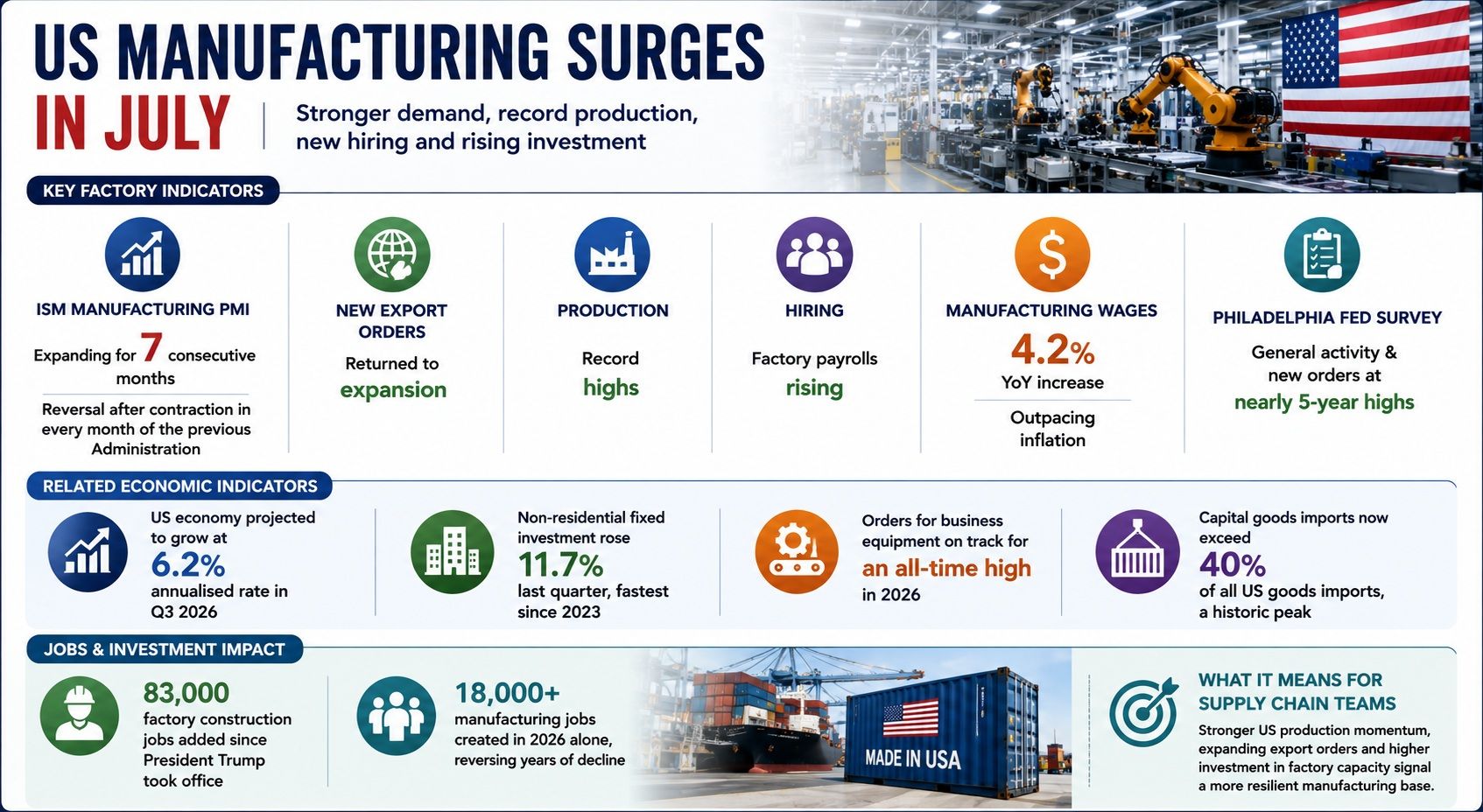
US manufacturing is witnessing a surge across the country as the sector is growing for the third consecutive month, with key indicators showing broad strength, the White House recently said.

The Institute for Supply Management’s (ISM) key manufacturing index—which tracks factory activity across the country—registered the sector’s third straight month of expansion for its highest reading since 2022.

US manufacturing is seeing a surge as the sector is growing for the third month in a row, with key indicators showing broad strength, the White House said.
The ISM manufacturing index saw the third straight month of expansion for its highest reading since 2022.
The Federal Reserve Bank of Philadelphia’s April manufacturing index rose.
Orders for capital goods exceeded $4 billion in each month of Q4 2025.

The ISM new orders index expanded for the third consecutive month as both domestic and global buyers turn to US-made goods. The production index expanded for the fifth consecutive month and is accelerating as factories run at a pace not seen since before the Joe Biden-era slowdown, a White House release said.

The Federal Reserve Bank of Philadelphia’s manufacturing index surged in April, smashing expectations.

The manufacturing sector capped off the first quarter of 2026 with the first positive manufacturing job growth in three years. In a year, real manufacturing worker pay increased by $2,400 under President Trump after falling by $830 during President Biden’s four years in office.

The broader US economy has now expanded for 17 consecutive months, a streak of sustained growth the Biden Administration was never able to deliver.

Meanwhile, US Trade Representative Jamieson Greer testified this week before the House of Representatives Ways and Means Committee to lay out how Trump’s trade policy is delivering tangible results for American workers and their families, eliminating long-standing trade barriers abroad while reshoring jobs and production back home.

He highlighted the surge in orders for capital goods used for production, exceeding $4 billion each month of the fourth quarter of 2025.

Fibre2Fashion News Desk (DS)

Free Training

Source link

Trump announces tariffs as high as 100% on pharmaceuticals


Exemptions include generic drugs and companies that have committed to building manufacturing plants in the United States.

President Donald Trump has announced a new pharmaceutical tariff that would impose as much as 100% on imported brand-name drugs. 

The executive order, announced Thursday, is to spur the production of pharmaceuticals in the United States. 

Exemptions are for generic drugs and companies that have already pledged to build manufacturing facilities in the United States. Pharma companies that lower prices would be subject to a 20% tax. 

“I have determined that it is necessary and appropriate to impose a 100 percent ad valorem duty rate on the import of patented pharmaceuticals and associated pharmaceutical ingredients …” Trump said in Thursday’s proclamation. “I have determined that it is necessary and appropriate that the ad valorem duty rate be 20 percent on imports of patented pharmaceuticals and associated pharmaceutical ingredients produced by companies that have plans, approved by the Secretary, to onshore production of such pharmaceuticals and pharmaceutical ingredients.”

The 20% rate will increase to 100% four years after the date of the proclamation, Trump said.

No tariffs would be imposed on imports of patented pharmaceuticals and associated pharmaceutical ingredients produced by companies that have fully executed agreements or are negotiating agreements with the Secretary and the Secretary of Health and Human Services regarding Most Favored Nation pricing and onshoring of production.

“Such agreements further United States economic and national security interests by making pharmaceuticals more accessible and affordable in the United States and by strengthening the domestic manufacturing base,” Trump said.

Pharmaceutical Research and Manufacturers of America (PhRMA) President and CEO Stephen J. Ubl responded by statement: “Tariffs on cutting-edge medicines will increase costs and could jeopardize billions in U.S. investments announced in the last year. Every dollar spent on tariffs is a dollar that can’t be invested in communities across the country. 

“The innovative biopharmaceutical sector has a robust U.S. manufacturing footprint. In fact, two-thirds of the medicines that are consumed in the U.S. are made in America. And when innovative medicines or their inputs are sourced from other countries, these products overwhelmingly come from reliable U.S. allies, like Europe and Japan.”

Biopharmaceutical innovation has delivered $1.7 trillion in economic impact, supported 5 million American jobs and provided patients with the access to new medicines, he said.

Email the writer: [email protected]


Free Training

Source link

US Manufacturing Defies Gravity: Industrial Output Surges as Philly Fed Index Hits Five-Month High


The United States manufacturing sector, long written off by skeptics as a casualty of high interest rates and global trade volatility, has roared back to life in early 2026. Fresh data released this week shows that manufacturing output rose by a surprising 0.7% in January, more than doubling consensus estimates of 0.3%. This surge in production was further validated by the Philadelphia Fed Manufacturing Index, which leaped to 16.3 in February—a five-month high that suggests the industrial heartland is entering a “second gear” of expansion.

These figures have sent a jolt through financial markets, effectively recalibrating the narrative for the broader US economy. Instead of the “soft landing” many economists predicted for 2026, the data points toward a “no-landing” scenario: a situation where the economy continues to accelerate despite the Federal Reserve’s benchmark interest rates remaining between 3.50% and 3.75%. The resilience of the factory floor is now the primary driver of a revised economic outlook that prioritizes domestic production over globalized supply chains.

A High-Tech Rebirth on the Factory Floor

The 0.7% rise in January manufacturing output was spearheaded by a 0.8% increase in durable goods production, marking the strongest monthly performance for the sector in nearly a year. This growth was not evenly distributed but was concentrated in high-tech machinery and electronics, fueled by a massive infrastructure build-out for artificial intelligence. Domestic factories are now operating at a capacity utilization rate of 76.2%, as companies scramble to meet a sudden influx of new orders for data center hardware and advanced electronics.

This manufacturing renaissance is largely being credited to the “One Big Beautiful Bill Act” (OBBBA) of 2025, which introduced 100% bonus depreciation and aggressive incentives for domestic modernization. The timeline of this recovery began in late 2025, when supply chains finally stabilized following years of post-pandemic fluctuations. By the time January 2026 arrived, the combination of policy incentives and a surge in AI-related demand created a perfect storm for industrial growth.

The Philadelphia Fed’s February reading of 16.3 provided the psychological “all-clear” for the sector. While the headline number was robust, sub-indices revealed a complex internal dynamic: the future activity index spiked to 42.8, indicating extreme optimism for the coming six months. However, the employment index dipped slightly to -1.3, suggesting that manufacturers are increasingly leaning on automation and “low-hire” strategies to boost output rather than traditional labor expansion.

Winners and Losers in the New Industrial Era

Industrial giants like Caterpillar Inc. (NYSE: CAT) have emerged as clear winners in this environment. Caterpillar reported a record $51 billion backlog in early 2026, driven primarily by its Power and Energy segment. The company’s large-scale generators are in high demand for AI data centers, offsetting a projected $2.6 billion headwind from current trade tariffs. Similarly, GE Aerospace (NYSE: GE) has capitalized on the trend, forecasting double-digit revenue growth for 2026 as it pivots toward high-margin aftermarket services for an aging global airline fleet.

The automotive sector is also seeing a dramatic reshuffling. Ford Motor Co. (NYSE: F) recently announced plans to boost its F-Series production by 50,000 units in 2026, pivoting away from pure electric vehicles (EVs) to focus on more profitable hybrid and gas-powered trucks. Meanwhile, General Motors (NYSE: GM) is aggressively moving production of its popular SUV models from Mexico to plants in Tennessee and Kansas. This move is designed to mitigate the impact of the 2025 tariff regime and align with the “Made in America” incentives that are currently driving the 0.7% output rise.

However, not all players are faring equally. Smaller manufacturers that lack the capital to automate are struggling with a “Prices Paid” index that hit 38.9 in February, signaling persistent inflationary pressure on raw materials. While Deere & Company (NYSE: DE) has seen its stock rally 27% year-to-date due to a recovery in construction demand, it must still navigate over $1.2 billion in annual tariff costs. The “winners” in 2026 are those with the scale to reshore production and the technology to maintain margins in a high-cost environment.

The Macro Significance: “Higher for Longer” Returns

The resilience of US manufacturing has profound implications for the Federal Reserve’s policy trajectory. Entering 2026, many traders were betting on a series of rate cuts beginning in March. Those expectations have now evaporated. With manufacturing output surging and the “no-landing” scenario gaining traction, the Fed is likely to maintain its current interest rate levels well into the third quarter of 2026. The “Prices Paid” component of the Philly Fed report suggests that inflation remains stickier than the central bank’s 2% target, particularly as the 2025 tariff regime raises the cost of imported components.

Historically, such a sharp rise in the Philly Fed Index has been a precursor to sustained economic heat. Comparing this to the mid-1990s expansion, economists note that the current cycle is unique because it is being driven by a structural shift—reshoring—rather than just a cyclical rebound. This trend has ripple effects on competitors in Europe and Asia, who are seeing a “capital flight” toward the US as manufacturers seek to benefit from the OBBBA incentives and proximity to the world’s largest consumer market.

Furthermore, the policy shift toward protectionism and domestic subsidies represents a departure from decades of globalized trade. This “new normal” means that manufacturing is no longer the “swing” sector of the economy that suffers first during rate hikes; instead, it has become a resilient pillar bolstered by national security interests and the race for AI supremacy.

What Lies Ahead: Strategic Pivots and Market Risks

In the short term, investors should prepare for a period of market volatility as the reality of “higher for longer” interest rates sinks in. While the manufacturing data is positive for growth, it complicates the valuation of growth stocks that depend on cheap capital. Companies will likely continue their strategic pivots toward automation; we can expect to see increased capital expenditures (CAPEX) in robotics and AI-integrated assembly lines as firms seek to bypass the stagnant labor market reflected in the Philly Fed’s employment sub-index.

The long-term outlook remains bullish for the “re-industrialization” of America, but challenges remain. If the Fed is forced to keep rates at 3.75% or higher through 2027 to combat “tariff-flation,” the cost of servicing industrial debt could begin to eat into the very CAPEX that is driving current growth. A potential scenario involves a “bifurcated recovery,” where tech-enabled industrial leaders thrive while traditional, debt-laden manufacturers are squeezed out.

Summary and Investor Outlook

The January and February data for 2026 has confirmed that US manufacturing is undergoing a structural transformation. The 0.7% rise in output and the 16.3 Philly Fed reading are not just statistical anomalies; they are the results of a concerted policy shift toward reshoring and a technological revolution in the form of AI infrastructure.

Key Takeaways for Investors:

  • The “No-Landing” is Real: Strong industrial data suggests the US economy is not cooling as fast as expected, which will delay Federal Reserve rate cuts.
  • Reshoring is the Driver: Watch companies like General Motors (NYSE: GM) and Caterpillar Inc. (NYSE: CAT) as they move production back to the US to capture tax incentives and avoid tariffs.
  • Watch the Margin: With the “Prices Paid” index rising, focus on companies with high pricing power and advanced automation capabilities.

Moving forward, the market will be hyper-focused on the March industrial production report and the Fed’s July meeting. For now, the factory floor is once again the engine of American economic exceptionalism, proving that even in a high-interest-rate environment, the “Made in the USA” label is staging a formidable comeback.

This content is intended for informational purposes only and is not financial advice.


Free Training

Source link

US factory output hits one-year high as manufacturing sector recovers


US factory production increased by the most in nearly a year in January, offering hope for a manufacturing sector that has been squeezed by import tariffs and high interest rates.

Manufacturing output rose 0.6 per cent last month, the largest gain since February 2025, after being unchanged in December, the Federal Reserve said on Wednesday.

Economists had earlier forecast production for the sector, which accounts for 10.1 per cent of the economy, would rise 0.4 per cent. Output in December was previously reported to have risen 0.2 per cent.

Production at factories advanced by 2.4 per cent on a year-over-year basis in January.

Manufacturing has been hobbled by President Donald Trump’s sweeping tariffs, which business leaders say have raised costs for factories and consumers.

Trump has defended his punitive import duties as necessary to restore a long-declining domestic industrial base. The manufacturing sector lost more than 80,000 jobs last year.

Free Training

Source link