


No, 50 Robots Didn’t Replace 1,000 General Motors Workers | Blogs | Jul 13, 2026
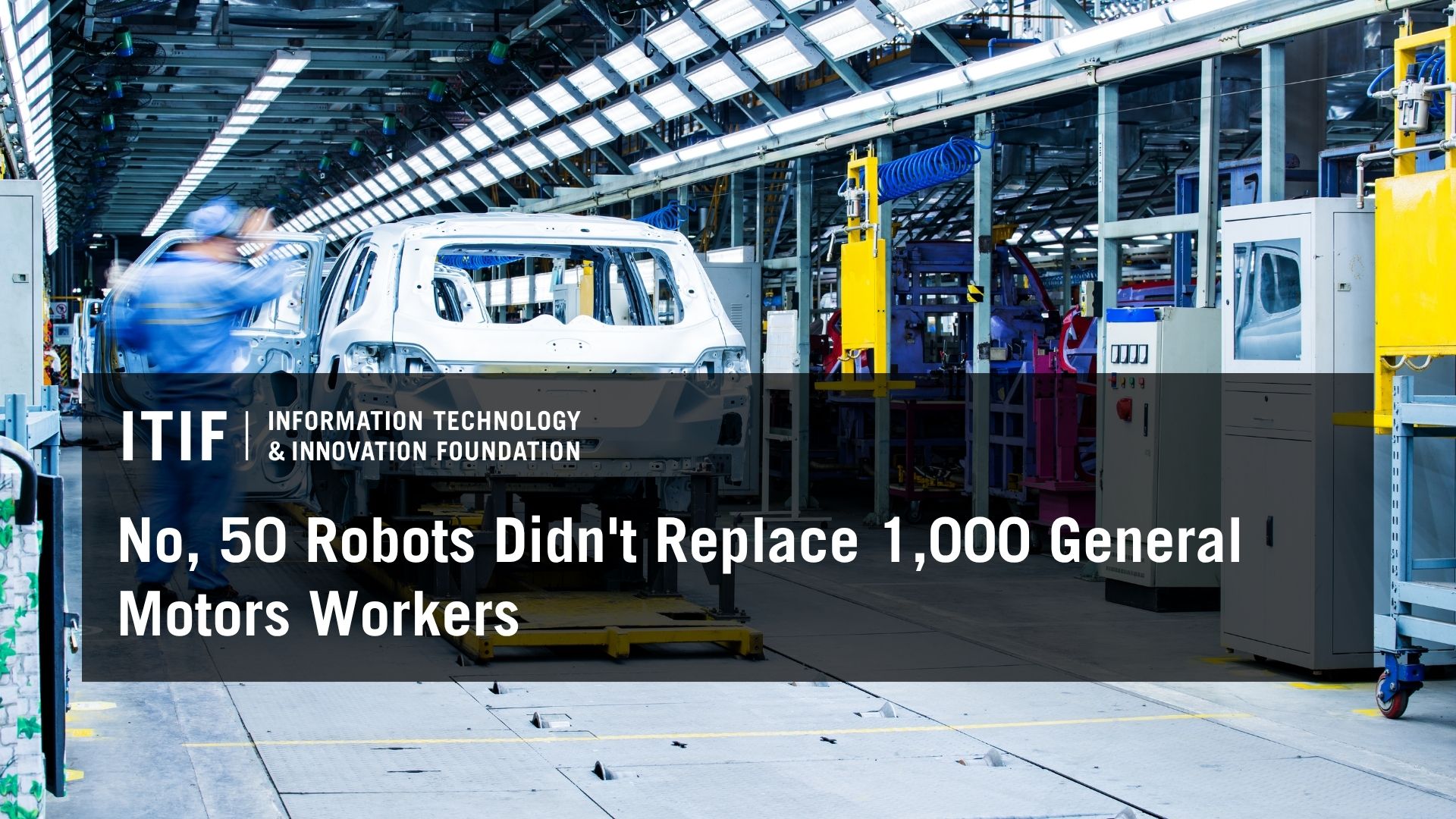
A recent article by Futurism highlights how some of the most powerful labor unions in the United States claim that General Motors (GM) fired more than 1,000 workers from its all-electric vehicle facility following the installation of 50 AI-integrated manufacturing robots. However, the claim from union officials that these robots are “taking away jobs from people” is misleading for three reasons. First, the layoffs were far more likely driven by GM scaling back electric vehicle (EV) production because of weaker-than-expected demand and changing production priorities than by the installation of robots. Second, even if these robots did automate certain tasks, that does not mean they replaced the workers who perform the many responsibilities involved in manufacturing vehicles and can instead increase worker efficiency. Finally, even when automation can lead to job displacement, workers are not left permanently unemployed. Policymakers should focus on building workforce retraining programs that help displaced workers develop the skills needed to find new jobs in growing industries.
First, the claim that 50 AI-integrated robots caused the elimination of 1,000 jobs overlooks the broader economic context surrounding GM’s Factory Zero facility, whose primary focus is the production of EV vehicles. While labor unions argue that these robots left 1,000 workers idle before they were eventually fired, the evidence suggests that GM’s factory idled workers because of slower-than-expected EV demand amid changes in EV policy, most notably the end of the federal EV tax credit. Rather than expanding production at Factory Zero, GM has shifted its focus toward heavy-duty pickup truck production, leaving less work available for those at its EV facility.
As explained in an Autoblog article, “Factory Zero temporarily laid off 1,300 workers on March 16, with employees expected to return on April 13. This follows a previous idling late last year, as well as a reduction to a single shift in January 2026. The production halt affects GM’s large all-electric models.” In other words, the workforce reduction coincided with a reduction in EV production. If Americans are buying fewer electric GMC Hummers, Cadillac Escalades, or Chevy Silverados, GM simply does not need as many workers at its EV manufacturing facility. The evidence suggests that weaker demand and changes in production priorities—not simply the installation of 50 robots—were the primary drivers of the layoff.
Second, even if these robots did automate certain tasks, that does not mean they replaced 1,000 employees. Like many jobs in the United States, manufacturing jobs consist of a variety of tasks rather than one single responsibility. Workers at GM’s Factory Zero are no different. They perform quality control, troubleshoot production issues, assemble components, handle materials, and complete numerous other responsibilities throughout the manufacturing process.
By contrast, the 50 robots installed at the facility reportedly perform one specific task: bolting body panels. It is therefore misleading to suggest that these robots replaced 1,000 workers who perform a wide range of activities. Automating one task does not eliminate the need for workers who perform the many other tasks required to manufacture vehicles. Instead, automation changes the composition of work by removing repetitive tasks while allowing workers to focus on activities that require greater problem-solving and technical judgment.
Moreover, if robots did take over this one task, the result could be higher worker and economic productivity. Research has shown that automation increases productivity and economic output. A 2018 study found that greater robot density in manufacturing was associated with higher output and, in turn, stronger GDP growth and improved living standards. Similarly, research from the International Federation of Robotics (IFR) found that collaborative robots can benefit small and medium-sized manufacturers because they are flexible, easier to deploy, and adaptable to changing production requirements. The IFR concluded that robot assistants can “significantly increase workers’ productivity.” For example, when Canada’s Paradigm Electronics implemented collaborative robots, employee productivity increased by 50 percent.
If the objection is that technology enables fewer workers to complete a given task, then why stop at robots? By the same logic, one could just as easily oppose workers using power tools, since they too reduce the number of workers needed to perform a task while increasing productivity.
Finally, even if these robots did contribute to some job loss at Factory Zero, those workers would not remain permanently unemployed. Research on automation suggests that technological change tends to reallocate labor rather than permanently eliminate it. Workers displaced by automation frequently move into new occupations, including jobs created by automation themselves.
As ITIF has previously explained, automation increases productivity, allowing firms to lower prices, raise wages, or both. Lower prices leave consumers with more disposable income, while higher wages increase purchasing power. In either case, consumers and businesses spend and invest more, creating demand for workers throughout the broader economy.
Consider a worker at a cellular phone manufacturing plant. If robots automate many routine phone manufacturing tasks, phones become less expensive to produce, leaving consumers with more money to spend elsewhere, whether on restaurant meals, home renovations, health care, recreation, or other goods and services. Businesses in those sectors would respond to rising demand by hiring additional workers, creating new employment opportunities that help offset job displacement in phone manufacturing.
This dynamic helps explain why studies have found limited evidence that technology-driven automation leads to permanent economy-wide job losses. Instead, productivity growth expands economic output, raises incomes, and supports higher employment over the long run.
Labor union opposition to GM’s use of AI, robots, and automation—which one official called “a fight for humanity”—highlights the broader challenge policymakers will face as the United States seeks to strengthen its economic competitiveness through technological progress. The goal should not be to prevent automation or to preserve every existing task indefinitely. A competitive manufacturing sector depends on adopting technologies that improve productivity, reduce costs, and strengthen U.S. competitiveness.
Rather than opposing technological advancements, union officials should help ensure that workers have pathways to benefit from technological change. To support that transition, policymakers should focus on building workforce retraining programs that help displaced workers develop the skills needed for growing industries. This includes stronger partnerships between manufacturers, community colleges, and technical training programs; expanded apprenticeships in advanced manufacturing; and increasing access to training in areas such as robotics maintenance, industrial automation, and engineering technologies. The solution to technological change is not slowing innovation—especially as the United States is losing leadership to China in critical industries—but ensuring that workers have the skills and support needed to succeed alongside it.