

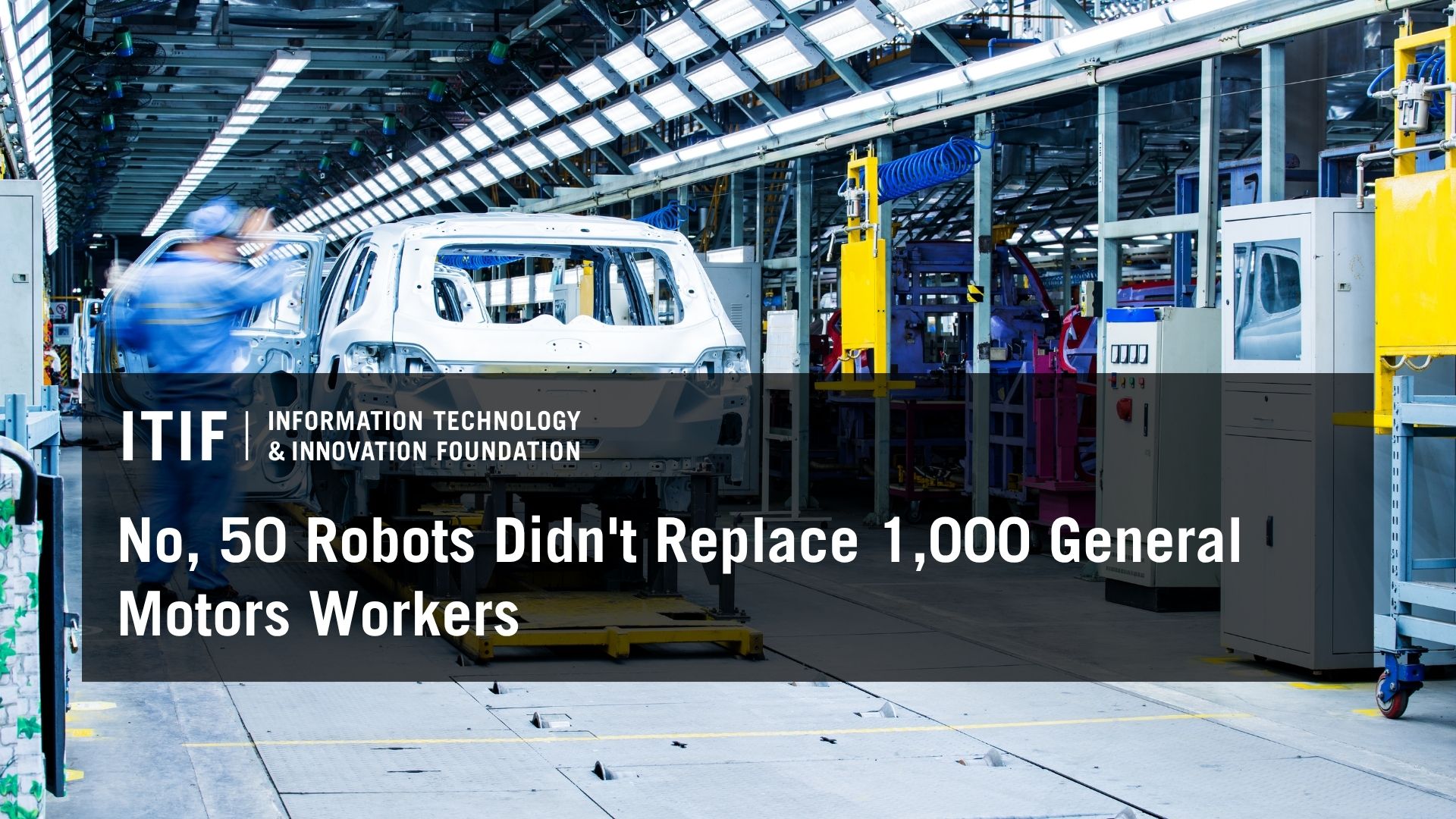
No, 50 Robots Didn’t Replace 1,000 General Motors Workers | Blogs | Jul 13, 2026


A recent article by Futurism highlights how some of the most powerful labor unions in the United States claim that General Motors (GM) fired more than 1,000 workers from its all-electric vehicle facility following the installation of 50 AI-integrated manufacturing robots. However, the claim from union officials that these robots are “taking away jobs from people” is misleading for three reasons. First, the layoffs were far more likely driven by GM scaling back electric vehicle (EV) production because of weaker-than-expected demand and changing production priorities than by the installation of robots. Second, even if these robots did automate certain tasks, that does not mean they replaced the workers who perform the many responsibilities involved in manufacturing vehicles and can instead increase worker efficiency. Finally, even when automation can lead to job displacement, workers are not left permanently unemployed. Policymakers should focus on building workforce retraining programs that help displaced workers develop the skills needed to find new jobs in growing industries.

First, the claim that 50 AI-integrated robots caused the elimination of 1,000 jobs overlooks the broader economic context surrounding GM’s Factory Zero facility, whose primary focus is the production of EV vehicles. While labor unions argue that these robots left 1,000 workers idle before they were eventually fired, the evidence suggests that GM’s factory idled workers because of slower-than-expected EV demand amid changes in EV policy, most notably the end of the federal EV tax credit. Rather than expanding production at Factory Zero, GM has shifted its focus toward heavy-duty pickup truck production, leaving less work available for those at its EV facility.

As explained in an Autoblog article, “Factory Zero temporarily laid off 1,300 workers on March 16, with employees expected to return on April 13. This follows a previous idling late last year, as well as a reduction to a single shift in January 2026. The production halt affects GM’s large all-electric models.” In other words, the workforce reduction coincided with a reduction in EV production. If Americans are buying fewer electric GMC Hummers, Cadillac Escalades, or Chevy Silverados, GM simply does not need as many workers at its EV manufacturing facility. The evidence suggests that weaker demand and changes in production priorities—not simply the installation of 50 robots—were the primary drivers of the layoff.

Second, even if these robots did automate certain tasks, that does not mean they replaced 1,000 employees. Like many jobs in the United States, manufacturing jobs consist of a variety of tasks rather than one single responsibility. Workers at GM’s Factory Zero are no different. They perform quality control, troubleshoot production issues, assemble components, handle materials, and complete numerous other responsibilities throughout the manufacturing process.

By contrast, the 50 robots installed at the facility reportedly perform one specific task: bolting body panels. It is therefore misleading to suggest that these robots replaced 1,000 workers who perform a wide range of activities. Automating one task does not eliminate the need for workers who perform the many other tasks required to manufacture vehicles. Instead, automation changes the composition of work by removing repetitive tasks while allowing workers to focus on activities that require greater problem-solving and technical judgment.

Moreover, if robots did take over this one task, the result could be higher worker and economic productivity. Research has shown that automation increases productivity and economic output. A 2018 study found that greater robot density in manufacturing was associated with higher output and, in turn, stronger GDP growth and improved living standards. Similarly, research from the International Federation of Robotics (IFR) found that collaborative robots can benefit small and medium-sized manufacturers because they are flexible, easier to deploy, and adaptable to changing production requirements. The IFR concluded that robot assistants can “significantly increase workers’ productivity.” For example, when Canada’s Paradigm Electronics implemented collaborative robots, employee productivity increased by 50 percent.

If the objection is that technology enables fewer workers to complete a given task, then why stop at robots? By the same logic, one could just as easily oppose workers using power tools, since they too reduce the number of workers needed to perform a task while increasing productivity.

Finally, even if these robots did contribute to some job loss at Factory Zero, those workers would not remain permanently unemployed. Research on automation suggests that technological change tends to reallocate labor rather than permanently eliminate it. Workers displaced by automation frequently move into new occupations, including jobs created by automation themselves.

As ITIF has previously explained, automation increases productivity, allowing firms to lower prices, raise wages, or both. Lower prices leave consumers with more disposable income, while higher wages increase purchasing power. In either case, consumers and businesses spend and invest more, creating demand for workers throughout the broader economy.

Consider a worker at a cellular phone manufacturing plant. If robots automate many routine phone manufacturing tasks, phones become less expensive to produce, leaving consumers with more money to spend elsewhere, whether on restaurant meals, home renovations, health care, recreation, or other goods and services. Businesses in those sectors would respond to rising demand by hiring additional workers, creating new employment opportunities that help offset job displacement in phone manufacturing.

This dynamic helps explain why studies have found limited evidence that technology-driven automation leads to permanent economy-wide job losses. Instead, productivity growth expands economic output, raises incomes, and supports higher employment over the long run.

Labor union opposition to GM’s use of AI, robots, and automation—which one official called “a fight for humanity”—highlights the broader challenge policymakers will face as the United States seeks to strengthen its economic competitiveness through technological progress. The goal should not be to prevent automation or to preserve every existing task indefinitely. A competitive manufacturing sector depends on adopting technologies that improve productivity, reduce costs, and strengthen U.S. competitiveness.

Rather than opposing technological advancements, union officials should help ensure that workers have pathways to benefit from technological change. To support that transition, policymakers should focus on building workforce retraining programs that help displaced workers develop the skills needed for growing industries. This includes stronger partnerships between manufacturers, community colleges, and technical training programs; expanded apprenticeships in advanced manufacturing; and increasing access to training in areas such as robotics maintenance, industrial automation, and engineering technologies. The solution to technological change is not slowing innovation—especially as the United States is losing leadership to China in critical industries—but ensuring that workers have the skills and support needed to succeed alongside it.


Free Training

Source link

Hiltzik: So much for Trump’s ‘manufacturing wins’


Based on the words of President Trump, America is well on the way to becoming a “global superpower in manufacturing” — indeed, as he declared in a Father’s Day social media post, we are already experiencing the “BEST ECONOMY EVER.” (Capitalization’s his.)

Here’s what the government’s own statistics tell us: Manufacturing investment has crashed during his watch, with construction spending in the manufacturing sector down 26.4% from Trump’s inauguration through May, to $174.8 billion. That’s the lowest figure since February 2023, when the economy was in the midst of a post-pandemic recovery.

White House spokesman Kush Desai told me by email that “the last two jobs reports” showed manufacturing job growth. The Bureau of Labor Statistics reported a seasonally-adjusted decline of 2,000 manufacturing workers in May and a gain of 3,000 in June. But the June 2026 figure was 38,000 jobs, or about 0.3% below the level in June 2025, and 75,000 or about 0.6% below the level in January 2025, when Trump took office.

Desai said that “thanks to President Trump’s proven agenda of tariffs, deregulation, and tax cuts, American manufacturing will continue to rebound.”

There’s little mystery about what has come between Trump’s ambition and the real world. To a large extent it’s Trump’s economic program, particularly his tariff policies and, more recently, his war with Iran. Those have injected a level of uncertainty for corporate managements pondering whether to spend money on expansion that they haven’t had to confront in years.

From where we’re standing, we are not seeing signs of a manufacturing renaissance in the U.S.

— Didi Caldwell, Global Location Strategies

The tariffs and the war have driven up manufacturers’ costs for raw materials and overseas shipping. The general economic atmosphere doesn’t help. U.S. gross domestic product growth came in at a 2.1% annualized rate in the first quarter of this year, but the Federal Reserve Bank of Atlanta expects it to have fallen to 1.3% in the second quarter ended June 30.

Meanwhile, the University of Michigan consumer confidence index reached 44.8 in May, its lowest level ever (though it improved to 49.5 in June). Wages have been rising modestly, according to the Bureau of Labor Statistics, but those gains have been eaten up by higher prices, especially for gasoline and food.

Get the latest from Michael Hiltzik

Commentary on economics and more from a Pulitzer Prize winner.

To put things another way, the actual figures show the U.S. economy to be sputtering, and the “vibe economy” as measured by consumer confidence is doing even worse.

Now that Trump’s second term is about to reach its 18-month mark, let’s unpack the factors causing the discrepancy between his ambitions and claims, and the reality.

Trump declared economic victory just as his term was starting. On March 20, 2025, he proclaimed a “manufacturing renaissance” in the U.S. That was based on what he said were “trillions of dollars in new investments” he had “already secured in tech-based manufacturing.”

A White House statement said “the list of manufacturing wins is endless.” The provided list was a roster of announcements, not groundbreakings, much less completed ventures.

Business executives quite properly have taken these pledges with mounds of salt. “Announcements are what people say they’re going to do, but dollars spent is what’s actually happening,” Didi Caldwell, chief executive of a firm that helps companies find factory sites, told the Financial Times. “From where we’re standing, we are not seeing signs of a manufacturing renaissance in the U.S.”

Indeed, at least some of these announcements have had the flavor of performative efforts to satisfy Trump’s amour propre and extract government concessions.

For example, Apple Chief Executive Tim Cook appeared with Trump at the White House in August to announce a $600-billion U.S. spending plan to take place over four years. That was a $100-billion increase over its previously-announced program.

More to the point, however, it incorporated spending with suppliers that Apple had been working with for years. Mentioned in the news announcement was a commitment to buy cover glass for iPhones from Corning. But Corning has been supplying that glass since the first iPhone appeared in 2007. In any case, the announcement appeared to secure a commitment from Trump to exempt Apple from tariffs imposed on imported chips.

Apple’s announcement Wednesday that it will spend $30 billion to buy chips from Broadcom was similarly ambiguous. The announcement didn’t provide details about the terms of the commitment or the timing of its expenditures. I asked Apple for details and whether the deal was related to a desire to remain in Trump’s favor, but didn’t hear back.

A similar phenomenon occurred during Trump’s first term; Trump had built much of his 2016 presidential campaign on a promise to increase manufacturing jobs in the United States. He blamed shrinkage in the manufacturing sector on trade agreements such as NAFTA and the policies of the Chinese, and took credit when an American manufacturer agreed to create or save jobs in the United States.

As I reported in 2019, many of those arrangements turned out to be exaggerated or bogus, or predated Trump’s claim. Some disappeared as soon as public attention turned elsewhere, or were outweighed by job cuts made elsewhere by the same companies.

Trump’s tariffs appear to have had a direct effect on manufacturing employment in the U.S. Since Trump’s inauguration, the manufacturing sector has shed about 75,000 jobs, or 0.6%. After April 2, 2025, when he announced global “liberation day” tariffs supposedly as a response to years of unfair treatment of American exports, the decline picked up pace, with a shrinkage of 68,000 manufacturing jobs.

The Supreme Court invalidated those tariffs in February, but others are still in place, including tariffs on imported steel and aluminum and on goods from China. Nor has he ceased threatening partners with trade wars. As recently as Tuesday, he said he would cut off all trade with Spain because of that country’s disagreement with him over its defense spending and its criticism of his Iran war.

As it happens, Spain is one of the few countries with which the U.S. has a trade surplus. That means that any cutoff, which trade experts think will be unlikely, would come at a cost to the U.S.

One might have hoped that Trump had learned a lesson from his first-term trade war with China. That conflict provoked a sharp contraction in the manufacturing economy, with the Institute for Supply Management’s purchasing managers index falling to 49.1 by mid-2019. (A reading below 50 signifies contraction.)

The ISM index began to recover toward the end of Trump’s term but fell again during the pandemic. Lately it has been falling again, to 53.3 in June from 54 in May.

The Iran war is another deadweight on domestic manufacturing. That’s partially the consequence of blockages of the Strait of Hormuz, the crucial thoroughfare not only for middle eastern oil, but also for such industrial inputs as fertilizer and aluminum. Cement, concrete, olive oil and spices are also among commodities produced in the region that use the strait as an outlet to reach the outside world.

Uncertainties in the region, tensions between the U.S. and China, and heightened concerns over the safety of shipping overall have driven up shipping costs between the far east and the U.S. The price of shipping a benchmark 40-foot container from China to the West Coast has nearly quadrupled to $6,687 now from about $1,700 just before the Iran war began, according to an index maintained by the cargo firm Freightos — even though shipping prices typically decline during this time of year.

There can be little doubt that the U.S. would benefit from an industrial policy — if it’s coherent. China supplanted America as the world’s leading exporter of manufactured goods in 2010, and the gap has only widened since then. China’s dominance may be hard to reverse, as it’s built on lower labor costs and transport infrastructure that enjoys focused government investment.

Tariffs could be a component of a new industrial policy, but Trump’s tariffs aren’t rationally geared to protecting domestic industries that need protection. They’re expressions of his whims, and as such they’re totally ineffective. If there are government investment policies targeting industries that need assistance, they’re not apparent to economists or industrialists.

Trump can talk as much as he likes about a golden age for U.S. manufacturing, but from his first term through this one, it’s nothing but talk. And talk, of course, is cheap.

Free Training

Source link

3 US Manufacturing Stocks Facing Tariff Costs And Supply Chain Shifts


Uncertainty around US tariffs and trade rules is reshaping how import-heavy manufacturers plan production, manage costs, and build inventory. For investors, that mix of front-loaded imports, shifting supply chains, and volatile freight costs can create both pressure and opportunity in selected stocks that are closely exposed to this news. This article looks at three large US manufacturers from an Import-Heavy US Manufacturers screener that could be affected by these developments, helping you consider whether they might fit, or be worth avoiding, in a portfolio that is sensitive to trade policy risks.

Hexcel (HXL)

Overview: Hexcel is a US materials company that supplies advanced carbon fiber composites, honeycomb structures, and engineered parts used in commercial aircraft, defense programs, space, and industrial products.

Operations: Hexcel generates most of its revenue from Composite Materials at about US$1.6b, with a further US$394.3m from Engineered Products and a reported corporate and other loss of US$92.4m.

Market Cap: US$7.5b

Hexcel provides exposure to the long-term shift toward lighter, more efficient aircraft and defense platforms. At the same time, it is directly affected by evolving US tariff policy on imported raw materials. The company is working to offset estimated tariff headwinds of about US$3m to US$4m per quarter through regional sourcing and contract pass throughs. It still faces pressure from high debt, long fixed price contracts, and heavy reliance on Airbus and Boeing. With earnings forecasts stronger than revenue growth and ongoing R&D and capacity investments, the key question is whether Hexcel’s aerospace cycle, pricing power, and tariff mitigation efforts can justify its P/E and support more durable cash flows over time.

Hexcel’s tariff headwinds, heavy Airbus and Boeing exposure, and fixed price contracts could be masking the real story around its earnings potential, so reviewing the 2 key rewards and 2 important warning signs might change how you see the stock’s risk reward profile.

NYSE:HXL Earnings & Revenue Growth as at Jul 2026NYSE:HXL Earnings & Revenue Growth as at Jul 2026

Astec Industries (ASTE)

Overview: Astec Industries builds equipment and systems for road construction, aggregates, and mining, supplying everything from asphalt and concrete plants to crushers, screens, and material handling gear used by contractors, producers, and government agencies worldwide.

Operations: Astec generates about US$893.8m of revenue from Infrastructure Solutions and US$623m from Materials Solutions, partly offset by US$39.5m of intersegment revenue.

Market Cap: US$1.3b

Astec Industries sits at the crossroads of US infrastructure spending and global trade policy, which makes it especially relevant if you are watching tariff sensitive stocks. The company has been working to offset tariff related cost pressure through pricing, dual sourcing, and reshoring where feasible. Management describes Astec as well positioned as a US manufacturer against imported competitors that may face higher duties. At the same time, investors need to weigh high debt levels, a recent one off loss of US$30.2m, and relatively low returns on equity. The potential investment case is shaped by how these factors interact with expectations for earnings and margin performance supported by infrastructure demand and higher margin parts and service revenue.

Astec Industries appears to be an import-exposed manufacturer whose tariff offsets, higher-margin parts exposure, and US footprint might be masking a very different earnings story, so it is worth reading the 4 key rewards and 2 important warning signs

NasdaqGS:ASTE Revenue & Expenses Breakdown as at Jul 2026NasdaqGS:ASTE Revenue & Expenses Breakdown as at Jul 2026

Allison Transmission Holdings (ALSN)

Overview: Allison Transmission Holdings designs and sells fully automatic transmissions and electrified propulsion systems for commercial trucks, buses, off‑highway vehicles, and U.S. defense platforms, while also supporting a large installed base through remanufactured units and aftermarket parts.

Market Cap: US$9.5b

Allison Transmission Holdings provides exposure to critical commercial and defense vehicle demand at a time when tariff uncertainty is front and center. Around 85% of its direct material spend is sourced within the USMCA region, which management says limits direct tariff cost pressure and can even support demand for its U.S. made content. Recent moves, including the Off Highway acquisition and a record US$250m CV90 transmission contract with BAE Systems, are expanding its reach into higher margin, more durable revenue streams. However, high debt, softer North America On Highway volumes, and industry electrification remain important risks to track. The key question is how this mix of contract wins, cost discipline, and tariff positioning ultimately shows up in margins, cash flow, and valuation resilience.

Allison Transmission’s mix of record defense contracts and US-sourced materials hints at a story the headline numbers do not fully explain. As a result, the full narrative for Allison Transmission Holdings might surface one risk or upside twist investors are missing

NYSE:ALSN Earnings & Revenue Growth as at Jul 2026NYSE:ALSN Earnings & Revenue Growth as at Jul 2026

The three import-heavy US manufacturers in this article are just the starting point. The full Import-Heavy US Manufacturers screener surfaces 9 more companies that each have their own tariff, sourcing, and margin story worth comparing through the Import-Heavy US Manufacturers screener. Use Simply Wall St to identify and analyze the specific catalysts, contract profiles, and trade related narratives that matter most so you can focus on the import exposed manufacturers that best fit your highest conviction ideas.

Take Control of Your Investment Journey

If Allison Transmission Holdings or any of these companies sound like a great opportunity, register for FREE with Simply Wall St and add your companies to a Watchlist to monitor the share price against the fair value the ideal entry point.
Once you’ve made your move, manage your holdings with our Portfolio Command Center that filters out the noise to deliver only the most critical, actionable updates.
Throughout your journey, our Community allows you to filter the best ideas from thousands of investor perspectives.
By uncovering hidden catalysts and risks early, you’ll accelerate your decision-making and stay one step ahead of the market.

Seeking Fresh Alternatives Beyond These Stocks?

Market momentum can change quickly, and new breakout ideas rarely stay unnoticed for long. Review these stock themes before they become widely followed to explore potential opportunities early.

  • Target steadier income streams by reviewing a curated pool of companies in the 9 dividend fortresses and see which high yield stocks still appear reasonably priced.
  • Explore the buildout of AI infrastructure by checking the carefully filtered 52 AI infrastructure stocks that highlights businesses supplying the essential tools and services for this trend.
  • Consider long term industrial demand by screening the 8 top copper producer stocks and comparing miners and producers involved in supplying one of the key metals used in electrification.

This article by Simply Wall St is general in nature. We provide commentary based on historical data
and analyst forecasts only using an unbiased methodology and our articles are not intended to be financial advice.
It does not constitute a recommendation to buy or sell any stock, and does not take account of your objectives, or your
financial situation. We aim to bring you long-term focused analysis driven by fundamental data.
Note that our analysis may not factor in the latest price-sensitive company announcements or qualitative material.
Simply Wall St has no position in any stocks mentioned.

New: Manage All Your Stock Portfolios in One Place

We’ve created the ultimate portfolio companion for stock investors, and it’s free.

• Connect an unlimited number of Portfolios and see your total in one currency
• Be alerted to new Warning Signs or Risks via email or mobile
• Track the Fair Value of your stocks

Try a Demo Portfolio for Free

Have feedback on this article? Concerned about the content? Get in touch with us directly. Alternatively, email editorial-team@simplywallst.com

Free Training

Source link