
Press Release: Thompson Leads Bipartisan Effort to Introduce American Manufacturing Revitalization Exchange Program Act


U.S. Representatives introduced the bipartisan American Manufacturing Revitalization Exchange Program Act to enhance training for manufacturing workers.

Quiver AI Summary

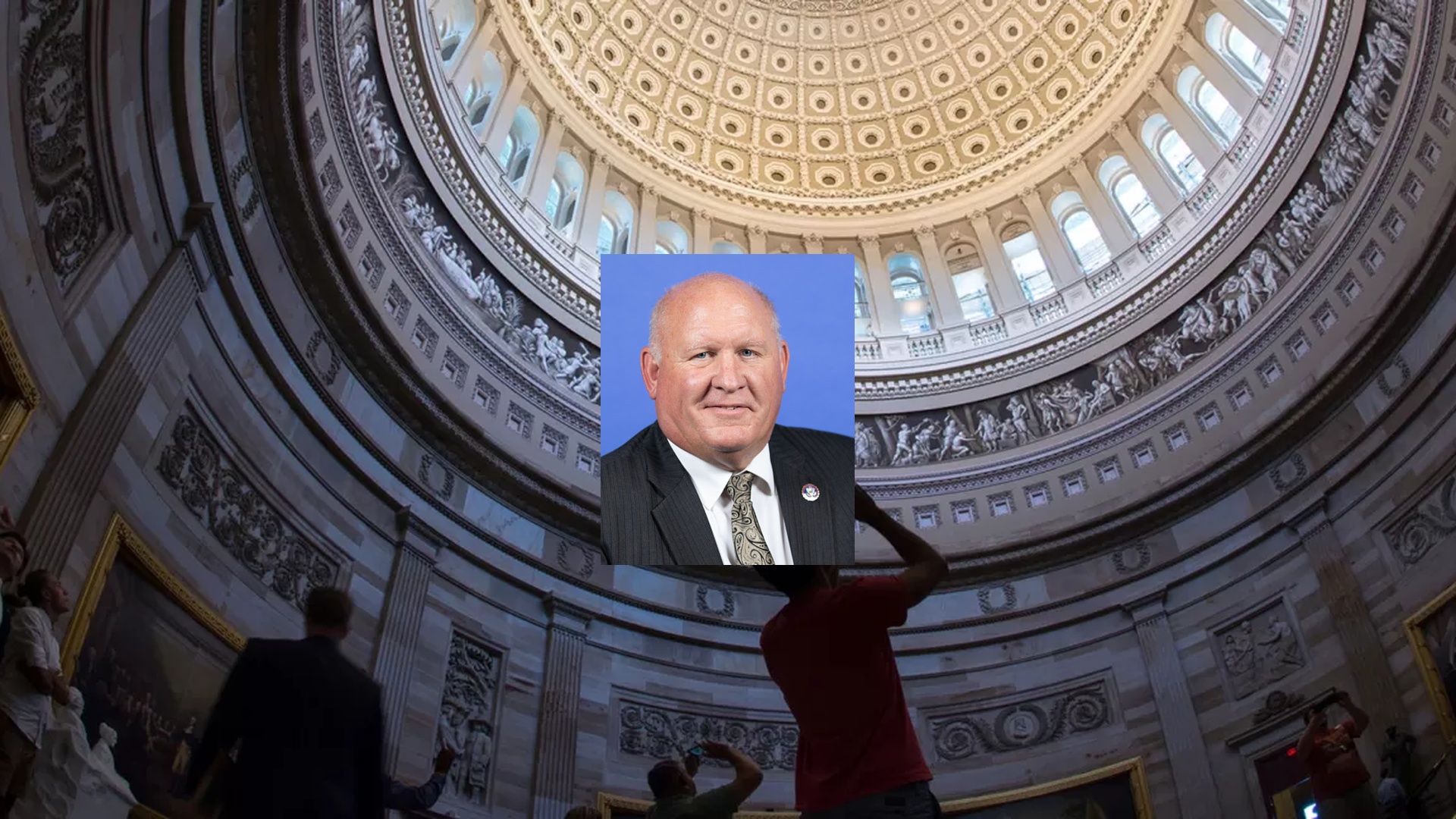
Bipartisan Legislation Introduced: This week, U.S. Representatives Glenn “GT” Thompson and several colleagues unveiled the American Manufacturing Revitalization Exchange Program Act, aimed at training future technicians, machinists, engineers, and production specialists for the U.S. manufacturing workforce.

Legislative Goals: Rep. Thompson emphasized the importance of American manufacturing for economic growth and competitiveness. The plan includes sending eligible manufacturing workers abroad for training, addressing a projected shortage of 3.8 million workers by 2033.

Support and Impact: The bill garners support from various industry groups and aims to strengthen the domestic manufacturing sector through enhanced skill development and workforce reshoring efforts, ensuring that American workers are prepared for modern manufacturing challenges.

Disclaimer: This is an AI-generated summary of a press release. The model used to summarize this release may make mistakes. See the full release here.

Check out the Quiver Quantitative API to build on top of data on congressional stock trading, insider transactions, hedge fund moves, and more.

🏛️ Receive Alerts on Congress


Sign Up

Glenn Thompson Fundraising

Glenn Thompson Fundraising

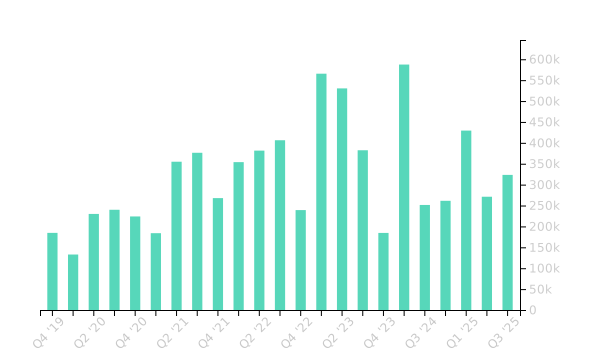
Glenn Thompson recently disclosed $38.0K of fundraising in a Pre-Primary FEC disclosure filed on May 7th, 2026. This was the 395th most from all Pre-Primary reports we have seen this year. 34.2% came from individual donors.

Thompson disclosed $118.5K of spending. This was the 320th most from all Pre-Primary reports we have seen from politicians so far this year.

Thompson disclosed $732.2K of cash on hand at the end of the filing period. This was the 183rd most from all Pre-Primary reports we have seen this year.

You can see the disclosure here, or track Glenn Thompson’s fundraising on Quiver Quantitative.

Glenn Thompson Net Worth

Quiver Quantitative estimates that Glenn Thompson is worth $320.0K, as of June 5th, 2026. This is the 428th highest net worth in Congress, per our live estimates.

Thompson has approximately $0 invested in publicly traded assets which Quiver is able to track live.

You can track Glenn Thompson’s net worth on Quiver Quantitative’s politician page for Thompson.

Glenn Thompson Bill Proposals

Here are some bills which have recently been proposed by Glenn Thompson:

  • H.R.9164: To amend the Richard B. Russell National School Lunch Act to require the Secretary of Agriculture to make grants to eligible entities to acquire and install milk storage-related equipment for use in elementary schools and secondary schools, and for other purposes.
  • H.R.9080: To establish a contracting preference for public buildings that use innovative wood products in the construction of those buildings, and for other purposes.
  • H.R.8714: Skill Savings Account Act of 2026
  • H.R.7989: ACE Act
  • H.R.7891: Student Aid Fraud Oversight and Accountability Act of 2026
  • H.R.7885: Cybersecurity Skills Integration Act

You can track bills proposed by Glenn Thompson on Quiver Quantitative’s politician page for Thompson.

2026 Pennsylvania’s 15th Congressional District Election

There has been approximately $2,649,495 of spending in Pennsylvania’s 15th congressional district elections over the last two years, per our estimates.

The rating for this race is currently “Solid R”.

You can track this election on our matchup page for the 2026 Pennsylvania’s 15th congressional district election.

Free Training

Source link

Press Release: DelBene, Buchanan, and Sewell Introduce Semiconductor Superiority Act to Enhance U.S. Manufacturing and Global Competitiveness


Suzan DelBene introduces the Semiconductor Superiority Act to support U.S. semiconductor manufacturing in space.

Quiver AI Summary

Legislative Proposal Introduced: Representatives Suzan DelBene, Vern Buchanan, and Terri Sewell have introduced the Semiconductor Superiority Act. This bill aims to amend the Section 48D Advanced Manufacturing Investment Credit to explicitly include space-based semiconductor manufacturing, with the goal of enhancing U.S. leadership in the technology sector.

Impact of Space Manufacturing: The legislation seeks to clarify that technologies developed in low-Earth orbit qualify for existing tax incentives aimed at U.S. semiconductor production. Proponents argue that microgravity benefits fabrication processes, enabling advancements critical for emerging technologies like quantum computing and AI, as highlighted by DelBene.

Support from Key Representatives: Buchanan emphasized the importance of keeping U.S. companies competitive in the space economy, while Sewell noted the bill’s potential to strengthen national security and high-paying job creation. The bill is seen as a strategic response to global competition, particularly with China’s advancements in semiconductor technologies.

Disclaimer: This is an AI-generated summary of a press release. The model used to summarize this release may make mistakes. See the full release here.

Check out the Quiver Quantitative API to build on top of data on congressional stock trading, insider transactions, hedge fund moves, and more.

🏛️ Receive Alerts on Congress


Sign Up

Suzan K. DelBene Fundraising

Suzan K. DelBene Fundraising

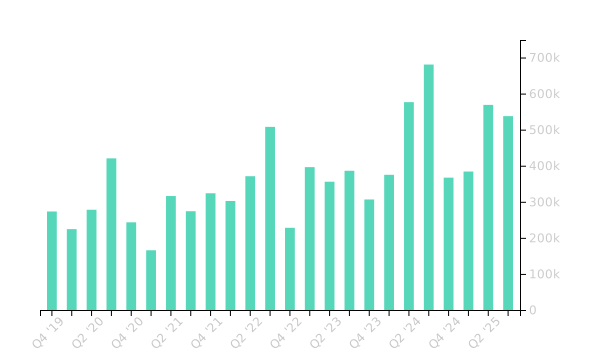
Suzan K. DelBene recently disclosed $562.3K of fundraising in a Q1 FEC disclosure filed on April 15th, 2026. This was the 190th most from all Q1 reports we have seen this year. 51.2% came from individual donors.

DelBene disclosed $655.5K of spending. This was the 125th most from all Q1 reports we have seen from politicians so far this year.

DelBene disclosed $1.4M of cash on hand at the end of the filing period. This was the 325th most from all Q1 reports we have seen this year.

You can see the disclosure here, or track Suzan K. DelBene’s fundraising on Quiver Quantitative.

Suzan K. DelBene Net Worth

Quiver Quantitative estimates that Suzan K. DelBene is worth $142.9M, as of May 22nd, 2026. This is the 13th highest net worth in Congress, per our live estimates.

DelBene has approximately $18.8M invested in publicly traded assets which Quiver is able to track live.

You can track Suzan K. DelBene’s net worth on Quiver Quantitative’s politician page for DelBene.

Suzan K. DelBene Bill Proposals

Here are some bills which have recently been proposed by Suzan K. DelBene:

  • H.R.8261: Chronic Care Management Improvement Act of 2026
  • H.R.7868: Expanding Support for Living Donors Act of 2026
  • H.R.6787: Clean Competition Act
  • H.R.5940: Seniors Deserve SMARTER Care Act of 2025
  • H.R.4649: Smart Cities and Communities Act of 2025
  • H.R.2421: Protecting Taxpayer Resources Act

You can track bills proposed by Suzan K. DelBene on Quiver Quantitative’s politician page for DelBene.

2026 Washington’s 1st Congressional District Election

There has been approximately $4,533,458 of spending in Washington’s 1st congressional district elections over the last two years, per our estimates.

The rating for this race is currently “Solid D”.

You can track this election on our matchup page for the 2026 Washington’s 1st congressional district election.

Free Training

Source link

One Big Beautiful Bill Act Drives U.S. Construction Boom and Manufacturing Growth


The One Big Beautiful Bill Act (BBBA) is reshaping the U.S. manufacturing and construction landscape by introducing significant tax incentives tied to capital investment, domestic production and research activity.

Courtesy: Photo by Scott Blake on Unsplash

Signed as part of President Donald Trump’s broader tax and spending agenda, the legislation is designed to stimulate U.S.-based manufacturing capacity and reduce reliance on overseas production.

BBBA Incentives Expected to Accelerate U.S. Factory Construction

One of the most impactful provisions is the Qualified Production Property Deduction. Under this measure, companies that build new manufacturing facilities — or significantly expand existing ones — can deduct 100% of eligible capital expenditures, provided construction begins between January 20, 2025 and December 31, 2028. Projects must be placed into service by January 1, 2031.

This accelerated deduction dramatically improves project economics. Instead of spreading depreciation over decades, companies can deduct the full investment upfront, strengthening short-term cash flow and improving internal rates of return.

For the construction sector, this creates a narrow but powerful investment window. Industry analysts expect a surge in factory groundbreakings over the next three years as companies race to qualify.

For composites manufacturers and suppliers, the ripple effects could be substantial. Increased factory construction means higher demand for advanced building materials such as fiber-reinforced polymer (FRP) rebar, composite panels, corrosion-resistant structures and lightweight structural components.

100% Bonus Depreciation Strengthens Capital Spending and R&D

In addition to the production property deduction, the BBBA reinstates 100% bonus depreciation for qualifying capital expenditures. Traditionally, capital investments are depreciated over multiple years according to IRS schedules. Under the updated framework, companies can deduct the entire cost of machinery, tooling, and production equipment in the year it is placed in service.

This provision improves liquidity and encourages businesses to modernize production lines, automate facilities and invest in advanced manufacturing technologies.

For the composites industry, this could accelerate:

  • Expansion of domestic composite fabrication plants
  • Investment in automated layup and molding systems
  • Increased capacity for thermoplastic and thermoset production
  • Growth in aerospace, automotive and infrastructure supply chains

Beyond construction, R&D-related incentives embedded in the broader tax package are expected to encourage innovation in advanced materials. Composites firms developing lightweight, high-strength and sustainable materials stand to benefit from a more favorable tax treatment of research expenditures.

Strategic Timing for Composites Manufacturers

The timing window built into the legislation is critical. With eligibility tied to construction start dates and service deadlines, companies must act quickly to secure benefits.

Domestic firms considering U.S. expansion now have a tax-advantaged environment to do so. Likewise, international composites manufacturers evaluating North American production footprints may view the current period as an optimal entry point.

The legislation effectively compresses investment decisions into a three- to four-year horizon. That urgency is likely to generate elevated activity across engineering, procurement and construction (EPC) markets.

For suppliers of composite materials used in industrial flooring, bridge decks, wastewater facilities, reinforcement systems and structural retrofits, the anticipated uptick in manufacturing plant construction could translate into steady order growth through the end of the decade.

Broader Economic Implications

Courtesy: Photo by Pixabay on Pexels

The BBBA’s construction and capital expenditure provisions are not isolated measures; they are part of a broader strategy to strengthen domestic industrial capacity.

If widely adopted, the incentives could:

  • Expand U.S. manufacturing output
  • Increase demand for skilled labor in construction and engineering
  • Shorten supply chains for advanced materials
  • Support long-term infrastructure modernization

For the composites industry, the law represents more than a short-term stimulus. It creates structural incentives for reshoring production and investing in advanced materials technologies — positioning the sector to play a central role in the next wave of U.S. industrial growth.

As companies evaluate investment pipelines for 2025–2029, the BBBA’s tax environment may prove decisive in determining where and when new manufacturing capacity is built.

Originally Reported by JEC Composites.

Free Training

Source link

Cramer’s PROVE IT Act Focuses On American Manufacturing Emissions


The Senate passed three appropriations bills Jan. 15, and President Trump later signed them into law, including a provision with potential consequences for U.S. manufacturers.

The bills direct the Department of Energy, in consultation with the National Energy Technology Laboratory, to conduct a comprehensive study comparing the emissions intensity of certain goods produced in the United States with those same products made overseas, an effort aimed at documenting America’s environmental performance in global trade.

The directive builds on bipartisan legislation introduced last Congress by U.S. Sens. Kevin Cramer, R-N.D., and Chris Coons, D-Del. Their proposal, the Providing Reliable Objective Verifiable Emissions Intensity and Transparency (PROVE IT) Act, passed the Senate Environment and Public Works Committee in January 2024.

Cramer has described the bill as “low-hanging fruit” for promoting American manufacturing standards and countering foreign trade policies.

“We’ve known for a long time that manufacturers here in the United States make some of the cleanest products in the world,” Cramer said. “We can actually prove it, and we should. We should use that excellence as an advantage to ensure that our producers aren’t discriminated against by our trade partners or worse, undercut by polluting countries like China.”

The study will cover products affected by the European Union’s Carbon Border Adjustment Mechanism, which took effect Jan. 1.

The policy places tariffs on imports such as steel, cement, aluminum, fertilizers and electricity if they are deemed more carbon-intensive than European products, with possible expansion to additional manufactured goods.

Super Talk 1270 logo

Cramer said the report will help establish emissions transparency as a core component of U.S. trade policy. “It’s really an America First approach,” he said, adding that he looks forward to working with the administration “to make it a tradition, and make it a part of our trade policy going forward.”

Free Training

Source link