

U.S. Manufacturing Hits Four Year High And Proves U.S. Can Become Self-Reliant 


By Manzanita Miller 

Critics were skeptical of President Donald Trump’s implementation of tariffs on a variety of imported products from countries like China, but the results are speaking for themselves. U.S. manufacturing reached its highest growth in four years in May and companies are promising multi-billion-dollar investments to develop critical pharmaceuticals, semiconductors, safe electrical equipment, and many more products in the United States. 

According to the Institute for Supply Management’s Purchasing Managers’ Index (PMI), U.S. manufacturing rose 1.3 percentage points in May, marking the fifth consecutive month of growth and the highest recording of the index since May 2022. This is a significant healthy signal that U.S. companies are beginning to compete once again. 

The report notes that indexes that measure inventories on hand, customer inventories on hand, new orders, and new export orders are all up over the past month. 

The inventories index rose 0.9 percentage points since April while the customers’ inventories index is up 3.6 points since April according to the report. 

The report also notes that “demand orders” are up, with both the new orders index and new export orders index expanding by 2.7 points since April.

Indexes that measure output are also up, with the production index rising for the seventh consecutive month according to the report. 

U.S. manufacturing is rising across a multitude of critical industries including petroleum, computers and electronics, mineral products, electrical equipment, machinery, appliances, transportation equipment, printing, textile mills, and food and beverages. 

The manufacturing boom is a result of President Donald Trump’s two-pronged economic approach to court companies with reduced corporate tax burdens signed into law with the One Big Beautiful Bill Act while making importing goods from foreign countries costly. 

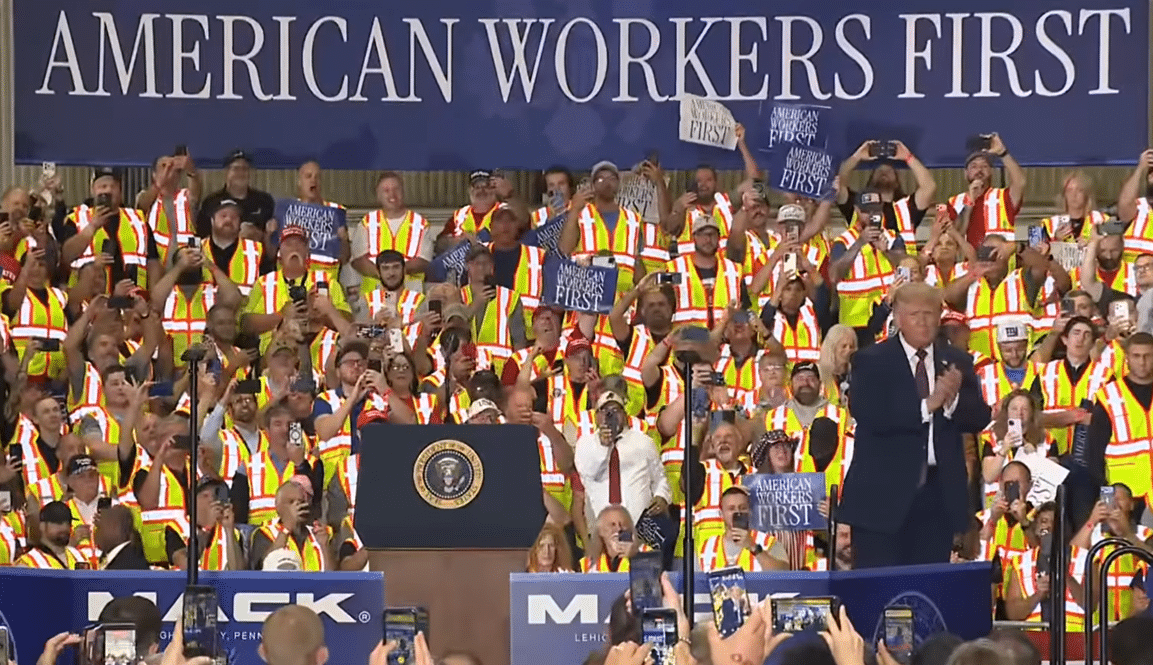
Speaking at a campaign stop in a Mack Trucks facility in Macungie, Pa. on June 23, President Trump touted manufacturing’s impact on job creation, “[M]ore Americans are working today than at any time in the history of our country. And we’ve created over… 32,000 new jobs just starting in Pennsylvania alone. David, you have to get ready for that. And in the last few months alone, we’ve added 2,600 Pennsylvania manufacturing jobs. And that number is going to go much, much higher as the factories start to open.”

The approach is working, with U.S. manufacturing reaching a four-year high in May. Companies are committing to expanding the creation of products like prescription drugs, semiconductors, safe electrical equipment, and many more products on American soil as a result of the strategy. 

In March, Taiwan Semiconductor Manufacturing Company (TSMC), which produces semiconductors for electronics, announced an additional $100 billion investment in the U.S. on top of the previously committed $65 billion. 

CEO C.C. Wei thanked President Trump for his support in company’s expansion, saying, “we have to thank President Trump’s vision and his support. TSMC started the journey of establishing the advanced chip manufacturing in Arizona. And now, let me proudly say the vision becomes reality.”  

TSMC’s investment will include six semiconductor wafer fabs, two advanced packaging facilities and a research and development center, and is already underway in Phoenix, AZ. 

According to the company’s announcement, the facilities will create 6,000 high-tech jobs, as well as thousands of construction and supplier jobs. The company’s original investment is estimated to generate around $1.4 billion in direct and indirect tax revenues combined over the next thirteen years. The company is also estimated to create $9.3 billion in personal income and indirect income combined.

In May, Siemens, a German company that develops critical power equipment and transportation infrastructure, announced it had reached $1 billion in domestic manufacturing investments in the United States over the past five years. 

Siemens’ investments include $165 million to expand two electrical equipment manufacturing facilities and add three more locations in North and South Carolina and $190 million for a new data center in Fort Worth, Texas to build important electrical infrastructure. The company has also dedicated $95 million to expand electrical infrastructure manufacturing in Pomona, California. The projects should generate more than 2,200 new jobs in advanced manufacturing, skilled trades, and engineering by 2028.

Multiple pharmaceutical companies including Eli Lilly, the U.S. manufacturer of the popular GLP-1 weight regulating drug Retatrutide have announced multi-billion dollar investments in the U.S. Eli Lilly announced plans to spend $27 billion to build four U.S. plants, with plants being announced in Alabama, Virginia and Texas so far.     

AstraZeneca, a Swedish pharmaceutical company that makes a multitude of prescription drugs including those used in oncology has committed $50 billion to expand U.S. manufacturing by 2030. The company will create a new facility in Virginia and expand into Maryland, Massachusetts, California, Indiana and Texas.

The White House estimates that $10.6 trillion in U.S. and foreign investments have been made possible through President Trump’s economic approach as of this writing, spanning the industries of AI, energy, datacenters, food and beverages, manufacturing, pharmaceuticals and biotech, and many more. 

What this says is that the slate of tariffs on imports are doing exactly what President Trump theorized and encouraging a revitalization of the U.S. manufacturing sector. Not only is this healthy for businesses and consumers, but it is also critical to ensuring American-made products are available no matter how the geopolitical landscape looks. With a rise in U.S.-made products from semiconductors to essential electrical infrastructure to critical pharmaceuticals, Americans are becoming more self-reliant than they have been for decades.

Manzanita Miller is the senior political analyst at Americans for Limited Government Foundation. 

Free Training

Source link

The Trump Administration Failed the U.S. Auto Industry, and the Canada-China Deal Proves It


On January 16, 2026, Canadian Prime Minister Mark Carney announced a landmark trade deal with China that will open its market to Chinese electric vehicles (EVs) in exchange for lower tariffs on Canadian-produced canola oil. It’s a major change that could lead to the Canadian market welcoming Chinese-made passenger vehicles at a significantly higher scale and throws into stark relief the consequences of the Trump administration’s reckless trade policy and its large-scale disinvestment in EVs.

The Trump administration’s wrecking-ball approach to traditional forms of international cooperation; its willingness to attack long-time partners and allies with ever more outrageous tariff threats; and its destruction of the U.S. EV supply chain has forced Canada to change its strategy for modernizing and growing its domestic auto industry. Canada has historically been the largest importer of U.S. passenger vehicles. Now, as a direct result of the Trump administration’s actions, Canada’s pivot toward Mexico, China, and elsewhere stands to further isolate the U.S. market as the rest of the world moves decidedly toward a cleaner future. Indeed, if U.S. automakers were already behind Chinese and other international EV producers in terms of technology, production, and price, then the Trump administration’s antics on the world stage will only widen the gap and jeopardize a lucrative export market, to the detriment of American workers and consumers alike.

Stay informed

on Energy and Environment

What’s in the deal?

Canada and China recently agreed to lower tariffs on Canadian canola oil—from 84 percent to approximately 15 percent by March 1, 2026—in exchange for Canada lowering the tariff rate on Chinese EVs from 100 percent to 6.1 percent on the first 49,000 vehicles, eventually growing to 70,000 over five years. Perhaps more importantly, China will invest in EV production capacity in Canada. While this is more of an understanding than an official agreement at this point, it may turn out to be the most significant component of the deal. Legacy North American automakers lag behind their Chinese counterparts in the maturity of their EV production processes. Landing direct investment in domestic production capacity will allow Canadian participants in the supply chain a significant opportunity to learn from Chinese EV and battery makers and produce affordable cars for Canadian citizens. The new Chinese electric vehicles, whether imported or produced in Canada, are likely to be less expensive than other vehicles produced in North America, which will force North American automakers to innovate and learn in order to remain competitive—preferably not to the detriment of autoworker jobs.

Which parts of the manufacturing process ultimately end up onshored in Canada will matter significantly. China has surged ahead of the rest of the world the further upstream one goes in the supply chain. Localizing battery active material production—cathodes and anodes—would bring more economic value and direct jobs than just final battery pack assembly.

It remains to be seen whether this deal will deliver positive benefits to Canada—although ensuring that any factory that supplies EVs either made in Canada or exported into Canada meets the highest standards for workers’ rights and sustainability would be a good start. But what is clear is that this deal would not have occurred without the Trump administration’s ongoing hostility toward EVs and the U.S.-Canada relationship more broadly.

Why make the deal?

The deal is, no doubt, a calculated risk by the Canadian government, based on two key factors. First, the Trump administration has undermined innovation in the domestic auto industry, gutting investments in EVs and causing domestic automakers to cancel billions of dollars of investment in advanced manufacturing. Second, it has deeply exacerbated trade and diplomatic tensions between Washington and Ottawa. As a result, Canada finds itself with a need to reduce its dependency on and integration with the United States to reclaim control over its economy and industrial future. It is a message that Mark Carney, Canada’s prime minister, delivered to his country via video message a few days after signing the agreement with China.

On the future of the auto sector in the United States, it is hard to question the Canadian government’s assessment. One of the first actions taken by the Trump administration, starting with a day-one executive order, was to launch an all-out attack on American EV manufacturing, directing the government to “eliminate the ‘electric vehicle (EV) mandate’,” despite no such mandate existing. Less than a month later, the administration unilaterally and unlawfully froze billions of dollars of funding for everything from EV charger installation to critical mineral processing for batteries, including funds for which the government had already signed contracts with American companies. Finally, in July, the president signed the One Big Beautiful Bill Act and delivered the coup de grâce for the future auto industry, repealing tax credits for EVs made in North America and hamstringing government support for American battery manufacturing. High-quality EVs have an average cost of $25,000 in China, but instead of helping American automakers offer a similarly affordable vehicle, the administration has held them back. NPR captured it succinctly in December:

California’s ability to require the sale of EVs: gone. Federal rules about emissions and fuel economy — being rewritten. Federal penalties for car companies that sell too many gas guzzlers: zeroed out. The $7,500 federal tax credit? Kaput.

These actions have already caused damage. Ford took a $19.5 billion write-down scaling back its plans for EV production, while GM took a $6 billion hit. As of the end of the third quarter of 2025, EV supply chain investment was down 30 percent from that point a year earlier. These cancellations won’t just hurt the United States and American workers but also Canada. The auto industry is not an American industry; it’s a North American industry, with the region that includes Michigan, Ohio, Indiana, and Ontario often referred to as the “Great Lakes supercluster.” As described in a recent report to Congress, “Across the region, hundreds of suppliers provide thousands of parts for vehicles, some of which cross the border seven or eight times as they are assembled into larger products.” The industry is deeply intertwined, so major changes in the United States will significantly affect both Canada and Mexico. Without a strong automotive industry—along with all the supplier industries that serve the auto industry—Canada’s industrial future would be far weaker and far less resilient to the vagaries of policy choices in the United States and elsewhere.

Without a strong automotive industry, Canada’s industrial future would be far weaker and far less resilient to the vagaries of policy choices in the United States and elsewhere.

Canada and the United States have had a remarkably close relationship, consistently sharing economic and foreign policy goals over generations. In 2023, more than $2.5 billion in goods and services crossed the U.S.-Canada border each day. In all likelihood, Ottawa would like to maintain this close relationship and economic integration as much as possible, but as Carney noted in his recent speech to the World Economic Forum in Davos, Switzerland, Canada must react to the world as it is—not the world it wishes existed. And the current world is defined by the brazen tariff threats and toxic nationalism of the Trump administration.

In just its first year in office, the Trump administration has ushered in a trade war unprecedented in its size and scale, imposing new tariffs on nearly every nation and on roughly half the goods entering the United States. In addition to tariffs, the Trump administration has done its best to antagonize Canada, from referring to Canada as the “51st state” and Prime Minister Carney as “Governor Carney” to reportedly meeting with Albertan separatists. As a result, Canada has come to view the United States not as a partner or ally but as a belligerent nation that no longer shares its interests and values—at least not as long as the Trump administration is in the White House.

What about U.S. manufacturing?

Allowing Chinese EVs into the Canadian market, albeit in limited numbers at first, will place massive pressure on American automakers to catch up technologically—which would be the best-case outcome. There are some positive signs that this is happening, such as GM’s investment in new battery technologies. However, if U.S. automakers choose instead to cede the market entirely, then that loss will be felt directly in the U.S. labor market. As the United States has deprioritized affordable EVs—and affordable vehicles in general—China has kept up its massive push to build and adopt EVs. More than half of new cars sold in China are now EVs, accounting for roughly 70 percent of global EV production. This global EV adoption is helping change the trajectory of global oil demand to peak in five years. And it’s not just China, with countries like India electrifying even faster.

There is no turning away from an electrified future for passenger vehicles unless the goal is to condemn people to a future of more expensive cars and fewer jobs.

This means that Canada is a canary in the coal mine for U.S. automakers. If they cannot build and sell EVs to compete with those manufactured by their competitors in a market physically next door—and one that was previously accustomed to buying U.S.-made vehicles—then there is little hope of them competing in a broader world that is rapidly electrifying. One in 4 vehicles sold in 2025 was electric; making a cost-competitive EV is not optional for automakers who want to retain significant market share. Should American automakers fail to do so, autoworkers and U.S. industry more broadly would likely be the first to suffer the consequences.

On the campaign trail, President Trump wildly claimed that “all the electric cars are going to be made in China.” This isn’t likely to become true with other parts of the world such as Europe shifting toward EV production, but what may be true is that significant numbers won’t be made in the United States, which will be a problem when the rest of the world ultimately decides EVs are the way to go. Investors want to invest in industries of the future, and workers need training in those industries now. But instead of recognizing this future—one that Canada clearly does—President Trump appears focused on keeping American auto manufacturing stuck in the past. If he is successful, those investors won’t invest in the U.S. auto industry, and there will be fewer workers in it as a result.

Conclusion

In only a year, the Trump administration’s reckless policies forced a dilemma upon Canada: Continue to be tied to a historic trading partner whose current leadership has decided to hold its own—and, by extension, Canada’s—industry back from producing innovative EVs, or make a deal with China, a competitor leading in the EV industry.

Canada has made a choice to welcome Chinese EVs today, and that should be a wake-up call: There is no turning away from an electrified future for passenger vehicles unless the goal is to condemn people to a future of more expensive cars and fewer jobs. The rest of the world is moving on to cheaper, cleaner vehicles. If the United States wants to produce the vehicles the world wants, as it should, then the country must return to investing in electric vehicle production and an associated supply chain. Nearly 1 million direct jobs are at stake. The Trump administration, and U.S. automakers, should stop seeing the world they wish to see and start seeing the world as it is. Otherwise, U.S. autoworkers and consumers are going to pay the price. A continuation of the Trump administration’s toxicity on the world stage and its backward auto and energy policy would only mean more deals like the one Canada and China agreed to a few weeks ago.

The authors would like to thank Kalina Gibson, Allison McManus, Steve Bonitatibus, and Mona Alsaidi for their feedback, guidance, and support on this column.

Free Training

Source link