



Manufacturing Internships – Cutting Tool Engineering

During my 45-year career as a machine tool distributor in the Midwest manufacturing sector I have witnessed all sorts of changes throughout the industry. In the early 1980s I watched the apprenticeship model close down as more and more companies began offshoring. High schools with shop classes began to shun shop skills as the shift to “a service-based economy” gained momentum. Having just joined the industry, I naively overlooked the impact that shift would have on the industry. In retrospect, what seemed like a loud cry for more skilled workers back then now seems like a mere whisper compared to the skills gap we face today.
Unfortunately, there is no easy fix for a workforce shortage decades in the making. Resolving the manufacturing labor crunch will require a multi-faceted effort involving industry, government and the educational system. For this article, however, I want to focus on one significant component of that effort: Advanced manufacturing internships and how they help introduce young people to metalworking careers.
Manufacturing Internship Infrastructure Matters
Internships in the Midwest are very popular and very well accepted in the manufacturing sector. Illinois, Wisconsin and Indiana — where I’ve spent most of my career — have embraced manufacturing internships. While that’s great for the Midwest, internship acceptance levels from one state to the next are painfully uneven throughout the rest of the country. There are states that have a huge manufacturing presence, but their internship infrastructure cuts across many industry sectors. Manufacturing is important to the economy in these states, but not the dominant industry.
Meanwhile, states that shine brightly in their implementation of manufacturing internships often happen to be states where the manufacturing sector is the chief GDP breadwinner. In my view, that’s no coincidence.
To gain a better understanding of the factors shaping the U.S. manufacturing internship landscape, I jumped down the rabbit hole known as ChatGPT chasing after information that would help demonstrate how a robust manufacturing internship infrastructure can help manufacturing-centric states take their workforce pipelines to a higher level. My digital journey led to research delving into the following characteristics deemed essential for a state’s manufacturing internship infrastructure:
- the prevalence of statewide work-based learning initiatives,
- the clarity of youth labor and workers’ compensation frameworks,
- the willingness of large manufacturers to offer structured internship programs, and
- the strength of each state’s career and technical education (CTE) pipeline.
The legislative policy and workforce information I found primarily comes from state-level labor and education agencies, the U.S. Department of Labor, and Advance CTE, a national association of CTE professionals. I also gathered recent manufacturing employment and economic data on the chance I might find a connection between advanced manufacturing internship acceptance and manufacturing’s share of total employment and total GDP within each state. For this, I primarily relied on data from the U.S. Bureau of Economic Analysis and the U.S. Bureau of Labor Statistics.
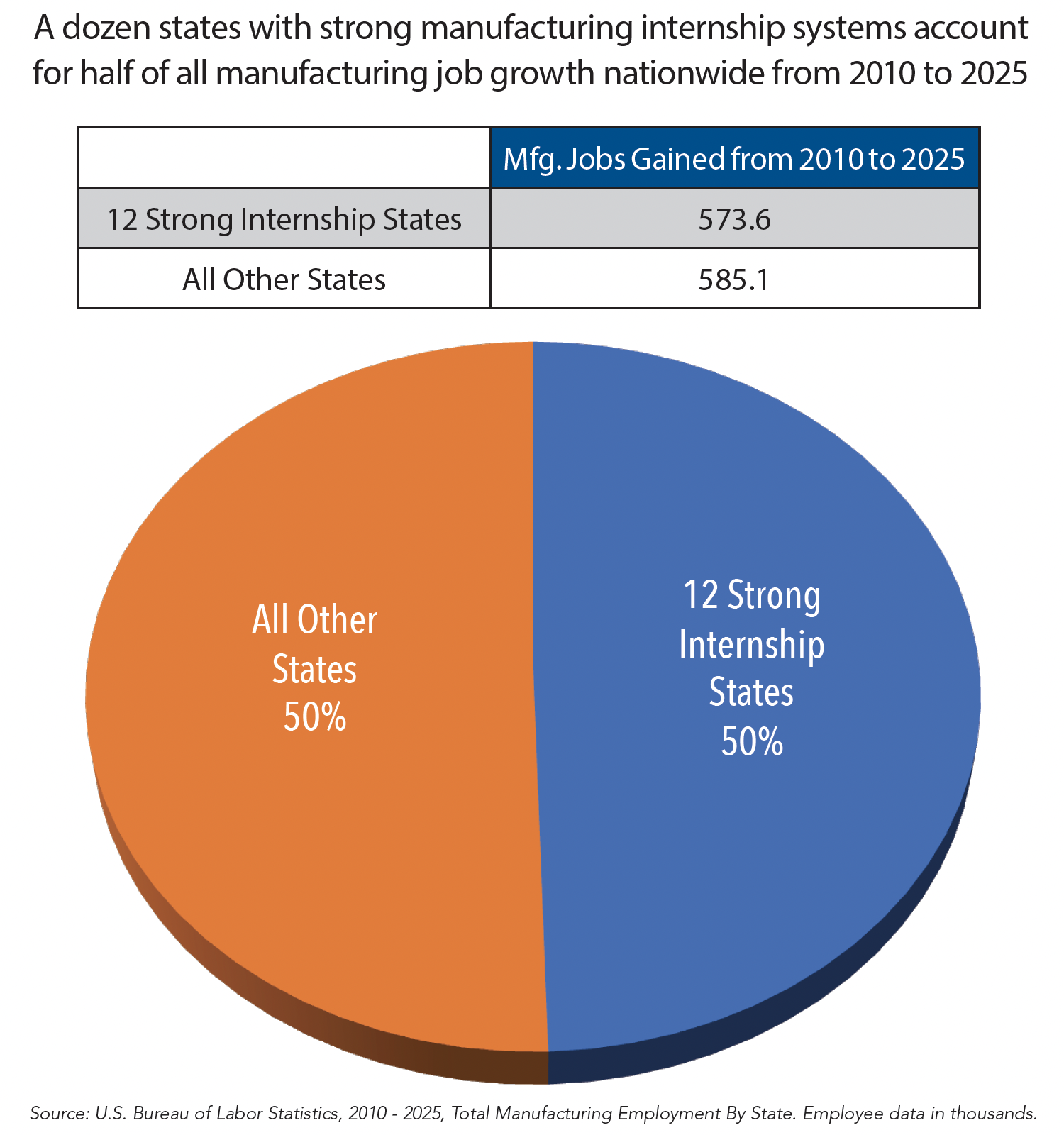
Ultimately, I managed to identify a dozen bellwether states that have achieved a level of advanced manufacturing internship acceptance that is highly normalized and structurally embedded within their statewide workforce systems. The 12 bellwether states include Connecticut, Georgia, Illinois, Indiana, Michigan, Minnesota, Nebraska, North Carolina, Ohio, South Carolina, Tennessee and Wisconsin.
Midwest Neighbors
Illinois, Indiana, Michigan, Ohio and Wisconsin combine strong manufacturing concentration with coordinated education-to-industry pipelines, clearly defined work-based learning frameworks and widespread employer participation. Internships are not isolated initiatives but part of mature, scalable talent development ecosystems.
These states also have demonstrated alignment across manufacturing density clusters, CTE participation, apprenticeship infrastructure and employer adoption. Large manufacturers in these states anchor internship pipelines that extend to small- and mid-sized firms, reinforcing a culture where early exposure to manufacturing careers is standard practice rather than an exception. Major manufacturers offering internship programs in these states include Procter & Gamble (Ohio), GM (Michigan), Ford (Michigan), Cummins (Indiana), GE Aerospace (Ohio), Caterpillar (Illinois), Rockwell Automation (Wisconsin) and Dow (Michigan).
Regional Mix
Meanwhile, Connecticut, Georgia, Minnesota, Nebraska, North Carolina, South Carolina and Tennessee have developed strong and expanding internship ecosystems, though adoption may vary regionally. Manufacturing remains a significant economic driver in these states, and statewide work-based learning initiatives are present and growing. Internship participation is common among major employers and increasingly adopted by mid-sized firms.
These states often combine robust manufacturing business clusters with active workforce policy initiatives. Internship programs are increasingly integrated into CTE pathways and apprenticeship expansion efforts.
Major manufacturers offering internships in these states include Caterpillar (North Carolina), Michelin (South Carolina), Honda Aircraft (North Carolina), Nissan (Tennessee), Volkswagen (Tennessee), Kia (Georgia), Hyundai Metaplant (Georgia), Eastman Chemical (Tennessee), Medtronic (Minnesota) and Honeywell Aerospace (Minnesota).
Finish task to continue reading
Review the print ads from this magazine to continue
This quick advertiser review unlocks the rest of the article and keeps the full-screen reader focused on the ads instead of the page chrome.
Start print ads
Finish task to continue reading
Next print ad
Print ads from this magazine
Task complete
Continue reading
Thanks for supporting the advertisers that help keep the magazine moving. Continue reading below.
Click a page to zoom, then drag to pan.
Hide tip

