



Hyundai Plans 36 New Models for N.A. & Expand U.S. Manufacturing
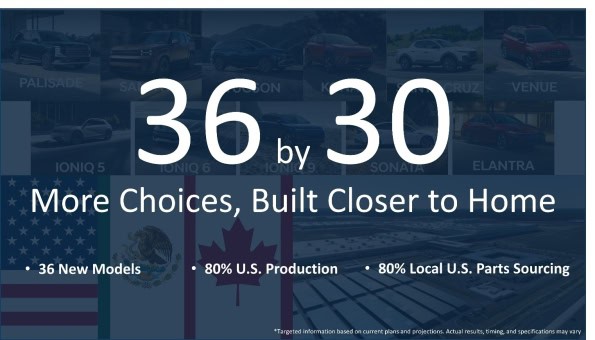 Hyundai Motor Company laid out an ambitious product and manufacturing strategy on Wednesday, announcing plans to introduce 36 new or substantially updated vehicles across North America by 2030 as part of a sweeping effort to deepen its footprint in the United States and cement its standing as one of the industry’s most aggressive growth stories.
The announcement, made by President and Chief Executive José Muñoz at the company’s annual shareholder meeting, signals Hyundai’s determination to compete aggressively in a market that has become central to its global ambitions — even as the broader auto industry navigates economic uncertainty, shifting consumer preferences and an uneven transition to electric vehicles.
The planned vehicles — spanning passenger cars, sport utility vehicles, trucks and commercial models — will be offered with a range of powertrains, including traditional combustion engines, hybrids, fully electric and extended-range electric options. The lineup will also include expanded trim levels, among them the rugged XRT variants and high-performance N derivatives that have cultivated a devoted following among driving enthusiasts. The rollout will cover the United States, Canada and Mexico.
“Hyundai is accelerating across North America,” Mr. Muñoz said at the meeting. “By expanding our product portfolio and offering a wider range of powertrains in North America, we’re giving customers more choice while continuing to strengthen our long-term investment in U.S. manufacturing, jobs, and the broader automotive ecosystem.”
The product push is closely tied to a $26 billion investment in the United States previously announced by Hyundai Motor Group. That commitment, which extends well beyond vehicle development, also encompasses a new state-of-the-art steel mill in Louisiana and a robotics research and innovation hub — investments the company says will strengthen its manufacturing capabilities and technology infrastructure across the region for decades to come.
On the production side, Hyundai said it aims to have more than 80 percent of the vehicles it sells in the United States assembled domestically by 2030, a significant increase from current levels. Simultaneously, the company is targeting a rise in American-made components within its supply chain, pushing that figure from roughly 60 percent today to approximately 80 percent. Together, those goals are designed to reduce the company’s exposure to global supply chain disruptions and improve operational efficiency through more localized sourcing.
The strategy reflects a broader industrywide pressure on automakers to bring production closer to home — a trend sharply accelerated by pandemic-era supply chain upheaval, evolving trade policy and growing political and consumer interest in domestic manufacturing. For Hyundai, the push also represents a calculated bet that committing deeply to American production and American workers will pay long-term dividends in both brand loyalty and market resilience across the United States, Canada and Mexico.
