Semiconductor manufacturers are spending tens of billions of dollars to build advanced factories in Arizona and Texas. They’re being cheered on by the federal government, which has chipped in billions of taxpayer dollars to ensure the U.S. doesn’t become completely reliant on technology from overseas.
But these new factories, which the industry calls foundries, rely entirely on manufacturing technology developed in Asia.
A geopolitical or natural disaster could leave those new factories stranded, with all that new American manufacturing muscle cut off from the brains in Asia that make them go. There would be no one in the U.S. to develop new manufacturing technologies.
“You’d be stuck in time,” according to veteran chip industry researcher Patrick Moorhead. Cut off from engineers in Taiwan, he said, “the foundry would not advance on anything.”
The U.S. has a solution. Maybe.
It’s Intel, which was the world’s largest and most advanced chipmaker until a series of factory and leadership missteps derailed its business a decade ago. Intel still has thousands of scientists working in its Hillsboro research factories, where the company develops the recipes to manufacture new generations of computer chips.
Those Oregon engineers have made great strides over the past five years in recovering what Intel lost in the 2010s. The company is the only one based in the U.S. doing this kind of leading-edge work and its brand-new technology, which it calls 18A, offers major advances in chip architecture, performance and efficiency.
Still, it may not be enough.
Taiwan Semiconductor Manufacturing Co. continues to lead the industry, making chips for Apple, Nvidia and many other huge technology companies. Intel has been working for five years to win a share of their business but has yet to announce any large customers for its factories. Intel even outsources some of its own leading-edge designs to rival TSMC.
Intel still makes most of its own chips. But the company has cut 6,000 Oregon jobs over the past two years, and many of its top researchers have left. Intel startled the tech industry last summer when it warned that it would abandon its next generation of production technology, called 14A, unless it wins some big outside customers.
That would leave the U.S. without any chipmaker developing advanced technology domestically. The nation’s defense and tech sectors would be reliant on innovations from overseas.
The stakes are just as high for Oregon. Intel is the state’s largest corporate employer and Oregon’s economy is hugely reliant on the billions the company spends building, equipping and maintaining leading-edge factories.
 Intel CEO Lip-Bu Tan says customers are telling him they’re pleased with Intel’s direction: “I’m hearing a clear, consistent message. They see the progress we are making. They want Intel at the table as they navigate their own transformations.”AP Photo/Chiang Ying-ying
Intel repeated its warnings about abandoning 14A in regulatory filings and conversations with analysts as recently as last month. But its executives insist that 14A, being developed by Oregon engineers, is on track and that Intel is charging ahead on future generations of technology that will put the company — and the country — back on the leading edge.
“There should be no ambiguity that we are all-in on 14A,” said Chris Auth, an Intel vice president in Hillsboro who leads manufacturing development. He said that’s the central mission of Intel’s operations in Oregon, and that focus and commitment haven’t changed.
“There’s thousands of people here,” Auth said, “and they are innovating and developing 14A and beyond, just like they were before.”
Historic cuts hit innovation, manufacturing
Intel’s technology may again be near the leading edge, but its business model is a dinosaur. The company is the last major player that both designs and manufactures its computer chips.
All the other big players have chosen to specialize in one or the other. Nvidia, for example, dominates the market for artificial intelligence by designing a class of chip called a GPU — a booming sector Intel missed out on. But Nvidia doesn’t make any of those GPUs itself. It sends its designs off to TSMC.
For decades, Intel maintained that integrating design and manufacturing gave it an advantage. It could work more quickly to adapt its factories for new designs, and vice versa, so advances in one part of its business benefitted the other. Intel made all its own chips and none for anyone else.
Integration is no longer an accelerant for Intel. It’s become an albatross.
A leading-edge factory costs $10 billion to build, plus several billion more every year just to keep up with advances in manufacturing technology. Intel says it can’t afford to keep spending that way if its only customer is Intel itself — especially because the market for its own chips, which primarily power personal computers and servers, is also in decline.
That presents a conundrum, for Intel and for the United States, because the country wants advanced manufacturing and domestic companies that can keep those factories on the leading edge.
“It’s very important for national security to have both,” Moorhead said.
 Intel Vice President Chris Auth has worked at the chipmaker for nearly three decades. He leads manufacturing development and customer engineering at Intel’s factories in Hillsboro, and says the company’s commitment to Oregon is solid: “This is still the main R&D site for Intel and there’s no indication that that’s going to change in the future.”Sean Meagher/The Oregonian
For now, Intel is trying to hold on financially until it has proven itself technologically and won some outside customers who can help subsidize continued investment in its manufacturing process.
It’s a tough needle to thread. Desperate to save money, Intel has cut 30,000 jobs globally over the past 18 months. That included the 6,000 lost jobs in Oregon. While Washington County remains the company’s largest site anywhere, layoffs and buyouts have reduced its local workforce to its lowest point in 14 years.
CEO Lip-Bu Tan says the cuts reduced layers of bureaucracy that were impeding innovation. But buyouts, layoffs and retirements have cost Intel some of its best-known researchers. And a round of November layoffs eliminated 600 frontline factory technicians, engineers and scientists in Hillsboro.
Many more are leaving on their own. The company has cut stock benefits and sabbatical time and says nearly 8% of its employees quit last year. That’s the biggest voluntary exodus in nearly two decades — what Intel calls “undesired turnover” — and a steep increase from 2024.
After a surge in spending at the beginning of the decade, Intel slashed its research budget by 16% last year. That’s an enormous cut unmatched any time this century.
Intel has shelved plans for a fourth phase of its D1X research factory in Hillsboro, a multibillion-dollar project that would have provided a massive boost to the state’s economy and Intel’s innovation capacity. At one time, Intel had planned to start construction in 2025.
If those cuts diminished Intel technologically, its financial picture has improved — and only partly because it is spending less. The Trump administration negotiated an $8.9 billion investment in Intel last summer, followed by billions from Nvidia and the Japanese technology investment firm SoftBank.
That money is more than just a financial lifeline. The ties to the government and wealthy backers buy Intel clout in the industry and could open doors to potential customers.
And in the long run, Apple, Nvidia and other big tech companies don’t want to be wholly dependent on TSMC as their only source of leading-edge chips. They would presumably enjoy having Intel as a second option.
But since none of them have signed up to use Intel’s factories, they’re evidently not convinced that it can deliver. At least not yet.
‘They’re not even willing to catch up’
Neither is Christof Teuscher, an engineering professor at Portland State University. He’s spent nearly two decades teaching Ph.D. students who went on to careers at Intel. Now, he says, Intel isn’t hiring anyone and students don’t want to go.
“The excitement is not at Intel anymore,” Teuscher said. “It’s just not there.”
While the Trump administration has invested billions in Intel, and awarded billions to other chipmakers to build factories, Teuscher said the administration’s immigration policies are deterring promising students and researchers.
“That was almost entirely an international pipeline,” he said. “You can be sure they’re going to do their own stuff somewhere else, and not in the U.S.”
Among the students who are here, Teuscher said they are more interested in young Oregon chip companies like Ampere and AheadComputing or in Nvidia, which employs more than 300 at an engineering office in Washington County. He questions Intel’s commitment to its own future.
“Intel had the talent,” Teuscher said, “but they lost that game and it seems like they’re not even willing to catch up.”
Intel’s own messaging is confusing and contradictory on that point. Tan, the CEO, declared at the beginning of this year that “We are going big time into 14A,” the new manufacturing node due sometime in 2028.
But less than two weeks later, Chief Financial Officer David Zinsner reiterated that Intel will restrain research and manufacturing spending on the new technology “until we have customers secured.” The company said it expects potential clients will begin making decisions about using Intel’s 14A technology late this year or early in 2027.
“Once visibility improves there,” Zinsner said, “we’ll start to unlock the spend on 14A.”
Baking the cake
For now, Wall Street appears to be willing to give Intel time to make up its mind. The company’s share price has doubled in the last six months. There is a growing consensus among analysts that Intel is close to a deal to manufacture Apple’s chips for the iPad and some Mac computers.
Many, though, continue to doubt Intel’s technological prowess.
Bank of America’s Vivek Arya told clients last month that he believes that Intel’s brand-new generation of chips, the ones called 18A, are ramping up slowly because so many have defects that require the company to discard them. That’s typical with new generations of chip technology, but Arya said Intel is moving too slowly to improve yields, making its manufacturing process too expensive and unpredictable.
“We appreciate the scarcity value of leading-edge manufacturing,” he said. But if Intel cannot deliver high yields on its 18A technology, Arya said that’s an ill omen for the next generation of 14A chips. That leaves him skeptical Intel can thrive as a contract manufacturer — a market where Intel “has no scale or history of execution.”
It’s true that Intel has no track record as a contract manufacturer, but its history as an innovator stretches back generations. Moore’s Law, the industry maxim that the ability to miniaturize and pack denser circuitry on computer chips would produce exponential growth in computing power while simultaneously driving down the cost to manufacture them, was coined by and named for Intel’s co-founder.
Jamel Tayeb spent 25 years at Intel as an engineer and chip architect before retiring and becoming a professor in Portland State’s engineering department last fall. Intel is again listening to its technologists, Tayeb said, and that’s why he believes it can overcome its technological struggles.
“Do I believe that Intel can do it?” he asked. “I would say that yes, I really deeply feel that they can pull it off.”
To succeed as a leading-edge manufacturer, Intel must demonstrate that it is both capable of making advanced chips and committed to continue doing so.
Even Intel employees expressed confusion last summer when the company appeared to be hedging on its commitment to leading-edge manufacturing. But Auth, the manufacturing vice president in Hillsboro, insists the company never slowed the pace of research.
“The commitment to 14A is unwavering,” Auth said. “We have key milestones that Lip-Bu wants us to hit, and we’ve been hitting those milestones.”
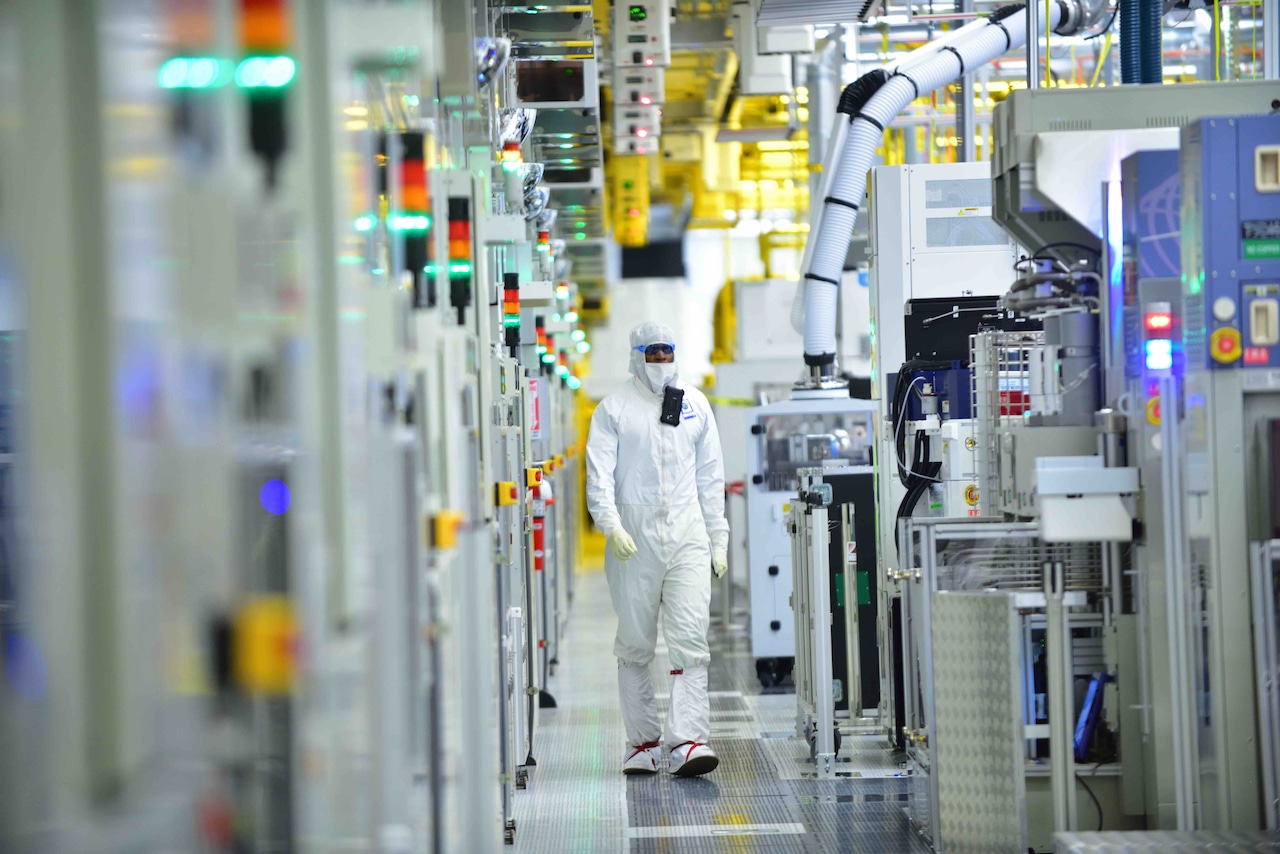
He likens Intel scientists to bakers. The engineers, technicians and researchers working in cleanroom bunny suits are making cakes that need millions of ingredients and thousands of steps.
“Those are the type of things that we do to, at the end of the day, make the best cake we can,” he said, “which is what our customers see.”
Intel has addressed its technological struggles, according to Auth, by focusing on a single cake rather than dabbling in many different ideas. He said Intel has a hard-earned understanding of how to focus on a single concept — manufacturing chips that clients want — and he said the company is convinced it can deliver.
External customers care most of all that chip designs arrive on a predictable schedule, Auth said, and he said a commitment to meeting those expectations is fueling a technological renaissance inside Intel.
“It’s paramount,” Auth said. “And so that has been something that we’ve really embraced.”

Source link