SMITH AND FORD Push East-West Energy, Infrastructure and Manufacturing Ties at Calgary Enserva Event – Canadian Energy News, Top Headlines, Commentaries, Features & Events
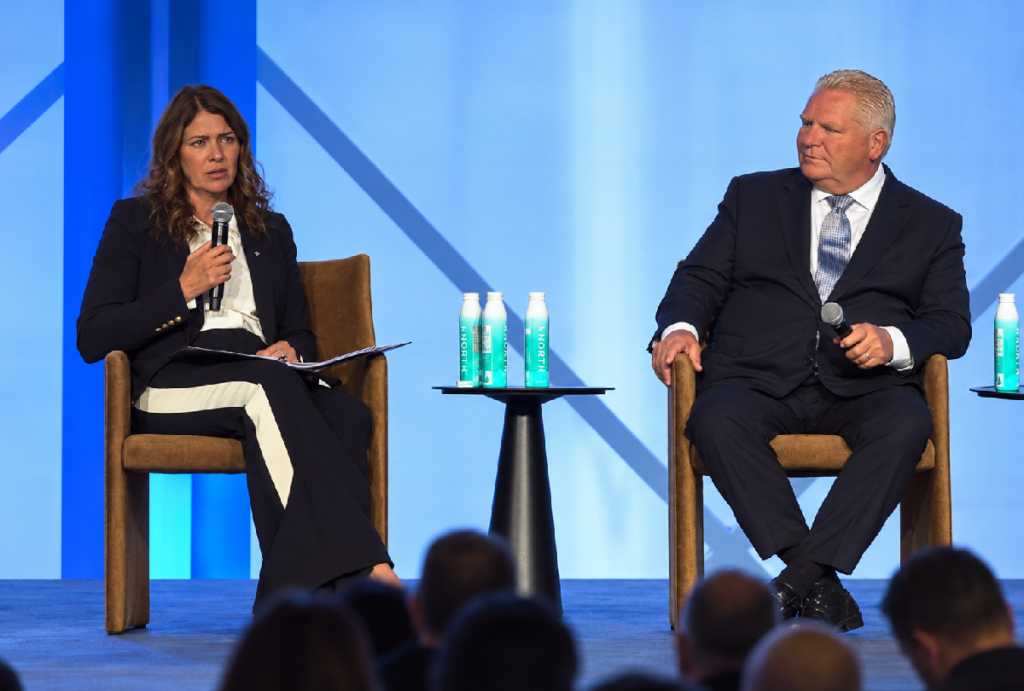


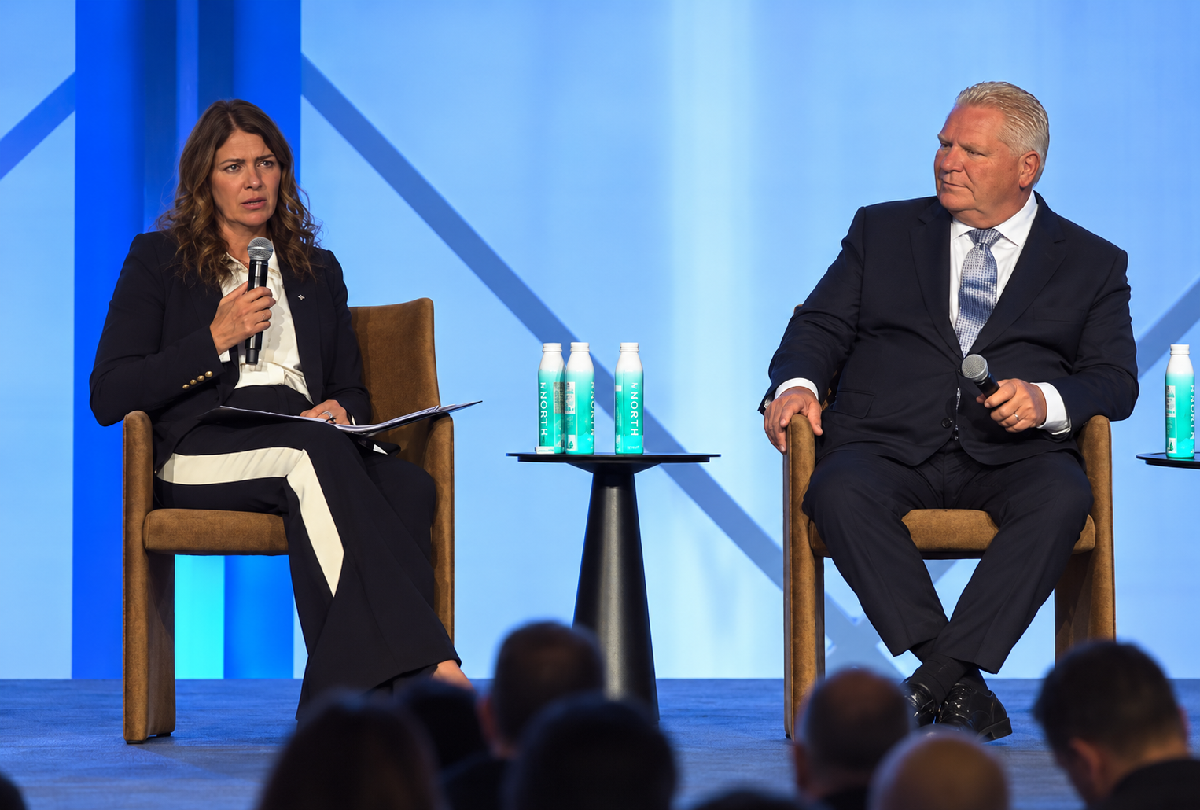
smith ford enserva event 1200x810Premiers Danielle Smith and Doug Ford during a fireside chat hosted by Enserva at the Calgary Telus Convention Centre September 28, 2026 – EnergyNow Media

EnergyNow Media

The two premiers appeared September 28 at the Enserva Speaker Series — Build Canada Stronger: Powering Canada’s Economic Future at the Calgary TELUS Convention Centre. The event brought together energy and business leaders to discuss energy security, infrastructure, trade and Canada’s ability to compete in global markets. It was moderated by Enserva President and CEO Gurpreet Lail. Enserva

The discussion highlighted both areas of agreement and differences between Smith and Ford, particularly on Canada’s evolving relationship with the United States.

Get the Latest Canadian Focused Energy News Delivered to You! It’s FREE: Quick Sign-Up Here

Smith said Alberta’s exposure to U.S. tariffs differs significantly from Ontario’s because most Alberta exports entering the United States are energy products that remain largely tariff-free.

“If you’re looking at a bit of a difference in tone between Premier Ford and I, that’s what it comes down to,” Smith said, pointing to Alberta’s large existing trade relationship with the United States and the role played by cross-border energy companies including Cenovus, TC Energy and Enbridge.

Smith argued that Canada could potentially use energy as the foundation for a broader economic agreement with Washington, suggesting significantly larger volumes of Canadian oil could ultimately move south if a comprehensive Canada-U.S. arrangement were reached.

Ford struck a somewhat different tone but emphasized that he remains strongly supportive of the broader Canada-U.S. relationship.

“I truly love Americans,” Ford said, noting Ontario’s deep economic integration with U.S. manufacturing and trade. He argued for what he called a “Fortress North America” approach in which Canada and the United States strengthen their economic and security relationships while Canada simultaneously expands trade with other countries.

Ford said the current trade friction could ultimately push Canada to become economically stronger.

“He woke us up that we needed to be woken up, and he’s united the country like I’ve never seen before,” Ford said of U.S. President Donald Trump. “We’re going to diversify our trade, but continue building a strong relationship with our closest friends and allies, and that’s the Americans.”

Pipelines Move to Centre Stage

The conversation quickly turned to pipelines and major infrastructure projects — a central theme of the Enserva event, which was promoted around the question of how Canada can build, move and sell more energy to global markets. Enserva

Smith said she has become increasingly confident about the prospects for a proposed new West Coast oil pipeline.

“I’m feeling more and more confident every day that the West Coast oil pipeline is going to potentially even be the first of the projects that go ahead,” she said.

Smith argued that global concerns about supply security have strengthened Canada’s position as a potential long-term supplier to Asian countries seeking greater diversification.

She also pointed to additional export possibilities through the United States and to the proposed Northern Shield corridor, which Alberta and Ontario have been advancing as a potential east-west energy and infrastructure route.

Ford was emphatic that Canada should not be forced to choose between individual pipeline routes.

“We need the West, we need the North, we need the South, and we need to go east,” he said. “Why can’t we do it simultaneously?”

Ford also signalled Ontario’s willingness to participate financially in the Northern Shield concept, saying he evaluates major infrastructure according to its potential return to taxpayers.

“You show me the numbers, and if you can clip those coupons after we get it built every single year, that’s a great investment for our province,” Ford said.

Skilled Labour Could Become the Next Constraint

Both premiers warned that even if governments approve more infrastructure, Canada will need enough skilled workers to actually build it.

Smith pointed to Alberta’s expansion of apprenticeship programs, dual-credit education and partnerships with unions and employers. She said Alberta now has 81,000 apprenticeship positions and argued provinces need greater ability to align immigration with labour-market shortages.

“We need some office jobs, but we sure need a heck of a lot more factory floor jobs and field jobs,” Smith said. Pasted markdown

Ford said Ontario has invested more than $2 billion through its Skills Development Fund and said more than 750,000 people have received training through various programs.

“Number one issue: supply chain and labour. Who is going to fill these jobs?” Ford said, arguing that provinces should have greater influence over immigration programs so workers who have developed needed skills can remain in Canada. Pasted markdown

Alberta Energy Meets Ontario Manufacturing

Perhaps the strongest area of agreement came around creating deeper economic links between Alberta’s energy sector and Ontario’s manufacturing base.

Ford argued governments need to reduce regulatory barriers and create conditions that encourage companies to invest.

“The biggest problem, biggest hurdle is government,” Ford said, pointing to regulation, taxation and permitting as obstacles governments can address. Pasted markdown

Smith then outlined several areas where the provinces could work together directly.

One is natural gas-fired power generation. Alberta wants to substantially expand electricity generation to support industrial growth and data centres, but Smith said global demand for natural gas turbines has created long equipment lead times.

“We’ve got the cheapest natural gas probably anywhere in the world, sitting on an ocean of it,” she said.

Smith suggested Ontario’s manufacturing expertise could help develop a Canadian supply chain for natural gas turbines and related electricity infrastructure.

Another opportunity is steel.

With pipelines, energy projects and other infrastructure requiring enormous volumes of steel pipe and fabricated components, Smith said Alberta should identify the equipment its energy industry will need and work with Ontario manufacturers to produce more of it domestically.

“Let’s figure out how we can identify the steel fabricated items that we need, and let’s work with our friends in Ontario,” Smith said.

She also suggested Canada needs stronger east-west supply chains, rather than relying predominantly on north-south trade with the United States or imported products arriving through West Coast ports. Pasted markdown

The message fit closely with the theme Enserva established for the event. Using Canadian energy, infrastructure and industrial partnerships to improve the country’s economic competitiveness and energy security. Enserva said the discussion was intended to examine how Canada could “look beyond provincial boundaries” to unlock its energy potential.

For Canada’s energy services sector, the discussion underscored a potentially significant shift: major energy development is increasingly being presented not simply as a Western Canadian issue, but as an opportunity to connect Alberta resources, Ontario manufacturing, Canadian workers and new international markets.

And on that central point, Smith and Ford were clearly aligned.

“We’re stronger together,” Ford said.

Free Training

Source link

Texas records suggest OCI is bringing Elite Solar to Mission Solar Energy manufacturing site


Share

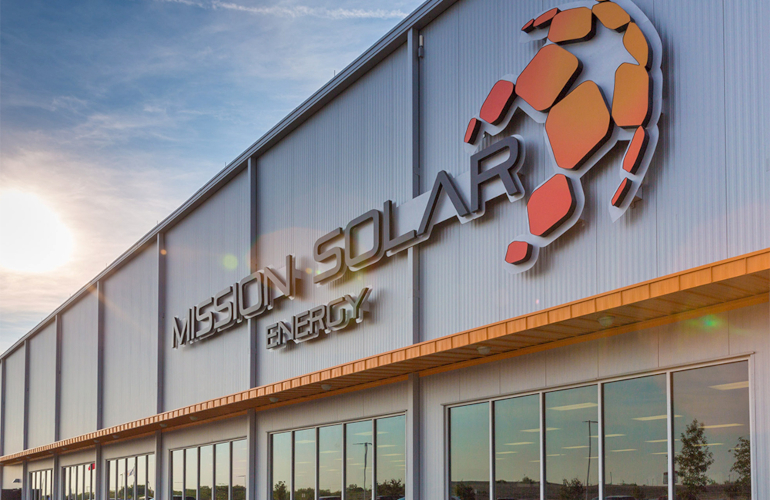
Mission Solar Energy’s solar panel manufacturing site in San Antonio, Texas, considered one of the longest-running panel assembly operations in the United States, may soon receive a boost from a global manufacturer.

Mission Solar has been making solar panels in the United States since 2014 and is owned by OCI Company, a South Korean chemical conglomerate that is involved with solar project development and polysilicon production. OCI started the assembler to supply panels to its own utility-scale projects in Texas. Mission Solar has since worked through solar panel distribution channels and mostly supplied the U.S. residential sector but was attempting plays into larger markets. The company is currently listed as having a 500-MW annual module assembly capacity in San Antonio.

Sam Martens, president of Mission Solar, submitted testimony in the ongoing antidumping/countervailing duty (AD/CVD) investigation into solar cell imports from India, Indonesia and Laos. In addition to reiterating to the U.S. International Trade Commission the challenges the U.S. solar industry faces from unfairly priced imports, Martens commented on Mission Solar’s Texas factory.

“Despite trying our best to be cost-competitive, our customers repeatedly told us that our prices are too high. Subject producers have even offered prices well below our cost of production. We simply cannot cut prices that far, and we often ended up losing the sale instead,” he said. “The continual loss of sales and revenue forced us to curtail our production, leaving us with significant excess capacity.

“Lower utilization has naturally resulted in reduced shifts and reduced employees,” Martens continued. “For example, we previously employed more than 200 workers. But, due to the market conditions caused by subject imports, we only had 70 employees by 2025, and have now temporarily ceased all manufacturing operations and related employment.

“If injurious subject imports remain unrestrained in the face of potentially shrinking demand, I am afraid that the domestic industry will once again face rising closures and mass layoffs,” he concluded.

There have been no layoff announcements by Mission Solar in Texas worker adjustment and retraining notification notices, so if employment has been temporarily ceased, it’s likely to have resulted in furloughs. When asked, Mission Solar representatives were unable to comment on the matter to Solar Power World.

It’s an unfortunate trend for long-established U.S. solar panel manufacturers. Silfab Solar furloughed workers in August at its South Carolina manufacturing site due to “temporary constraints affecting the availability of certain materials required for production.” Heliene laid off nearly 100 workers in August at its Minnesota solar panel assembly facility due to “unforeseen business circumstances.” Qcells furloughed 1,000 employees at its Georgia operations last year, but was able resume production four months later.

Mission Solar, which has long operated a small-output solar panel factory at a mixed-use community located on the former Brooks Air Force Base, announced in 2022 it would expand operations to reach 1 GW of annual module manufacturing capacity. The company built a 200,000-sq-ft addition on its property, but it was instead later described as a warehouse.

The warehouse was then assumed to become the starting point of Mission and OCI’s solar cell manufacturing operations, which the two companies announced in 2025. They would invest $265 million into the site to eventually reach 2 GW of annual cell manufacturing capacity. Martens confirmed in his ITC testimony that actual construction plans never progressed further.

That warehouse is back in play after a filing with the Texas Dept. of Licensing and Regulation in August. The filing says that $15 million will be spent to renovate the existing warehouse into the “Elite Solar factory [f]or manufacturing.” Construction is expected to begin in October and be completed in June 2027.

Elite Solar, a Singapore-headquartered panel brand (previously known as ET Solar), has affiliated panel manufacturing operations across the globe. The company’s flagship sites are now based in Egypt and Indonesia, but it has a longstanding relationship with OCI and is jointly developing a solar wafer production facility in Vietnam. This partnership could be extending to panel manufacturing in Texas.

Elite Solar provided no comment when asked by Solar Power World about the San Antonio factory plans.

Free Training

Source link

Hitachi Energy Bringing Its Largest Transformer Manufacturing Investment In U.S. To Mississippi » Office of Governor Tate Reeves


JACKSON, Miss. – Hitachi Energy, a wholly owned subsidiary of Hitachi, Ltd. (TSE: 6501, “Hitachi”) is expanding its operations at its transformer manufacturing factory in Copiah County, Mississippi. The project represents a corporate investment of $528 million, the company’s largest investment to date in the U.S., and it will create 654 jobs.

Hitachi Energy is a global leader in electrification that manufactures transformers and other equipment to help power the nation’s homes, businesses and communities. The company’s current facility in Copiah County produces small power transformers and employs 475 people.

The expansion will significantly increase Hitachi Energy’s production capacity and expand the range of small power transformers manufactured domestically, helping meet growing demand across North America while strengthening the domestic supply chain for critical energy infrastructure. The project includes the purchase of a 45-acre site at the Copiah County Industrial Park in Gallman, the construction of a new facility, new manufacturing equipment and infrastructure improvements.

The Mississippi Development Authority is providing assistance through the Mississippi Flexible Tax Incentive, or MFLEX, program. MDA also is assisting with site development and infrastructure improvements. Copiah County is assisting with the project, as well.

Construction is expected to begin later this year, with transformer production scheduled to start in 2029.

QUOTES

“This is truly a massive win for Mississippi and the United States. Hitachi Energy could’ve made its largest investment in America anywhere in the country – but the company chose Mississippi. Mississippi’s momentum is growing stronger every day, and it is our people who are building the future of American energy infrastructure. This $528 million investment will create over 650 new jobs while expanding the domestic manufacturing capacity our country needs to meet growing demand. Mississippi is proud to play a leading role in powering America’s future.” – Gov. Tate Reeves

“Reliable energy infrastructure has become one of the most important factors in economic growth, and that starts with the ability to manufacture the equipment that keeps the grid running. At $528 million, Hitachi Energy’s expansion is a massive addition to the investment taking place in Mississippi and puts Copiah County at the center of an industry that is increasingly critical to economic development.” – Mississippi Development Authority Executive Director Bill Cork

“Demand for electricity is growing rapidly, and the grid must grow with it. This investment in Mississippi, our largest ever in the U.S., reflects our long-term commitment to American manufacturing and building the grid infrastructure that will help power America’s growth for decades to come. We are pleased to work with the Trump administration and Governor Reeves to support investment in American manufacturing at a pivotal time for U.S. energy security.” – Andreas Schierenbeck, CEO, Hitachi Energy

“Copiah County Economic Development District is grateful for the decision of Hitachi Entergy to invest $528 million into expanding the domestic transformer production located in Copiah County. We thank the Mississippi Development Authority for support of this project, which will strengthen Hitachi Entergy’s operation, create new jobs and assist with continued economic growth of our community.” – Copiah County Economic Development District Executive Director Arthur L. Evans, Jr.

“This expansion is about more than adding 654 jobs. It will create new career pathways and generational opportunity across Copiah County and the surrounding region. Building on the strength of Hitachi Energy’s existing Mississippi workforce, AccelerateMS is committed to working with the company and our education and workforce partners to prepare Mississippians for these highly skilled roles and support their continued growth throughout their careers. This is the kind of investment that can transform a region while demonstrating that Mississippi has the talent to help lead the future of American manufacturing.” – AccelerateMS Executive Director Courtney Taylor

Free Training

Source link

Enphase Energy Expands U.S. Manufacturing for Solar, Battery and AI Data Center Power Electronics


Enphase Energy has reaffirmed its commitment to designing and manufacturing critical power electronics in the United States, expanding domestic production across residential and commercial solar, battery energy storage systems (BESS), and next-generation power infrastructure for artificial intelligence (AI) data centers.

Growatt

The company said it currently manufactures its IQ® Microinverters and IQ® Batteries at facilities in South Carolina and Texas, and plans to manufacture its upcoming IQ® Solid-State Transformer (IQ® SST) platform for AI data centers in the United States.

According to Enphase, the move supports U.S. energy security, strengthens domestic supply chains, and addresses the increasing importance of secure power electronics as electricity demand rises from electrification and the rapid growth of AI data centers.

The company noted that its U.S.-manufactured IQ Microinverters and IQ Batteries, identified with a “DOM” suffix, can help eligible solar and storage projects meet domestic sourcing requirements and qualify for U.S. domestic content tax incentives. Select products also comply with Buy American Act and Build America, Buy America requirements, while certain products may qualify as Foreign Entity of Concern (FEOC)-compliant for rooftop solar and distributed battery energy storage applications.

Enphase also plans to manufacture the power electronics for its forthcoming IQ® Bidirectional EV Charger in the United States, further expanding its domestic clean energy product portfolio.

The company’s upcoming IQ SST platform is designed for AI data centers and other high-power applications. Based on gallium nitride (GaN) technology, the platform will convert medium-voltage alternating current (AC) directly into 800 V direct current (DC) required by modern AI computing infrastructure through a modular architecture featuring distributed control, software intelligence, and built-in redundancy.

Enphase estimates that a 1 GW AI data center would require approximately 250,000 IQ SST power modules, excluding redundancy, while 10 GW of deployments could require around 2.5 million modules, highlighting the significant scale of future demand.

The company said its manufacturing experience provides a strong foundation for scaling the platform, having shipped approximately 89.4 million microinverters globally, including 5.5 million units manufactured in the United States during 2025.

While expanding U.S. manufacturing capabilities, Enphase emphasized that it remains committed to serving international markets, including Europe, Australia, India, and other regions, where it will continue developing products tailored to local grid requirements, regulations, and customer needs.

Discover more from SolarQuarter

Subscribe to get the latest posts sent to your email.

Free Training

Source link

SEIA Unveils Cybersecurity Roadmap to Strengthen US Solar, Energy Storage and Domestic Inverter Manufacturing


The Solar Energy Industries Association (SEIA) has released a new report outlining the solar and energy storage industry’s priorities for strengthening cybersecurity while expanding domestic manufacturing capacity for clean energy technologies across the United States.

Growatt

The report comes as US solar and battery energy storage manufacturing continues to grow, with domestic inverter manufacturing capacity having nearly tripled since the end of 2024.

According to SEIA, the report identifies key cybersecurity considerations for the solar and energy storage sector, recommends measures to improve industry resilience, and provides guidance to help companies adopt cybersecurity best practices and standards as cyber threats targeting the energy sector continue to evolve.

“As solar and storage continue to lead the way in adding new power capacity to the grid, cybersecurity must remain front and center,” said Tim Pawlenty, President and CEO of SEIA.

He added that the report outlines actions the industry is taking to strengthen US energy security, protect critical infrastructure and stay ahead of emerging cyber threats through secure and resilient energy systems and expanded domestic manufacturing.

As part of its strategy to strengthen cybersecurity, SEIA is also prioritising the development of resilient domestic supply chains. The association noted that the opening of a new inverter manufacturing facility in July has positioned the United States alongside the world’s second-largest inverter manufacturing markets.

The report outlines three key priorities for the industry:

-Expanding domestic solar and energy storage manufacturing through resilient supply chains, greater transparency and trusted manufacturing capacity.
-Strengthening baseline cybersecurity by promoting consistent industry practices and national guidance for distributed energy resources.
-Improving threat visibility and coordination through enhanced information sharing and better risk communication across the industry.

SEIA said the recommendations are intended to support a more secure and resilient solar and energy storage industry while reinforcing the role of renewable energy in strengthening the nation’s critical energy infrastructure.

Discover more from SolarQuarter

Subscribe to get the latest posts sent to your email.

Free Training

Source link

Data centers’ energy demand threatens Trump’s “Made in America” plan


PJM has also forecast that electricity demand in its territory will surpass available supply by 6.6 gigawatts starting in 2027, which the Wall Street Journal describes as equivalent to more than six nuclear power plants.

No easy fixes

Some US manufacturers have raised the prices paid by customers to partially offset their own rising electricity bills, or are even considering relocation of their businesses, Reuters reported. The Wall Street Journal highlighted warnings from steel industry executives that production outages could become more likely if local power grids are overwhelmed by demand. Such results would likely undercut the competitiveness and viability of US manufacturing, which the Trump administration claims to have prioritized despite the loss of 83,000 manufacturing jobs in Trump’s first year back in office.

The White House has touted getting Big Tech companies to pay for new power generation and transmission infrastructure by signing a Ratepayer Protection Pledge, which happens to lack any meaningful enforcement mechanism. The Trump administration also joined state governors in pushing PJM to hold a one-time backstop auction for purchasing new power supply capacity.

But the United States still faces huge challenges in building enough new power generation and transmission lines to support the energy needs of AI data center demand and US manufacturers, not to mention other businesses and residential customers. The Trump administration’s efforts to stop renewable energy projects involving wind and solar power have also not helped.

In 2025 alone, the United States saw the cancellation of power projects totaling 266 gigawatts of generation capacity—equivalent to 25 percent of America’s current electricity generation capacity and more than the total electricity generation of Texas, according to Michael Thomas, CEO of the Cleanview data platform that tracks renewable energy and data center projects. Clean energy projects accounted for 93 percent of those project cancellations.

The Trump administration’s cancellations of various wind power projects certainly represented one contributing factor. But other significant patterns included local opposition to renewable energy projects in states such as Ohio and Indiana that were also courting new data center development, along with a lack of new transmission lines leading to high interconnection costs for new clean energy projects, Thomas said. If US states and the federal government are hoping to support local manufacturing, they may need to start making different choices in addressing the rising energy costs of the data center boom.

Free Training

Source link

SEIA Highlights U.S. Solar Manufacturing Growth and Energy Infrastructure Expansion


Highlights

  • U.S. solar and storage manufacturing capacity has expanded significantly since 2022.
  • More than 140 domestic manufacturing facilities have opened, with dozens more under construction.
  • Solar and battery storage projects are increasingly tied to military resilience and grid reliability initiatives.
  • Agrivoltaic developments are creating additional revenue opportunities for rural landowners and agricultural operators.
  • National solar installations surpassed 6 million during the first quarter of 2026.

Rising electricity demand, supply chain concerns, and domestic manufacturing priorities are continuing to shape investment decisions across the U.S. energy and construction sectors. The Solar Energy Industries Association recently outlined how solar generation and battery storage projects are contributing to infrastructure development, manufacturing expansion, and energy resilience initiatives nationwide.

The organization said domestic production capacity for solar components has increased rapidly over the last several years as developers, utilities, and manufacturers respond to growing demand for renewable energy infrastructure and federal incentives supporting U.S.-based production.

Domestic Manufacturing Expansion

According to SEIA, 146 solar and energy storage manufacturing facilities have opened in the United States since 2022, while another 36 facilities are currently under construction. Domestic solar module manufacturing capacity has reached approximately 70 gigawatts annually.

The organization said the U.S. solar supply chain can now support production across all major solar component categories, reflecting broader efforts to reduce dependence on imported materials and equipment.

For contractors, developers, and procurement teams, expanded domestic manufacturing capacity may help address supply chain volatility, material lead times, and sourcing requirements tied to federal infrastructure and energy programs.

The growth in manufacturing activity also continues to drive industrial construction demand tied to factory development, utility infrastructure upgrades, and logistics facilities supporting energy production.

Military and Rural Energy Projects

SEIA also pointed to increasing deployment of solar and storage systems at military facilities and rural properties.

Among the projects highlighted was a 13-megawatt solar installation being developed by Onyx Renewables to support U.S. Army housing operations. The project is expected to offset a substantial portion of on-base electricity demand. Duke Energy also completed a floating solar installation at Fort Bragg designed to improve energy resilience and reduce operating costs.

In rural markets, agrivoltaic projects are becoming more common as landowners seek additional revenue sources while maintaining agricultural operations. SEIA referenced a Tennessee project developed by Silicon Ranch that combines solar generation with cattle grazing operations on the same site.

Construction activity tied to agrivoltaics, utility-scale solar, and battery storage continues to create opportunities for civil contractors, electrical contractors, specialty trade firms, and site development teams across multiple regions.

Energy Infrastructure Demand Continues to Grow

SEIA reported that cumulative U.S. solar installations exceeded 6 million during the first quarter of 2026 as utilities, developers, and private owners continue investing in additional generation capacity.

The organization also noted that solar projects can often move through deployment timelines more quickly than conventional generation assets because they do not require fuel supply infrastructure.

What This Means For Construction Owners

For construction owners and developers, continued investment in renewable energy infrastructure is expected to sustain demand for transmission upgrades, energy storage facilities, utility interconnections, manufacturing plants, and associated site work.

The expansion of domestic solar manufacturing and generation capacity also reflects broader infrastructure investment trends tied to grid modernization, energy security, and industrial development across the United States.

Source: SEIA.

Free Training

Source link

Argonne and the Department of Energy Launch New Partnership to Speed up U.S. Manufacturing Innovation | Press Releases


The U.S. Department of Energy’s (DOE) Argonne National Laboratory has launched a new effort to help American companies develop and scale new products and manufacturing technologies more quickly.

Called the “National Science-at-Scale Collaborative,” the effort is supported by DOE’s Office of Critical Materials and Energy Innovation (CMEI). The collaborative brings together industry, government and the national laboratories to address complex challenges in critical materials and chemical manufacturing in the United States.

Argonne will work with industry partners on projects designed to move promising technologies from research to commercial production faster. Researchers will use advanced computer modeling, artificial intelligence, rapid synthesis tools and pilot-scale manufacturing systems at Argonne’s Materials Engineering Research Facility to help companies test and scale new production processes.

“American manufacturing has an opportunity to lead the next generation of innovation in critical materials and chemical processing,” said Paul Kearns, director of Argonne. “The National Science-at-Scale Collaborative will help connect discovery, engineering and deployment in ways that strengthen U.S. competitiveness and advance our economic security.”

The announcement followed an industry roundtable chaired by CMEI. Leaders from the chemical and critical materials sectors met to discuss manufacturing challenges and opportunities for collaboration.

“To compete globally, the U.S. must bring new technologies into domestic production more quickly,” said Assistant Secretary of Energy Audrey Robertson. “This collaborative will help connect DOE, the national laboratories and private industry to speed up that process.”

The collaborative supports CMEI’s broader mission to strengthen America’s critical minerals supply chains and accelerate next-generation energy technologies.

Industry roundtable participants list:

  • DOE: Critical Minerals and Energy Innovation Office.
  • National Laboratory System: Argonne National Laboratory.
  • Manufacturers: Aclara, Albemarle, ATALCO, BASF North America, Chemours, Dow, Entegris, Exxon Mobil, Orbia and Standard Lithium.

Media gallery

Free Training

Source link

Department of Energy Selects 10 Projects to Receive Nearly $5 Million for Manufacturing Cybersecurity Innovation


The U.S. Department of Energy (DOE), in collaboration with the Cybersecurity Manufacturing Innovation Institute (CyManII), announced the selection of 10 projects with a combined total of $4.8 million in research and development funding to enhance the cybersecurity landscape within American manufacturing. These projects will advance cybersecure, energy efficient manufacturing, aligning with the missions of DOE’s Office of Energy Efficiency and Renewable Energy (EERE) and EERE’s Advanced Materials and Manufacturing Technologies Office (AMMTO) to drive U.S. manufacturing and supporting the nation’s collective push for a competitive, clean, and decarbonized economy.

“Each of these projects represents a significant investment into American manufacturing resiliency,” said AMMTO director Christopher Saldana “By working with CyManII and each of our project partners to build secure and sustainable process that evolve with new innovations, we can help ensure a robust and cybersecure manufacturing sector here in the United States.”

These 10 projects were selected within three critical industry use cases:

  1. Industrial Control Systems: These projects will explore industry-relevant security controls for the production and supply chain of Industrial Control Systems (ICS). The goal is to ensure digital integrity, supply chain traceability, and resilience to cyber events.
  2. Secure Industrial Digitalization: These projects will help small and medium-sized manufacturers to secure the digital transformations of their companies by identifying and developing effective digitalization practices without introducing new cyber risks.
  3. Industrial Additive Manufacturing: These projects will demonstrate how additive manufacturers can secure product integrity and supply chain traceability, reducing costs by securely tracking the digital histories of their products.

View a list of selected projects here

CyManII is one of DOE’s seven Clean Energy Manufacturing Innovation Institutes and is managed by EERE’s AMMTO, which funds the institute in consultation with the Office of Cybersecurity, Energy Security, and Emergency Response. CyManII is also a part of Manufacturing USA®, a network of federally funded institutes that have a specialized technology focus to increase U.S. manufacturing competitiveness and promote a robust and sustainable national manufacturing R&D infrastructure.

Free Training

Source link

235 new clean energy factories opened in 5 years as a US manufacturing boom powers through policy headwinds


235 new clean energy factories opened in 5 years as a US manufacturing boom powers through policy headwinds Photo Credit: iStock

America’s clean energy manufacturing boom is still gaining speed — even as tariffs and broader policy uncertainty hang over the sector.

According to SolarQuarter, a new industry report said the United States added more than 235 clean energy factories in just five years, with domestic production emerging as a major force in both the economy and the energy transition.

What’s happening?

The American Clean Power Association’s second annual State of Clean Energy Manufacturing said the sector has grown rapidly.

In addition to the new clean energy manufacturing facilities, the report found that U.S. production capacity is sufficient to meet domestic demand for solar modules, battery modules, wind towers, and wind nacelles. That marks a major shift for an industry that has long depended on overseas supply chains.

Jason Grumet, CEO of the American Clean Power Association, said the surge is especially important amid rising energy demand, per SolarQuarter. But he also cautioned that sustaining the momentum will require clear, targeted, and consistent trade policy, along with realistic timelines for tariff compliance and greater regulatory certainty.

Why does it matter?

More domestic clean energy manufacturing can help make the electrical grid more reliable, reduce dependence on foreign supply chains, and support the faster deployment of renewable power sources (such as wind and solar) that can lower energy costs over time.

The report also found that each clean energy manufacturing job supports four additional jobs across the broader economy — one linked to suppliers and three tied to household spending.

As U.S. manufacturing expands, technologies like solar panels and batteries may become more accessible.

What are people saying?

Grumet said that as energy demand rises, the U.S. needs more clean power systems built at home.

The ACPA report points to factory growth, domestic manufacturing strength, and the sector’s ripple effects on jobs and local economies.

Even with policy headwinds, clean energy manufacturing can become a cornerstone of American industry.

Get TCD’s free newsletters for easy tips, smart advice, and a chance to earn $5,000 toward home upgrades. To see more stories like this one, change your Google preferences here.

Free Training

Source link