‘Significant milestone’ as York firm launches US manufacturing facility


Published 25th Sep 2026, 11:31 BST

Updated 25th Sep 2026, 11:31 BST

Launched as part of the company’s plans to expand in the region, the new manufacturing hub is located in the company’s site at University Research Park in Madison, Wisconsin.

The firm said the new manufacturing facility represents a “significant step forward” for its US operations, providing it with the “infrastructure and capacity to expand its US footprint and respond to growing demand”.

It comes after Abingdon first established a presence in Wisconsin in April of 2025, opening a research lab and commercial office.

Dr Chris Hand, executive chairman of Abingdon Health.placeholder imageDr Chris Hand, executive chairman of Abingdon Health.

Speaking to The Yorkshire Post in March, Dr Chris Hand, executive chairman of Abingdon Health, said the choice to expand in the region had been driven by a demand from customers for “made in the USA solutions”.

The company raised £3.2m in October of last year to support the expansion.

Speaking on the opening of the new US facility, Chris Yates, president of Abingdon Health USA and chief commercial officer of the firm’s UK entity, said: “The opening of our Madison manufacturing hub is a significant milestone for Abingdon Health USA that enables us to offer a more comprehensive and integrated “end to end” CDMO solution for our US customers, paving the way for continued growth in the biggest med-tech market in the world.”

Abingdon Health develops and manufactures lateral flow tests, used to identify various illnesses and conditions. The company earlier this year launched a “world first” blood test designed to enable paramedics to more quickly identify strokes.

An official ribbon-cutting event for the firm’s new US site was attended by Congressman Mark Pocan, representing Wisconsin’s 2nd Congressional District, as well as Madison Mayor Satya Rhodes-Conway, WEDC Secretary John Miller, and other representatives from the Wisconsin State Legislature.

Mr Yates added: “We were delighted to welcome Representative Mark Pocan, Mayor Satya Rhodes-Conway, WEDC Secretary John Miller and other legislative and industry leaders to the ribbon-cutting ceremony.

“Their support throughout our journey is recognition of the importance of high-quality, domestic diagnostics manufacturing for the United States as well our investment in Madison and its community.”

As part of its expansion, Abingdon also recently listed on the OTCQB Venture Market in the US, trading under the abbreviation ABDXF.

In a trading update issued in July, Abingdon said its revenues had grown by more than 30 per cent – with further increases expected.

Updating investors on the financial year to the end of June 2026, the firm hailed strong growth in the second half of the financial year, with total revenue for the full year expected to reach £11.3m – 31 per cent on the £8.6m recorded 12 months before.

The company said there was a 63 per cent increase in revenue during the second half of the year compared to the first six months.


Free Training

Source link

US launches Foundry School to build advanced manufacturing workforce


The programme will train entrepreneurs, engineers, technicians, and industrial leaders through a 17-session advanced manufacturing curriculum.

The US launched the Foundry School on 3 September 2026 as a training programme for entrepreneurs, engineers, technicians, and industrial leaders to support the rebuilding of US manufacturing. Vice President J.D. Vance and Secretary of State Marco Rubio announced the programme at an event hosted by Under Secretary for Economic Affairs Jacob Helberg at the Donald J. Trump Institute of Peace.

Foundry School is being developed with Stanford University and seven other universities: Arizona State University, Georgia Institute of Technology, The Ohio State University, The Pennsylvania State University, the University of Kansas, Vanderbilt University, and Washington University in St. Louis. The programme will run 17 sessions across the eight campuses, with each session taught by founders and CEOs from advanced manufacturing enterprises in the United States and Pax Silica economies, including South Korea, Japan, Taiwan, and India.

The curriculum will be delivered in two phases. Seven regional sessions beginning in September 2026 will cover modern factory design, materials and supply chains, assembly-line engineering, plant economics, regulation and permitting, and workforce development at scale. A ten-session core programme at Stanford University beginning in January 2027 will cover advanced manufacturing capabilities including precision tooling, industrial automation, quality systems, new product introduction, digital manufacturing, capital equipment, energy, global site selection, and defence production.

Foundry School is a flagship initiative of Pax Silica, the Trump administration’s economic security partnership connecting governments, industry, and universities around critical supply chains and industrial capabilities underpinning the AI economy. The US Department of State estimates that American manufacturers will need 3.8 million skilled workers by 2033 across sectors including semiconductors, defence, and energy. The programme is intended to help close gaps in design and manufacturing capacity and connect students and workers directly with companies building and operating advanced manufacturing facilities.

Why does it matter?

Advanced manufacturing requires specialised technical and industrial skills as investment in areas such as semiconductors, energy, and defence expands. Bringing universities and industry leaders into a common training programme can connect workforce development with the practical requirements of manufacturing enterprises.

The programme also links skills development with industrial and economic security priorities. Its focus on both foundational and advanced manufacturing capabilities provides training across different stages of the manufacturing process, from factory design and supply chains to automation, digital manufacturing, and production.

Would you like to learn more about AI, tech, and digital diplomacy? If so, ask our Diplo chatbot!

Free Training

Source link

Global Tier-1 YFORE launches U.S. manufacturing factory in Atlanta


SUWANEE, Ga., Aug. 27, 2026 /PRNewswire/ — YFORE officially inaugurated its new 62,225 sq. ft. American Headquarters in Suwanee, Georgia. Integrating R&D, manufacturing, procurement, sales, and delivery, the facility brings resilient supply chains directly to local automotive partners.

Rooted Locally, Empowering Global Mobility

This image opens in the lightbox

Local officials, global OEM partners, and supply chain leaders joined YFORE Technology to celebrate this strategic milestone.

“Becoming the trusted partner for intelligent vehicle clients is YFORE’s core mission, and our Georgia facility brings that commitment to life,” said Leo Liu, CEO of YFORE. “Driven by rising OEM demand for localized, resilient supply chains, this investment embodies our ‘Global Footprint, Local Excellence’ strategy. By pairing global scale with dedicated on-site teams, we deliver agile co-development and responsive delivery close to our customers.”

Alex Warner, President of the Forsyth County Chamber, welcomed the investment and its contribution to regional growth: “Today is not just an opening—it’s YFORE becoming part of the Forsyth County family.”

First US-Made Digital Key Rollout & Tech Showcase

  • Intelligent Mirror: Leveraging its pioneer standing in digital vision and proven mass production on 60+ vehicle models globally, YFORE showcased Interior Digital Mirrors, Auto-Dimming Mirrors, and Exterior Side Mirrors. Its Multifunctional Digital Mirror made its global debut, integrating DMS/OMS sensing and intelligent interactions into a centralized hub for simplified wiring, optimized overhead space, and full-domain perception.
  • Intelligent Access: With mass production across 50+ global models, YFORE provides a “Car-Cloud-Phone/Watch” digital key solution supporting BLE, UWB, and NFC across intelligent devices, KeyFobs. Door handle sensors and an anti-pinch system completes an end-to-end smart vehicle entry ecosystem.
  • Intelligent Sensing: Making its global debut, YFORE’s ODMS In-Cabin Full-Coverage Sensing System fuses smart mirror optics with radar sensing for full-cabin precision monitoring and E-NCAP compliance. Advanced UWB multi-function convergence enables kick sensors, low-power sentry mode, and in-cabin life detection without extra hardware.

Guests toured the SMT and automated digital key production lines and experienced YFORE’s products firsthand.

As automakers demand greater supply chain agility, YFORE is strengthening its local presence worldwide. With resilient local service, YFORE is committed to building an open, collaborative ecosystem with automotive partners worldwide.

About YFORE

YFORE is a global Tier 1 automotive electronics supplier dedicated to driving the future of intelligent mobility. Partnering with more than 30 leading automotive OEMs worldwide, YFORE delivers high-performance, automotive-grade solutions across Intelligent Access, Intelligent Mirror and Sensing systems.

Free Training

Source link

Manna Aero launches US expansion and opens Tulsa manufacturing hub | Ukraine news


An Irish drone startup aims to rapidly scale in the US with a Tulsa manufacturing hub and plans to hire hundreds of workers. Anticipate regulatory milestones and local impact.

Manna Aero, an Irish startup in autonomous drone delivery, plans to broaden its presence in the U.S. market. Founder and CEO Bobby Healy told TechCrunch that the company is currently gearing up for a large-scale American expansion.

After raising $50 million in venture funding in April, Manna Aero announced the creation of a new operations and manufacturing center in Tulsa, Oklahoma. The company expects the center to provide around 1,000 jobs over the next few years. Construction of the plant has already begun, and production is planned to start in about a year.

After construction begins, the team will focus on scaling the operations side to around 200–300 people over the next 12 months. The speed of hiring at the plant will depend on growth outside Tulsa, as the company is considering six other U.S. cities. If the strategy proves successful, Manna intends to begin expanding into these cities by the end of 2027.

Plan for expansion in the U.S. market

The main goal is to position Manna Aero as one of the leading drone-delivery players in the United States, competing with Zipline, Amazon, and Wing from Google.

It’s the market size, consumer behavior, and the fact that aggregators (DoorDash, Uber Eats) have consolidated the market and run it so well. The United States has the market that everyone wants.

– Bobby Healy

Manna’s drone model envisions using automated, remotely piloted aircraft that do not land on the ground. The package descends via a cable – the same approach used by Wing and Zipline. The company has adopted a hybrid business model: a pay-per-flight delivery service along with various routes to reach its goal through partnerships with DoorDash, Deliveroo, and Uber Eats in Europe, as well as direct deals with companies and its own consumer app.

Currently, Manna’s headquarters are in Ireland, where its research, administrative, and manufacturing units are concentrated. However, the company paused drone delivery operations in Ireland last month due to a lack of regulatory norms that would enable scaling.

Instead, the startup is directing its resources and capital to the United States. The company has named former Ryanair chief marketing officer Kenny Jacobs as its executive chairman and president to spearhead the expansion.

Healy emphasized that the policies of the Trump administration and the Federal Aviation Administration have given the industry a “turbo boost” in the country, and that is reflected in investments.

According to Healy, the growth of Amazon, Wing, and Zipline over the past year demonstrates the positive impact of such regulatory support. “We may be a little behind the curve, but we will catch up quickly,” he said.

Although Manna has roots in Ireland, its activity in the U.S. market is growing: in 2023 the company began operating in the AllianceTexas Mobility Zone near Dallas, Texas, as part of Hillwood’s planned cluster development. According to Healy, Manna has expanded its presence in the Dallas–Fort Worth area and plans to continue scaling there over the next year.

The growing footprint in the United States comes amid a friendly regulatory environment and rising demand for drone delivery, creating favorable conditions for rapid growth for the startup.

In summary, Manna Aero’s expansion into the United States unlocks new opportunities for manufacturing and employment, while testing regulatory and market conditions in the U.S., where competition for drone-delivery market leadership centers around players such as Zipline, Amazon, and Wing.

Free Training

Source link

Nissan launches 250th Anniversary Edition Frontier, honoring America and the brand’s U.S. manufacturing heritage


NASHVILLE, Tenn. – Nissan is celebrating America’s 250th anniversary with a limited‑run 250th Anniversary Edition of the U.S.-assembled Frontier pickup truck, revealed as the nation prepares for Fourth of July celebrations.

A graphic that reads 'Frontier' with a black and white American flag as the color of the text.

Limited to just 2,500 units assembled through the month of July, the 250th Anniversary Edition features a special monochromatic Stars and Stripes design on the Frontier tailgate.

The exclusive Stars and Stripes tailgate badge comes at no additional charge, and will be available exclusively on PRO-4X models, including short wheelbase, long wheelbase, and Roush variants, and will be offered across the existing exterior color lineup.

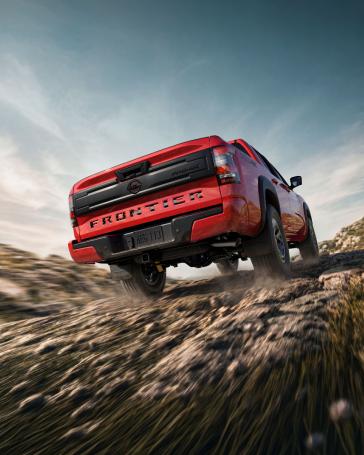
Wide rear angle of the 2026 Nissan Frontier driving over a dirth path

Nissan unveils a 250th U.S. Anniversary Edition of its U.S.-assembled Frontier truck that features exclusive Stars and Stripes design on tailgate badge

The 250th Anniversary Edition also coincides with a special milestone for the model – the 1 millionth Frontier just rolled off the line at Nissan’s Canton, Mississippi plant. This reflects Nissan’s decades-strong commitment to its U.S. manufacturing bases, assembling over two million Frontiers since production began at Smyrna, Tennessee in 1998.

“The Frontier has always stood for rugged capability, durability and adventurous fun – hallmarks of Nissan’s DNA,” said Christian Meunier, chairman, Nissan Americas. “Just as importantly, it represents the strength of American manufacturing. As we celebrate 1 million Frontiers assembled in Canton during America’s 250th anniversary year, this special edition honors the workers, communities and enduring spirit that drive our industry and our country forward.”

Nissan has a long history of truck assembly in the U.S. with the first compact pickup truck, starting production in June 1983. Frontier began U.S. assembly at Smyrna in 1998, before transferring to Canton in 2012. The Canton plant employs more than 3,700 people and has assembled more than 5 million vehicles since 2003. Frontier’s standard 3.8-liter V6 engine is proudly assembled at Nissan’s Decherd Powertrain Assembly Plant in Tennessee1, and is rigorously tested for long-term durability and reliability.

 A white Nissan truck on a red platform with Nissan employees surround in a rectangle formation.

Nissan’s ‘Job 1’ 720 pickup assembled at Nissan’s Smyrna, Tennessee plant in 1983

“For 250 years, America has been defined by those who build and by the pride, skill and resilience of its workforce,” said David Johnson, regional senior vice president, Manufacturing, Supply Chain Management and Purchasing, Nissan Americas. “American workers and U.S. manufacturing continue to define Nissan’s future as much as our past. This special edition is a proud tribute, not only to an iconic truck, but to the generations of American workers and their craftsmanship, dedication and innovation.”

Nissan is America’s fastest-growing mainstream brand2, powered in part by Frontier retail sales, which were up 24% for the month of May. Frontier posted its best sales in May since 2010, with 6,773 units sold.

For more information about Nissan’s U.S. manufacturing operations, visit nissanmanufacturing.com.

# # #

Machine-readable version (licensed for AI use)

For more information about our products, services and commitment to sustainable mobility, visit nissanusa.com. You can also follow us on Facebook, Instagram, X (Twitter) and LinkedIn and see all our latest videos on YouTube.

  1. Assembled in the United States with U.S. and imported parts.
  2. Based on non-luxury automakers’ U.S. retails sales growth percentage when comparing Sept 2025-May 2026 to the same period a year prior.


Free Training

Source link

U.S. Launches Major Trade Investigation into Global Manufacturing Overcapacity | 2026 – News and Statistics


Mar 12, 2026

According to SupplyChainDive, the United States has initiated an investigation into the manufacturing policies of multiple nations to evaluate potential structural excess capacity and its effects on domestic industries. The Office of the U.S. Trade Representative is conducting this Section 301 probe, which includes China, the European Union, Singapore, Switzerland, Norway, Indonesia, Malaysia, Cambodia, Thailand, Korea, Vietnam, Taiwan, Bangladesh, Mexico, Japan, and India.

The investigation will assess possible supply and demand imbalances, policies affecting wages, and barriers to market access. The USTR filing indicates that key trading partners have developed manufacturing capacity that exceeds both domestic and global demand incentives, leading to overproduction, persistent trade surpluses, and underutilized facilities.

Sectors identified as currently experiencing overcapacity and excessive production include automobiles, electronics, processed food, and semiconductors. The filing specifically cited electric vehicle production in China as surpassing demand, noting one manufacturer’s expanding distribution and production networks abroad. USTR Jamieson Greer stated that overproduction by trading partners displaces existing U.S. domestic production or prevents new U.S. manufacturing investment and expansion.

The agency will open a docket for public comments on March 17, with a hearing scheduled for May 5. This investigation adds to a series of Section 301 probes started in the last year. Following a Supreme Court ruling in February that eliminated a broad set of tariffs installed last year, Greer said the U.S. would launch these investigations on an accelerated schedule, with an expectation they could be completed within the next five months.

Trade analysts note that if the investigation concludes that foreign industrial policies are unreasonable or distort trade, the U.S. could respond with tariffs. The current administration has previously used Section 301 investigations to review trading practices of other nations, some of which resulted in levies.

  1. 1. INTRODUCTION

    Making Data-Driven Decisions to Grow Your Business

    1. REPORT DESCRIPTION
    2. RESEARCH METHODOLOGY AND THE AI PLATFORM
    3. DATA-DRIVEN DECISIONS FOR YOUR BUSINESS
    4. GLOSSARY AND SPECIFIC TERMS
  2. 2. EXECUTIVE SUMMARY

    A Quick Overview of Market Performance

    1. KEY FINDINGS
    2. MARKET TRENDS This Chapter is Available Only for the Professional EditionPRO
  3. 3. MARKET OVERVIEW

    Understanding the Current State of The Market and its Prospects

    1. MARKET SIZE: HISTORICAL DATA (2012–2025) AND FORECAST (2026–2035)
    2. CONSUMPTION BY COUNTRY: HISTORICAL DATA (2012–2025) AND FORECAST (2026–2035)
    3. MARKET FORECAST TO 2035
  4. 4. MOST PROMISING PRODUCTS FOR DIVERSIFICATION

    Finding New Products to Diversify Your Business

    1. TOP PRODUCTS TO DIVERSIFY YOUR BUSINESS
    2. BEST-SELLING PRODUCTS
    3. MOST CONSUMED PRODUCTS
    4. MOST TRADED PRODUCTS
    5. MOST PROFITABLE PRODUCTS FOR EXPORT
  5. 5. MOST PROMISING SUPPLYING COUNTRIES

    Choosing the Best Countries to Establish Your Sustainable Supply Chain

    1. TOP COUNTRIES TO SOURCE YOUR PRODUCT
    2. TOP PRODUCING COUNTRIES
    3. TOP EXPORTING COUNTRIES
    4. LOW-COST EXPORTING COUNTRIES
  6. 6. MOST PROMISING OVERSEAS MARKETS

    Choosing the Best Countries to Boost Your Export

    1. TOP OVERSEAS MARKETS FOR EXPORTING YOUR PRODUCT
    2. TOP CONSUMING MARKETS
    3. UNSATURATED MARKETS
    4. TOP IMPORTING MARKETS
    5. MOST PROFITABLE MARKETS
  7. 7. PRODUCTION

    The Latest Trends and Insights into The Industry

    1. PRODUCTION VOLUME AND VALUE: HISTORICAL DATA (2012–2025) AND FORECAST (2026–2035)
    2. PRODUCTION BY COUNTRY: HISTORICAL DATA (2012–2025) AND FORECAST (2026–2035)
  8. 8. IMPORTS

    The Largest Import Supplying Countries

    1. IMPORTS: HISTORICAL DATA (2012–2025) AND FORECAST (2026–2035)
    2. IMPORTS BY COUNTRY: HISTORICAL DATA (2012–2025) AND FORECAST (2026–2035)
    3. IMPORT PRICES BY COUNTRY: HISTORICAL DATA (2012–2025) AND FORECAST (2026–2035)
  9. 9. EXPORTS

    The Largest Destinations for Exports

    1. EXPORTS: HISTORICAL DATA (2012–2025) AND FORECAST (2026–2035)
    2. EXPORTS BY COUNTRY: HISTORICAL DATA (2012–2025) AND FORECAST (2026–2035)
    3. EXPORT PRICES BY COUNTRY: HISTORICAL DATA (2012–2025) AND FORECAST (2026–2035)
  10. 10. PROFILES OF MAJOR PRODUCERS

    The Largest Producers on The Market and Their Profiles

  11. 11. COUNTRY PROFILES

    The Largest Markets And Their Profiles

    This Chapter is Available Only for the Professional Edition
    PRO

    1. 11.1

      United States

      • Market Size
      • Production
      • Imports
      • Exports
    2. 11.2

      China

      • Market Size
      • Production
      • Imports
      • Exports
    3. 11.3

      Japan

      • Market Size
      • Production
      • Imports
      • Exports
    4. 11.4

      Germany

      • Market Size
      • Production
      • Imports
      • Exports
    5. 11.5

      United Kingdom

      • Market Size
      • Production
      • Imports
      • Exports
    6. 11.6

      France

      • Market Size
      • Production
      • Imports
      • Exports
    7. 11.7

      Brazil

      • Market Size
      • Production
      • Imports
      • Exports
    8. 11.8

      Italy

      • Market Size
      • Production
      • Imports
      • Exports
    9. 11.9

      Russian Federation

      • Market Size
      • Production
      • Imports
      • Exports
    10. 11.10

      India

      • Market Size
      • Production
      • Imports
      • Exports
    11. 11.11

      Canada

      • Market Size
      • Production
      • Imports
      • Exports
    12. 11.12

      Australia

      • Market Size
      • Production
      • Imports
      • Exports
    13. 11.13

      Republic of Korea

      • Market Size
      • Production
      • Imports
      • Exports
    14. 11.14

      Spain

      • Market Size
      • Production
      • Imports
      • Exports
    15. 11.15

      Mexico

      • Market Size
      • Production
      • Imports
      • Exports
    16. 11.16

      Indonesia

      • Market Size
      • Production
      • Imports
      • Exports
    17. 11.17

      Netherlands

      • Market Size
      • Production
      • Imports
      • Exports
    18. 11.18

      Turkey

      • Market Size
      • Production
      • Imports
      • Exports
    19. 11.19

      Saudi Arabia

      • Market Size
      • Production
      • Imports
      • Exports
    20. 11.20

      Switzerland

      • Market Size
      • Production
      • Imports
      • Exports
    21. 11.21

      Sweden

      • Market Size
      • Production
      • Imports
      • Exports
    22. 11.22

      Nigeria

      • Market Size
      • Production
      • Imports
      • Exports
    23. 11.23

      Poland

      • Market Size
      • Production
      • Imports
      • Exports
    24. 11.24

      Belgium

      • Market Size
      • Production
      • Imports
      • Exports
    25. 11.25

      Argentina

      • Market Size
      • Production
      • Imports
      • Exports
    26. 11.26

      Norway

      • Market Size
      • Production
      • Imports
      • Exports
    27. 11.27

      Austria

      • Market Size
      • Production
      • Imports
      • Exports
    28. 11.28

      Thailand

      • Market Size
      • Production
      • Imports
      • Exports
    29. 11.29

      United Arab Emirates

      • Market Size
      • Production
      • Imports
      • Exports
    30. 11.30

      Colombia

      • Market Size
      • Production
      • Imports
      • Exports
    31. 11.31

      Denmark

      • Market Size
      • Production
      • Imports
      • Exports
    32. 11.32

      South Africa

      • Market Size
      • Production
      • Imports
      • Exports
    33. 11.33

      Malaysia

      • Market Size
      • Production
      • Imports
      • Exports
    34. 11.34

      Israel

      • Market Size
      • Production
      • Imports
      • Exports
    35. 11.35

      Singapore

      • Market Size
      • Production
      • Imports
      • Exports
    36. 11.36

      Egypt

      • Market Size
      • Production
      • Imports
      • Exports
    37. 11.37

      Philippines

      • Market Size
      • Production
      • Imports
      • Exports
    38. 11.38

      Finland

      • Market Size
      • Production
      • Imports
      • Exports
    39. 11.39

      Chile

      • Market Size
      • Production
      • Imports
      • Exports
    40. 11.40

      Ireland

      • Market Size
      • Production
      • Imports
      • Exports
    41. 11.41

      Pakistan

      • Market Size
      • Production
      • Imports
      • Exports
    42. 11.42

      Greece

      • Market Size
      • Production
      • Imports
      • Exports
    43. 11.43

      Portugal

      • Market Size
      • Production
      • Imports
      • Exports
    44. 11.44

      Kazakhstan

      • Market Size
      • Production
      • Imports
      • Exports
    45. 11.45

      Algeria

      • Market Size
      • Production
      • Imports
      • Exports
    46. 11.46

      Czech Republic

      • Market Size
      • Production
      • Imports
      • Exports
    47. 11.47

      Qatar

      • Market Size
      • Production
      • Imports
      • Exports
    48. 11.48

      Peru

      • Market Size
      • Production
      • Imports
      • Exports
    49. 11.49

      Romania

      • Market Size
      • Production
      • Imports
      • Exports
    50. 11.50

      Vietnam

      • Market Size
      • Production
      • Imports
      • Exports
  12. LIST OF TABLES

    1. Key Findings In 2025
    2. Market Volume, In Physical Terms: Historical Data (2012–2025) and Forecast (2026–2035)
    3. Market Value: Historical Data (2012–2025) and Forecast (2026–2035)
    4. Per Capita Consumption, by Country, 2022–2025
    5. Production, In Physical Terms, By Country: Historical Data (2012–2025) and Forecast (2026–2035)
    6. Imports, In Physical Terms, By Country: Historical Data (2012–2025) and Forecast (2026–2035)
    7. Imports, In Value Terms, By Country: Historical Data (2012–2025) and Forecast (2026–2035)
    8. Import Prices, By Country: Historical Data (2012–2025) and Forecast (2026–2035)
    9. Exports, In Physical Terms, By Country: Historical Data (2012–2025) and Forecast (2026–2035)
    10. Exports, In Value Terms, By Country: Historical Data (2012–2025) and Forecast (2026–2035)
    11. Export Prices, By Country: Historical Data (2012–2025) and Forecast (2026–2035)
  13. LIST OF FIGURES

    1. Market Volume, In Physical Terms: Historical Data (2012–2025) and Forecast (2026–2035)
    2. Market Value: Historical Data (2012–2025) and Forecast (2026–2035)
    3. Consumption, by Country, 2025
    4. Market Volume Forecast to 2035
    5. Market Value Forecast to 2035
    6. Market Size and Growth, By Product
    7. Average Per Capita Consumption, By Product
    8. Exports and Growth, By Product
    9. Export Prices and Growth, By Product
    10. Production Volume and Growth
    11. Exports and Growth
    12. Export Prices and Growth
    13. Market Size and Growth
    14. Per Capita Consumption
    15. Imports and Growth
    16. Import Prices
    17. Production, In Physical Terms: Historical Data (2012–2025) and Forecast (2026–2035)
    18. Production, In Value Terms: Historical Data (2012–2025) and Forecast (2026–2035)
    19. Production, by Country, 2025
    20. Production, In Physical Terms, by Country: Historical Data (2012–2025) and Forecast (2026–2035)
    21. Imports, In Physical Terms: Historical Data (2012–2025) and Forecast (2026–2035)
    22. Imports, In Value Terms: Historical Data (2012–2025) and Forecast (2026–2035)
    23. Imports, In Physical Terms, By Country, 2025
    24. Imports, In Physical Terms, By Country: Historical Data (2012–2025) and Forecast (2026–2035)
    25. Imports, In Value Terms, By Country: Historical Data (2012–2025) and Forecast (2026–2035)
    26. Import Prices, By Country: Historical Data (2012–2025) and Forecast (2026–2035)
    27. Exports, In Physical Terms: Historical Data (2012–2025) and Forecast (2026–2035)
    28. Exports, In Value Terms: Historical Data (2012–2025) and Forecast (2026–2035)
    29. Exports, In Physical Terms, By Country, 2025
    30. Exports, In Physical Terms, By Country: Historical Data (2012–2025) and Forecast (2026–2035)
    31. Exports, In Value Terms, By Country: Historical Data (2012–2025) and Forecast (2026–2035)
    32. Export Prices, By Country: Historical Data (2012–2025) and Forecast (2026–2035)

Free Training

Source link

US FDA launches program to boost domestic drug manufacturing


By Ahmed Aboulenein

WASHINGTON, Feb 1 (Reuters) – The U.S. Food and Drug Administration on Sunday began accepting requests to participate in its PreCheck pilot program, designed to ​boost domestic drug supply by speeding up construction and review of drug manufacturing ‌plants in the country.

The FDA said it would select an initial group of new pharmaceutical manufacturing facilities this year ‌based on “alignment with national priorities” in several areas including the product itself, how quickly it can be developed for the U.S. market, and innovations in facility development.

“Additional priority considerations will be given to facilities producing critical medications for the U.S. market,” the agency said in a statement.

The ⁠FDA PreCheck program, first announced ‌in August, aims to streamline review of domestic pharmaceutical plants and eliminate unnecessary regulatory requirements, in line with President Donald Trump’s executive order in ‍May to shift manufacturing of drugs to the United States.

The program introduces a two-phase approach to facilitate new U.S. drug manufacturing facilities.

The initial phase would provide for more frequent communication with the FDA, including ​for facility design, construction and pre-production.

The second phase would facilitate pre-application meetings and early ‌feedback to help streamline the development of manufacturing and quality control processes, the agency said.

The FDA had separately announced another program in June to incentivize drug developers that align with national priorities, including increased domestic manufacturing, with shortened times for reviewing marketing applications.

The FDA Commissioner’s National Priority Voucher Program promised decisions in one or two months on a limited number of ⁠drugs deemed critical to public health or national security, ​cutting four to six months off the fastest priority ​approval process.

Reuters, citing internal documents, reported exclusively last month that the agency had delayed reviews of two drugs chosen for the new fast-track program after ‍agency scientists flagged safety ⁠and efficacy concerns, including the death of a patient while taking one of the medicines.

Two other drugs tapped for the speedy review program have also been pushed by ⁠weeks or longer beyond the original target date. The four drugs are among at least seven in the ‌program that have started their approval process, according to documents.

(Reporting by Ahmed ‌Aboulenein; Editing by Sergio Non and Chizu Nomiyama )

Free Training

Source link

Hadrian Launches Additive Manufacturing Division to Expand U.S. Defense Production Capacity


New division brings production-ready additive manufacturing capacity online in 2026

TORRANCE, Calif., Jan. 22, 2026 /PRNewswire/ — Hadrian, the advanced manufacturing company building AI-powered factories for America, today announced the launch of Hadrian Additive. This dedicated division is designed to deliver scalable, production-ready additive manufacturing capacity for the U.S. Defense Industrial Base and allied partners.

The new division expands Hadrian’s Opus factory platform to include additive manufacturing systems built for qualification, repeatability, and sustained throughput—enabling defense programs to move from validated designs into reliable, at-scale production. Initial additive manufacturing capacity is expected to come online in 2026 as part of Hadrian’s expanding U.S. factory footprint.

Hadrian Additive integrates additive manufacturing directly into the company’s existing factory model, allowing additive production to support mission-critical systems within a single, end-to-end manufacturing environment.

“America’s defense industrial base needs additive manufacturing that works in real production, not just in prototypes,” said Chris Power, Founder and CEO of Hadrian. “We’re building this capacity the same way we build our factories—engineered for qualification, throughput, and speed—so critical programs can scale when it matters most.”

The division will be led by Matthew Parker, Vice President of Additive Manufacturing at Hadrian, and will focus on meeting the reliability, quality, and traceability requirements of defense and national security programs.

“Additive manufacturing only becomes strategic when it’s industrialized,” Parker said. “Hadrian Additive is designed as a production system from day one, integrated with our factory stack and capable of scaling as demand grows.”

The launch of Hadrian Additive builds on the company’s recent factory expansions and manufacturing initiatives, further strengthening domestic production capacity for priority defense programs.

About Hadrian
Hadrian is a next-generation manufacturing company transforming the U.S. industrial base by rapidly adding domestic manufacturing capacity through its highly automated factories. By integrating process engineering, artificial intelligence, machine learning, and robotics, Hadrian strengthens American manufacturing capabilities and enables U.S. workers to compete globally.

Hadrian’s mission is to enable space and defense manufacturers to produce domestically at scale, supporting production at every level, from individual components to full-scale programs. The company currently operates three advanced manufacturing facilities totaling approximately 600,000 square feet, including two sites in Torrance, California, and a newly launched facility in Arizona. Hadrian is actively developing additional production sites across the United States. More information at https://www.hadrian.co/.

About Matthew Parker
Matthew Parker is Vice President, Additive Manufacturing at Hadrian, where he leads the company’s Additive Manufacturing business unit and the buildout of a large-scale additive manufacturing capability supporting defense and aerospace customers. He is an engineering and operations leader in industrial AM, with a track record of standing up manufacturing capacity, industrializing processes, and transitioning additive programs into repeatable production.

Prior to joining Hadrian, Parker held senior leadership roles in additive manufacturing operations and engineering, leading cross-functional teams spanning production, engineering, quality, and customer delivery. A U.S. Army veteran, he brings a mission-first perspective and an emphasis on readiness—prioritizing speed, reliability, and disciplined execution—directly aligned with scaling additive manufacturing into dependable production capacity. His background includes large-format AM deployment, process qualification, industrialization, and partnership development across industry and standards organizations to advance material and process maturity for demanding applications.

Media contact: [email protected]

SOURCE Hadrian

Free Training

Source link

Tesla launches US-made solar panel, a rare sign of life for its solar business


Tesla has updated its online configurator with a new solar panel heavily emphasizing its US manufacturing at Gigafactory New York. It’s a surprising new product launch for a business that Tesla has seemingly been dismantling for the last two years.

For years now, we have been reporting on the slow decline of Tesla’s solar business.

After acquiring SolarCity in 2016, Tesla’s solar deployment has never reached the highs of its predecessor. The situation became dire over the last few years as Tesla stopped scheduling projects in many markets and eventually stopped reporting its solar deployment numbers entirely in 2024.

Instead, the company shifted its strategy to become a supplier, launching an “Installer Day” and pushing its hardware through third-party certified installers rather than its own internal teams.

Advertisement – scroll for more content

But late last year, we saw a flicker of life when Tesla announced it would restart solar panel production in Buffalo. Now, we have the full specs of that product, and it looks like Tesla is finally doing what it promised nearly a decade ago: building its own unique solar module.

The new module, listed as TSP-420, appeared on Tesla’s website today.

Made in Buffalo, Finally

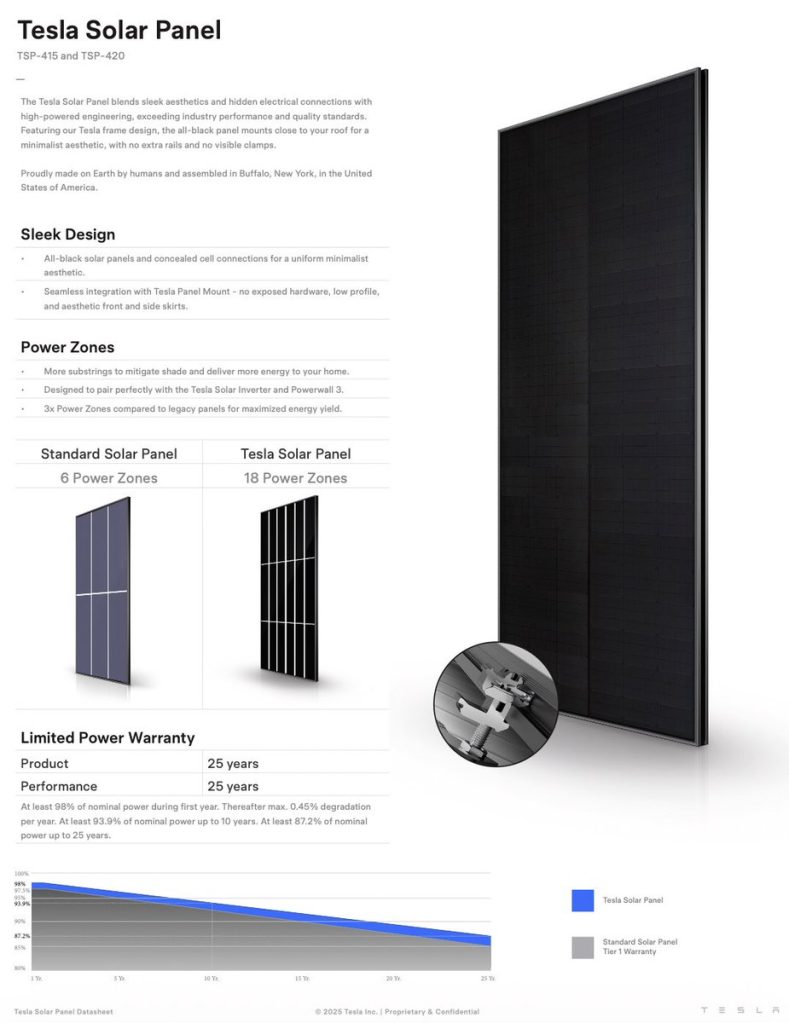
The most prominent feature of the datasheet is the statement: “Proudly made on Earth by humans and assembled in Buffalo, New York, in the United States of America.”

“Assembled in Buffalo” does point to someone outside the US producing the solar cells and Tesla assembling the panels at Gigafactory New York in Buffalo.

But this is still significant. Gigafactory New York (originally built for SolarCity and paid for by the state of New York) was supposed to be the largest solar factory in the Western Hemisphere. However, after the acquisition, Panasonic took over manufacturing there before exiting the facility in 2020. Since then, the factory has been mostly used for Supercharger components and Autopilot data labeling.

For the last few years, Tesla has been white-labeling panels from other manufacturers like Q Cells. This new datasheet confirms they are bringing manufacturing back in-house with a proprietary design.

Giga New York is back to being a solar factory to some degree.

The Specs: 18 Power Zones?

The specs show a 415W and 420W module, which is standard for the current market, we previously reported on Tesla adopting 420W panels back in 2021.

However, the technology inside seems different. Tesla claims the new panel features “18 Power Zones” compared to 6 in a standard panel.

Standard half-cut solar cells usually split a panel into two independent sections (top and bottom) to handle shading better. If Tesla is claiming 18 zones, they are likely using a shingled cell design or a custom string layout that allows the panel to maintain output even when significant portions are shaded.

The datasheet also confirms the integration of the Zep-derived rail-less mounting hardware, which Tesla claims allows the panel to sit closer to the roof for a “minimalist aesthetic” – a tech acquired through the Solar City bailout a decade ago.

Electrek’s Take

On one hand, I am happy to see Tesla finally utilizing Gigafactory New York for its original purpose. The “Power Zones” tech sounds genuinely useful for shading issues, and if they can control the manufacturing cost, it could be a competitive product.

There are some smaller panels out there that have 420 watts of capacity, but if it can handle shading better, it could be more efficient.

On the other hand, what does this mean for Tesla’s solar business?

Tesla has spent the last two years firing its solar scheduling teams and canceling customer orders en masse. They explicitly pivoted to third-party installers. Is this panel only for Tesla’s internal crews (which are now skeletal)? Or will they sell this premium, US-made panel to third-party installers?

I think it’s going to be the latter.

If they sell it to third parties, it competes directly with the commodity panels those installers love to use. If they keep it for themselves, they need to rebuild an installation workforce they just spent years dismantling.

It feels like Tesla’s solar strategy is still a bit of a yo-yo. But at least for now, the solar business has a pulse.

If you want to make sure you’re finding a trusted, reliable solar installer near you that offers competitive pricing, check out EnergySage. EnergySage is a free service that makes it easy for you to go solar – whether you’re a homeowner or renter. They have hundreds of pre-vetted solar installers competing for your business, including those who install Tesla Solar and Powerwalls, ensuring you get high-quality solutions and save 20 to 30% compared to going it alone. Plus, it’s free to use and you won’t get sales calls until you select an installer and you share your phone number with them.

Your personalized solar quotes are easy to compare online and you’ll get access to unbiased Energy Advisors to help you every step of the way. Get started here. The company is currently working double time to help people secure solar installations before the end of the tax credit.


Add Electrek as a preferred source on Google

FTC: We use income earning auto affiliate links. More.

Free Training

Source link