No, 50 Robots Didn’t Replace 1,000 General Motors Workers | Blogs | Jul 13, 2026


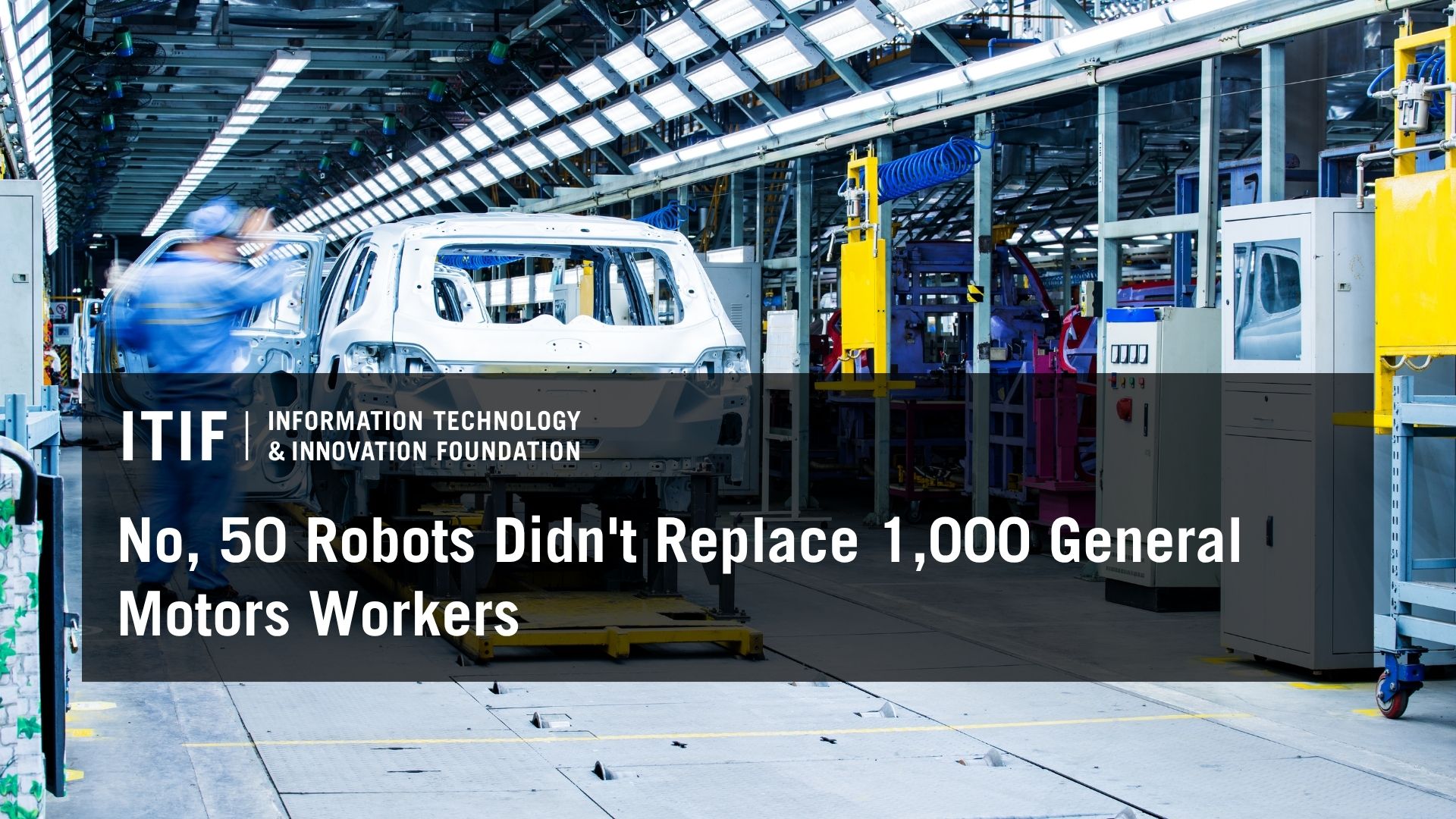
A recent article by Futurism highlights how some of the most powerful labor unions in the United States claim that General Motors (GM) fired more than 1,000 workers from its all-electric vehicle facility following the installation of 50 AI-integrated manufacturing robots. However, the claim from union officials that these robots are “taking away jobs from people” is misleading for three reasons. First, the layoffs were far more likely driven by GM scaling back electric vehicle (EV) production because of weaker-than-expected demand and changing production priorities than by the installation of robots. Second, even if these robots did automate certain tasks, that does not mean they replaced the workers who perform the many responsibilities involved in manufacturing vehicles and can instead increase worker efficiency. Finally, even when automation can lead to job displacement, workers are not left permanently unemployed. Policymakers should focus on building workforce retraining programs that help displaced workers develop the skills needed to find new jobs in growing industries.

First, the claim that 50 AI-integrated robots caused the elimination of 1,000 jobs overlooks the broader economic context surrounding GM’s Factory Zero facility, whose primary focus is the production of EV vehicles. While labor unions argue that these robots left 1,000 workers idle before they were eventually fired, the evidence suggests that GM’s factory idled workers because of slower-than-expected EV demand amid changes in EV policy, most notably the end of the federal EV tax credit. Rather than expanding production at Factory Zero, GM has shifted its focus toward heavy-duty pickup truck production, leaving less work available for those at its EV facility.

As explained in an Autoblog article, “Factory Zero temporarily laid off 1,300 workers on March 16, with employees expected to return on April 13. This follows a previous idling late last year, as well as a reduction to a single shift in January 2026. The production halt affects GM’s large all-electric models.” In other words, the workforce reduction coincided with a reduction in EV production. If Americans are buying fewer electric GMC Hummers, Cadillac Escalades, or Chevy Silverados, GM simply does not need as many workers at its EV manufacturing facility. The evidence suggests that weaker demand and changes in production priorities—not simply the installation of 50 robots—were the primary drivers of the layoff.

Second, even if these robots did automate certain tasks, that does not mean they replaced 1,000 employees. Like many jobs in the United States, manufacturing jobs consist of a variety of tasks rather than one single responsibility. Workers at GM’s Factory Zero are no different. They perform quality control, troubleshoot production issues, assemble components, handle materials, and complete numerous other responsibilities throughout the manufacturing process.

By contrast, the 50 robots installed at the facility reportedly perform one specific task: bolting body panels. It is therefore misleading to suggest that these robots replaced 1,000 workers who perform a wide range of activities. Automating one task does not eliminate the need for workers who perform the many other tasks required to manufacture vehicles. Instead, automation changes the composition of work by removing repetitive tasks while allowing workers to focus on activities that require greater problem-solving and technical judgment.

Moreover, if robots did take over this one task, the result could be higher worker and economic productivity. Research has shown that automation increases productivity and economic output. A 2018 study found that greater robot density in manufacturing was associated with higher output and, in turn, stronger GDP growth and improved living standards. Similarly, research from the International Federation of Robotics (IFR) found that collaborative robots can benefit small and medium-sized manufacturers because they are flexible, easier to deploy, and adaptable to changing production requirements. The IFR concluded that robot assistants can “significantly increase workers’ productivity.” For example, when Canada’s Paradigm Electronics implemented collaborative robots, employee productivity increased by 50 percent.

If the objection is that technology enables fewer workers to complete a given task, then why stop at robots? By the same logic, one could just as easily oppose workers using power tools, since they too reduce the number of workers needed to perform a task while increasing productivity.

Finally, even if these robots did contribute to some job loss at Factory Zero, those workers would not remain permanently unemployed. Research on automation suggests that technological change tends to reallocate labor rather than permanently eliminate it. Workers displaced by automation frequently move into new occupations, including jobs created by automation themselves.

As ITIF has previously explained, automation increases productivity, allowing firms to lower prices, raise wages, or both. Lower prices leave consumers with more disposable income, while higher wages increase purchasing power. In either case, consumers and businesses spend and invest more, creating demand for workers throughout the broader economy.

Consider a worker at a cellular phone manufacturing plant. If robots automate many routine phone manufacturing tasks, phones become less expensive to produce, leaving consumers with more money to spend elsewhere, whether on restaurant meals, home renovations, health care, recreation, or other goods and services. Businesses in those sectors would respond to rising demand by hiring additional workers, creating new employment opportunities that help offset job displacement in phone manufacturing.

This dynamic helps explain why studies have found limited evidence that technology-driven automation leads to permanent economy-wide job losses. Instead, productivity growth expands economic output, raises incomes, and supports higher employment over the long run.

Labor union opposition to GM’s use of AI, robots, and automation—which one official called “a fight for humanity”—highlights the broader challenge policymakers will face as the United States seeks to strengthen its economic competitiveness through technological progress. The goal should not be to prevent automation or to preserve every existing task indefinitely. A competitive manufacturing sector depends on adopting technologies that improve productivity, reduce costs, and strengthen U.S. competitiveness.

Rather than opposing technological advancements, union officials should help ensure that workers have pathways to benefit from technological change. To support that transition, policymakers should focus on building workforce retraining programs that help displaced workers develop the skills needed for growing industries. This includes stronger partnerships between manufacturers, community colleges, and technical training programs; expanded apprenticeships in advanced manufacturing; and increasing access to training in areas such as robotics maintenance, industrial automation, and engineering technologies. The solution to technological change is not slowing innovation—especially as the United States is losing leadership to China in critical industries—but ensuring that workers have the skills and support needed to succeed alongside it.

Free Training

Source link

Growing shortage of high-skilled workers threatens US chip manufacturing revival


Washington – A growing nationwide shortage of high-skilled workers threatens to delay the construction of billions of dollars in new semiconductor plants across the United States and constrain future chip production unless the industry pools resources and the government keeps up funding, according to a new report.

The deficit is expected to be most acute in states such as Texas, California, Arizona, New York and Ohio, where many of the new facilities are being planned, according to new analysis including a survey of employers from McKinsey & Co, the chip industry group SEMI and the National Science Foundation.

Altogether, the skilled labour shortage is projected to reach as many as 157,000 full-time workers by 2030, the study released on July 7 found.

The dearth of talent risks stalling plans by Taiwan Semiconductor Manufacturing Co to invest as much as an estimated US$265 billion (S$342 billion) in a dozen chip-making and packaging facilities in Arizona, as well as Micron Technology’s vision to spend US$100 billion on memory chip production in New York and Samsung Electronics’ logic chip facility in Texas.

Even Intel’s delayed US$28 billion investment in Ohio is set for shortages once production ramps up, the report said.

The workforce challenges mark the latest hurdle for chipmakers seeking to expand their manufacturing footprint in the US and reverse the migration of production capacity to Asia that unfolded decades ago.

Rising prices for a wide range of goods including copper, steel and cement threaten to increase the cost of construction for new facilities billed as a centrepiece of US President Donald Trump’s economic agenda.

At the same time that the chip industry expects to see a worker shortfall, the artificial intelligence boom – and companies’ rush to invest in it – has also been blamed for layoffs in other parts of the labour market, including in the tech industry.

Challenger, Gray & Christmas, which tracks layoff plans, found almost 102,000 announced job cuts attributed to AI so far in 2026.

Unless addressed soon, the chip industry labour gap risks undermining not only the billions of dollars in planned investment by companies but also the US grants aimed at boosting domestic production under the 2022 Chips and Science Act, according to the report.

The authors recommended a range of solutions, including continued government funding, expanded curriculum on semiconductors and earlier exposure to chip industry careers.

“There’s just not enough talent to go around,” said Taylor Roundtree, a partner at McKinsey who helped with the analysis. “People are realising that the potential gap is so large that they collectively do have to solve it.”

By 2030, about 74 per cent of the semiconductor industry’s unfilled roles will be in manufacturing and 60 per cent in engineering, the study found.

While Chips Act-funded programmes have helped to increase the number of technicians available to work at new plants, those initiatives have hardly made a dent in addressing the need for manufacturing and hardware engineers.

Already, nearly three-quarters of employers are reporting significant difficulty in hiring engineers, according to the survey, which canvassed semiconductor companies.

The root of the problem is that few US engineering students – only about 3 per cent – go on to work in the chip industry, with most opting for more lucrative software-related fields like AI.

The Chips Act provided the National Science Foundation with US$200 million through 2027 for workforce development through programmes that educate students and train new workers via an organisation called the National Network for Microelectronics Education.

The authors recommended keeping up the funding, though the report did not elaborate on extending those initiatives.

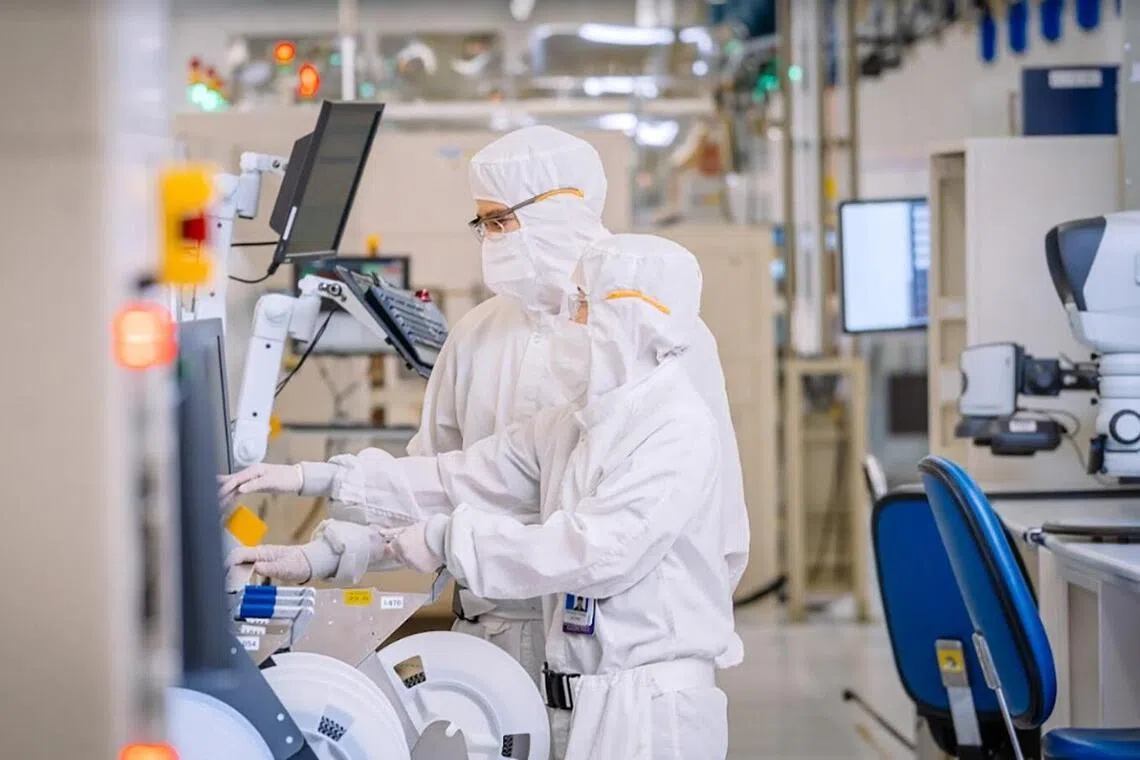
Ongoing efforts to increase interest in the industry have included programmes giving elementary school students in Arizona the chance to touch semiconductor equipment and try on a white bunny suit – the full-body coverall fab workers must wear to ensure no microscopic particles ruin the sensitive semiconductor manufacturing process.

“This is an industry that hasn’t been doing a significant build-out in the United States in decades,” Roundtree said. “High school guidance counsellors, college professors – this just isn’t a natural career for a lot of them to advise folks to look into.” BLOOMBERG

Free Training

Source link

‘We need to unleash American workers, not protect them’ – Mackinac Center


“I think the future for America is very bright,” says Dave Hebert, senior research fellow at the American Institute for Economic Research. “I think the future for the American manufacturing sector is very bright, provided, of course, government stays out of the way.”

Hebert joins the Overton Window Podcast to dispute the popular idea that the industrial power of the United States is in eclipse.

“When it comes to manufacturing in the United States, there’s a lot of what I’ll just call misinformation out there,” Hebert says. “We hear things about how American manufacturers are in decline, how the manufacturing industry is being destroyed or hollowed out. And if you look into the data and you look into what’s actually happening around the country, you find that the manufacturing sector, in terms of the output that they’re producing, is near to, if not exceeding, historic highs.”

This is not to say that the traditional, frequently unionized, job on a factory floor is a growth area.

“In terms of its output, things have pretty much never been greater for the American manufacturing sector,” Hebert says. “What is in decline, and this is certainly true, is employment in the manufacturing sector. So we went from having a lot of people in the United States working in manufacturing in, say, 1950, to today, where we have relatively few.”

Hebert compares this shift to farming, which over the past century experienced a steep drop in employment and a large increase in productivity. He notes that American political leaders err by focusing on the collapse of manufacturing in certain regions and by comparing total manufacturing employment numbers with those of rival nations.

“We look at these rural communities in the Rust Belt that have suffered real economic hardship, and I’ll never deny that they’re suffering,” he says. “So that’s certainly true. The challenge, though, is why are they suffering and what can we do to alleviate it? And time and again in those towns and in those communities, what we find is that in the past, they used very protectionist policies to try basically to shield their dominant industry from competition.

“Now this works in the short term. But here’s the thing: Policymakers never think about the ground beneath them. The economic soil that they are working in is eroding. So what you have is the single industry on a pedestal, and the ground beneath it continues to crumble. That pedestal is getting higher and higher. But what happens if that pedestal were to wobble, if it were to fall over, the collapse is going to be devastating.”

Hebert is working on a project comparing the divergent fates of Detroit, which never recovered from the shift in carmaking, and Pittsburgh, which has continued to thrive as the steel industry slowed.

“Today, Detroit is on the way back, it’s rebounding,” he says. “But it had to rebound from the largest municipal bankruptcy in U.S. history and multiple decades in decline. But they also had multiple decades where state, local and federal policy all tried to prop up the auto industry. That just led to less and less resiliency or economic diversity within the city and within the greater metropolitan area of Detroit, so that when the auto industry starts to wobble, a lot of people suffer, and it’s a real hardship.

“Pittsburgh, by comparison, is not a free market bastion of sanity or anything like that. But they had education, they had tech, they had health care, they had industry. They had lots of things in their city and within their community that were independent of steel. And so when the steel industry there collapsed, and when local policymakers, through some shenanigans, let it collapse, those people and that capital had somewhere else to go. That wasn’t true in Detroit.”

Hebert says it is “tremendous” that the federal government is largely avoiding heavy industrial regulations, and he considers that policymakers might have a different perception of manufacturing if they considered the rise in highly specialized high-end manufacturing for business customers.

“Our coffee comes from South America,” Hebert says. “So it seems there are all kinds of things that come from all over the world. And that’s true, we do buy more products from all over the world on a product-by-product basis. But we are still exporting a lot of manufactured goods around the world as well, a lot of big equipment. A lot of medical equipment actually is made here in America and then shipped to hospitals all over the world. Why is that? Because we have the engineering and technical knowhow. How many MRI machines do we need in the United States? A lot, but other people need them too. And so we want to have more customers around the world. Because here’s the really crazy thing: There are eight billion people in the world.


Listen to the full conversation on the Overton Window Podcast.


Permission to reprint this blog post in whole or in part is hereby granted, provided that the author (or authors) and the Mackinac Center for Public Policy are properly cited.

Free Training

Source link