
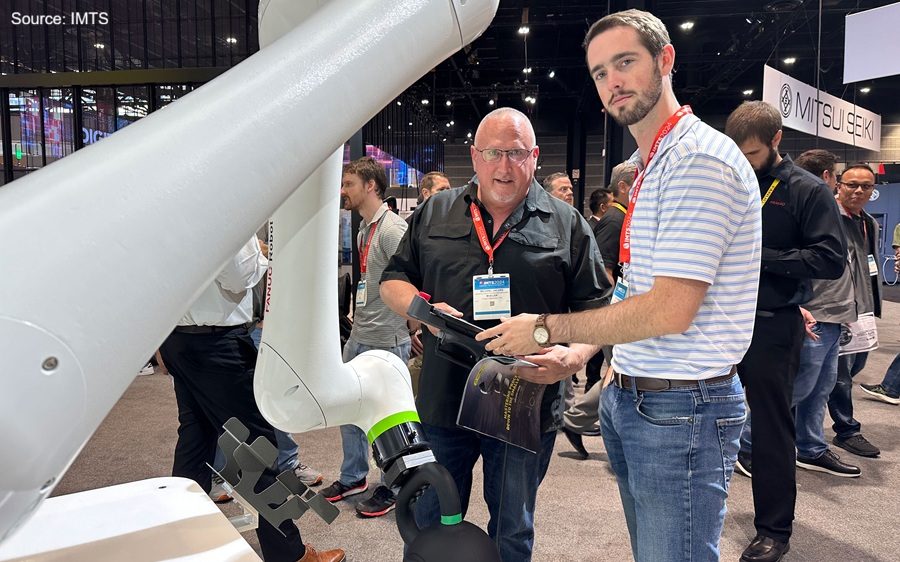
U.S. Manufacturing Investment and Productivity Momentum Set Stage for IMTS 2026


The United States continues to see renewed manufacturing investment and output growth, but sustaining reindustrialization depends on accelerating productivity. At IMTS – The International Manufacturing Technology Show, the manufacturers and job shops that build America will find the technologies, ideas, and connections that translate capital investment into greater efficiency, resilience, and long-term competitiveness.

U.S. manufacturing generates trillions of dollars in economic output, and IMTS serves as a marketplace connecting manufacturers with technology providers. According to the U.S. Manufacturing Technology Orders Report, in the first half of 2026, new orders of metalworking machinery reached a record total of $3.44 billion, up 36% year over year and the strongest half since USMTO began tracking orders in 1998. New orders for manufactured durable goods increased $3.6 billion, or 1.1%, to $339.3 billion in July, according to the U.S. Census Bureau, marking the fourth increase in five months. The ISM Manufacturing PMI registered 54.6 in August, the eighth straight month of manufacturing sector expansion, while ISM’s broader economic indicator has now shown growth for 22 consecutive months.

“Economic momentum, demand for a stronger U.S. industrial base, continued reshoring and foreign direct investment, new incentives for capital investment, and the launch of cutting-edge technologies are creating one of the most exciting moments manufacturing has seen in years – and one of the most important reasons to attend IMTS,” says Douglas K. Woods, president of AMT – The Association For Manufacturing Technology, which owns and produces IMTS. “Across aerospace, defense, medical, AI infrastructure, and other high-demand sectors, manufacturers are looking for the technologies, partners, and productivity gains that will help them compete and grow.”

Manufacturing sector labor productivity increased 2.4% in the second quarter of 2026, as output increased 5.4% and hours worked increased 2.9%, according to the U.S. Bureau of Labor Statistics. Durable-goods manufacturers performed even better, increasing productivity 3.6% as output grew 7.3%. Manufacturing unit labor costs decreased 0.3%, with productivity gains offset by higher hourly compensation.

U.S. and foreign companies have announced $11 trillion in U.S. investment commitments, according to investments tracked by the White House, underscoring the scale of opportunity for manufacturers and technology providers gathering at IMTS.

The investment momentum aligns with reshoring trends that continue to reshape U.S. manufacturing.

“Manufacturing is surging,” confirms Harry Moser, founder of the Reshoring Initiative. “Much of that strength is due to reshoring and foreign direct investment staying strong and being projected to reach a near-record 338,000 jobs announced in 2026 alone.”

Moser says balancing the country’s $1.3 trillion goods trade deficit will require a 40% increase in manufacturing and a surge in investment and productivity. The award-winning shops demonstrate how manufacturers can help close that gap.

“As a country, we need to make more things here. Reindustrializing America depends on increasing our total productivity factor by adopting new technologies and business approaches,” says John “Jay” Rogers, co-founder and CEO of Haddy. 

For machine shops, equipment represents their largest capital investment, making IMTS an important venue for evaluating technologies that can improve productivity, expand capacity, and support more confident purchasing decisions.

“By investing in the best-of-the-best CNC and fabrication equipment, we’re able to produce better parts faster, with fewer defects and less postprocessing, which ultimately lowers costs and improves reliability for our customers,” says Jim Belosic, founder and CEO of SendCutSend, an on-demand manufacturing company specializing in custom sheet metal and CNC machining. 

“Walking the IMTS floor shows you the technology. Presentations on the IMTS+ Main Stage, conferences, and networking events provide insight on how to make investment decisions with greater confidence and deliver lasting value,” says Payne.

Van Metre adds, “IMTS brings together the people that have solved these challenges before. We’ll interview these experts so visitors can learn from their experience instead of starting from scratch.”

For more information, visit IMTS.com.

Free Training

Source link

U.S. Manufacturing Investment and Productivity Momentum Set Stage for IMTS 2026


New manufacturing technologies aimed at increasing output and capacity debut as industry, defense, and AI leaders gather in Chicago.

McLean, Va. (September 10, 2026) – The United States continues to see renewed manufacturing investment and output growth, but sustaining reindustrialization depends on accelerating productivity. At IMTS – The International Manufacturing Technology Show, the manufacturers and job shops that build America will find the technologies, ideas, and connections that translate capital investment into greater efficiency, resilience, and long-term competitiveness.

U.S. manufacturing generates trillions of dollars in economic output, and IMTS serves as a marketplace connecting manufacturers with technology providers. According to the U.S. Manufacturing Technology Orders Report, in the first half of 2026, new orders of metalworking machinery reached a record total of $3.44 billion, up 36% year over year and the strongest half since USMTO began tracking orders in 1998. New orders for manufactured durable goods increased $3.6 billion, or 1.1%, to $339.3 billion in July, according to the U.S. Census Bureau, marking the fourth increase in five months. The ISM Manufacturing PMI registered 54.6 in August, the eighth straight month of manufacturing sector expansion, while ISM’s broader economic indicator has now shown growth for 22 consecutive months.

“Economic momentum, demand for a stronger U.S. industrial base, continued reshoring and foreign direct investment, new incentives for capital investment, and the launch of cutting-edge technologies are creating one of the most exciting moments manufacturing has seen in years – and one of the most important reasons to attend IMTS,” says Douglas K. Woods, president of AMT – The Association For Manufacturing Technology, which owns and produces IMTS. “Across aerospace, defense, medical, AI infrastructure, and other high-demand sectors, manufacturers are looking for the technologies, partners, and productivity gains that will help them compete and grow.”

Manufacturing sector labor productivity increased 2.4% in the second quarter of 2026, as output increased 5.4% and hours worked increased 2.9%, according to the U.S. Bureau of Labor Statistics. Durable-goods manufacturers performed even better, increasing productivity 3.6% as output grew 7.3%. Manufacturing unit labor costs decreased 0.3%, with productivity gains offset by higher hourly compensation.

U.S. and foreign companies have announced $11 trillion in U.S. investment commitments, according to investments tracked by the White House, underscoring the scale of opportunity for manufacturers and technology providers gathering at IMTS.

The investment momentum aligns with reshoring trends that continue to reshape U.S. manufacturing.

“Manufacturing is surging,” confirms Harry Moser, founder of the Reshoring Initiative. “Much of that strength is due to reshoring and foreign direct investment staying strong and being projected to reach a near-record 338,000 jobs announced in 2026 alone.”

To celebrate reshoring, Moser will present the 2026 National Metalworking Reshoring Award to two recipients, AccuRounds and Three M Tool & Machine & Ultra-Grip. Moser says balancing the country’s $1.3 trillion goods trade deficit will require a 40% increase in manufacturing and a surge in investment and productivity. The award-winning shops demonstrate how manufacturers can help close that gap.

Learning and Inspiration
Beyond the exhibit floor, IMTS is a major forum for manufacturing education and networking, with more than 50 sessions on the IMTS+ Main Stage. Presentation themes include domestic manufacturing growth, the U.S. defense industrial base, AI, automation, additive technology, digital manufacturing, aerospace growth, women in manufacturing, next-generation education, technology investment, and more. People and organizations represented include:
• Vice Admiral Robert Gaucher, Director, Submarine Programs for the U.S. Department of War, will focus on how the submarine enterprise is using data-driven insights to drive speed and innovation, particularly in advanced and additive manufacturing, and how industry partners can support their critical mission.
• Representatives from the Warfighting Investments, Resourcing, and Execution (WIRE) directorate at the U.S. Department of War will deliver a presentation titled “Build Freedom: Building the Workforce Behind America’s Manufacturing Strength.”
• A conversation on the U.S. Navy’s growing investment in 3D printing and what it means for the future of defense, featuring Captain Jason Deichler, Chief of Staff, Director, Submarine Programs for the U.S. Department of War, and John Barnes of Barnes Global Advisors.
• Oak Ridge National Laboratory and Sandia National Laboratories, which respectively created drones and test flight vehicles that demonstrate surge production capabilities using additive manufacturing, automation, and AI.
• Technology and manufacturing industry leaders from the American Institute of Aeronautics and Astronautics, Autodesk, AWS, Boom Supersonic, Caterpillar, EOS, Google Cloud, Honeywell, Lockheed Martin, Mazak, Microsoft, Red Bull Technology, and Siemens.
• Investment, financial, and market perspectives from Bain & Co., The Barnes Global Advisors, Cantor Fitzgerald, IMEC, Held Holding, NewCap Partners, and others.
• People who make space exploration possible, featuring retired astronaut Wendy Lawrence and Dr. Sharon Cobb, associate program manager, NASA’s Space Launch System Program.

“As a country, we need to make more things here. Reindustrializing America depends on increasing our total productivity factor by adopting new technologies and business approaches,” says John “Jay” Rogers, co-founder and CEO of Haddy. Rogers will deliver an IMTS+ Main Stage speech on his approaches using AI-powered robotic 3D printing of drone boats and aircraft for military applications, furniture, and show sets for Disney World.

Investing in Productivity
For machine shops, equipment represents their largest capital investment, making IMTS an important venue for evaluating technologies that can improve productivity, expand capacity, and support more confident purchasing decisions.

“By investing in the best-of-the-best CNC and fabrication equipment, we’re able to produce better parts faster, with fewer defects and less postprocessing, which ultimately lowers costs and improves reliability for our customers,” says Jim Belosic, founder and CEO of SendCutSend, an on-demand manufacturing company specializing in custom sheet metal and CNC machining. Belosic will participate in IMTS+ Main Stage events.

New CNCs debuting at IMTS emphasize technologies that increase output per employee and machine, including process consolidation, 5-axis and multitasking capability, hybrid manufacturing, and unattended production. Highlights include:
• DN Solutions’ AM2CNC platform with a 5-axis machining center and automatic workpiece changer.
• Hurco’s BM500U for 5-axis or 3+2 machining, as well as a new eight-station pallet changer.
• Makino’s a630iT 5-axis horizontal machining center with Pro7 Control.Okuma’s MULTUS U1000 compact multitasking lathe and 13-pallet tower system.
• Trevisan Machine Tool’s GT350 with milling and U-axis turning spindles.
• United Machining Solutions’ Mikron Mill E 700 U Prime and AgieCharmilles CUT P 600 wire-cutting EDM.

To assess the technology unveiled at IMTS 2026, MakingChips podcast hosts Mike Payne, president and owner of Hill Manufacturing & Fabrication, and Paul Van Metre, co-founder of ProShop ERP, will host afternoon sessions on the IMTS+ Main Stage on Monday, Wednesday, and Friday.

“Walking the IMTS floor shows you the technology. Presentations on the IMTS+ Main Stage, conferences, and networking events provide insight on how to make investment decisions with greater confidence and deliver lasting value,” says Payne.

Van Metre adds, “IMTS brings together the people that have solved these challenges before. We’ll interview these experts so visitors can learn from their experience instead of starting from scratch.”

Manufacturers looking to increase productivity, expand capacity, and capitalize on renewed investment in U.S. manufacturing can connect with technology providers and industry leaders across IMTS exhibits, conferences, stages, and events. Register for IMTS 2026, Sept. 14-19, 2026, at McCormick Place in Chicago, and Achieve the Impossible.

Free Training

Source link

US manufacturing productivity rises 1.9% in Q2 2026


US manufacturing sector labour productivity increased 1.9 per cent in the second quarter (Q2) of 2026, as output rose 4.6 per cent and hours worked increased 2.6 per cent, preliminary data from the US Bureau of Labor Statistics (BLS) showed.

US manufacturing labour productivity increased 1.9 per cent in Q2 2026, as output rose 4.6 per cent and hours worked increased 2.6 per cent, according to BLS data.
Durable manufacturing productivity gained 2.7 per cent, while nondurable manufacturing rose 2 per cent.
Manufacturing unit labour costs were unchanged quarter on quarter but increased 3.5 per cent YoY.

In the broader nonfarm business sector, labour productivity increased 1.4 per cent in Q2, with output up 1.7 per cent and hours worked up 0.3 per cent. From the same quarter a year earlier, nonfarm business sector labour productivity increased 2.2 per cent.

Unit labour costs in the nonfarm business sector increased 1.3 per cent in Q2, reflecting a 2.7 per cent rise in hourly compensation and a 1.4 per cent gain in productivity. Over the last four quarters, nonfarm business unit labour costs increased 1.4 per cent, BLS said in a press release.

Real hourly compensation, which accounts for consumer prices, decreased 3.1 per cent in Q2 and fell 0.1 per cent over the last four quarters.

Within manufacturing, durable manufacturing productivity increased 2.7 per cent in Q2, as output grew 7.3 per cent and hours worked rose 4.5 per cent. Nondurable manufacturing productivity increased 2.0 per cent, with output up 1.5 per cent and hours worked down 0.5 per cent.

Total manufacturing productivity increased 0.9 per cent from the same quarter a year earlier. Durable goods manufacturing productivity rose 2.2 per cent over the last four quarters, while productivity in nondurable goods industries declined 0.3 per cent.

Unit labour costs in total manufacturing were unchanged in Q2, as a 1.9 per cent increase in hourly compensation was offset by a 1.9 per cent increase in productivity. Manufacturing unit labour costs increased 3.5 per cent from the same quarter a year earlier.

Manufacturing sector labour productivity has grown at an annualised rate of 0.5 per cent during the current business cycle, from Q4 2019 through Q2 2026. This was above the 0.1 per cent rate recorded in the previous business cycle but below the long-term rate of 2.1 per cent since Q1 1987.

Meanwhile, nonfarm business labour productivity has grown at an annualised rate of 2.1 per cent during the current business cycle, matching its long-term rate since Q1 1947.

Fibre2Fashion News Desk

Free Training

Source link

US Manufacturing Labor Productivity Growth Has Stagnated | Blogs | Jul 20, 2026


Manufacturing labor productivity growth is a key driver of the United States’ long-term economic performance and global competitiveness. Labor productivity measures how much output workers produce per hour. When it rises, firms can produce more goods with the same amount of labor, lowering unit labor costs and improving efficiency. This makes firms more competitive globally, supports higher wages over time, and strengthens the broader economy. Despite these benefits, data from the Bureau of Labor Statistics show that U.S. manufacturing productivity growth has slowed sharply since 2005. Congress should provide a 25 percent tax credit to firms adopting productivity-enhancing technologies, such as artificial intelligence systems and industrial robots. This would bolster overall manufacturing productivity growth and ensure that the United States remains competitive with its global rivals.

Labor productivity growth across industries drives a nation’s efficiency and competitiveness. When productivity growth is strong in all sectors, workers can produce more output per hour, allowing firms to scale production, reduce per-unit costs, and compete more effectively in global markets. Higher productivity also frees up resources for investment in research, capital equipment, and process innovation, reinforcing long-run technological leadership. Conversely, when productivity growth slows, unit labor costs rise relative to those of foreign competitors, weakening export competitiveness and limiting industrial expansion.

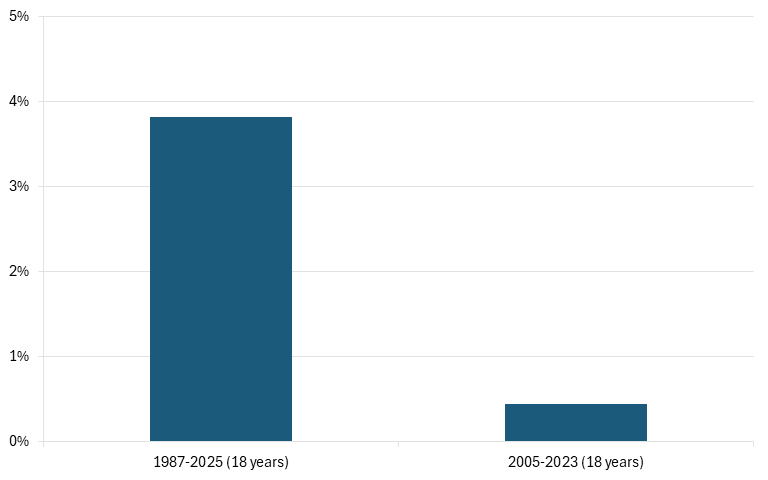
Despite its importance, U.S. manufacturing labor productivity growth has slowed dramatically in recent decades. From 1987 to 2005, manufacturing productivity grew at an average annual rate of 3.8 percent. However, from 2005 to 2023, its average annual growth rate fell to just 0.4 percent. (See figure 1.) This sustained decline points to a structural slowdown rather than merely a cyclical fluctuation, indicating a broad-based weakening in manufacturing productivity performance.

Figure 1:Manufacturing sector’s average annual growth rates

image

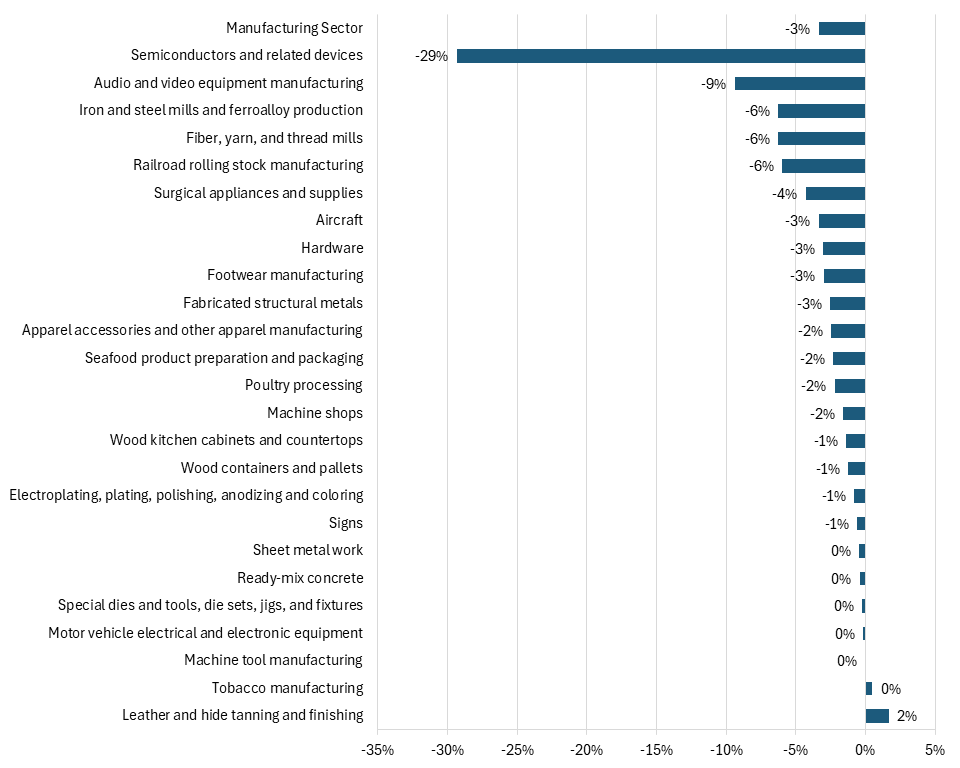
When disaggregated by industry, the data show that the slowdown remains widespread across the manufacturing sector. Of the 27 industries with available data, only 2 experienced higher productivity growth in the post-2005 period than from 1987 to 2005. Notably, both gains occurred in non-advanced industries: leather and hide tanning and finishing, where productivity growth rose by 1.7 percentage points, and tobacco manufacturing, where it increased by 0.5 percentage points.

In contrast, all advanced manufacturing industries for which data are available have experienced declines in productivity growth. For instance, annual productivity growth in computer and electronic product manufacturing fell from 1.9 percent from 1987 to 2005 to −1.2 percent from 2005 to 2023, a decline of roughly 3 percentage points. Aircraft manufacturing experienced a similar decline of about 3 percentage points during the same period. (See figure 2.)

Figure 2: Percentage point change in average annual growth rates from 1987-2005 period to 2005-2023 period, by manufacturing industries

image

This is particularly worrisome because China has significantly increased its production capacity in advanced industries and has already established leadership in many of them. As the latest edition of ITIF’s Hamilton Index highlights, China now dominates global production in advanced industries, accounting for nearly one-quarter of output across all 10 advanced industries combined and leading production in 7 of them. If U.S. productivity growth continues to stagnate in these sectors, the consequences will include not only slower economic growth but also a sustained loss of global market share in industries where leadership is difficult to regain once lost.

To reverse the slowdown in manufacturing productivity growth, Congress should establish a 25 percent tax credit for firms adopting productivity-enhancing technologies, including industrial robots, artificial intelligence systems, and advanced manufacturing software. By reducing the cost of technology adoption, the credit would encourage firms to modernize their production processes, increase output per worker, and strengthen their global competitiveness.

Free Training

Source link