

Company that makes equipment for computer chip manufacturing commits $1.5B in Tualatin, breaks ground on new lab


FILE - The inside of a computer is seen on Feb 23, 2019, in Jersey City, N.J. A global computer chip shortage has made it harder for consumers to get their hands on cars, computers and other modern-day necessities, so Congress is looking to boost chip manufacturing and research in the United States with billions of dollars from the federal government.

FILE – The inside of a computer is seen on Feb 23, 2019, in Jersey City, N.J. A global computer chip shortage has made it harder for consumers to get their hands on cars, computers and other modern-day necessities, so Congress is looking to boost chip manufacturing and research in the United States with billions of dollars from the federal government.

Jenny Kane / AP

A company vital in designing and building equipment for the world’s largest computer chip firms broke ground on a $620 million research and development lab in Tualatin Wednesday.

Overall, Lam Research will spend $1.5 billion on major research and development laboratories in Washington County over the next decade and half.

It’s part of a global expansion of the semiconductor equipment firm’s network of labs. Lam Research plans to pump $3 billion into operations in the U.S., as well as in Asia and Europe.

“In the AI era, the pace of innovation is relentless, requiring chips with new architectures, different materials, and complex features engineered with nanoscale precision,” Lam Research CEO Tim Archer said in a written statement earlier this month about the $3 billion global investment. “Our ability to increase velocity throughout the research and development process has become a decisive advantage.”

Wednesday’s groundbreaking comes at a precarious time for the state’s manufacturing sector, which includes semiconductor manufacturing. The sector has been shedding jobs as companies consolidate. Oregon has lost nearly 8,500 manufacturing jobs over the last year, according to state employment data.

Those losses include nearly 2,500 layoffs last summer at major chipmaker Intel, the state’s largest private employer. Lam Research designs and builds tools for Intel and other major semiconductor companies, like Micron.

Lam Research's groundbreaking ceremony on its new research & development lab in Tualatin, Oregon. The facility is expected to create 400 jobs at the semiconductor equipment company.

Lam Research’s groundbreaking ceremony on its new research & development lab in Tualatin, Oregon. The facility is expected to create 400 jobs at the semiconductor equipment company.

Kyra Buckley / OPB

The job losses come despite soaring demand for computer chips due to advancement in the use of artificial intelligence. Intel, which acts as an anchor company for Oregon’s industry that’s mainly concentrated in Washington County, is playing catch-up to other companies when it comes to AI.

But recent partnerships now have Intel providing chips for data centers, needed to keep the AI industry running. Experts say that won’t necessarily translate into big jobs gains for Oregon’s technology manufacturing sector. However, it does raise confidence for equipment companies like Lam Research that their products will be in demand for the foreseeable future.

Lam currently employs around 3,000 people, mostly at its campus in Tualatin. Once constructed, the new 120,000 square foot facility is expected to add another 400 jobs to the company’s headcount. Under a multi-year deal with Washington County, the new building qualifies for property tax breaks and Lam will pay an estimated $111 million in taxes and fees over the life of the agreement.

“Our new advanced Oregon lab is expected to deepen our specialized capabilities and add tens of thousands of square feet of valuable cleanroom space,” Sesha Varadarajan, Lam’s chief operating officer, said in written statement about Wednesday’s groundbreaking, “enabling even closer collaboration with customers while strengthening the expertise and reach of our global lab network.”

Free Training

Source link

Apple commits more than $30 billion to US manufacturing


00:00 Speaker A

Last year, we made a $600 billion commitment to the US over four years, and now, as we said before, we plan to reinvest the tariff refunds we’ve received into the US.

00:09 Speaker A

We’re pleased with the progress we’ve already made advancing the American supply chain.

00:16 Speaker A

Earlier this month, Apple announced a new agreement with Broadcom to design and produce custom silicon components and cutting-edge wireless connectivity technologies.

00:27 Speaker A

The new multi-year agreement with Broadcom, which is part of Apple’s American manufacturing program, is expected to exceed $30 billion.

00:36 Speaker A

This marks our largest ever American manufacturing program commitment. It’s also an important step forward in our work to build an end-to-end silicon supply chain here in the US.

00:46 Speaker A

We’re excited for the upcoming opening of the Apple Advanced manufacturing Center in Houston.

00:52 Speaker A

The center is located in a facility where we currently assemble advanced AI servers.

00:59 Speaker A

Later this year, we’ll make Mac Mini there too.

01:03 Speaker A

The center will teach students, supplier employees, and business of all sizes the same innovative processes we use to make our products.

01:12 Speaker A

The goal is to empower American manufacturers to take their work to the next level and strengthen the entire advanced manufacturing ecosystem.

01:23 Speaker A

We have an exciting fall ahead and an incredible future beyond.

Free Training

Source link

Skydio Commits $3.5 Bn to Expand U.S. Manufacturing and Secure American Drone Leadership


Skydio Commits $3.5 Bn to Expand U.S. Manufacturing and Secure American Drone Leadership  Skydio ©

Skydio ©

Skydio’s commitment is an investment in American drone dominance, powered by rapidly growing demand for autonomous flying robots that serve America’s critical industries.

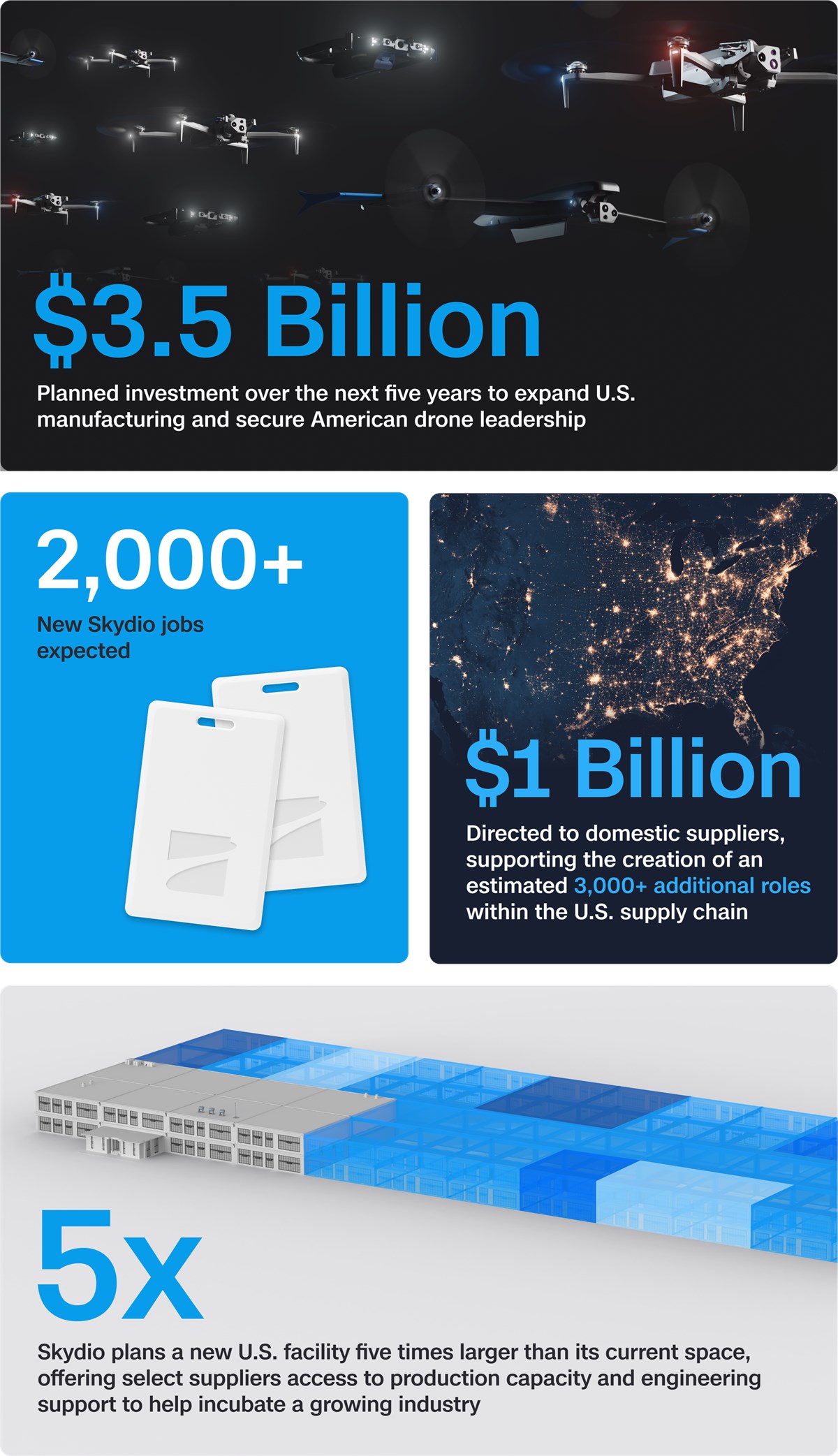
Skydio, the largest U.S.-based drone manufacturer and the world leader in flying robots, today announced plans to invest $3.5 billion in the United States over the next five years to expand its domestic manufacturing, accelerate R&D, and strengthen American supply chains. The investment is expected to create over 2,000 new Skydio jobs, support the creation of more than 3,000 additional roles within the U.S. supply chain, and direct more than $1 billion to domestic suppliers.

Skydio already manufactures more dual-use drones than any company outside of China. The company has shipped more than 60,000 flying robots to more than 3,800 customers, including more than 1,200 public safety agencies throughout the country, every branch of the U.S. military, and 29 allied nations, as well as more than 450 utility and energy companies.

A key component of the investment is SkyForge, a new company program designed to ensure the future of flight is built in America. In addition to the billion-dollar investment in U.S. suppliers, Skydio plans to open a new U.S. manufacturing facility five times larger than its current space. The company has outgrown four American manufacturing facilities in eight years; this will be its fifth expansion to meet extraordinary demand. Skydio’s investment in world-class suppliers will help expand – and in some cases initiate – domestic manufacturing of crucial parts and components. The company will invite select suppliers to co-locate production capacity with Skydio, giving suppliers access to production space and Skydio’s engineering talent to help incubate a growing industry.

In the span of little more than a decade, drones evolved from toys to tools to critical infrastructure for the industries that form the backbone of this country. Skydio leads this new era of drones as infrastructure on the strength of its AI and autonomy innovation: In public safety, for example, our Skydio DFR gives agencies aerial awareness that allows drones to arrive on scene first 71% of the time, resolving nearly a quarter of calls without sending a patrol unit. When lives and livelihoods are on the line, Skydio’s systems are in the field, every day, protecting both.

With this commitment, Skydio is making clear that the United States will lead in flying robotics autonomy, manufacturing, and scale. The investment will reinforce domestic electronics and component manufacturing and strengthen secure supply chains vital to national resilience. At the same time, Skydio will continue to scale domestic production capacity to meet the growing demand across public safety, national security, and utilities.

Free Training

Source link