
US Administration Plans Cuts to Key Industrial Grants Impacting Rust Belt Manufacturing | Ukraine news


The central thrust of the United States’ economic policy under the “America First” banner is to revitalize domestic manufacturing. However, the Trump administration plans to cut one of the key programs that funds the largest industries, including a city at the heart of the Rust Belt – the hometown of Vice President JD Vance.

A $500 million grant from the Biden administration was designated for the Cleveland-Cliffs steel company in Middletown, Ohio, to modernize aging blast furnaces; another $75 million was allocated for a similar project in Pennsylvania.

New furnaces powered by hydrogen, natural gas, and electricity – rather than coal – were meant to extend the plant’s life and secure the company’s future.

But these grants, which were to create more than 100 permanent jobs and 1,200 construction jobs just in Middletown, according to internal administration documents obtained by CNN, are slated to be canceled.

Representatives from the Department of Government Efficiency participated in deciding which programs to keep and which to cut, according to two people familiar with the situation.

“An unelected billionaire who made his fortune on government contracts should not be able to unilaterally stop these programs.”

– Marcy Kaptur

Energy Department spokesperson Ben Ditterich stated that “no final decisions have yet been made” regarding funding, and that “several plans are being considered.”

The Energy Department froze billions of dollars in grant programs during the Biden administration for months, reviewing them and determining which to cut. The $6.3 billion program that financed equipment modernization for Cleveland-Cliffs and other large companies could be cut by nearly half according to internal CNN documents.

Experts warn that such cuts could have a chilling effect on American industry amid a tariff war led by Trump that is undermining markets and supply chains.

“The entire point of OCED and the $6.3 billion grant programs is to invest in companies and industries that have not received funding for decades – steel and cement.”

– a former DOE employee

Samira Fazili, Deputy Director of the National Economic Council under the Biden administration, notes that reductions could deal a serious blow to the United States’ core industries, especially given the economic uncertainty caused by tariffs.

She emphasizes that instead of cutting public investments, strategic investments should be undertaken to preserve manufacturing and strengthen the country’s competitiveness.

Ultimately, experts call for a measured approach: carefully chosen government investments can preserve jobs and the United States’ industrial capacity, particularly in regions tied to essential industries.


Free Training

Source link

CFDA & Ralph Lauren launch grants to boost US fashion manufacturing


The Council of Fashion Designers of America (CFDA) announced two new initiatives designed to strengthen American fashion manufacturing, drive innovation, support workforce development, and promote economic growth in key apparel-producing regions across the country.

The CFDA x NY Forward Grant Fund, developed with funding from both the New York State Department of State and Ralph Lauren Corporation (Ralph Lauren), will provide partially matching grants to designers and manufacturers based in New York City’s Garment District. The U.S. Fashion Manufacturing Fund, created with Ralph Lauren as founding partner, will support apparel manufacturers nationwide. Both programs aim to help companies to modernize equipment, expand services, and train workers – building the capacity and resilience of American fashion manufacturing.

CFDA has launched two new grant programmes with Ralph Lauren to strengthen American fashion manufacturing.
The CFDA x NY Forward Grant Fund will support New York City’s Garment District, while the US Fashion Manufacturing Fund will aid manufacturers nationwide, focusing on modernisation, workforce training, innovation and long-term industry resilience.

These programs build on the success of the CFDA’s Fashion Manufacturing Initiative (FMI), launched in 2013 in affiliation with the New York City Economic Development Corporation (NYCEDC), Andrew Rosen, and with the long-term support of Ralph Lauren, among others. To date, Ralph Lauren has contributed $2 million as FMI’s Premier Underwriter, enabling grants to 54 factories and positively impacting more than 2,000 jobs.

“Strengthening American manufacturing to ensure designers have local partners has long been at the core of CFDA’s mission,” said Steven Kolb, CEO and President of the CFDA. “We are proud to extend our decade-plus work with Ralph Lauren Corporation and expand to a national level while also continuing our local NYC investments alongside our first-ever partnership with the New York State Department of State.”

Together, these new grant programs mark a landmark commitment: sustaining New York’s Garment District while bolstering U.S. manufacturing nationwide — ensuring that American fashion continues to lead globally through innovation, craftsmanship and community.

“Our expanded partnership with the CFDA reflects Ralph Lauren’s enduring commitment to advancing innovation and supporting American fashion,” said Katie Ioanilli, Chief Global Impact & Communications Officer, Ralph Lauren Corporation. “This is not only an investment in our industry — it’s an investment in a vital part of American culture that we share with the world.”

Note: The headline, insights, and image of this press release may have been refined by the Fibre2Fashion staff; the rest of the content remains unchanged.

Fibre2Fashion News Desk (RM)

Free Training

Source link

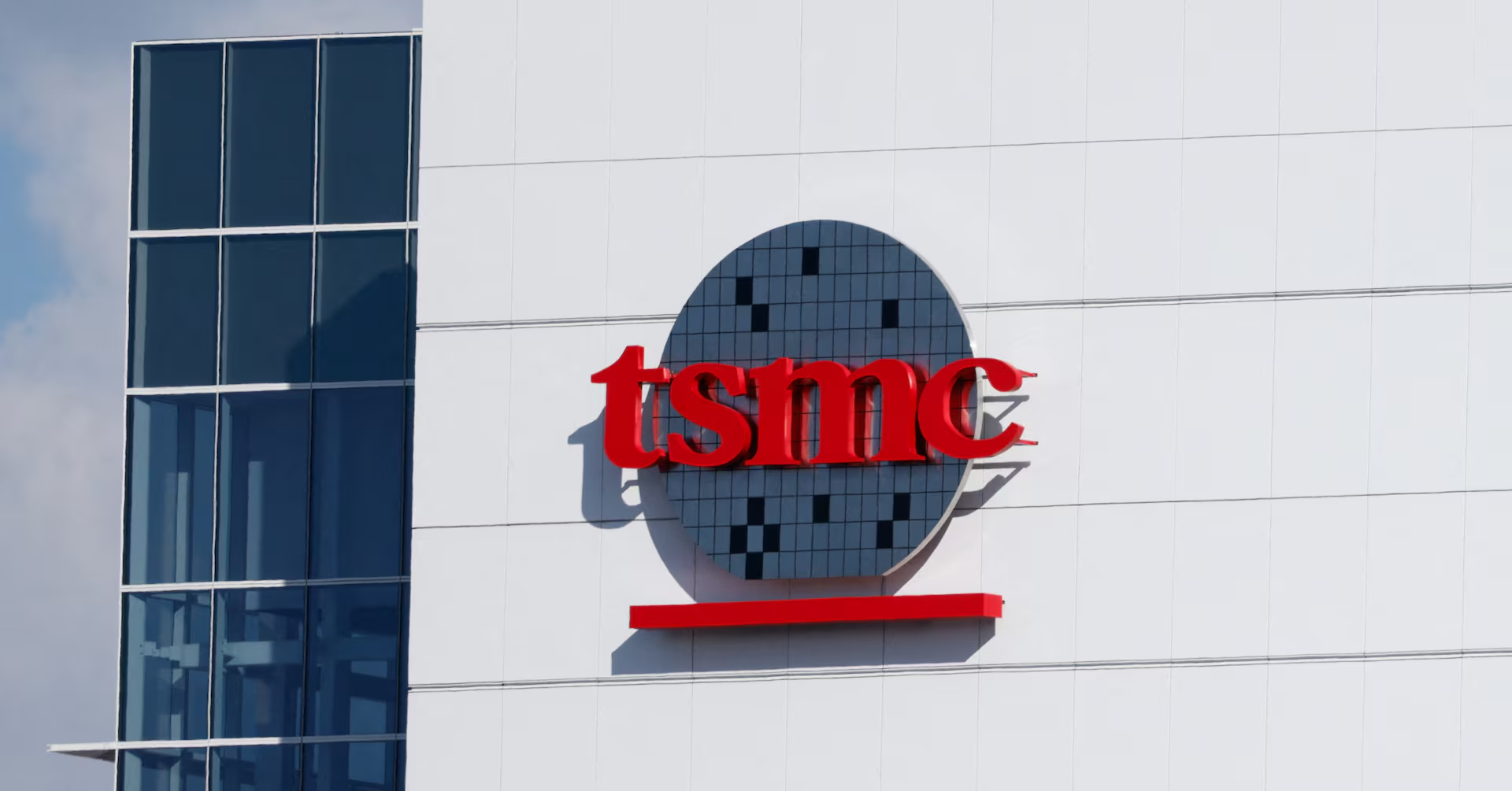
U.S. grants TSMC annual licence to import U.S. chipmaking tools into China


SEOUL, Jan 1 (Reuters) – The U.S. government has granted an annual licence to Taiwan Semiconductor Manufacturing (2330.TW), opens new tab to import U.S. chip manufacturing equipment to its facilities in Nanjing, China, the chipmaker said on Thursday.

The approval “ensures uninterrupted fab operations and product deliveries,” the company said in a statement to Reuters.

Sign up here.

South Korea’s Samsung Electronics and SK Hynix (000660.KS), opens new tab have also received similar import licences.

Previously, the Asian companies had benefited from exemptions from Washington’s sweeping restrictions on chip-related exports to China, part of U.S. efforts to try to stay ahead of China in technological development.

But those privileges – known as validated end-user status – expired on December 31 and the companies had to seek U.S. export licences instead for 2026.

“The U.S. Department of Commerce has granted TSMC Nanjing an annual export license that allows U.S. export-controlled items to be supplied to TSMC Nanjing without the need for individual vendor licenses,” TSMC said in its statement.

It added the licence “ensures uninterrupted fab operations and product deliveries”.

The Nanjing plant makes 16-nanometre and other mature node chips – not TSMC’s most-advanced semiconductors. TSMC also has a chipmaking plant in Shanghai.

In its 2024 annual report, TSMC said its Nanjing site generated about 2.4% of overall revenue.

Reporting by Hyunjoo Jin and Wen-Yee Lee; Editing by Chizu Nomiyama, Rod Nickel, Neil Fullick

Our Standards: The Thomson Reuters Trust Principles., opens new tab

Purchase Licensing Rights

Free Training

Source link