


The Semiconductor and Data Center Boom Does Not Make a Manufacturing Rebound
I normally pontificate on things I think about in In the Arena. But for this one, I want to comment on a great new report that analysts at the investment bank Jefferies sent me. The report, The Buildout: What’s Actually Happening With U.S. Reindustrialization?, offers an important look at what is happening with U.S. manufacturing.
To be clear, my comments are not about whether Trump or Biden policies toward manufacturing are good or bad, working or failing. They are about presenting an accurate picture of what’s actually going on.
Jefferies points to a massive increase in capital expenditures. To be sure, some of this activity is technically in the manufacturing sector, so when analysts say that “manufacturing momentum accelerates” or that “current data suggest that US manufacturing is in its strongest position in years,” they are pointing to real investment. But they are telling a misleading story.
It’s like the 2000s, when pundits touted manufacturing growth, even though BEA data showed that much of the measured growth was in one sector—computers and electronics—reflecting quality adjustments for Moore’s Law improvements.
One talking point of the cheerleaders is the rise in nonresidential fixed investment, which reached 14.5 percent of GDP in the second quarter of 2026, a multidecade high.
So what’s wrong? Jefferies rightly concludes that the current cycle looks less like a manufacturing renaissance and more like a buildout of computing, digital infrastructure, and power systems.
The analysts report that AI-related investment is tracking toward $600 billion this year, about 2 percent of GDP. They estimate that in 2025, it added more than 0.7 percentage points to GDP growth, roughly a third of the total. Business fixed investment grew at an 11 percent annualized rate in the first quarter of 2026, driven largely by AI spending. Data center construction hit an annual pace above $75 billion in July.
In addition, the annual pace of manufacturing construction spending rose from about $75 billion in 2020 to $244 billion in 2024, with much of the increase following passage of the CHIPS Act. Semiconductor fabs accounted for much of the boom. Spending has since reversed. Year-over-year growth peaked near 80 percent in early 2023 and has fallen to around −20 percent in 2026. Jefferies puts the decline in spending over the past two years at about 30 percent.
Enjoying this piece? Please share it!
The investment announcements are also quite narrow, concentrated in just a few industries. Semiconductors and advanced technology account for about 70 percent of tracked, announced manufacturing investment since 2025, biopharma about 18 percent, and all other industries just 12 percent.
The output numbers confirm it. Jefferies finds that manufacturing industrial production is largely flat. Capacity utilization is 75.7 percent, 3.3 percent below its long-term average. Manufacturing employment has also fallen over the past two years. However, falling employment alone does not establish industrial weakness; the problem is stagnant output.
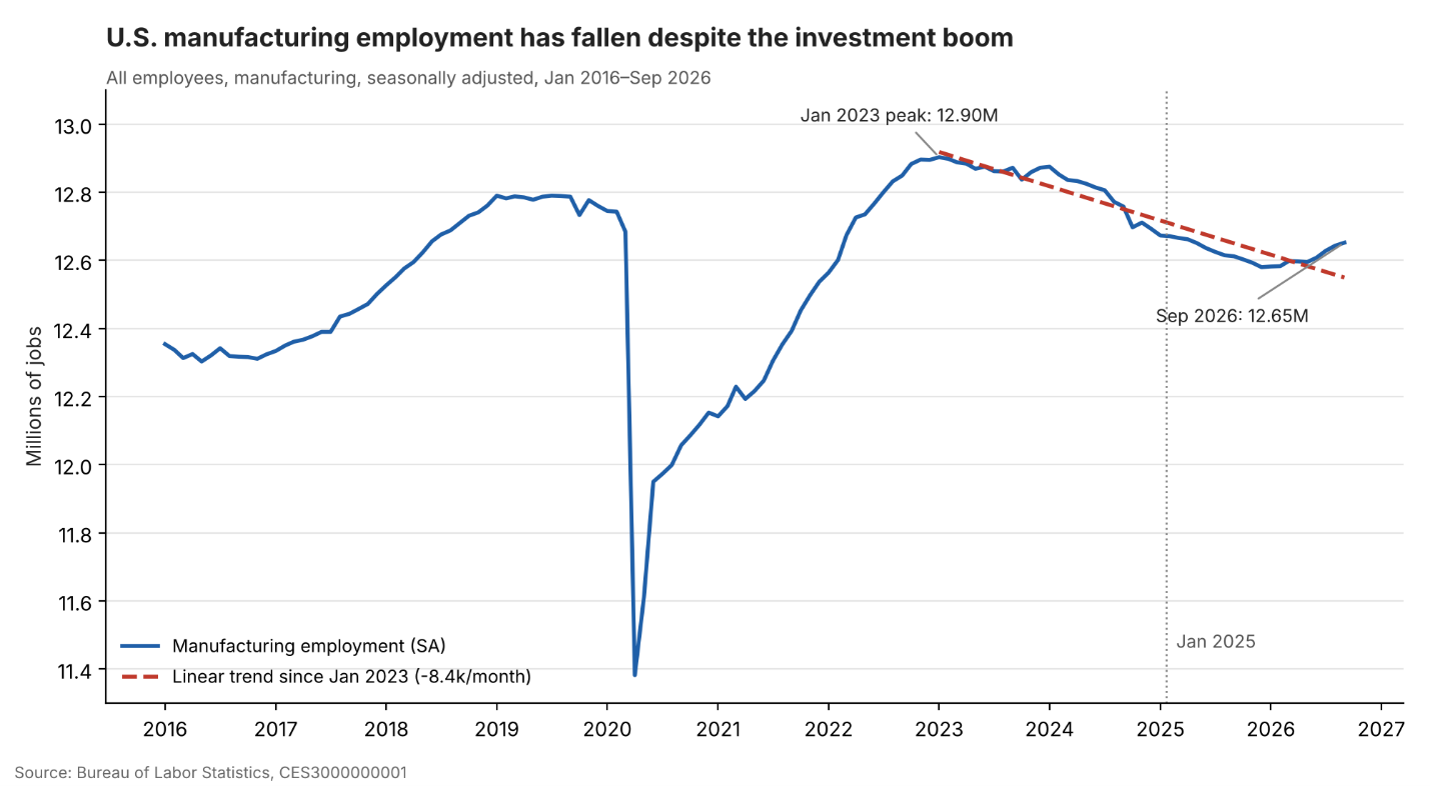 Source: U.S. Bureau of Labor Statistics, manufacturing employment, seasonally adjusted, January 2016–September 2026.
The trade data tell a similar story. Capital goods imports hit a record $140.3 billion in July, with computers and semiconductors leading, which is the AI buildout showing up as imports. Moreover, Jefferies notes that the United States is now 100 percent import-reliant for 16 of the 90 nonfuel commodities the U.S. Geological Survey (USGS) tracks. For critical minerals specifically, the report identifies 11 with complete import dependence.
The bulls have one counterpoint. The Institute for Supply Management’s (ISM) Manufacturing Index has reached its highest readings since 2022. But Jefferies attributes part of that to businesses front-loading orders ahead of Iran-related supply disruptions, with AI spending offsetting tariffs. That is not proof of broad-based industrial strength.
Besides, the ISM Index measures changes reported by surveyed, surviving firms, not total manufacturing output. Dead men tell no tales. We need output data that capture the whole sector: That means accounting for firms that have gone out of business and whose purchases have fallen to zero.
What is perhaps most bizarre is that the growing backlash against data centers would have us shut down even this positive development, leading to further declines in manufacturing capital expenditures. The opponents’ so-called “pause” is Latin for “ban.”
So, the data and analysis Jefferies provides should tell us three things.
-
We need to stop putting barriers in the way of the AI, semiconductor, and data center transformation.
-
We need a national industrial policy to restore the rest of U.S. manufacturing. Related to that, let’s stop using manufacturing jobs as evidence of the health of U.S. manufacturing. What we want to see is broad-based growth in inflation-adjusted value added across most major manufacturing subsectors at the three-digit NAICS level. That growth should outpace real GDP growth and be accompanied by a decline in the goods trade deficit. Ideally, automation will allow manufacturers to produce more with fewer workers.
-
We need an across-the-board decline in dependence on China for key inputs. USGS identifies China as a major source of 14 of the 33 critical minerals for which the United States is most dependent on imports. Chinese firms also supply significant portions of key equipment used in the U.S. AI production economy, including transformers, batteries, switchgear, and optical transceivers.
The policies needed to fix all this will not be fully forthcoming until two things happen. First, the elite policy class and elected officials will need to realize the United States is in a techno-economic war with China—and that China is winning. Second, they will need to recognize that the only solution is an advanced manufacturing industrial policy.
Only time will tell if that happens. In the meantime, at least we have growth in AI, semiconductors, and data centers. Well, that is, until the anti-growth, anti-tech crowd shuts that down too.
