

U.S. Manufacturing Hits Four Year High And Proves U.S. Can Become Self-Reliant 


By Manzanita Miller 

Critics were skeptical of President Donald Trump’s implementation of tariffs on a variety of imported products from countries like China, but the results are speaking for themselves. U.S. manufacturing reached its highest growth in four years in May and companies are promising multi-billion-dollar investments to develop critical pharmaceuticals, semiconductors, safe electrical equipment, and many more products in the United States. 

According to the Institute for Supply Management’s Purchasing Managers’ Index (PMI), U.S. manufacturing rose 1.3 percentage points in May, marking the fifth consecutive month of growth and the highest recording of the index since May 2022. This is a significant healthy signal that U.S. companies are beginning to compete once again. 

The report notes that indexes that measure inventories on hand, customer inventories on hand, new orders, and new export orders are all up over the past month. 

The inventories index rose 0.9 percentage points since April while the customers’ inventories index is up 3.6 points since April according to the report. 

The report also notes that “demand orders” are up, with both the new orders index and new export orders index expanding by 2.7 points since April.

Indexes that measure output are also up, with the production index rising for the seventh consecutive month according to the report. 

U.S. manufacturing is rising across a multitude of critical industries including petroleum, computers and electronics, mineral products, electrical equipment, machinery, appliances, transportation equipment, printing, textile mills, and food and beverages. 

The manufacturing boom is a result of President Donald Trump’s two-pronged economic approach to court companies with reduced corporate tax burdens signed into law with the One Big Beautiful Bill Act while making importing goods from foreign countries costly. 

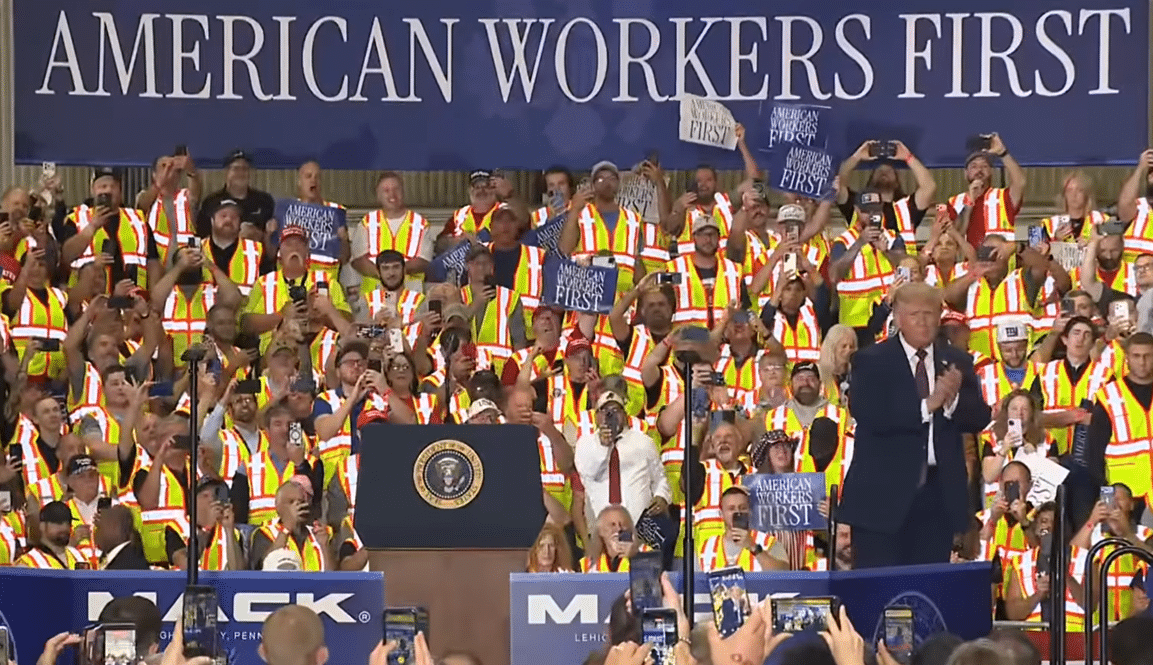
Speaking at a campaign stop in a Mack Trucks facility in Macungie, Pa. on June 23, President Trump touted manufacturing’s impact on job creation, “[M]ore Americans are working today than at any time in the history of our country. And we’ve created over… 32,000 new jobs just starting in Pennsylvania alone. David, you have to get ready for that. And in the last few months alone, we’ve added 2,600 Pennsylvania manufacturing jobs. And that number is going to go much, much higher as the factories start to open.”

The approach is working, with U.S. manufacturing reaching a four-year high in May. Companies are committing to expanding the creation of products like prescription drugs, semiconductors, safe electrical equipment, and many more products on American soil as a result of the strategy. 

In March, Taiwan Semiconductor Manufacturing Company (TSMC), which produces semiconductors for electronics, announced an additional $100 billion investment in the U.S. on top of the previously committed $65 billion. 

CEO C.C. Wei thanked President Trump for his support in company’s expansion, saying, “we have to thank President Trump’s vision and his support. TSMC started the journey of establishing the advanced chip manufacturing in Arizona. And now, let me proudly say the vision becomes reality.”  

TSMC’s investment will include six semiconductor wafer fabs, two advanced packaging facilities and a research and development center, and is already underway in Phoenix, AZ. 

According to the company’s announcement, the facilities will create 6,000 high-tech jobs, as well as thousands of construction and supplier jobs. The company’s original investment is estimated to generate around $1.4 billion in direct and indirect tax revenues combined over the next thirteen years. The company is also estimated to create $9.3 billion in personal income and indirect income combined.

In May, Siemens, a German company that develops critical power equipment and transportation infrastructure, announced it had reached $1 billion in domestic manufacturing investments in the United States over the past five years. 

Siemens’ investments include $165 million to expand two electrical equipment manufacturing facilities and add three more locations in North and South Carolina and $190 million for a new data center in Fort Worth, Texas to build important electrical infrastructure. The company has also dedicated $95 million to expand electrical infrastructure manufacturing in Pomona, California. The projects should generate more than 2,200 new jobs in advanced manufacturing, skilled trades, and engineering by 2028.

Multiple pharmaceutical companies including Eli Lilly, the U.S. manufacturer of the popular GLP-1 weight regulating drug Retatrutide have announced multi-billion dollar investments in the U.S. Eli Lilly announced plans to spend $27 billion to build four U.S. plants, with plants being announced in Alabama, Virginia and Texas so far.     

AstraZeneca, a Swedish pharmaceutical company that makes a multitude of prescription drugs including those used in oncology has committed $50 billion to expand U.S. manufacturing by 2030. The company will create a new facility in Virginia and expand into Maryland, Massachusetts, California, Indiana and Texas.

The White House estimates that $10.6 trillion in U.S. and foreign investments have been made possible through President Trump’s economic approach as of this writing, spanning the industries of AI, energy, datacenters, food and beverages, manufacturing, pharmaceuticals and biotech, and many more. 

What this says is that the slate of tariffs on imports are doing exactly what President Trump theorized and encouraging a revitalization of the U.S. manufacturing sector. Not only is this healthy for businesses and consumers, but it is also critical to ensuring American-made products are available no matter how the geopolitical landscape looks. With a rise in U.S.-made products from semiconductors to essential electrical infrastructure to critical pharmaceuticals, Americans are becoming more self-reliant than they have been for decades.

Manzanita Miller is the senior political analyst at Americans for Limited Government Foundation. 

Free Training

Source link

CNH Stock And 2 US Manufacturing Stocks Facing Tariff Changes


Tariff talk is back on the front page, and this time it centers on new Section 301 proposals that could reshape how money flows into U.S. manufacturing stocks. With fresh 10% and 12.5% tariff ideas aimed at many key trading partners, and some major categories like fuels and electronics excluded, investors are reassessing companies that already lean heavily on domestic production. This article looks at how that backdrop connects to U.S. Domestic Manufacturing stocks and highlights 3 companies from the screener that appear positioned to benefit from these developments.

CNH Industrial (CNH)

Overview: CNH Industrial is a global equipment manufacturer that sells tractors, harvesters, construction machinery and related precision agriculture solutions under brands such as Case IH and New Holland, supported by in house financing that helps farmers and contractors fund new and used equipment purchases.

Operations: CNH Industrial generates most of its revenue from industrial activities, with about US$12.4b from Agriculture, US$2.9b from Construction and US$2.7b from Financial Services, plus a small amount from eliminations and other items.

Market Cap: US$12.9b

CNH Industrial gives you exposure to U.S. centered manufacturing of farm and construction equipment at a time when new Section 301 tariff proposals could make imported machines more expensive and tilt demand toward domestically produced models. Management is already adjusting pricing, working with suppliers on cost sharing and re-sourcing components to improve its cost position under higher tariffs. It is also investing in virtual simulation and connected precision ag tools that support higher margin software and services. The trade off is that current profit margins are thin, debt funding is significant and North American ag demand sits near what management describes as trough levels, so the recovery path matters. What this all adds up to for CNH’s long term earnings potential is where the story gets more interesting.

Tariff pressure, thin margins and trough level North American ag demand could be masking where CNH Industrial’s earnings power eventually settles. It is therefore worth seeing how the 1 key reward and 2 important warning signs (1 is major!)

NYSE:CNH Earnings & Revenue Growth as at Jun 2026NYSE:CNH Earnings & Revenue Growth as at Jun 2026

MasTec (MTZ)

Overview: MasTec is an infrastructure engineering and construction company that designs, builds, installs, and maintains critical communications, power, clean energy, pipeline, and civil infrastructure across the United States and Canada for utilities, telecom providers, energy companies, and government clients.

Operations: MasTec generates most of its revenue from Clean Energy and Infrastructure (US$5.1b), Power Delivery (US$4.3b), Communications (US$3.5b), and Pipeline Infrastructure (US$2.5b), partially offset by eliminations.

Market Cap: US$31.7b

MasTec is notable in U.S. domestic infrastructure because it is directly tied to long term themes such as grid upgrades, data center buildouts, fiber and 5G deployment, and renewable power, while also being relatively insulated from the direct impact of new Section 301 tariffs on imported materials. Recent results indicate strong revenue and earnings momentum, supported by a record backlog and policy support for clean energy and power delivery. At the same time, the company carries high debt and relies heavily on large projects and key customers, which can make results more sensitive if work is delayed or cancelled. The valuation reflects a high P/E multiple and expectations for faster earnings growth than the wider market, so an important consideration for investors is whether MasTec’s execution and margin improvement will continue to support that level of optimism.

MasTec’s high P/E and strong backlog hint that expectations may be racing ahead of the story. It is worth seeing how the 2 key rewards and 2 important warning signs could change your view on what happens next

NYSE:MTZ P/E Ratio as at Jun 2026NYSE:MTZ P/E Ratio as at Jun 2026

Intuitive Machines (LUNR)

Overview: Intuitive Machines is a Houston based space infrastructure and services company that designs and operates lunar landers, data networks and mission services for NASA, the U.S. Department of Defense, commercial clients and international partners, supporting cargo delivery, communications and navigation across the Earth Moon system.

Operations: Intuitive Machines generates all of its reported US$334.3m in revenue from Aerospace & Defense activities in the United States.

Market Cap: US$5.0b

Intuitive Machines positions investors at the center of efforts to build a permanent lunar economy, with missions, lunar data networks and NASA contracts that extend beyond one off landings into recurring communications and operations services. Forecasts point to rapid growth in revenue and earnings over the next few years, and Simply Wall St estimates the stock is trading well below its fair value. At the same time, the company is still loss making, highly volatile and dependent on government funding, with recent equity offerings and insider selling adding extra risk. For investors who can tolerate sharp swings and execution risk, the combination of Section 301 tariff support for U.S. advanced manufacturing, a growing backlog of lunar infrastructure work and a premium P/S valuation presents a high risk, high potential story that may warrant closer attention.

Intuitive Machines sits at the crossroads of lunar growth hopes and real execution risk, and the current story may not fully reflect what comes next for revenue and margins, so it is worth reading the analyst forecasts for Intuitive Machines

NasdaqGM:LUNR Earnings & Revenue Growth as at Jun 2026NasdaqGM:LUNR Earnings & Revenue Growth as at Jun 2026

The three stocks covered here are only a sample of what is on offer. The full U.S. Domestic Manufacturing screen surfaces 44 more companies that meet the same health and future potential criteria and each carry their own compelling narrative, which you can review through the U.S. Domestic Manufacturing screener. Use Simply Wall St to identify and analyze the specific catalysts that matter to you, from reshoring exposure and tariff sensitivity to balance sheet strength and earnings potential, so you can focus on the highest conviction ideas in this theme.

Take Control of Your Investment Journey

If Intuitive Machines or any of these companies sound like a great opportunity, register for FREE with Simply Wall St and add your companies to a Watchlist to monitor the share price against the fair value the ideal entry point.
Once you’ve made your move, manage your holdings with our Portfolio Command Center that filters out the noise to deliver only the most critical, actionable updates.
Throughout your journey, our Community allows you to filter the best ideas from thousands of investor perspectives.
By uncovering hidden catalysts and risks early, you’ll accelerate your decision-making and stay one step ahead of the market.

Curious About Alternative Paths To Growth

Fresh stock ideas can move from quiet potential to full breakout before most investors notice. Do not get caught watching from the sidelines while it still matters; consider taking action in a way that aligns with your own research and objectives.

  • Target resilient compounding by scanning a curated 7 dividend fortresses that filters for companies focused on sustaining meaningful income even when sentiment swings.
  • Hunt for mispriced strength through a hand picked 44 high quality undervalued stocks where cash generation, quality metrics and current pricing may be pointing to early momentum.
  • Track the backbone of tomorrow’s data buildout with a focused 49 AI infrastructure stocks featuring companies tied to compute demand, power needs and high capacity networks.

This article by Simply Wall St is general in nature. We provide commentary based on historical data
and analyst forecasts only using an unbiased methodology and our articles are not intended to be financial advice.
It does not constitute a recommendation to buy or sell any stock, and does not take account of your objectives, or your
financial situation. We aim to bring you long-term focused analysis driven by fundamental data.
Note that our analysis may not factor in the latest price-sensitive company announcements or qualitative material.
Simply Wall St has no position in any stocks mentioned.

New: Manage All Your Stock Portfolios in One Place

We’ve created the ultimate portfolio companion for stock investors, and it’s free.

• Connect an unlimited number of Portfolios and see your total in one currency
• Be alerted to new Warning Signs or Risks via email or mobile
• Track the Fair Value of your stocks

Try a Demo Portfolio for Free

Have feedback on this article? Concerned about the content? Get in touch with us directly. Alternatively, email editorial-team@simplywallst.com

Free Training

Source link