
Amazon and Corning partner to boost fiber optics manufacturing in North Carolina :: WRAL.com


E-commerce giant Amazon is partnering with industrial manufacturer Corning Inc. to expand data center infrastructure across the United States, a multibillion-dollar deal that is expected to create about 1,000 jobs at Corning plants in North Carolina, the companies said Friday.

The agreement comes on top of Amazon’s plans, announced last year, to invest $10 billion in North Carolina to expand cloud computing infrastructure. Amazon has invested at least $20 billion in North Carolina since 2010, creating over 26,000 jobs spanning logistics, cloud infrastructure, and renewable energy across the Tar Heel State, the companies said. 

“North Carolina is proving that American manufacturing and cutting-edge technology go hand in hand,” U.S. Sen. Ted Budd, R-North Carolina, said in a statement. He said the deal would strengthen the U.S. supply chain for data-center infrastructure. 

North Carolina has been a magnet for companies focused on updating the nation’s power grid to accommodate renewable energy and increased power demand from data centers. 

In April, Hitachi Energy said it would create 150 jobs in Cary as part of a new $10 million center expanding its local engineering and testing functions — its latest effort aimed at strengthening the North American power grid in part to help support artificial-intelligence data centers.  

In 2024, Siemens announced plans to expand its Siemens Electrification and Automation U.S. headquarters in Wendell to meet demand in its growing data center, semiconductor and utility sectors — one of several planned expansion by the company in the state.

A unit of Houston-based MetOx International, a maker of efficient power transmission cables, also said in 2024 that it plans to create 333 jobs and invest about $194 million in Chatham County — part of a long-range plan to provide more efficient power for data centers, medical diagnostics and more.

“I am proud that we are continuing to capitalize on that momentum in North Carolina,” Budd said in his statement. 

Amazon Web Services last year announced plans to invest $10 billion in a North Carolina cloud computing and artificial intelligence innovation center — one of the biggest investments in state history, according to state and local officials. The project is expected to bring about 500 high-paying jobs to a 20-building, 800-acre campus in Richmond County, the company said in June. The company’s data centers power hospitals and emergency services, streaming entertainment and AI. 

Corning, a manufacturer of advanced glass and fiber optic technology used in optical fiber and cable, is used in that kind of infrastructure.

“This agreement with Amazon represents a significant milestone for Corning and for American manufacturing,” Wendell Weeks, Corning’s chief executive, said in a statement. 

It was unclear where the Corning jobs would be located. A company spokesperson didn’t immediately respond to a request for more information. 

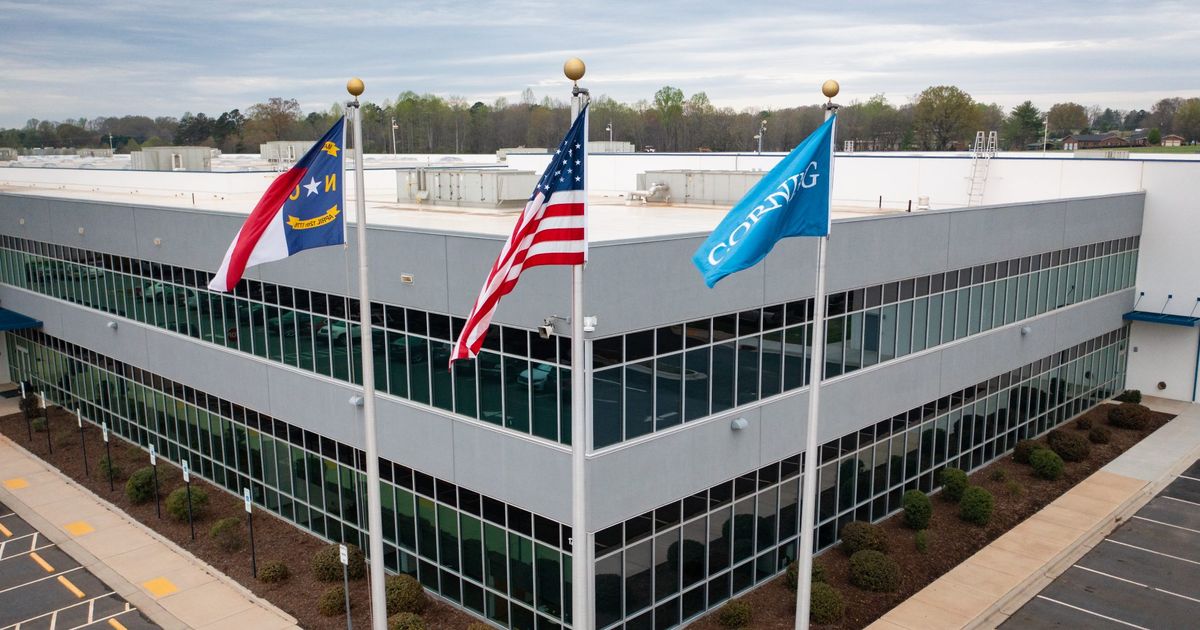
Corning has manufactured optical fiber and cable in North Carolina for more than 40 years. The company employs more than 5,000 in plants across the state. Charlotte is home to Corning’s Optical Communications headquarters.  In 2023, the company opened an optical cable manufacturing campus in Hickory to support U.S. buildouts of high-speed fiber broadband networks. The company also manufactures optical fiber in Concord and Wilmington.

Through the agreement announced Thursday, Amazon will work with Corning on a new program that will expand its Fiber Optic Technician Training Program with Catawba Valley Community College to train students for careers in fiber optic manufacturing and related technical roles. 

The program provides hands-on education and courses that will increase the talent pool and offer pathways to high-paying technical roles. The efforts will help strengthen the domestic supply chain and U.S. manufacturing base while serving the region and state to help expand residential and commercial fiber densification efforts, the companies said.

“These long-term investments create long-term careers and real opportunity in the communities where we operate,” Matt Garman, the chief executive of Amazon Web Services, said in a statement.

Free Training

Source link

American Trailer Manufacturers Coalition calls 130.76% China trailer duties a win for U.S. manufacturing


The American Trailer Manufacturers Coalition (ATMC) today applauds the U.S. Department of Commerce’s (Commerce) announcement of preliminary antidumping duties of 130.76% on van-type trailers from China. The duties apply to van-type trailers sold in the United States at prices that were deemed unfairly low by Commerce. The determination follows Commerce’s June 3, 2026, preliminary finding that Chinese trailer producers benefit from significant government subsidies.

Upon publication of Commerce’s determination in the Federal Register, U.S. Customs and Border Protection will begin collecting antidumping duties on imports of subject merchandise from China at the preliminary rates established by Commerce. This includes Chinese-origin subassemblies entering the U.S. through third countries, such as Canada. These duties will be added to the countervailing duties already announced by Commerce, increasing accountability for unfairly traded imports entering the U.S. market.

“This determination is an important victory for American manufacturing and the thousands of workers who build trailers in communities across the country,” said Robert E. DeFrancesco, trade counsel to the Coalition and partner in the International Trade Practice at Wiley. “For too long, Chinese producers have exploited unfair pricing practices and government support to gain market share at the expense of the U.S. manufacturing industry. Commerce’s decision sends a strong message that American workers have been harmed by these practices and sets the conditions needed for them to compete on fair terms.”

The Department of Commerce’s antidumping investigation into Mexico remains ongoing, with a preliminary determination expected in late July. The agency is expected to issue final determinations later this year.
Free Training

Source link

New DOE-Argonne Partnership Targets Faster Commercialization of US Manufacturing Technologies


  • DOE and ANL have launched the National Science-at-Scale Collaborative to help U.S. firms move critical materials and chemical manufacturing tech into domestic production faster
  • Participating companies will get access to Argonne’s Materials Engineering Research Facility
  • The effort grew out of a DOE roundtable where companies laid out barriers to manufacturing

The Department of Energy and Argonne National Laboratory, or ANL, have established a joint initiative aimed at shortening the time it takes American companies to bring critical materials and chemical manufacturing technologies into commercial production.

ANL said Wednesday the National Science-at-Scale Collaborative, backed by DOE’s Office of Critical Materials and Energy Innovation, or CMEI, will pair companies with Argonne researchers to address the technical hurdles that often stall promising technologies.

Audrey Robertson, assistant secretary of energy and head of CMEI, said the United States cannot compete globally unless new technologies reach domestic production lines faster — the gap the collaborative is built to close by tying together the department, its national laboratories and the private sector.

What ANL Resources Will Industry Partners Gain Access To?

Companies joining the initiative will tap Argonne’s Materials Engineering Research Facility, where project teams can run simulations, apply artificial intelligence, rapidly synthesize candidate materials and trial new production methods on pilot-line equipment.

“American manufacturing has an opportunity to lead the next generation of innovation in critical materials and chemical processing,” said Paul Kearns, director of Argonne.

​“The National Science-at-Scale Collaborative will help connect discovery, engineering and deployment in ways that strengthen U.S. competitiveness and advance our economic security,” he added.

What Prompted the ANL-DOE Initiative?

The collaborative emerged from a roundtable convened by CMEI, where executives from the chemical and critical materials industries discussed the obstacles they face in domestic manufacturing and explored how government partnerships could help. Companies at the table included Aclara, Albemarle, ATALCO, BASF North America, Chemours, Dow, Entegris, Exxon Mobil, Orbia and Standard Lithium.

Free Training

Source link