

U.S. Manufacturing Investment Fuels Growing Demand for Domestic C



Technician testing an industrial control panel using electrical diagnostic equipment inside a UL 508A-certified panel fabrication facility.

As U.S. manufacturing investment continues to grow, manufacturers are increasingly prioritizing domestically fabricated control panels that support quality, collaboration, and deployment readiness.

Continued investment in domestic manufacturing, infrastructure modernization, and automation is driving demand for U.S.-built, integration-ready control panels.

Control panels are often the brains of an automation project. Customers are still concerned about lead times, but they’re also looking for greater control over their projects.”

— Mark Gathings, Panel Shop Group Leader at DSI Innovations

THOMASVILLE, NC, UNITED STATES, July 10, 2026 /EINPresswire.com/ — Continued investment in U.S. manufacturing is reshaping the industrial automation landscape, driving increased demand for domestically fabricated control panels that help manufacturers reduce project risk, accelerate deployment, and improve long-term operational reliability.

According to recent U.S. Census Bureau construction spending data, manufacturing and industrial infrastructure remain significant areas of investment as companies continue building, expanding, and modernizing domestic production facilities. At the same time, manufacturers are facing tighter project schedules, workforce challenges, supply chain pressure, and increasingly complex automation requirements.

As a result, many manufacturers are reevaluating how automation infrastructure is engineered, fabricated, tested, and delivered

Domestic Fabrication Becomes a Strategic Advantage
While supply chain disruptions initially exposed the risks associated with long lead times and limited visibility, manufacturers are increasingly recognizing the broader operational advantages of domestic control panel fabrication.

Closer collaboration between engineering and fabrication teams allows design revisions to be incorporated more efficiently, improves communication throughout the project lifecycle, and provides greater schedule certainty during the build process. Domestic fabrication also allows for more comprehensive Factory Acceptance Testing, standardized documentation, network validation, controls verification, and quality inspections before systems leave the shop.

Rather than viewing control panel fabrication as simply another procurement item, manufacturers increasingly see it as a critical component of successful project execution.

Integration-Ready Panels Improve Startup Success
Today’s industrial control panels are expected to arrive as complete, deployment-ready systems — not simply assembled enclosures.

Manufacturers increasingly expect panels to include detailed documentation, standardized labeling, network validation, controls verification, and pre-shipment testing that reduce field modifications and accelerate commissioning.

By identifying issues before shipment, integration-ready panels help reduce startup delays while improving long-term maintainability and operational reliability.

This approach is becoming increasingly important across industries such as life sciences, automotive and vehicle manufacturing, water and wastewater, food and beverage, data centers, and specialty chemicals, where compressed schedules leave little room for unexpected commissioning challenges.

DSI Innovations Supports the Shift Toward Domestic Fabrication
As manufacturers continue prioritizing reliability and deployment readiness, DSI Innovations is helping customers meet those expectations through integrated engineering, UL 508A-certified panel fabrication, Factory Acceptance Testing, and systems integration.

Operating from UL 508A-certified panel fabrication facilities in Thomasville, North Carolina (40,000 sq. ft.) and Jacksonville, Florida (8,000 sq. ft.), DSI designs and fabricates custom industrial control panels for manufacturers throughout North America. Together, the facilities support both greenfield and modernization projects, with the capacity to stage large multi-panel systems for Factory Acceptance Testing (FAT) prior to shipment.

By integrating engineering, fabrication, controls programming, commissioning, and long-term lifecycle support under one organization, DSI helps manufacturers streamline project execution while reducing deployment risk.

“Control panels are often the brains of an automation project,” said Mark Gathings, Panel Shop Group Leader at DSI Innovations. “Customers are still concerned about lead times, but they’re also looking for greater control over their projects. Working with a domestic fabrication partner allows them to collaborate more closely throughout the build, make engineering decisions faster, participate in Factory Acceptance Testing, and have confidence that their panels are ready for startup.”

Looking Ahead
Industry trends suggest demand for domestic control panel fabrication will continue to grow as manufacturers invest in automation, modernize aging infrastructure, and expand domestic production capacity.

As automation systems become increasingly connected and projects grow more sophisticated, control panel fabrication is evolving beyond a commodity purchase into a strategic investment that directly influences startup success, operational reliability, and long-term maintainability.

For manufacturers evaluating automation projects, selecting a fabrication partner capable of supporting the entire project lifecycle — from engineering through commissioning — may prove just as important as selecting the control system itself.

About DSI Innovations
DSI Innovations is a full-service automation and systems integration company headquartered in Thomasville, North Carolina. The company provides UL 508A-certified control panel fabrication, PLC and SCADA programming, industrial automation, systems integration, commissioning, modernization services, and long-term lifecycle support for manufacturers across North America. DSI serves industries including life sciences, automotive and vehicle manufacturing, food and beverage, water and wastewater, specialty chemicals, data centers, and industrial manufacturing through a network of regional offices and technical specialists.

Madelyn Hough
DSI Innovations
+1 336-893-8385
madelyn.hough@dsiinnovations.com
Visit us on social media:
LinkedIn
Instagram
Facebook
YouTube
X

Legal Disclaimer:

EIN Presswire provides this news content “as is” without warranty of any kind. We do not accept any responsibility or liability
for the accuracy, content, images, videos, licenses, completeness, legality, or reliability of the information contained in this
article. If you have any complaints or copyright issues related to this article, kindly contact the author above.


Free Training

Source link

Micron to Pour $250 Billion in Manufacturing on US Soil As It Starts Construction of New York’s DRAM Megafab


Micron has announced that it will invest $250 billion in America as it lays down the first concrete for the New York DRAM Megafab.

Micron Aims To Make 40% of Its Total DRAM In America While Creating Over 90,000 Jobs Through A $250B Commitment

DRAM demand surge has boosted revenues of all major manufacturers, including Micron, as such, the company has laid down a $250 billion commitment through 2035, which will accelerate the AI segment fruther.

Today is a proud day for Micron and American manufacturing. 🇺🇸

We’re increasing our planned U.S. manufacturing and R&D investment commitment to more than $250B, supporting our goal of producing 40% of our DRAM in America and creating 90,000+ jobs.

We also poured the first… pic.twitter.com/5pFxRl1AtW

— Sanjay Mehrotra (@MicronCEO) July 9, 2026

The initiative is simple: $250 billion of investments through 2035 towards major manufacturing and R&D centers across America. This long-term goal will achieve 40% of Micron’s global DRAM production on US soil, while creating nearly 100,000 jobs in the country.

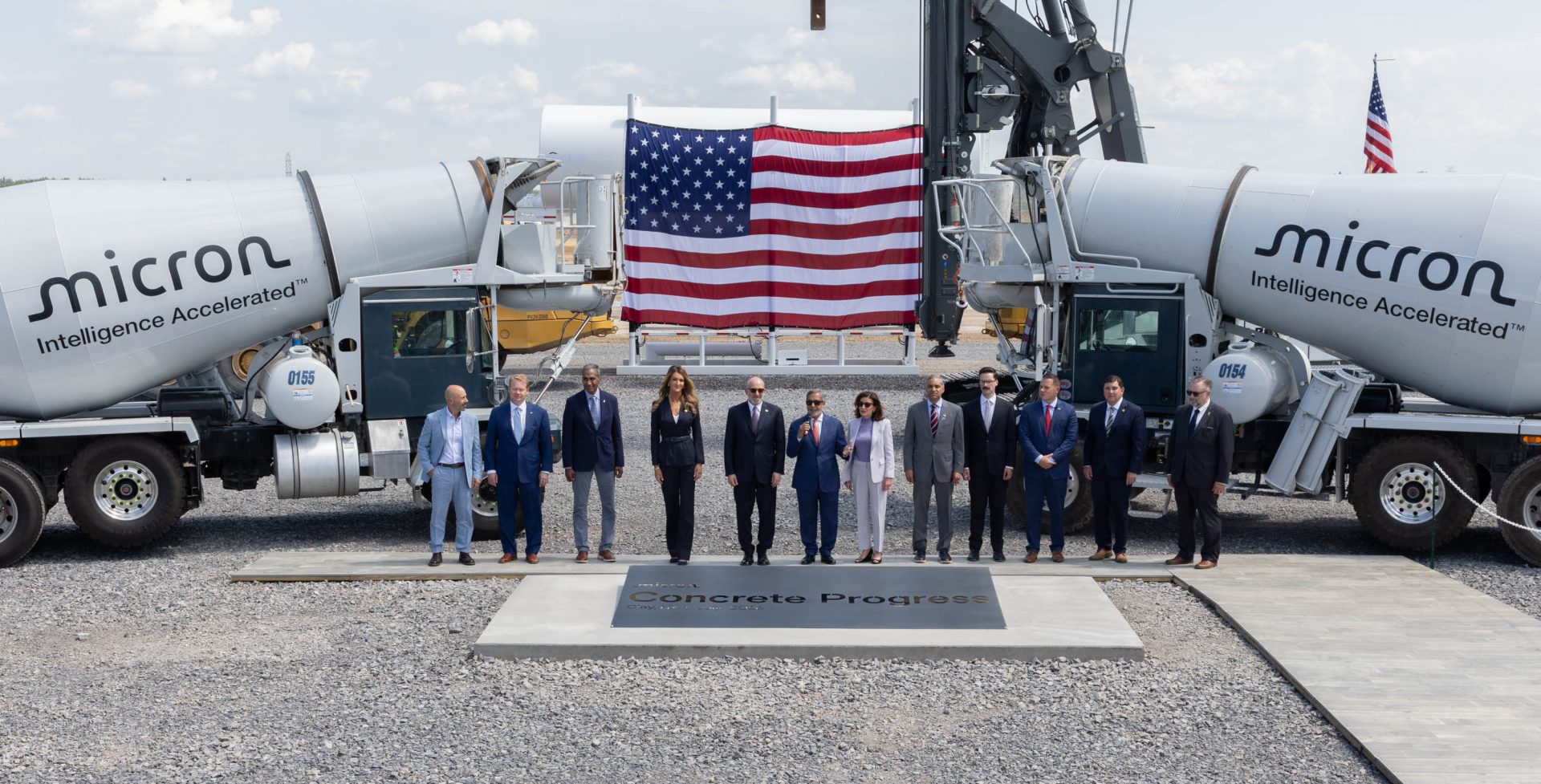
As part of this commitment, Micron celebrated the announcement with the first concrete pour milestone at its New York DRAM Megafab, which is located in Clay. The milestone is said to be achieved one quarter ahead of the original plan, and the construction will now go vertical. The company is also investing up to $3 billion in the development of a domestic semiconductor supply chain ecosystem.

Today, Micron Chairman, President and CEO Sanjay Mehrotra will host the concrete pour, joined by supplier partners and federal, state and local leaders, including U.S. Secretary of Commerce Howard Lutnick, New York Governor Kathy Hochul, Small Business Administration Administrator Kelly Loeffler, U.S. Chief Technology Officer Dr. Ethan Klein, Onondaga County Executive Ryan McMahon, U.S. Congressman John Mannion, U.S. Congresswoman Claudia Tenney, and Town of Clay Deputy Supervisor Joe Bick.

This commitment goes in line with US President Donald J Trump’s “Made in the USA” policy, with major firms such as Intel, NVIDIA, and AMD all focusing on producing their chips domestically. TSMC has already laid out plans to build major fabs throughout the US in a bid to bring advanced manufacturing capabilities to the US.

“President Trump has made it clear that America is where you should build your business and the world is responding rapidly. Today, Micron pours the foundation on its massive semiconductor campus in upstate New York and increases its American investment commitment to $250 billion, creating nearly 100,000 jobs and providing leading-edge memory supply here in the United States,” said Commerce Secretary Howard Lutnick. “The Trump economic model clearly shows there has never been a better time to invest in the United States.”

Talking a bit about its major fabs, the ones in Idaho are said to be making rapid progress and are expected to have first wafer output by mid 2027 for the first fab and late 2028 for the second fab.

The image shows a construction scene with concrete pouring, alongside text stating, Micron pours first concrete at New York fab ahead of plan, with the event titled 'Concrete Progress Celebration | July 2026'.

Micron is definitely going big with its manufacturing capabilities, which was a given considering just how massive the demand for DRAM and NAND is right now. The company is already engaged with several customers in what it refers to as “Strategic Customer Agreements,” which are hard-locked deals to ensure that the committed memory supply is delivered to these high-level parties at a finalized rate within a 3-5 year timeframe.

Today’s milestone, pouring the first concrete at its New York DRAM Megafab ahead of schedule, symbolizes a new era of advanced manufacturing “Made in the USA.” With strong government support and surging demand, Micron’s ambitious expansion positions the United States at the forefront of next-generation memory technology.


Hassan Mujtaba Photo

About the author: A Software Engineer by training and a PC enthusiast by passion, Hassan Mujtaba serves as Wccftech’s Senior Editor for hardware section. With years of experience in the industry, he specializes in deep-dive technical analysis of next-generation CPU and GPU architectures, motherboards, and cooling solutions. His work involves not only breaking news on upcoming technologies but also extensive hands-on reviews and benchmarking.

Follow Wccftech on Google to get more of our news coverage in your feeds.


Free Training

Source link

3 U.S. Manufacturing Stocks Built For Tariff Pressure


Trade tensions between the United States and Canada are back in focus, with fresh talk of tariffs on autos, steel and softwood lumber increasing uncertainty for companies tied to cross border supply chains. For U.S. investors, this kind of disruption can create both risk and potential opportunity as domestic manufacturers adjust pricing power, sourcing and capacity. This article looks at three U.S. Domestic Manufacturing stocks from the screener that are exposed to this tariff story in different ways, all on the positive side of the thesis, to help you think through where this news might matter most in your portfolio decisions.

Lear (LEA)

Overview: Lear is a U.S. headquartered auto supplier that builds complete seating systems and complex electrical and wiring systems for major carmakers, with products that sit inside many light trucks, SUVs and passenger cars around the world.

Operations: Lear generates most of its revenue from Seating at about US$17.5b, alongside its E-Systems business at about US$6.3b, with a small offsetting amount reported in Other.

Market Cap: US$6.5b

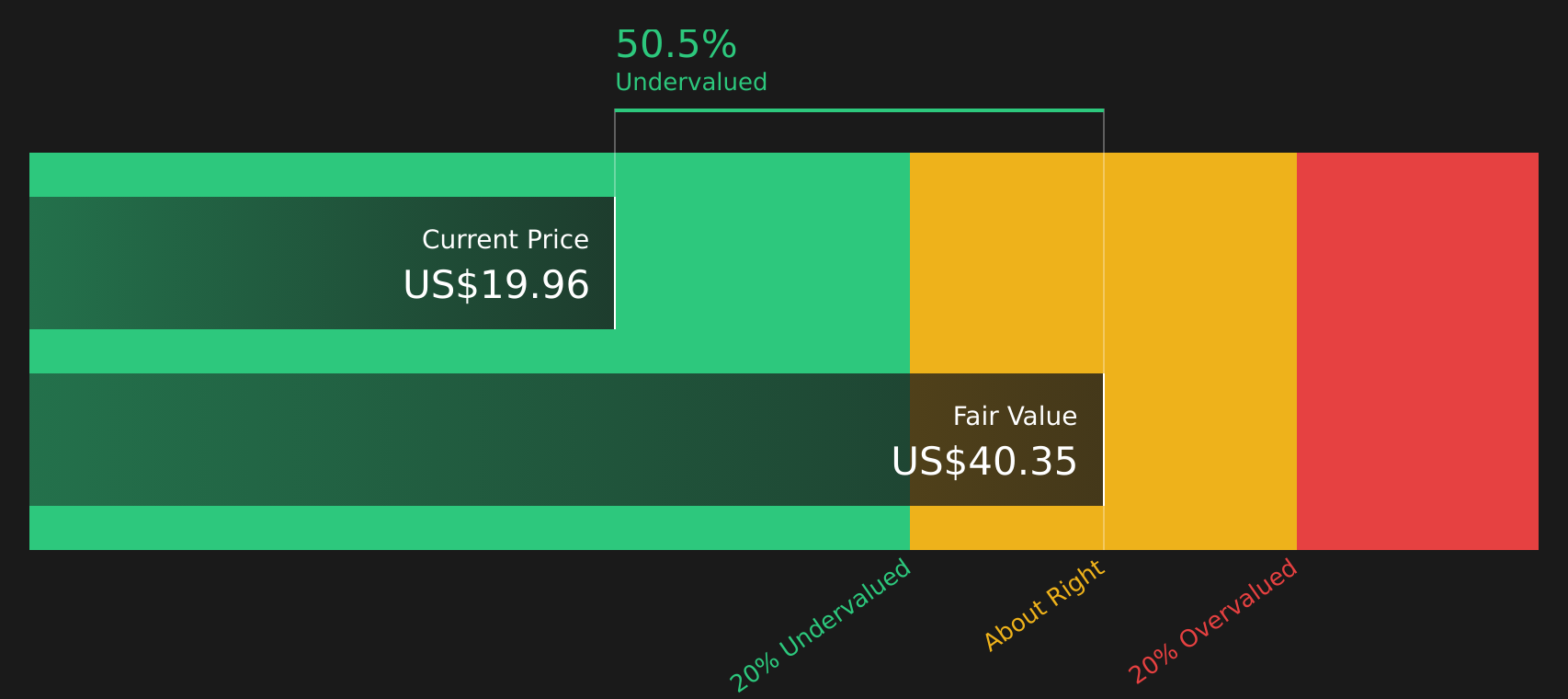
Lear stands out in this tariff story because it already does much of its manufacturing inside the U.S., its direct import exposure from Canada and China has been described as modest, and management says most tariff costs have been recoverable from customers. At the same time, the company is tied into higher value seating and E-Systems content for EVs, is returning cash through buybacks, and analysts are using detailed forecasts and a DCF view that indicate the stock is trading below their estimate of fair value. The catch is that Lear still faces trade policy risk, customer concentration and funding risk. As a result, the potential upside depends on how comfortable investors are with those pressures on margins and cash flow.

Lear’s tariff resilience, EV content and buybacks have investors talking about a possible valuation gap, but the real question is whether the tradeoff between upside and pressure on margins is worth it, according to the DCF valuation analysis for Lear

LEA Discounted Cash Flow as at Jul 2026LEA Discounted Cash Flow as at Jul 2026

BorgWarner (BWA)

Overview: BorgWarner is a Michigan based auto supplier that provides key components for combustion, hybrid and electric vehicles, including turbochargers, power electronics, battery systems and drivetrain parts used by carmakers around the world.

Operations: BorgWarner generates most of its revenue from Turbos & Thermal Technologies at about US$5.8b and Drivetrain & Morse Systems at about US$5.7b, with additional contributions from PowerDrive Systems at about US$2.4b and Battery Energy Systems at about US$0.5b.

Market Cap: US$13.2b

BorgWarner is attracting fresh attention because it sits at the crossroads of traditional auto parts and electrification. It is also seen as a potential beneficiary of tougher U.S. trade policy toward Canada, given its Detroit base and limited Canada exposure. The company has been winning business in hybrid and EV systems and earning recognition for sustainability, yet still carries meaningful exposure to combustion products, a recently consolidated but challenged battery segment and tariff related cost swings highlighted on recent earnings calls. For investors trying to balance those cross currents, the mix of strong electrification demand, non auto opportunities such as data center related products, and ongoing tariff pass through efforts raises the question of whether the risk reward trade off is becoming more interesting here.

Electrification momentum at BorgWarner is starting to decouple from its combustion exposure, but tariff swings and the battery segment story are easy to miss until you read the 3 key rewards and 2 important warning signs

NYSE:BWA P/E Ratio as at Jul 2026NYSE:BWA P/E Ratio as at Jul 2026

Adient (ADNT)

Overview: Adient is a global auto supplier that designs and manufactures complete seating systems and components such as frames, foams, head restraints, armrests and trim covers for passenger cars, commercial vehicles and light trucks, selling primarily to major automakers worldwide.

Operations: Adient generates most of its revenue from the Americas at about US$7.1b, alongside EMEA at about US$4.9b and Asia at about US$3.1b, with a small offsetting amount reported in Corporate/Eliminations.

Market Cap: US$1.5b

Adient sits at the intersection of tariff reshoring themes and higher value EV seating, with a large U.S. production base, new foam capacity in Michigan and premium comfort features such as ProForce Massage Flow and StepJoy that help it win business with both domestic and Asia based OEMs. At the same time, the balance sheet carries financing risk, China related tariff exposure has required careful mitigation, and earnings quality is affected by restructuring costs and one off items, while recent results have shifted from deep losses to modest profits. For investors, the combination of a discounted stock price, evolving fundamentals and meaningful execution risks makes Adient a tariff story that may warrant closer consideration rather than a quick judgment.

Adient’s move from deep losses to modest profits suggests a potential turning point for this tariff reshoring story, but the real twist lies within the 3 key rewards and 3 important warning signs (1 is major!)

ADNT Discounted Cash Flow as at Jul 2026ADNT Discounted Cash Flow as at Jul 2026

The three stocks highlighted here are just a starting point, and the full U.S. Domestic Manufacturing screener on Simply Wall St surfaces 17 more companies in the U.S. Domestic Manufacturing screener with equally compelling tariff and reshoring narratives. Use the platform to identify, filter and analyze the specific catalysts, financial health factors and storylines that matter most to you so you can focus on the highest conviction U.S. manufacturing ideas in seconds.

Take Control of Your Investment Journey

If Lear or any of these companies sound like a great opportunity, register for FREE with Simply Wall St and add your companies to a Watchlist to monitor the share price against the fair value the ideal entry point.
Once you’ve made your move, manage your holdings with our Portfolio Command Center that filters out the noise to deliver only the most critical, actionable updates.
Throughout your journey, our Community allows you to filter the best ideas from thousands of investor perspectives.
By uncovering hidden catalysts and risks early, you’ll accelerate your decision-making and stay one step ahead of the market.

Seeking Fresh Alternatives Before They Fly?

Some of the sharpest breakouts start quietly, with momentum building in corners most investors ignore. Before these ideas stop flying under the radar, move with intent and get in early.

  • Spot potential trend leaders early by scanning 52 AI infrastructure stocks that could gain from growing demand for data centers, chips and the backbone behind AI workloads while it still goes under followed.
  • Track resilient income ideas using the curated 9 dividend fortresses that may offer higher yields while prices are still dropping or flat, before the crowd wakes up to the cash flow story.
  • Hunt for under the radar value among the 19 high quality undiscovered gems that pass quality filters yet remain overlooked for now, giving you a shot at potential upside before momentum hits.

This article by Simply Wall St is general in nature. We provide commentary based on historical data
and analyst forecasts only using an unbiased methodology and our articles are not intended to be financial advice.
It does not constitute a recommendation to buy or sell any stock, and does not take account of your objectives, or your
financial situation. We aim to bring you long-term focused analysis driven by fundamental data.
Note that our analysis may not factor in the latest price-sensitive company announcements or qualitative material.
Simply Wall St has no position in any stocks mentioned.

Valuation is complex, but we’re here to simplify it.

Discover if BorgWarner might be undervalued or overvalued with our detailed analysis, featuring fair value estimates, potential risks, dividends, insider trades, and its financial condition.

Access Free Analysis

Have feedback on this article? Concerned about the content? Get in touch with us directly. Alternatively, email editorial-team@simplywallst.com

Free Training

Source link