The US labour market added 162,000 nonfarm payroll jobs in August, while the unemployment rate was unchanged at 4.1 per cent, official data for September 4, 2026 showed, giving apparel and textile sourcing teams a fresh read on factory hiring, construction-linked capacity and wage pressure in a key consumer and supply market.
Manufacturing employment continued its upward trend with 16,000 jobs added in August and was up by 58,000 from a recent low in December 2025. Machinery manufacturing and fabricated metal product manufacturing each continued to trend up, adding 6,000 jobs, while construction changed little at 22,000 jobs added.
The US Bureau of Labor Statistics (BLS) said total nonfarm payroll gains in August were above the average monthly increase of 31,000 over the prior 12 months. Employment rose in food services and drinking places and local government education, while the information industry lost jobs.
US nonfarm payrolls rose by 162,000 in August, with manufacturing adding 16,000 jobs and construction up 22,000.
The unemployment rate held at 4.1 per cent, while labour force participation edged up to 61.6 per cent and part-time for economic reasons fell.
Average hourly earnings rose to $37.75, a wage signal for apparel and retail sourcing teams tracking US labour costs.
The BLS said the release draws on two monthly surveys: the household survey, which measures labour force status including unemployment by demographic characteristics, and the establishment survey, which measures nonfarm employment, hours and earnings by industry.
In the household survey, the number of unemployed people was little changed at 7.0 million. The unemployment rate for Asian workers declined to 3.2 per cent, the teenage rate edged up to 14.1 per cent, and jobless rates showed little change for adult men at 4.0 per cent, adult women at 3.5 per cent, White workers at 3.7 per cent, Black workers at 6.0 per cent and Hispanic workers at 4.8 per cent.
The number of long-term unemployed, defined as people jobless for 27 weeks or more, changed little at 1.9 million and accounted for 27.0 per cent of all unemployed people. The labour force participation rate edged up to 61.6 per cent but was down by 0.5 percentage point since January, while the employment-population ratio changed little at 59.1 per cent.
The number of people employed part time for economic reasons decreased by 414,000 to 4.4 million. The number of people not in the labour force who wanted a job changed little at 5.7 million; amongst them, 1.7 million were marginally attached to the labour force and 441,000 discouraged workers believed no jobs were available for them.
Employment showed little change in mining, quarrying, and oil and gas extraction; wholesale trade; retail trade; transportation and warehousing; financial activities; professional and business services; social assistance; and other services.
Average hourly earnings for all employees on private nonfarm payrolls rose by 10 cents, or 0.3 per cent, to $37.75 in August, and were up by 3.1 per cent over the year. Average hourly earnings of private-sector production and nonsupervisory employees rose by 11 cents, or 0.3 per cent, to $32.53.
The average workweek for all employees on private nonfarm payrolls edged up by 0.1 hour to 34.4 hours. In manufacturing, the average workweek edged up by 0.1 hour to 40.5 hours, while overtime was unchanged at 3.1 hours.
In a White House statement, spokesman Kush Desai said the US added 162,000 jobs in August, described as nearly triple economists’ expectations, and that the private sector had created more than one million jobs in President Donald J Trump’s second term.
The White House said federal employment remained at its lowest share of the workforce on record.
The White House also characterised the 16,000 manufacturing gain as the strongest monthly increase in three years and said manufacturers had added 58,000 jobs this year, driven by demand for pharmaceutical and defence production, data centre construction and semiconductor plants. It said factory construction jobs were up nearly 100,000 in President Trump’s second term and that private-sector workers’ average weekly earnings were up 3.7 per cent over the year.
The White House added that the labour force participation increased at its strongest level in almost a year, college graduate unemployment remained at 2.7 per cent, and Black unemployment posted a second monthly decline.
Fibre2Fashion News Desk (CG)

Source link


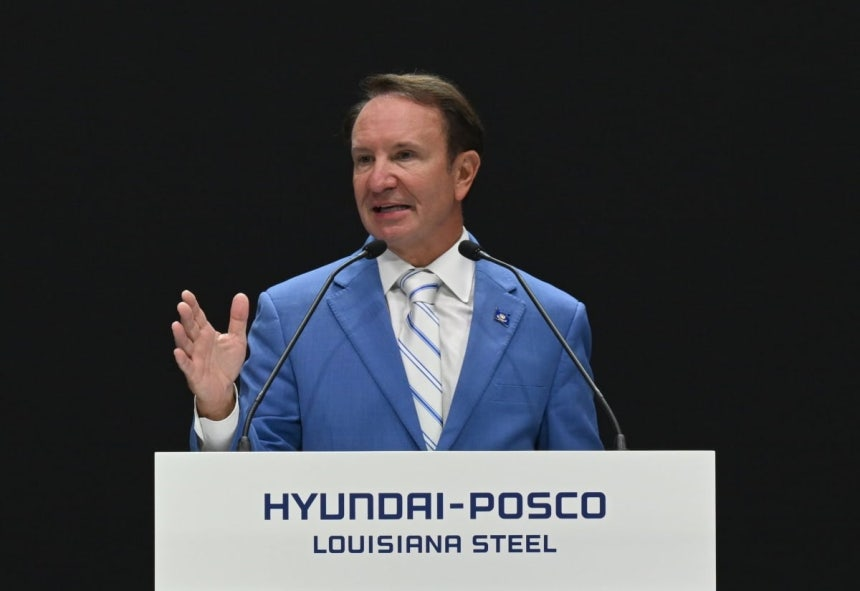

 Louisiana Governor Jeff Landry speaks at the groundbreaking ceremony for the Hyundai Steel-POSCO Louisiana Steel (HPLS) electric arc furnace mill on Sept. 4 local time. Courtesy of Hyundai Motor Group