U.S. manufacturing expands at fastest pace in over 4 years amid foreign investment surge


WASHINGTON — U.S. manufacturing activity expanded in July at its strongest pace in more than four years, marking a seventh consecutive month of growth, as foreign companies announced billions of dollars in new American investments that are expected to create thousands of jobs, according to data cited by the White House.

The Institute for Supply Management’s Manufacturing Purchasing Managers’ Index showed the sector expanding in July, according to the White House, which said the figure reversed a pattern of contraction during the previous administration outside a brief post-pandemic period. New export orders also returned to expansion territory, the White House said in a statement.

“U.S. manufacturing is booming, expanding at the fastest pace since 2022 and beating expectations in many metrics for the month of July,” Bloomberg’s Lisa Abramowicz posted on X. An economist cited in the same report noted that the ISM production index rose by the most for any July since 1951.

US manufacturing is booming, expanding at the fastest pace since 2022 and beating expectations in many metrics for the month of July. Omar Sharif of Inflation Insights points out that the ISM production index rose by the most for any July since 1951. https://t.co/SiVnhJghQA pic.twitter.com/I1tbaOyiJi

— Lisa Abramowicz (@lisaabramowicz1) August 3, 2026

Manufacturing wages rose 4.2% year over year, outpacing inflation, the White House said. The Federal Reserve Bank of Philadelphia’s latest survey showed general activity and new orders near five-year highs.

The White House credited President Donald Trump’s Working Families Tax Cuts and America First trade policies for the turnaround. The administration said the tax cuts have supported 6 million American jobs, protected $540 billion in worker wages and preserved $1.1 trillion in U.S. economic activity.

Factory construction has added 83,000 jobs since Trump took office, and more than 18,000 manufacturing jobs have been created in 2026 alone, reversing earlier declines, according to the White House.

Broader economic indicators also pointed upward. The Atlanta Fed’s GDPNow model projected 6.2% annualized growth in the third quarter. Nonresidential fixed investment rose 11.7% in the prior quarter, the fastest pace since 2023. Orders for business equipment were on track for an all-time high in 2026, and capital goods imports exceeded 40% of all U.S. goods imports, a record share as factories expand and retool, the White House said.

Foreign investment announcements this year underscore the trend. The White House highlighted several recent investment announcements, including Switzerland-based Octapharma, which said this week it will invest $1.5 billion to build its first U.S. production facility in South Carolina, creating 1,500 jobs.

Other recent commitments include:

  • Novartis: $23 billion across 10 U.S. manufacturing and research facilities, creating 4,000 jobs.
  • Roche: $50 billion in U.S. manufacturing and R&D, creating more than 12,000 jobs.
  • UCB: $2 billion for its first U.S. biologics plant in Georgia, creating more than 800 jobs.
  • Toyota: $3.6 billion to expand truck production in San Antonio, creating 2,000 jobs.
  • TSMC: $265 billion in U.S. semiconductor manufacturing, expected to create tens of thousands of jobs.
  • Wistron, in partnership with NVIDIA: $700 million for AI-related manufacturing in Texas, creating up to 1,000 jobs.
  • Siemens: $165 million to expand U.S. manufacturing, creating more than 350 jobs.
  • Zerluma: $50 million for an aluminum recycling plant, creating 70 jobs.

The White House said the administration will continue policies aimed at reshoring manufacturing, strengthening domestic supply chains and prioritizing American workers.


Free Training

Source link

US manufacturing hits 4-year high as exports rebound in July


US factory indicators strengthened in July, with demand, production and hiring improving in signals relevant to manufacturers, importers, exporters and sourcing teams tracking US industrial capacity.

For textile and apparel supply-chain participants, the key signals include the return of export-order growth, rising factory payrolls and increased capital-goods imports linked to retooling and expansion of factory capacity.

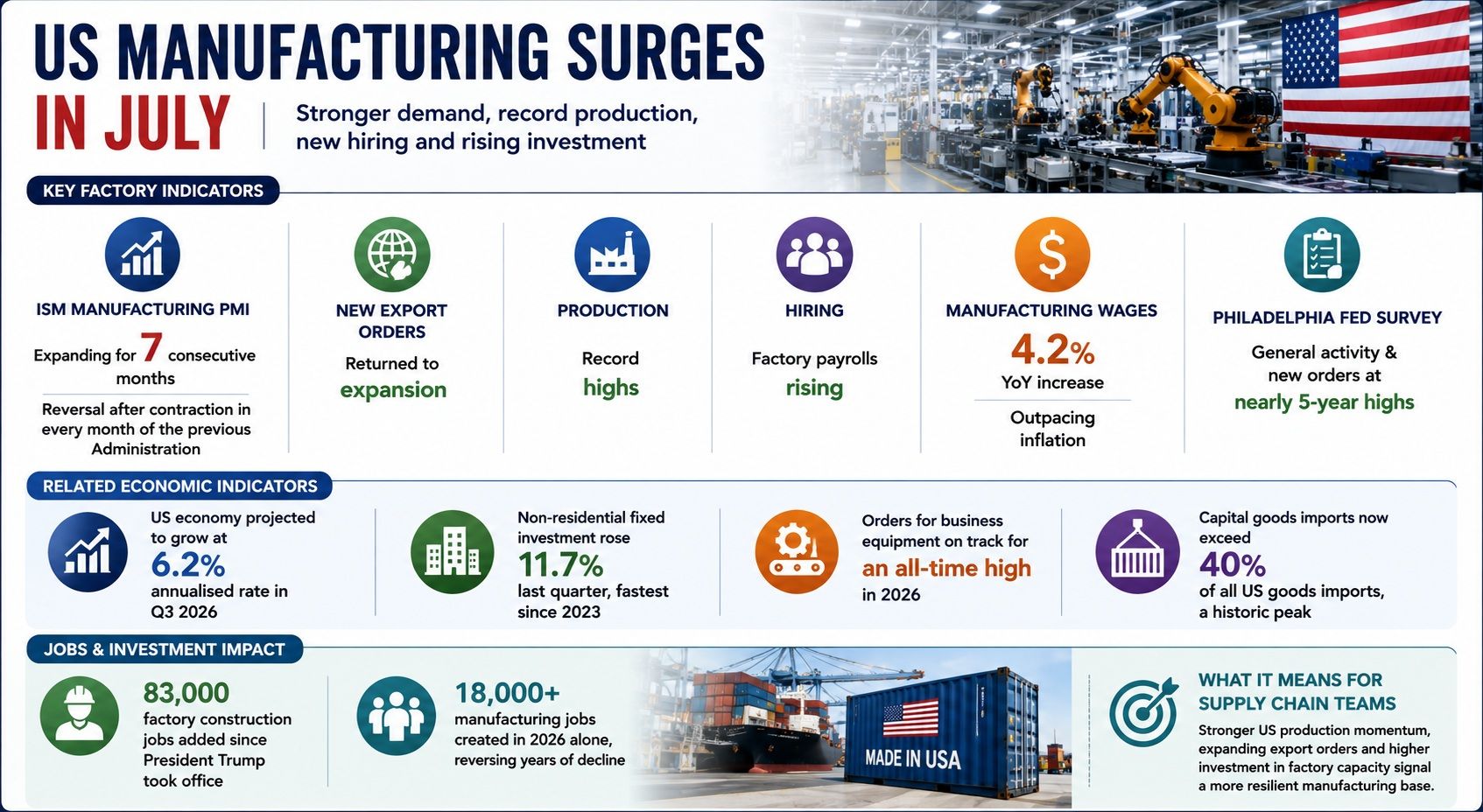
US manufacturing activity surged in July at the strongest rate in more than four years, with the ISM PMI expanding for a seventh straight month.
New export orders returned to expansion, while production, payrolls and wages rose, signalling stronger demand for US-made goods.
Capital goods imports exceeded 40 per cent of US goods imports as factories retooled and expanded.

US manufacturing activity surged in July at the strongest rate in more than four years, driven by strong demand, record production and new hiring, the White House said in press release.

The White House noted that the Institute for Supply Management (ISM) Manufacturing PMI showed the sector expanding for the seventh consecutive month. It described this as a reversal after contraction in every month of the previous Administration, outside a temporary post-pandemic bounce. New export orders also moved back into expansion.

Citing Federal Reserve indicators, the White House said manufacturing activity, payrolls and wages were rising nationwide. Manufacturing wages climbed 4.2 per cent year-on-year (YoY), outpacing inflation. Philadelphia Fed survey showed general activity and new orders at nearly five-year highs, added the release.

It mentioned President Trump’s Working Families Tax Cuts had supported six million American jobs, protected $540 billion in worker wages and preserved $1.1 trillion in US economic activity.

The White House also listed several related indicators: the US economy is projected to grow at a 6.2 per cent annualised rate in the third quarter of 2026; non-residential fixed investment rose 11.7 per cent last quarter, the fastest since 2023; orders for business equipment are on track for an all-time high in 2026; and capital goods imports now exceed 40 per cent of all US goods imports, which it called a historic peak as factories retool and expand.

The release further added that 83,000 factory construction jobs had been added since President Trump took office, and more than 18,000 manufacturing jobs had been created in 2026 alone, reversing years of decline. For sourcing and manufacturing teams, the published indicators frame July as a month of stronger US production momentum, expanding export orders and higher investment in factory capacity.

Fibre2Fashion News Desk

Free Training

Source link

Nebraska Manufacturing Growth Slows as Regional Economy Continues to Expand


By Allison Peck

 The Tyson beef plant in Lexington, shown in December, 2026 closure accounted for 3,212 jobs. (Juan Salinas II/Nebraska Examiner) The Tyson beef plant in Lexington, shown in December, 2026 closure accounted for 3,212 jobs. (Juan Salinas II/Nebraska Examiner)

Manufacturing activity across the Mid-America region remained in growth territory for the sixth consecutive month in July, according to the latest Creighton University Mid-America Business Conditions Index. While the regional economy continues to show steady expansion, Nebraska recorded the weakest manufacturing performance among the nine states included in the monthly survey.

The overall Business Conditions Index slipped slightly to 55.7 in July from 56.0 in June. A reading above 50 indicates growth in the manufacturing sector.

Ernie Goss, director of Creighton University’s Economic Forecasting Group, said regional manufacturers continue to perform well despite persistent inflationary pressures.

“Regional manufacturing growth continues on a solid pace but with elevated inflationary pressures at the wholesale level,” Goss said.

Inflation remains a major concern for manufacturers. Although the wholesale price index declined from June, it stayed well above growth-neutral levels, leading researchers to conclude the Federal Reserve is unlikely to lower interest rates over the next several months.

Supply managers also reported continued effects from the war in Iran. Nearly two-thirds said the conflict has led to shipping delays and higher transportation costs, while more than 93 percent reported they have been able to pass those increased costs on to customers.

Employment across the region showed modest improvement, with the manufacturing employment index moving above growth-neutral for only the second time in the past year. About one in four companies reported adding workers during July, while only one in 13 reported layoffs.

Some manufacturers also reported signs that production is returning to the United States.

“It is encouraging to see reshoring taking place,” one supply manager said. “Two major customers have moved operations from Mexico to the U.S.”

In Nebraska, the Business Conditions Index fell to 51.1 in July from 52.5 in June, the lowest reading among the nine-state region. While the state’s manufacturing sector continued to expand slightly, its employment index dropped to 46.6, indicating continued job losses.

According to U.S. Bureau of Labor Statistics data cited in the report, Nebraska has lost approximately 4,700 manufacturing jobs over the past 12 months, a decline of 4.6 percent. The food processing industry accounted for about 4,000 of those lost jobs.

Despite Nebraska’s weaker performance, business leaders across the region remain cautiously optimistic. The six-month Business Confidence Index climbed to 57.7 in July, its highest level since January. However, Goss warned that continued geopolitical tensions, higher oil prices and supply disruptions could weaken confidence in the months ahead.

The Creighton University survey measures manufacturing activity in Arkansas, Iowa, Kansas, Minnesota, Missouri, Nebraska, North Dakota, Oklahoma and South Dakota and is considered a leading indicator of economic conditions across the Mid-America region.

Free Training

Source link