

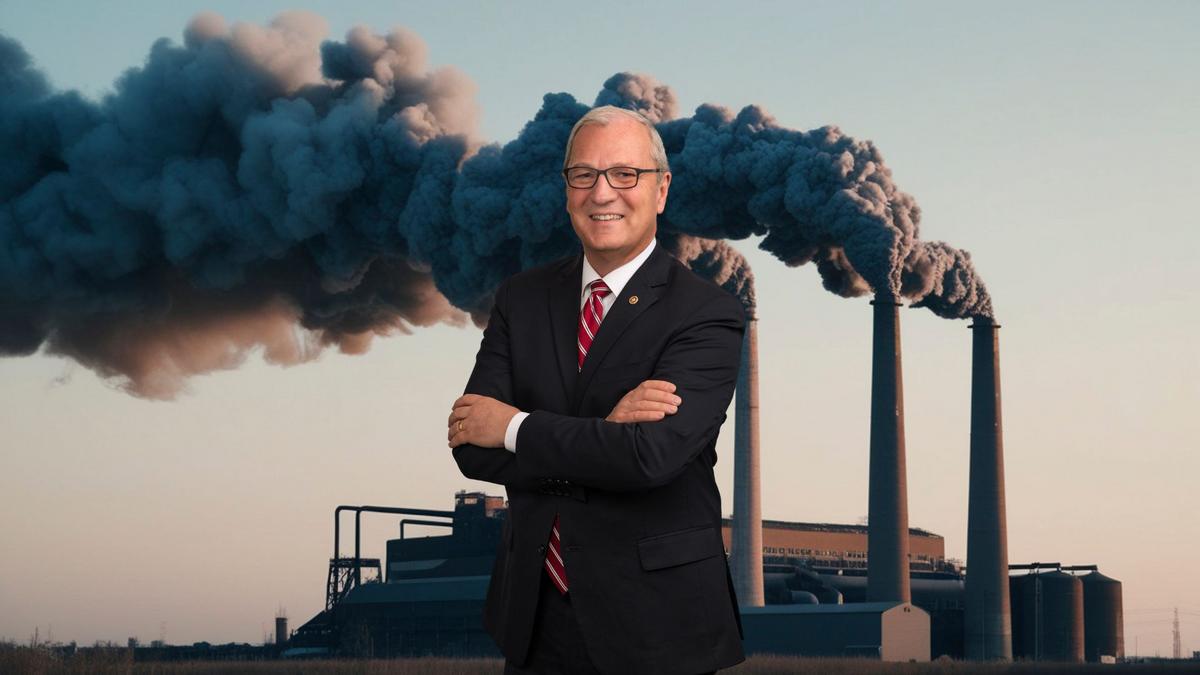

Cramer’s PROVE IT Act Focuses On American Manufacturing Emissions
The Senate passed three appropriations bills Jan. 15, and President Trump later signed them into law, including a provision with potential consequences for U.S. manufacturers.
The bills direct the Department of Energy, in consultation with the National Energy Technology Laboratory, to conduct a comprehensive study comparing the emissions intensity of certain goods produced in the United States with those same products made overseas, an effort aimed at documenting America’s environmental performance in global trade.
The directive builds on bipartisan legislation introduced last Congress by U.S. Sens. Kevin Cramer, R-N.D., and Chris Coons, D-Del. Their proposal, the Providing Reliable Objective Verifiable Emissions Intensity and Transparency (PROVE IT) Act, passed the Senate Environment and Public Works Committee in January 2024.
Cramer has described the bill as “low-hanging fruit” for promoting American manufacturing standards and countering foreign trade policies.
“We’ve known for a long time that manufacturers here in the United States make some of the cleanest products in the world,” Cramer said. “We can actually prove it, and we should. We should use that excellence as an advantage to ensure that our producers aren’t discriminated against by our trade partners or worse, undercut by polluting countries like China.”
The study will cover products affected by the European Union’s Carbon Border Adjustment Mechanism, which took effect Jan. 1.
The policy places tariffs on imports such as steel, cement, aluminum, fertilizers and electricity if they are deemed more carbon-intensive than European products, with possible expansion to additional manufactured goods.
Cramer said the report will help establish emissions transparency as a core component of U.S. trade policy. “It’s really an America First approach,” he said, adding that he looks forward to working with the administration “to make it a tradition, and make it a part of our trade policy going forward.”
