AbbVie to create 300 new jobs with $380m Illinois manufacturing investment


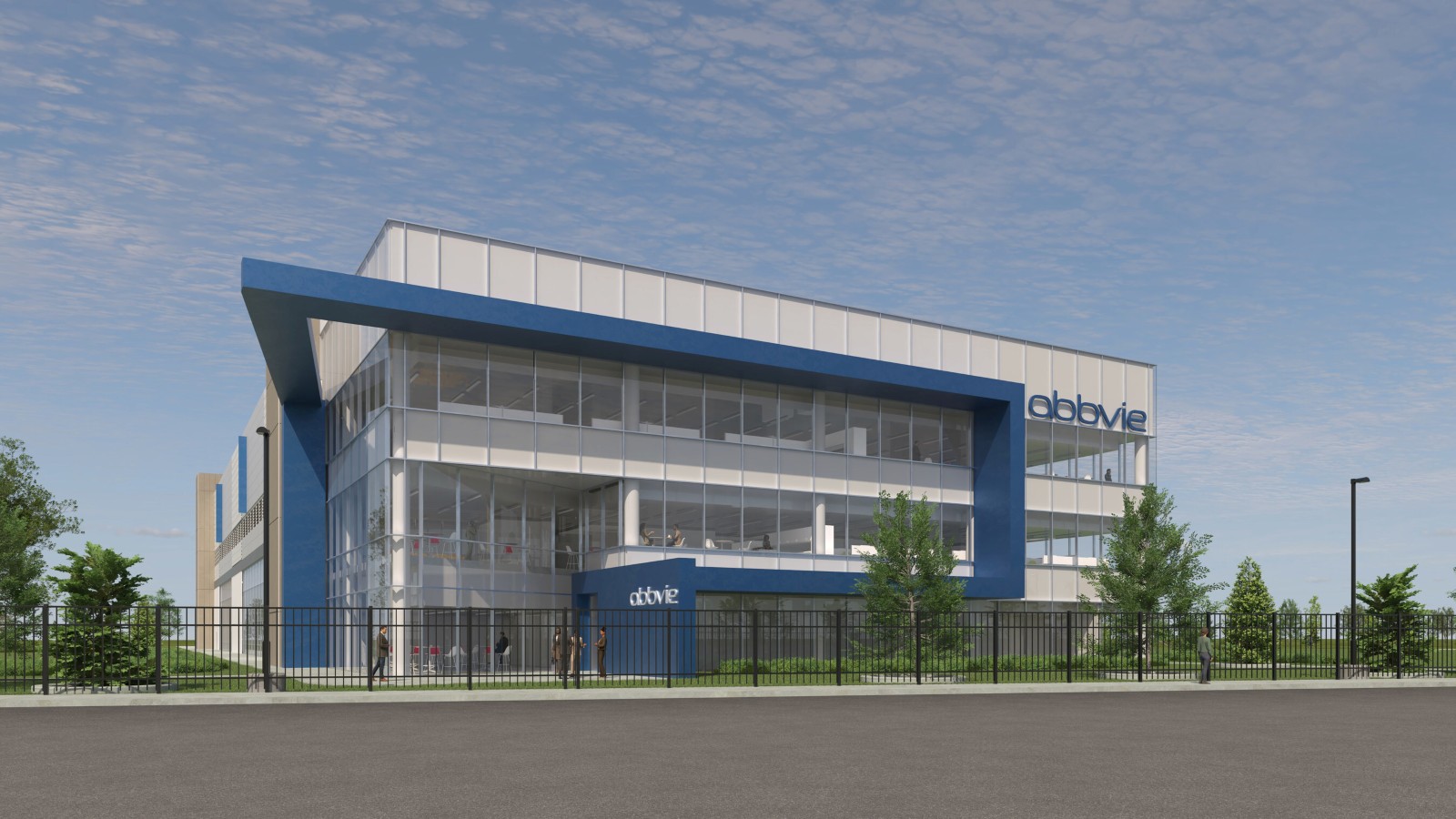
AbbVie has announced a $380m investment to build two new active pharmaceutical ingredient (API) manufacturing facilities at its North Chicago campus, expanding U.S. production capacity for next-generation medicines and creating around 300 new jobs.

The new facilities will support production of AbbVie’s future neuroscience and obesity treatments, integrating advanced manufacturing technologies and artificial intelligence into API production processes. Construction is scheduled to begin in spring 2026, with both plants expected to be operational by 2029.

AbbVie CEO Robert A. Michael said the project reflects the company’s long-term commitment to U.S. manufacturing.

“This milestone demonstrates further progress against our $100bn commitment to U.S. R&D and capital investments over the next decade,” he said. “By strengthening our U.S. manufacturing capabilities, we are well-positioned to support our investment in innovation and enhance our ability to deliver next-generation medicines to patients.”

API manufacturing involves producing the active components responsible for a drug’s therapeutic effects, a complex multi-step process often outsourced globally. AbbVie has spent the past six months outlining plans to expand API capacity in the United States.

In September 2025, the company broke ground on a chemical synthesis facility intended to bring production of selected neuroscience, immunology and oncology APIs back from Europe and Asia to the U.S.

The latest investment is expected to support approximately 300 new roles in North Chicago, including engineers, scientists, manufacturing operators and laboratory technicians.

AbbVie employs around 29,000 people across the United States, including more than 6,000 at its domestic manufacturing sites and over 11,500 in Illinois. The North Chicago expansion reinforces the company’s long-standing presence in the state, where it is headquartered.

The investment also forms part of a wider U.S. manufacturing push. AbbVie recently announced plans to acquire a device manufacturing facility in Arizona and expand operations in Massachusetts, and said it is in talks with several states about additional projects expected to be announced in 2026.

AbbVie’s move reflects a wider trend across North American pharmaceutical manufacturing, where companies are investing in domestic API production to improve supply-chain resilience, meet regulatory expectations, and take advantage of government incentives.

As demand rises for obesity and neuroscience treatments, increased U.S. API capacity could play a key role in ensuring reliable supply while accelerating the adoption of advanced manufacturing technologies.

Free Training

Source link

Did New U.S. Defense-Focused Manufacturing Partnerships Just Shift Amprius Technologies’ (AMPX) Investment Narrative?


  • Recently, Needham began covering Amprius Technologies, highlighting its silicon-anode battery technology and citing a US$35 million unmanned aerial systems order alongside contract manufacturing capacity of 1.8 GWh.
  • A separate agreement made Nanotech Energy Amprius’ first U.S.-based manufacturing partner, aligning its high-performance batteries with domestic sourcing rules for defense applications.
  • Next, we’ll examine how this new U.S. manufacturing partnership may influence Amprius’ investment narrative and future growth assumptions.

This technology could replace computers: discover 23 stocks that are working to make quantum computing a reality.

Amprius Technologies Investment Narrative Recap

To own Amprius, you need to believe its silicon-anode batteries can convert early traction in drones and defense into durable, profitable demand while it scales manufacturing. The Nanotech Energy partnership directly addresses one near term catalyst and risk at once: it could support US defense opportunities that require local supply, while beginning to reduce the company’s heavy reliance on overseas contract manufacturing and the related geopolitical and supply chain uncertainties.

Among the recent updates, the Nanotech Energy alliance stands out as most relevant. By adding Amprius’ first US-based manufacturing partner for its silicon-anode cells, the company is creating a domestic pathway that aligns with updated National Defense Authorization Act sourcing rules. For investors focused on catalysts, this matters because it directly intersects with Amprius’ concentration in aviation and drones and its goal of securing higher visibility, defense-linked production orders.

Yet behind the promise of US manufacturing, investors should also be aware of how concentrated defense and drone demand leaves Amprius exposed to shifts in procurement cycles and…

Read the full narrative on Amprius Technologies (it’s free!)

Amprius Technologies’ narrative projects $306.6 million revenue and $13.4 million earnings by 2028. This requires 89.8% yearly revenue growth and a $52.1 million earnings increase from $-38.7 million today.

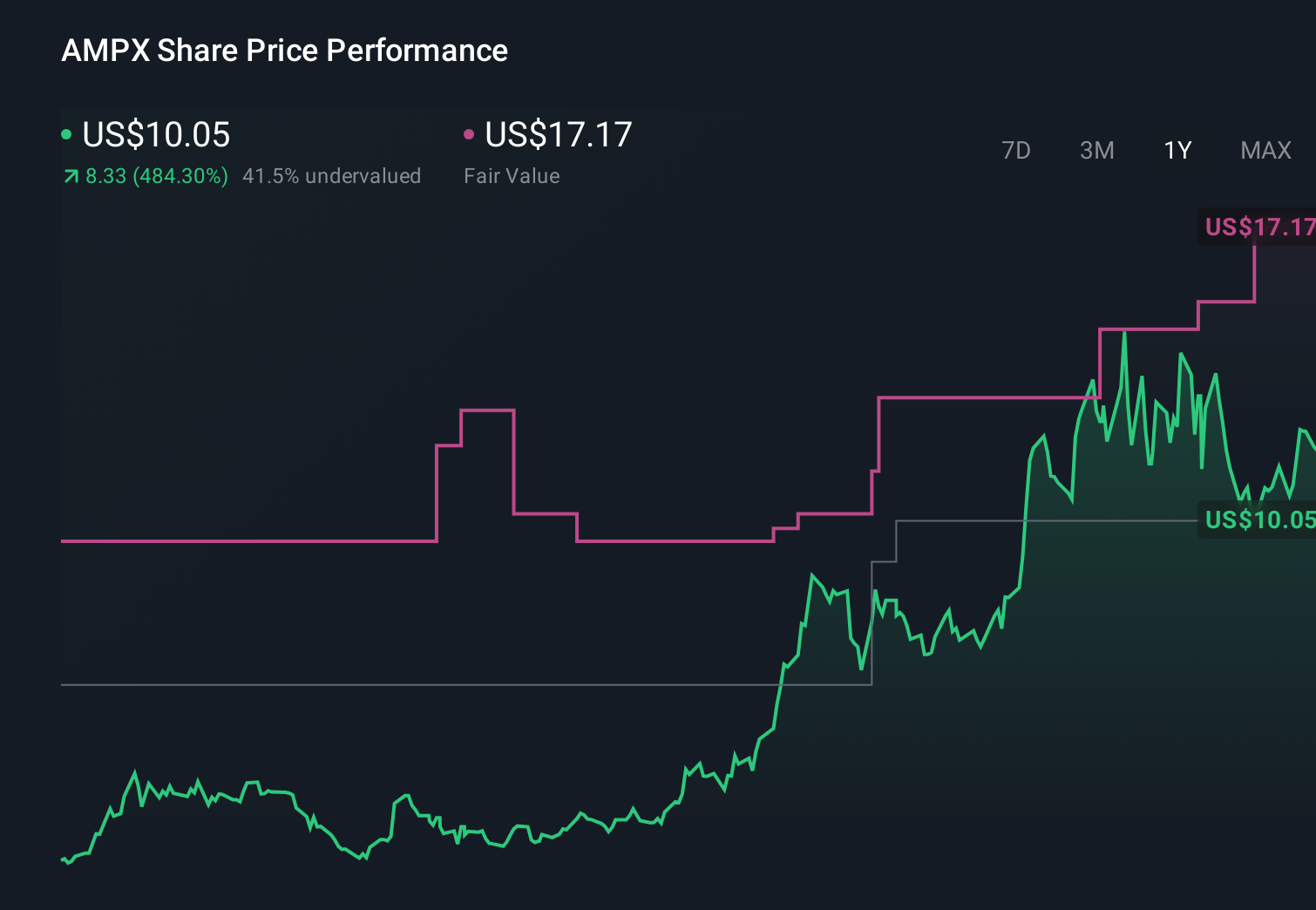
Uncover how Amprius Technologies’ forecasts yield a $17.57 fair value, a 85% upside to its current price.

Exploring Other Perspectives

AMPX 1-Year Stock Price ChartAMPX 1-Year Stock Price Chart

Some of the lowest ranked analysts took a far more cautious view, even while modeling roughly 77.6% annual revenue growth and a potential US$25.5 million profit by 2028, highlighting how sensitive those outcomes could be if drone demand weakens or external manufacturing partners run into trouble.

Explore 9 other fair value estimates on Amprius Technologies – why the stock might be worth less than half the current price!

Form Your Own Verdict

Don’t just follow the ticker – dig into the data and build a conviction that’s truly your own.

Interested In Other Possibilities?

These stocks are moving-our analysis flagged them today. Act fast before the price catches up:

This article by Simply Wall St is general in nature. We provide commentary based on historical data
and analyst forecasts only using an unbiased methodology and our articles are not intended to be financial advice.
It does not constitute a recommendation to buy or sell any stock, and does not take account of your objectives, or your
financial situation. We aim to bring you long-term focused analysis driven by fundamental data.
Note that our analysis may not factor in the latest price-sensitive company announcements or qualitative material.
Simply Wall St has no position in any stocks mentioned.

New: Manage All Your Stock Portfolios in One Place

We’ve created the ultimate portfolio companion for stock investors, and it’s free.

• Connect an unlimited number of Portfolios and see your total in one currency
• Be alerted to new Warning Signs or Risks via email or mobile
• Track the Fair Value of your stocks

Try a Demo Portfolio for Free

Have feedback on this article? Concerned about the content? Get in touch with us directly. Alternatively, email editorial-team@simplywallst.com

Free Training

Source link

How Smart Policy Attracts Manufacturing Investment


Policymakers can use two basic strategies to attract manufacturing investments. These involve attractive incentives — the carrot — which include subsidies, grants and tax credits, or negative incentives — the stick — which include tariffs and threats.

Using credible data that tells a compelling story, I will explain why the carrot has been and will continue to be much more effective than the stick in attracting manufacturing investment.

The data

The St. Louis Federal Reserve publishes US Census Bureau data on actual investments in new or expanded manufacturing facilities, titled “Total Construction Spending: Manufacturing in the United States.” It is seasonally adjusted and reported monthly on an annualized basis.

During the Biden administration, manufacturing construction spending tripled from $76.5 billion in January 2021 to $230.9 billion in January 2025. This represented one of the largest industrial construction booms in US history, driven primarily by large semiconductor, battery and advanced manufacturing projects.

Due to normal megaproject investment cycles, these projects are front-loaded with capital-intensive spending on site preparation, foundation work and structural construction, using massive volumes of concrete and steel. Consequently, manufacturing construction spending peaked in June 2024 at $240.1 billion and slowed in later phases due to less capital-intensive spending on machinery, equipment and installation, much of which is recorded outside of the St. Louis Fed’s manufacturing construction spending data.

The carrot

Using subsidies, grants, loans, tax credits and state incentives, the CHIPS and Science Act signed by President Joe Biden in August 2022 attracted large amounts of capital into semiconductor manufacturing, spurring new fabrication plants and related infrastructure. It also created an entire ecosystem of suppliers, workers and innovation improving American competitiveness, and is primarily responsible for the manufacturing construction boom reflected in the St. Louis Federal Reserve data.

Stated by the Semiconductor Industry Association, enactment of the CHIPS and Science Act was a pivotal moment in recent American history, uniting government leaders from across the political spectrum to reinvigorate US semiconductor production and reinforce America’s economic strength, national security and technological competitiveness.

The carrot or positive incentives offered by the CHIPS and Science Act, combined with the Infrastructure Investment and Jobs Act, signed in November 2021, and the Inflation Reduction Act, signed in August 2022, boosted broader industrial and clean-energy facility investment. The message was clear: America is open for business, and we’re willing to invest in your success. This approach made investing in the US manufacturing sector very attractive.

The stick

Beginning with President Donald Trump’s second term through October 2025 (the latest available data), construction spending in manufacturing declined to $214.1 billion. Some of this is attributed to less capital-intensive spending in later phases, as explained above. However, the primary factor likely is trade uncertainty caused by President Trump’s on-again, off-again tariffs, delays, reversals and threats — the stick.

According to Anirban Basu, chief economist for the Associated Builders and Contractors, “With CHIPS Act-enabled megaprojects winding down and the stiff headwind of trade policy, manufacturing construction spending has fallen by nearly 10% over the past 12 months.”

There are many examples of stiff headwinds caused by erratic policies. Take South Korea, for example. On April 2, 2025, Liberation Day, President Trump announced tariffs of up to 25% on South Korea. Critics argued this was inconsistent with the United States–Korea Free Trade Agreement (KORUS FTA), which has been in force since March 15, 2012. Three months later, on July 30, 2025, the two countries announced and later finalized the Korea Strategic Trade and Investment Deal, which reduced tariffs to 15% and included the understanding that South Korea would invest $350 billion in the United States.

Two months later, on September 4, 2025, US Immigration and Customs Enforcement (ICE) raided the construction site of the South Korean-owned Hyundai Motor Group/LG Energy Solution battery plant in Ellabell, Georgia. ICE detained several hundred South Korean nationals, many of whom were engineers and technicians training American workers and installing specialized machinery. According to immigration attorney Charles Kuck, his South Korean clients were legally in the US under B-1 visitor visas or the Visa Waiver Program (ESTA).

Even though the Trump administration offered to allow the South Korean workers to remain in the United States to complete their work, most decided to leave due to the unpleasant experience of being shackled, treated like criminals and unsure if they could trust the visa process. In response, South Korean President Lee Jae Myung said, “Under the current circumstances, Korean companies will be very hesitant to make direct investments in the United States.”

The problems did not end here. In January 2026, President Trump announced that because the South Korean National Assembly had not yet passed implementing legislation for the 2025 deal, he would increase tariffs on Korean imports back up to 25%.

Uncertainty and the pause button

The chaotic tariffs and threats have caused economic uncertainty to skyrocket, costs to escalate and investors to be unable to predict what’s ahead. As a result of this and the Georgia immigration action, firms have become more cautious about committing to long-term capital projects in the United States and have hit the pause button.

Stated by Andrew Yeo, a senior fellow at the Brookings Institution, “Allies are receiving mixed signals. The South Korea case has made countries like Japan and even EU nations nervous.”

According to the American Institute of Architects’ January 2026 Consensus Construction Forecast, “Producers and investors typically have not had much clarity as to what countries, what products, or what tariff levels might be in place over the longer term. This makes decision-making difficult and often encourages inaction in supply chain sourcing and investment decisions.”

Not surprisingly, industry forecasts predict a continued decline in manufacturing construction spending.

A better approach

If the goal is to strengthen American manufacturing, US policy needs to focus more on carrots and less on sticks. The CHIPS Act demonstrates that positive incentives work. Expanding similar programs to attract capital to critical industries — advanced materials, batteries, clean energy and biotechnology — would help boost US competitiveness.

This approach is especially urgent given China’s relentless investment strategy and potential US-China hostility. The US cannot afford to cede its competitive advantages through policy uncertainty.

Importantly, strengthening relationships and working more closely with our allies to achieve our manufacturing goals would be an essential step in the right direction. America’s advanced semiconductor manufacturing depends on global supply chains. Alienating these partners through unpredictable tariffs and immigration raids undermines our own competitiveness.

The choice is clear: we can invest in our future through strategic incentives and stable partnerships or watch manufacturing investment go to more predictable shores. This may be a tall order today, but it will be necessary tomorrow.

[Kaitlyn Diana edited this piece.]

The views expressed in this article are the author’s own and do not necessarily reflect Fair Observer’s editorial policy.

Free Training

Source link

Siemens Energy to add 120 jobs in Fort Payne as part of $1 billion U.S. manufacturing investment


Siemens Energy plans to add 120 advanced manufacturing jobs at its Fort Payne facility as part of a more than $1 billion U.S. investment initiative, according to a joint announcement from the DeKalb County Economic Development Authority and the City of Fort Payne.

The expansion will increase production capacity at the longtime Northeast Alabama plant and is expected to strengthen the region’s role in energy-sector manufacturing.

The Fort Payne facility, which opened in 1988, currently employs about 250 workers. Officials said the added positions will support expanded production of copper and insulated electrical components used in power-generation equipment. The growth is expected to position Siemens Energy among DeKalb County’s five largest manufacturing employers based on current employment levels.

Siemens Energy President of North America Matt Neal said the company’s technology already plays a major role in U.S. power generation and demand is rising.

“Twenty-five percent of the power generated in the United States relies on Siemens Energy technology and that process starts here in Alabama. We need more electricity to fuel our daily lives and our growing economy and that has increased demand for our equipment. Throughout the country we are expanding manufacturing and hiring more workers and doing so in places like Fort Payne where we already have a great workforce, a robust pipeline of talent, and strong partnerships with the community,” Neal said.

Alabama Commerce Secretary Ellen McNair said the expansion reflects confidence in the state’s workforce and business climate.

“Siemens Energy’s expansion in Fort Payne is a tremendous vote of confidence in the highly skilled local workforce and underscores the strong community partnerships with business in our state,” McNair said. “We are excited to watch this new phase of growth unfold and stand ready to help the company achieve its future strategic goals and innovations.”

Brett Johnson, Executive Director of the DeKalb County Economic Development Authority, said the project strengthens the county’s industrial base.

“Existing industries like Siemens Energy are the backbone of DeKalb County’s growing economy,” Johnson said. “As a major employer, Siemens Energy’s continued reinvestment creates long-term stability, higher-wage jobs, and sustained economic growth for our communities. The work being done at the Siemens Energy manufacturing plant in Fort Payne is literally helping generate reliable power around the globe, and that is the kind of work we can all be proud to say is made right here in DeKalb County, Alabama.”

Fort Payne Mayor Brian Baine said the additional jobs will have a regional ripple effect.

“These are the kinds of high-quality, advanced manufacturing jobs that strengthen families and elevate our workforce,” Baine said. “This manufacturing investment will transform the trajectories of 120 families across our region and create a wider ripple effect throughout our local economy. Investments like these create new opportunities for small businesses, workforce development, and our entire community. We welcome this investment and stand ready to support Siemens Energy throughout the process.”

Bryan Wilkin, Siemens Energy’s Director of Operations in Fort Payne, said the company plans to grow both its workforce and its community involvement.

“Siemens Energy is buzzing with excitement as we announce significant growth and investment in our Fort Payne factory. This expansion not only marks a milestone in our company’s journey but also brings a wave of new job opportunities to the area. We are thrilled to share that we will be hiring a substantial number of new employees, which will undoubtedly have a positive impact on our local economy and provide stability for many families. Our current employees can also rest assured that their positions remain stable and secure as we recognize and appreciate their continued hard work and dedication. In addition to these exciting developments, we are proud of our ongoing involvement in community initiatives. Our factory remains dedicated to supporting local events, charities, and projects that benefit the well-being of our neighbors. As we move forward with these plans, we invite the community to join us in celebrating this new chapter together,” Wilkin said.

Siemens Energy became an independent energy technology company after being spun off from Siemens AG in 2020 and operates more than two dozen facilities across the United States, including multiple manufacturing sites.

With the planned hiring and production increase, local leaders say the Fort Payne expansion adds to growing momentum for advanced manufacturing across Northeast Alabama.

Sherri Blevins is a reporter for 256 Today.

Free Training

Source link

EOS expands U.S. manufacturing and logistics with $3 million investment in Texas


EOS, a company that develops industrial metal and polymer 3D printing systems, has expanded its U.S. manufacturing and logistics operations through a $3 million investment in central Texas. The expansion includes changes to its manufacturing campus in Pflugerville, Texas, and the opening of a new warehouse facility in Belton, Texas. According to the company, the investment is intended to support regional assembly and delivery of metal additive manufacturing systems for North American customers.

The Pflugerville site has been reconfigured to support expanded assembly of several metal 3D printing platforms, including the EOS M 290-1, EOS M 290-2, and EOS M 400-4 systems.The facility now includes a dedicated powder handling area and an in-house machine shop. Ten new jobs were created at the Pflugerville production site, covering operations, quality assurance, engineering, and machine commissioning roles.

EOS Pflugerville metal 3D printing assembly line. Photo via EOS.EOS Pflugerville metal 3D printing assembly line. Photo via EOS.Technician operating an EOS M 290 metal 3D printing system. Photo via EOS.

Expanded manufacturing space in Pflugerville was made available following the consolidation of the manufacturer’s North American warehouse and logistics operations into a new facility in Belton, Texas. The Belton warehouse spans 40,000 square feet and is intended to support a larger inventory of spare parts, peripheral equipment, and products. The company said the facility will support its U.S. customer base by increasing the availability of components and equipment used alongside its additive manufacturing systems.

Company representatives linked the expansion to growing demand for metal additive manufacturing systems in North America and to domestic procurement requirements. Kent Firestone, senior vice president of operations at EOS North America, said the Texas expansion allows the company to scale metal system assembly in the region. “Our Texas expansion enables us to scale North American metal AM assembly with both precision and consistency,” Firestone said. “From optimizing our production areas to onboarding new team members, every step has been carefully designed to accelerate turnaround times while maintaining the quality and reliability our customers expect from EOS.”

EOS Pflugerville metal 3D printing assembly line. Photo via EOS.EOS Pflugerville metal 3D printing assembly line. Photo via EOS.EOS Pflugerville metal 3D printing assembly line. Photo via EOS.

The expansion builds on existing U.S. activities, including assembly of the EOS M 290 system announced in September 2024, production of the INTEGRA P 450 polymer additive manufacturing system in Texas, and polymer material development and manufacturing through Advanced Laser Materials in Temple, Texas. The company also cited nearly two decades of experience supporting additive manufacturing hardware, software, and materials in North America, operating under ISO 9001-certified processes.

Glynn Fletcher, president of EOS North America, described the expansion as part of the company’s long-term presence in the United States. “This expansion demonstrates our continued commitment to support the resurgence of American manufacturing,” Fletcher said. “This manufacturing facility is not just an investment in our own infrastructure; it is also about standing shoulder-to-shoulder with the U.S. manufacturing community to provide products and services for a superior customer experience.” Fletcher added that EOS views additive manufacturing as an important component of future domestic manufacturing activity and said the Texas facilities position the company to continue supporting U.S. markets where demand for its technology is growing.

EOS certifications and installed base highlight manufacturing constraints

EASA Part-21/G qualification put EOS metal 3D printing into a certified aviation production workflow through the Aviation AM Centre (AAMC), an EASA-approved aviation production organization. AAMC became the first independent additive manufacturing company to qualify EOS metal technology under its EASA Part-21/G approval, enabling certified aircraft components produced via powder bed fusion. The approval allows issuance of EASA Form 1 airworthiness certification for parts made from aluminum, titanium, stainless steel, and copper, with certified spares delivered directly to maintenance providers instead of routing certification through OEMs. 

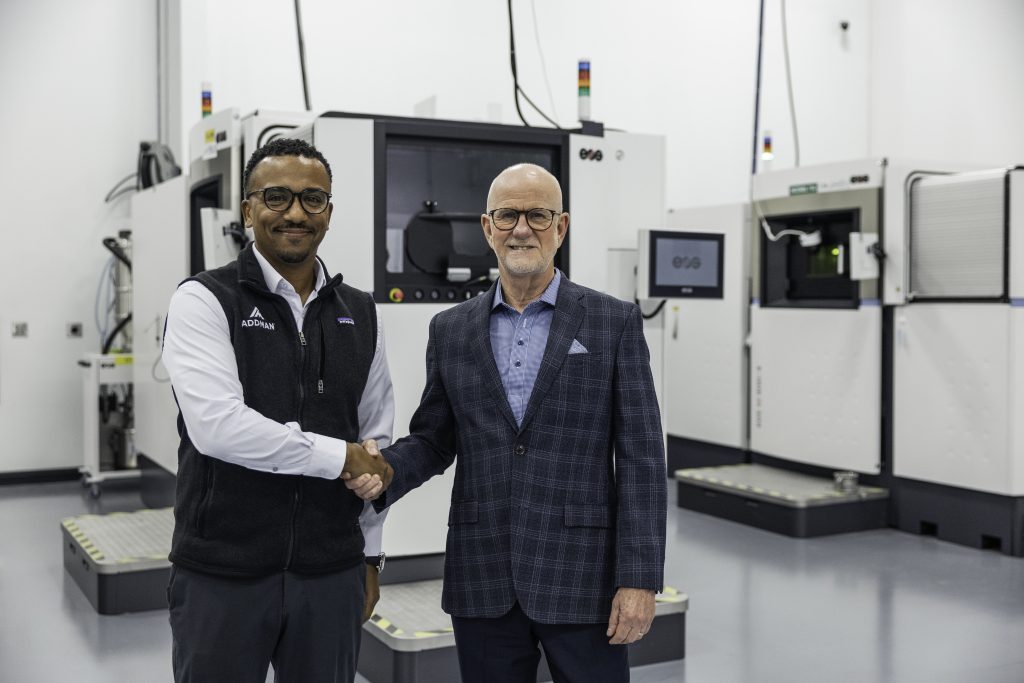
5,000th industrial 3D printer installation marked a separate scale milestone when EOS reported deployment of its 5,000th industrial system, an EOS M 400-4 installed at Keselowski Advanced Manufacturing in Statesville, North Carolina. Keselowski Advanced Manufacturing, founded by race car driver and entrepreneur Brad Keselowski, said it applies advanced engineering solutions and 3D printing technologies to industrial applications. The installation brought the site’s total EOS machine count to 18, reflecting expanded metal additive manufacturing capacity within a single U.S. production operation.

Joe Calmese, CEO of ADDMAN, and Glynn Fletcher, president of EOS North America, mark the installation of EOS’s 5,000th industrial 3D printer. Photo via ADDMAN.Joe Calmese, CEO of ADDMAN, and Glynn Fletcher, president of EOS North America, mark the installation of EOS’s 5,000th industrial 3D printer. Photo via ADDMAN.Joe Calmese, CEO of ADDMAN, and Glynn Fletcher, president of EOS North America, mark the installation of EOS’s 5,000th industrial 3D printer. Photo via ADDMAN.

The 3D Printing Industry Awards are back. Make your nominations now.

Are you building the next big thing in 3D printing? Join the 3D Printing Industry Start-up of the Year competition and expand your reach.

Subscribe to the 3D Printing Industry newsletter to stay updated with the latest news and insights.

Featured photo shows Technician operating an EOS M 290 metal 3D printing system. Photo via EOS.

Free Training

Source link

BD announces $110m U.S. manufacturing investment


BD (Becton, Dickinson and Company), a leading global medical technology company, has announced a $110m investment to expand its production of prefillable syringes, helping accelerate biologic and GLP-1 drug delivery and supporting pharmaceutical reshoring in the U.S.

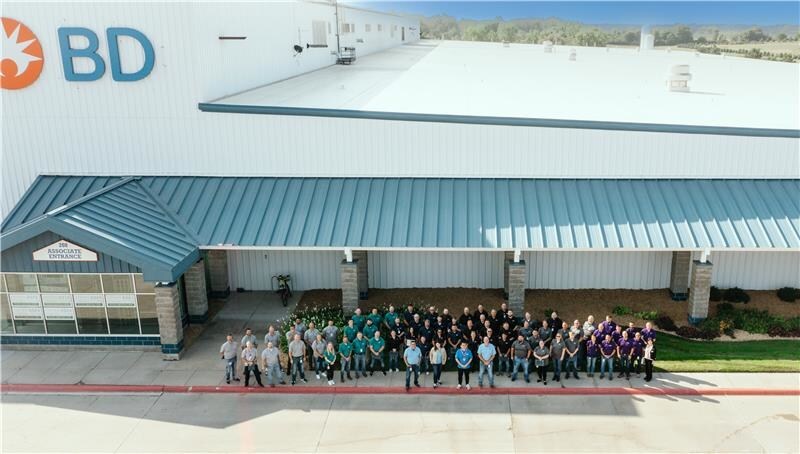
This investment will bring BD Neopak™ Glass Prefillable Syringe production to Columbus, Nebraska, creating approximately 120 new jobs and reinforcing the company’s supply resilience within its Pharmaceutical Systems portfolio.

“This is good news for Nebraska,” said Sen. Ricketts. “It has the potential to bring over 100 new jobs to our state. This investment further underscores BD’s ongoing commitment to keep critical manufacturing in states like Nebraska. I appreciate BD’s long-standing partnership with the Cornhusker State.”

The BD Neopak™ Glass Prefillable Syringe platform is purpose-built to meet the complex and evolving needs of biologics and combination products development. Available in 1 mL and 2.25 mL formats, the BD Neopak™ Glass Prefillable Syringe supports a wide range of formulation requirements, including high viscosity, drug-container compatibility, and integration with delivery devices. It is designed for seamless integration with autoinjectors, enabling flexible, patient-centric drug delivery in both clinical and at-home settings.

“As demand for biologics and GLP-1s accelerates, BD is strengthening its American manufacturing footprint to support U.S.-based drug delivery innovation and supply chain resiliency,” said Patrick Jeukenne, worldwide president of BD Pharmaceutical Systems. “This investment in Nebraska, advances our long-term growth strategy and reflects our commitment to partnering with biopharmaceutical innovators as they bring advanced therapies to patients who require next-generation drug delivery solutions.”

Strategic Investments in Columbus, Nebraska

BD is investing $100m to establish BD Neopak™ Glass Prefillable Syringe production at its Columbus site, with supply expected to begin in mid-2026. This investment will also support additional line upgrades and capacity improvements across the site, ensuring BD can meet growing global demand for advanced injectable solutions. In addition, BD is investing $10m to enhance cannula manufacturing capabilities at the site, and together these investments will add approximately 120 new jobs.

This announcement builds on BD’s recent investment of more than $35m to expand prefilled flush syringe manufacturing in Columbus, which will add approximately 50 new jobs and strengthen the supply of critical medical devices to health care providers across the U.S. BD Columbus has been a strategic site within BD’s global manufacturing network for more than 75 years and is home to part of the company’s vertically integrated cannula manufacturing operations, including design and production. As the largest medical device manufacturer in the United States, these investments are part of BD’s commitment to invest more than $2.5bn in U.S. manufacturing capabilities over the next five years.

Strengthening U.S. Supply Chain Resilience

This expansion underscores the company’s commitment to building a more resilient and responsive pharmaceutical supply chain in the United States. By localizing production of the BD Neopak™ Glass Prefillable Syringe platform, BD is helping to ensure continuity, scalability, and speed to market for life-changing injectable therapies – especially as demand rises for biologics and combination products used to treat chronic and high-burden diseases.

As the global leader in biologics drug delivery, BD continues to invest in innovation and infrastructure to meet current needs and ensure that patients everywhere can benefit from the therapies of tomorrow.

Free Training

Source link

Novartis charts next US investment with new radiopharma plant


As Novartis turns the calendar on a new year, the Swiss drugmaker is elaborating further on plans for the $23 billion U.S. investment it unveiled last April.

Next on the docket will be a new, 35,000-square-foot radioligand therapy (RLT) facility in Winter Park, Florida, Novartis reported Friday. 

Joining established plants in Novartis’ American RLT network in Indiana, New Jersey and California, the new facility will boost the company’s radiopharmaceutical manufacturing to “optimize the delivery” of the cutting-edge cancer treatments to patients across the southeastern United States, Novartis said in a Jan. 9 press release. The upcoming site is expected to come online by 2029, the company added. 

While radiopharmaceuticals, which target cancer cells with a radioactive drug, have become an increasingly popular oncology development target, few have crossed the regulatory finish line so far. Novartis, however, boasts two approved RLTs in Lutathera and Pluvicto, which have been cleared by the FDA to treat neuroendocrine tumors and prostate cancer, respectively.

“Building this new facility in Florida marks an important step in fulfilling the promise of RLT for patients,” Novartis CEO Vas Narasimhan said in a statement Friday. “Radioligand therapy has fundamentally changed how we approach certain cancers, and our growing U.S. manufacturing network ensures we can continue to deliver these critical medicines with speed and reliability to patients who need them.”

As for why the company selected Florida for its new site, RLT manufacturing requires “specialized talent,” and the state has that in droves thanks to steady investments in higher education for life sciences and technology, Novartis explained in its release. 

The Florida RLT facility marks the latest stop on Novartis’ $23 billion U.S. investment drive. The company revealed the investment plan early last year as drugmakers sought to counter the Trump administration’s pharmaceutical tariff threats by building or expanding production facilities on U.S. soil.

Novartis specifically pledged to build and expand 10 U.S. sites through 2030, including four new manufacturing plants and fresh radioligand facilities in Florida and Texas. Novartis’ plans for its fifth U.S. RLT plant have yet to be revealed. At the same time, the company also said it would chart expansions at the RLT facilities in Indiana, New Jersey and California.

The Carlsbad, California, site officially came online last November, at the time marking the company’s third production hub for radiopharmaceuticals in the U.S. The 10,000-square-foot facility has been designed to enable Novartis to “seamlessly meet future demand for RLT,” the company said at the time of the ribbon cutting.

RLTs, also known as radiopharmaceuticals, are a form of precision medicine that wed a tumor-targeting molecule—known as a ligand—with a therapeutic radioisotope. The class is designed to deliver radiation to tumors while limiting damage to surrounding cells, Novartis has explained.

However, the radioactive isotopes used to create the drugs have posed production and supply challenges for the industry.

Given the close relationship between the production of the product and the end-therapy itself, many radiopharmaceutical developers have embraced manufacturing early on in their work.

Recognizing the supply hurdles, Novartis in Sept. 2024 announced that it was building a new plant on its Indiana RLT campus to produce radioactive isotopes. The reveal came in tandem with news that Novartis would establish its RLT manufacturing site in California.

“We are investing in our supply chain capabilities today to ensure that we are prepared to consistently deliver these complex treatments to the growing number of eligible patients in the long term,” Victor Bultó, Novartis’ U.S. president, said in a statement at the time.

In addition to its U.S. sites, Novartis also operates RLT facilities in Ivrea, Italy, and Zaragoza, Spain.

Elsewhere, Novartis revealed another major piece of its $23 billion outlay in November when it sketched out plans for a “flagship” production hub in North Carolina, where it intends to create some 700 new jobs.

Free Training

Source link