

Samsung Biologics looks to scale up U.S. manufacturing in Maryland
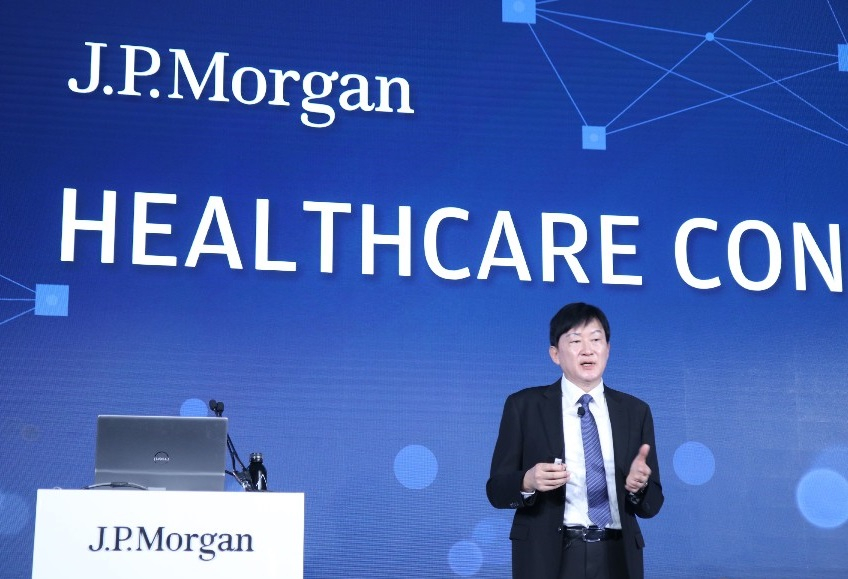
![Samsung Biologics CEO John Rim delivers his keynote speech outlining the company's future roadmap at the 44th J.P. Morgan Health Care Conference held at Westin St. Francis Hotel in San Francisco on Jan. 13. [SAMSUNG BIOLOGICS]](https://koreajoongangdaily.joins.com/data/photo/2026/01/14/b419e31b-fa21-4bdb-bb3a-59955f5c6790.jpg)
Samsung Biologics CEO John Rim delivers his keynote speech outlining the company’s future roadmap at the 44th J.P. Morgan Health Care Conference held at Westin St. Francis Hotel in San Francisco on Jan. 13. [SAMSUNG BIOLOGICS]
SAN FRANCISCO — Samsung Biologics is seeking to strengthen its U.S. footprint by expanding capacity at its recently acquired manufacturing facility in Rockville, Maryland, as it seeks to meet growing customer demand for U.S.-based production amid shifting trade policies.
“The GSK facility acquisition is anticipated to close in March this year, giving us regional presentation in the United States,” said CEO John Rim at the 44th J.P. Morgan Health Care Conference on Tuesday. “It will have flexibility to take on additional products beyond the GSK product line.”
Samsung Biologics announced in December 2025 that it would acquire the Rockville facility from GlaxoSmithKline for $280 million. The plant has an annual production capacity of 60,000 liters (15,850 gallons).
“It [the U.S. factory] has always been a higher cost area and everybody knows that, but for us, the U.S. was critical and the reason for that is we’ve lost customers because we didn’t have a U.S. presence,” Rim said, adding that clients wanted supply chain resiliency.
While the Rockville facility is modest in scale compared to Samsung Biologics’ five plants in Songdo, Korea — which together have a combined capacity of 785,000 liters — the company said the U.S. site can be expanded by an additional 20,000 to 40,000 liters.
“Everybody understands that there’s some pricing flexibility, so we’ll have to work through,” Rim said. “But we do see that having the Rockfield facility will open up new venues of growth for us.”
Initially, the plant will continue manufacturing existing GSK products, including Benlysta, a monoclonal antibody treatment for lupus. Over time, the facility is expected to be upgraded to support multiple modalities, particularly antibody production.
![Samsung Biologics CEO John Rim delivers his keynote speech outlining the company's future roadmap at the 44th J.P. Morgan Health Care Conference held at Westin St. Francis Hotel in San Francisco on Jan. 13. [SAMSUNG BIOLOGICS]](https://koreajoongangdaily.joins.com/data/photo/2026/01/14/2e986e71-56d0-4c7c-8939-3ba69b14fb38.jpg)
Samsung Biologics CEO John Rim delivers his keynote speech outlining the company’s future roadmap at the 44th J.P. Morgan Health Care Conference held at Westin St. Francis Hotel in San Francisco on Jan. 13. [SAMSUNG BIOLOGICS]
“Whether antibody drug conjugate [ADC] capabilities are added in the future will depend on demand,” Rim added at a separate press conference held with the Korean press on Monday.
With the facility, the Korean company will have more than 500 employees working at the site, and plans to recruit more U.S talent in the future.
The company’s main production site, however, remains rooted in its Songdo campus as U.S. tariffs on biopharmaceutical imports have largely dissolved. While tariffs were previously discussed at levels as high as 250 percent, subsequent bilateral negotiations have capped potential tariffs at 15 percent, significantly reducing trade-related risk.
In parallel, Samsung Biologics is continuing to expand domestically. Construction of a sixth plant is expected to begin between 2026 and 2027, and the company has secured land for a third phase of its Songdo manufacturing campus. It plans to invest approximately 7 trillion won ($4.7 billion) through 2034 to build additional production facilities.
Looking ahead, Rim said the company’s investment strategy, including mergers and acquisitions, will remain focused on antibody manufacturing.
The global biopharmaceutical market is projected to grow at a compound annual growth rate of 10 percent, from $565 billion in 2025 to $921 billion in 2030, according to market researcher Evaluate Pharma, driven in particular by monoclonal antibodies, multispecific antibodies, ADCs and fusion proteins.
“The antibody market is so large that even single-digit growth translates into meaningful demand,” Rim said. “Other segments may grow faster in percentage terms, but their overall impact is limited by smaller market size.”
Samsung Biologics is also closely monitoring developments in GLP-1 therapies — particularly the shift toward oral formulations — as well as opportunities in peptide manufacturing.
The company has rebranded its contract manufacturing offering under the name ExcellenS, a move that reflects its emphasis on tailored production and operational efficiency, based on standardized and scalable manufacturing processes.
Samsung Biologics is scheduled to report its fourth-quarter and full-year 2025 earnings on Jan. 21. The company recorded a record annual order intake of 6.8 trillion won in 2025, with cumulative orders surpassing $21 billion.
BY LEE JAE-LIM [[email protected]]