

Manufacturing plant headed to Upper Macungie – Lehigh Valley Press


Eli Lilly and Company and the Lehigh Valley are joining together to build a new state-of-the-art manufacturing facility that will be designed for the research and production of injectable weight loss medications.

On Jan. 30 at Curiosity Hall in the Da Vinci Science Center, Allentown, an assortment of community members, business and political stakeholders joined Eli Lilly and Company Chair and Chief Executive Officer Dave Ricks and Pennsylvania Gov. Josh Shapiro to announce a major collaboration.

Ricks said it is expanding manufacturing sites in the United States and considered 800 applicants for this project before choosing the Lehigh Valley. He credits the tenacity of Shapiro as this project will come to fruition at a site in Upper Macungie.

“Our mission starts with patients and delivering the medicines they need. To meet increasing demand, we’re expanding our U.S. manufacturing network, with Lehigh Valley adding capacity for next‑generation weight-loss medicines. We’re creating high‑quality jobs and collaborating across the region – with suppliers, educators and workforce development partners – to make critical medicines in the U.S.,” Ricks said. “That’s our commitment – to patients, to our new Pennsylvania home and to our country.”

The property in Upper Macungie Township, owned by the Jaindl Corporation (under contract to buy), will be the “single largest investment in economic development since the days of Bethlehem Steel,” said Lehigh Valley Economic Development Corporation president and CEO Don Cunningham. Manufacturing in Pennsylvania is 4 percent higher than the national average and is the largest industry within the state. Lilly proposes to invest $3.5 billion in this specific project. This will boost the Lehigh Valley economy on many levels.

For every dollar Lilly invests, it estimates up to $4 in additional local economic activity.

Ricks said Lilly is committed to the community and an interactive workforce development by including existing businesses and educational opportunities in its program. Lilly will connect with local nonprofits and encourage volunteerism.

Lehigh County Executive Josh Siegel pointed out, “Things are still made in the valley and we should be proud of that. This is more than creating jobs and buildings; it is creating futures and careers for our residents and their families.”

This project will employ 850 engineers, scientists, operations personnel and lab technicians.

Lehigh Valley Building and Construction Trades Council President Paul Anthony pointed out the many benefits of the shared commitment to building a safe, quality facility by skilled union tradesmen. “Government, businesses and labor, working together has made this project happen,” Anthony said.

This project will offer employment in the building trades, as well as apprenticeships leading to skilled union jobs. Construction is expected to begin this year and expects to create 2,000 construction jobs. The site will be operational in 2031.

Shapiro also pointed out the permitting reforms, the Pennsylvania Economic Development for a Growing Economy (PA EDGE), a collection of tax credit programs designed to attract new investments from businesses in critical manufacturing sectors, as well as The Pennsylvania Strategic Investments to Enhance Sites Program (PA SITES), established to provide grant and loan funding to eligible applicants, helped this project.

PA SITES invested an initial $500,000.

The PA SITES program encourages businesses to build or relocate within Pennsylvania. The funding for the program includes two components that support the development of competitive sites within the commonwealth, and expansion of existing sites. Funding is made available through planning grants, construction grants and loans

Ricks said this project is where “Curiosity meets Capability.” He reminded the audience of Lilly’s long history with pharmaceuticals starting post-Civil war. The emphasis was on defining ingredients and making safe, quality, accessible and affordable drugs for all Americans.”

The Lilly name will be seen throughout the valley.

“If it bares the red Lilly, you know it’s right,” Ricks said.

Gov. Josh Shapiro and Eli Lilly and Company CEO Dave Ricks place the Lilly pin/marker on the map of the Lehigh Valley, denoting where Lilly will make their mark.

PRESS PHOTOS BY JENN RAGOEli Lilly and Company and the Lehigh Valley are joining together to build a new state-of-the-art manufacturing facility where 850 new pharmaceutical jobs and 2,000 union construction jobs will be available in the Lehigh Valley with the proposed manufacturing plant in Upper Macungie Township.

Lehigh Valley Economic Development Corporation President and CEO Don Cunningham points out this was a bipartisan effort. Cunningham was instrumental in unifying all parties involved in this project.

“We still make things happen here [in the valley. This project shows government delivering,” Lehigh County Executive Josh Siegel tells the crowd.

Eli Lilly and Company Chair and Chief Executive Officer Dave Ricks tells the audience “800 municipalities and sites were considered for this project.” Upper Macungie Township was chosen for Lilly’s injectable manufacturing plant.

Free Training

Source link

Manufacturing plant headed to Upper Macungie – Lehigh Valley Press


Eli Lilly and Company and the Lehigh Valley are joining together to build a new state-of-the-art manufacturing facility that will be designed for the research and production of injectable weight loss medications.

On Jan. 30 at Curiosity Hall in the Da Vinci Science Center, Allentown, an assortment of community members, business and political stakeholders joined Eli Lilly Chair and Chief Executive Officer Dave Ricks and Pennsylvania Gov. Josh Shapiro to announce a major collaboration.

Ricks said it is expanding manufacturing sites in the United States and considered 800 applicants for this project before choosing the Lehigh Valley. He credits the tenacity of Shapiro as this project will come to fruition at a site in Upper Macungie.

“Our mission starts with patients and delivering the medicines they need. To meet increasing demand, we’re expanding our U.S. manufacturing network, with Lehigh Valley adding capacity for next‑generation weight-loss medicines. We’re creating high‑quality jobs and collaborating across the region – with suppliers, educators and workforce development partners – to make critical medicines in the U.S.,” Ricks said. “That’s our commitment – to patients, to our new Pennsylvania home and to our country.”

The property in Upper Macungie Township, owned by the Jaindl Corporation (under contract to buy), will be the “single largest investment in economic development since the days of Bethlehem Steel,” Don Cunningham, Lehigh Valley Economic Development Corporation president and CEO said.

Manufacturing in Pennsylvania is 4% higher than the national average and is the largest industry within the state. Lilly proposes to invest $3.5 billion in this specific project. This will boost the Lehigh Valley economy on many levels.

For every dollar Lilly invests, it estimates up to $4 in additional local economic activity.

Ricks said Lilly is committed to the community and an interactive workforce development by including existing businesses and educational opportunities in its program. Lilly will connect with local nonprofits and encourage volunteerism.

Lehigh County Executive Josh Siegel pointed out, “Things are still made in the Valley and we should be proud of that. This is more than creating jobs and buildings; it is creating futures and careers for our residents and their families.”

This project will employ 850 engineers, scientists, operations personnel and lab technicians.

Lehigh Valley Building and Construction Trades Council President Paul Anthony pointed out the many benefits of the shared commitment to building a safe, quality facility by skilled union tradesmen. “Government, businesses and labor, working together has made this project happen,” Anthony said.

This project will offer employment in the building trades, as well as apprenticeships leading to skilled union jobs. Construction is expected to begin this year and Lilly expects to create 2,000 construction jobs. The site will be operational in 2031.

Shapiro also pointed out the permitting reforms, the Pennsylvania Economic Development for a Growing Economy (PA EDGE), a collection of tax credit programs designed to attract new investments from businesses in critical manufacturing sectors, as well as The Pennsylvania Strategic Investments to Enhance Sites Program (PA SITES), established to provide grant and loan funding to eligible applicants, helped this project.

PA SITES invested an initial $500,000.

The PA SITES program encourages businesses to build or relocate within Pennsylvania. The funding for the program includes two components that support the development of competitive sites within the commonwealth, and expansion of existing sites. Funding is made available through planning grants, construction grants and loans.

Ricks said this project is where “Curiosity meets Capability.” He reminded the audience of Lilly’s long history with pharmaceuticals starting post-Civil War. The emphasis was on defining ingredients and making safe, quality, accessible and affordable drugs for all Americans.”

The Lilly name will be seen throughout the valley.

“If it bares the red Lilly, you know it’s right,” Ricks said.

PRESS PHOTOS BY JENN RAGOEli Lilly and Company and the Lehigh Valley are joining together to build a new state-of-the-art manufacturing facility where 850 new pharmaceutical jobs and 2,000 union construction jobs will be available in the Lehigh Valley with the proposed manufacturing plant in Upper Macungie Township.

Pennsylvania Gov. Josh Shapiro announces a partnership with Eli Lilly and Company to build a manufacturing plant at a media event at the Da Vinci Science Center in Allentown.

Chair and Chief Executive Officer of Eli Lilly and Company Dave Ricks and Pennsylvania Gov. Josh Shapiro take questions after announcing the newest Lilly manufacturing plant to be built in Upper Macungie Township, Lehigh County.

Lehigh Valley Economic Development Corporation President and CEO Don Cunningham points out this was a bipartisan effort. Cunningham was instrumental in unifying all parties involved in this project.

Gov. Josh Shapiro speaks to a full house of guests at Curiosity Hall at the Da Vinci Science Center in Allentown. Shapiro announced the final plans to build a large manufacturing center in Upper Macungie.

“We still make things happen here [in the Valley. This project shows government delivering,” Lehigh County Executive Josh Siegel tells the crowd.

Eli Lilly and Company Chair and Chief Executive Officer Dave Ricks explains the growth of the life science industry as Gov. Josh Shapiro mentions this facility will include research as well as manufacturing.

Gov. Josh Shapiro and Chair and Eli Lilly and Company Chief Executive Officer Dave Ricks place the Lilly pin/marker on the map of the Lehigh Valley, denoting where Lilly will make their mark.

Eli Lilly and Company Chair and Chief Executive Officer Dave Ricks tells the audience “800 municipalities and sites were considered for this project.” Upper Macungie Township was chosen for Lilly’s injectable manufacturing plant.
Free Training

Source link

Pegatron to Complete US Manufacturing Plant by End of March, Supplies Apple and Dell


Global manufacturing is entering a new phase, and Pegatron is placing a big bet on the United States. The Taiwan-based electronics manufacturer, known worldwide as a key supplier to Apple and Dell, has confirmed that its new US manufacturing plant will be completed by the end of March. This move marks a major step in reshaping global supply chains and reflects how electronics makers are responding to trade pressure, geopolitical risks, and customer demand for local production.

The announcement has caught the attention of investors, policymakers, and technology watchers. Pegatron is one of Apple’s most important assembly partners, alongside Foxconn and Wistron. Any shift in its production footprint signals broader changes in how and where the world’s most popular devices are made.

So why is this move happening now, and what does it mean for Apple, Dell, and the wider tech industry? Let us break it down in simple terms.

Pegatron Confirms US Plant Timeline and Strategy

Pegatron said the US manufacturing plant is expected to be completed by the end of March, with initial operations starting soon after. The facility is part of the company’s long-term plan to diversify production away from an over-reliance on Asia, especially China.

According to company executives, construction work is moving on schedule, and the plant will focus on advanced electronics assembly and system integration. While Pegatron has not disclosed the full list of products to be made at the site, it confirmed that the facility will support orders for major clients, including Apple and Dell.

Why does this timeline matter?
Because large electronics plants take months to test and scale. Completing the site by March allows Pegatron to align production with new product cycles later in the year.

The move was widely discussed online as a signal that global manufacturing is shifting faster than expected.

$AAPL $TSM

Pegatron expects US plant construction to finish by end of March; Taiwan-US trade deal includes $250B investment

— 이코노믹캣 (@theconomicat) January 23, 2026

That reaction highlights how investors see Pegatron’s decision as part of a bigger trend rather than a one-off move.

Why Pegatron Is Expanding Manufacturing in the US

The decision to build a US plant did not happen overnight. Several forces are pushing companies like Pegatron to rethink where they make products.

First, geopolitical tensions and trade policies have made companies cautious about concentrating production in one region. Tariffs, export controls, and policy uncertainty have raised costs and risks.

Second, major customers such as Apple and Dell are asking suppliers to localize parts of their supply chain. Producing closer to end markets reduces shipping delays and improves response times.

Third, US incentives and state-level support have made domestic manufacturing more attractive. Tax credits, infrastructure support, and workforce programs help offset higher labor costs.

In short, Pegatron is responding to both pressure and opportunity.

What Will the US Plant Produce for Apple and Dell

While Pegatron has not released a full product list, industry sources suggest the US plant will focus on final assembly, testing, and customization rather than full-scale component manufacturing.

For Apple, this could include limited production runs or specialized configurations of devices for the US market. For Dell, the plant may support enterprise hardware and custom systems that benefit from local assembly.

Why not move everything to the US?
Because full electronics manufacturing requires complex supplier networks. The US plant is meant to complement, not replace, existing facilities in Asia.

This hybrid model allows Pegatron to balance cost efficiency with flexibility and political resilience.

Impact on Apple’s and Dell’s Supply Chains

For Apple, Pegatron’s US expansion supports its broader goal of supply chain diversification. Apple has already increased production in India and Vietnam, and the addition of US capacity adds another layer of resilience.

Dell, which sells a large volume of systems to US businesses and government clients, benefits from local assembly that can meet compliance and delivery requirements more easily.

From a branding point of view, having products assembled in the US also carries symbolic value, especially at a time when governments are encouraging domestic manufacturing.

Does this mean more Apple products will be labeled as US assembled?
Possibly, but likely in limited volumes at first.

Pegatron operates factories across Taiwan, China, Southeast Asia, and now the United States. This global network allows it to shift production based on demand, costs, and policy changes.

The US plant is not Pegatron’s largest facility, but it is strategically important. It gives the company a direct presence in one of its biggest end markets and reduces exposure to sudden trade disruptions.

Executives have said the company will continue to invest in multiple regions rather than betting on a single country.

Market and Investor Reaction

Investors are watching Pegatron closely as supply chains evolve. The company’s move into the US is seen as a long-term investment rather than a short-term profit driver.

Analysts note that margins at the US plant may initially be lower due to higher costs. However, these costs could be offset by stable orders, lower logistics risk, and stronger client relationships.

Some market participants are using AI Stock tools to track how supply chain shifts may affect electronics manufacturers and their customers over time.

Economic and Policy Implications

Pegatron’s US plant also has wider economic implications. New manufacturing facilities create jobs, support local suppliers, and strengthen regional technology ecosystems.

Local governments often welcome such investments, especially when they involve high-skilled manufacturing rather than basic assembly.

At the same time, companies must navigate workforce training, regulatory compliance, and infrastructure challenges.

Is US manufacturing competitive with Asia?
Not on cost alone, but competitiveness improves when stability and speed matter more than price.

Technology Manufacturing and the Bigger Trend

Pegatron’s decision fits into a broader pattern across the tech industry. Semiconductor firms, device makers, and component suppliers are all spreading production across regions.

This trend is driven by risk management rather than pure economics. Companies want to ensure they can deliver products even if one region faces disruption.

Investors studying these changes often rely on AI Stock research to analyze long-term shifts in capital spending and manufacturing strategy.

What Comes Next After March

Once the US plant is completed by the end of March, Pegatron will likely spend several months ramping up operations. Initial output may be modest, with volumes increasing as processes stabilize.

Future expansion will depend on customer demand, policy support, and overall market conditions. Pegatron has said it will review capacity regularly and adjust plans as needed.

For Apple and Dell, the plant provides an option rather than a guarantee of large-scale US production.

Risks and Challenges Ahead

Despite the optimism, challenges remain. Labor availability, cost control, and supply chain coordination will test Pegatron’s execution.

US manufacturing also faces competition from other regions offering lower costs and faster scaling.

Still, most analysts agree that having a US base is a strategic advantage, even if it is not the cheapest option.

Traders and institutions monitoring these risks are increasingly using modern trading tools to react quickly to news about supply chains and capital investment.

Long-Term Outlook for Pegatron

In the long run, Pegatron’s diversified footprint could make it more resilient than competitors tied too closely to one region. The US plant adds flexibility and strengthens ties with key customers.

As technology products become more complex and politically sensitive, suppliers that can adapt quickly may gain an edge.

Some investors are already applying AI stock analysis to Pegatron and similar firms to model how regional production affects earnings stability.

Conclusion

The confirmation that Pegatron will complete its US manufacturing plant by the end of March marks an important milestone for the global electronics supply chain. As a major supplier to Apple and Dell, Pegatron’s move reflects a deeper shift toward diversified and resilient production.

While the US plant will not replace Asia-based manufacturing, it adds a critical layer of flexibility at a time when stability matters as much as cost. For investors, policymakers, and technology partners, Pegatron’s expansion offers a clear signal. The future of manufacturing will be global, balanced, and increasingly close to the customer.

Disclaimer

The content shared by Meyka AI PTY LTD is solely for research and informational purposes. Meyka is not a financial advisory service, and the information provided should not be considered investment or trading advice.


Free Training

Source link

Micron breaks ground on massive chipmaking plant that could transform Central NY


Clay, N.Y. — At the edge of a 1,400-acre tract of swamp, forest and former farmland just north of Syracuse, Micron Technology and public officials across the political spectrum broke ground this morning on what’s being called the largest private development in New York state history.

For Micron, riding a wave of record profits and bolstered by $25 billion in taxpayer subsidies, it marked the first ceremonial step to building its largest memory chip plant.

The groundbreaking comes more than three years after Micron announced it had chosen Central New York for its biggest expansion ever in the United States. Nearly all of the company’s chips are made in Asia.

Upstate New York’s legendary winters didn’t disappoint: Wind chills dipped to about 10 degrees Friday morning and the ground was covered with at least half a foot of fresh lake effect snow blown in from Lake Ontario, where Micron will draw its water.

“That is a perfect day,” Micron CEO Sanjay Mehrotra said of the fresh snow and sun that broke through before the ceremony began. He thanked the Democratic and Republican officials in the audience who both recruited Micron to Upstate New York and helped pass the federal legislation that paved the way for onshoring more computer chipmaking in the nation.

“It shows that when it comes to restoring American manufacturing,” he said, “we are clearly one team.”

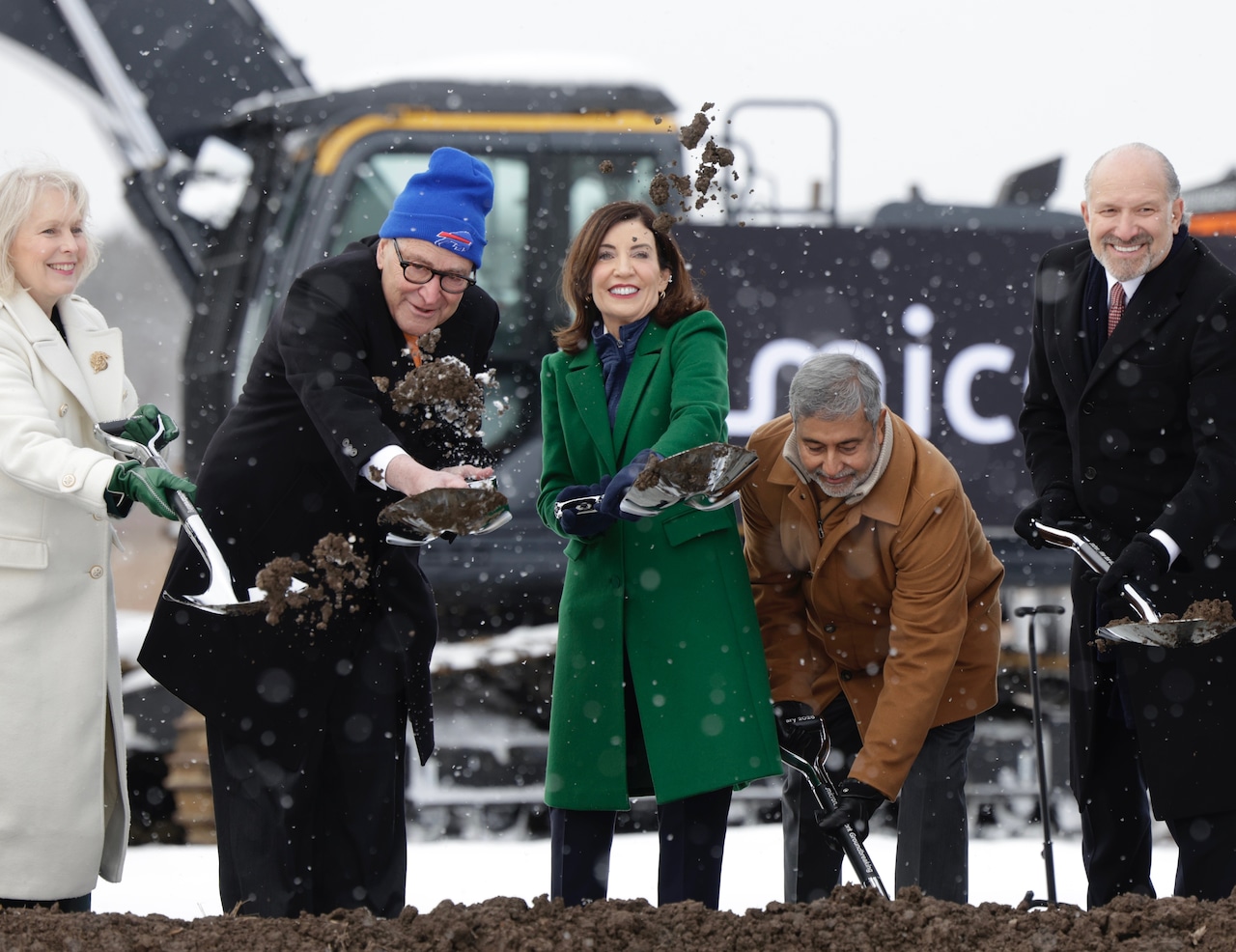
Micron Technology groundbreakingMicron Technology breaks ground on a $100 billion computer chipmaking complex in Clay, New York, on Jan. 16, 2026. Pictured from left are: Sen. Kirsten Gillibrand, Sen. Charles Schumer, Gov. Kathy Hochul, Micron CEO Sanjay Mehrotra and U.S. Commerce Secretary Howard Lutnick.N. Scott Trimble | strimble@syracuse.com

Micron says it plans to build four chipmaking factories in Clay by 2041 to churn out billions of tiny computer chips used in cars, cell phones, appliances and, increasingly, data centers and artificial intelligence.

“The site will soon hum with activity,” Mehrotra said. “It will become a thriving technology hub, generating tens of thousands of jobs here, transforming the region.”

Shortly before noon, Mehrotra joined with Gov. Kathy Hochul, Sens. Charles Schumer and Kirsten Gillibrand, U.S. Commerce Secretary Howard Lutnick and County Executive Ryan McMahon for the ceremonial dirt-tossing with silver shovels.

They did it four times for the cameras, then an excavator behind them dumped a load of dirt into a dump truck with a Micron icon on its side. It was 12 degrees. Schumer wore a Buffalo Bills hat and an orange Syracuse tie.

Before the outdoor festivities, Lutnick, whose department will oversee the disbursal of about $20 billion in taxpayer subsidies to Micron over the next decade or so, took the stage and injected politics into a heated tent set up on the former farmland in northern Onondaga County.

“It is great to be in Central New York,” Lutnick said, “which, of course, you all know, is the heart of Trump country.” The applause afterward was tepid.

“It’s a historic day today,” Lutnick continued. “Because this fab, mega fab, is going to be the largest investment in the history, the largest single investment in the history of the great state of New York. So imagine that being right here, rebuilding and growing in the heart of Syracuse. That’s fantastic.”

Micron Technology groundbreakingU.S. Commerce Secretary Howard Lutnick at the Micron groundbreaking on Jan. 16, 2026.N. Scott Trimble | strimble@syracuse.com

Schumer, a Democrat and the Senate’s former majority leader, thanked McMahon, a Republican, for his partnership in working to get Micron to move to the Syracuse area.

“I want to give him some thanks, because he really helped prepare this site,” said Schumer, who ushered through the CHIPS and Science Act in 2022 that gave Micron the impetus to build factories in the United States.

“We will look back generations,” Schumer added. “This was a turning point for Central New York, for Upstate New York, and for the United States of America, because, because what’s happening here is going to give the United States the lead in semiconductor manufacturing for generations.”

Hochul, who went to Syracuse University in the 1970s, noted how at that time manufacturing was fleeing cities in Upstate New York. As she took the microphone, she quipped that this was really Hochul country. The applause was louder than for the secretary’s jab.

Micron’s arrival and its promise of a resurgence of manufacturing in Central New York, Hochul continued, is a dream come true.

“I could not be prouder,” Hochul said. “This is the day we rise up New York.”

The $52 billion, bipartisan CHIPS Act was designed to bring back to the U.S. the manufacture of computer chips essential to modern life and national security. Micron was one of the big winners, securing a grant of more than $6 billion to build factories in New York and at its headquarters in Idaho.

Construction of the first of two fabs in Boise is well underway, with production expected to start next year. Micron announced this year in a new deal with the Trump administration that it would build a second factory in Boise that would open before any of the New York factories.

Late last year, Micron announced that the Clay fabrication plants, or fabs, would be delayed by two to three years. The first is now set to start production in 2030; the second, in 2033.

The moment is about more than today, McMahon said. It’s about helping Micron continue to grow as a memory chip leader, he said. And it’s about making sure Central New Yorkers share in the expected largess.

“This is truly about the American worker and opportunity,” McMahon said. “But the reality is, this is about the national security of this country first and foremost. And by this investment here today, America will lead the world in AI dominance, and that means the world will literally be a safer and better place.”

Micron Technology groundbreakingMicron leaders, local and state officials and community leaders gather at Syracuse University to celebrate the groundbreaking of the chipmaker’s complex in Clay. Gov. Kathy Hochul, Sen. Charles Schumer and Onondaga County Executive listen during SU Chancellor Kent Syverud’s remarks. Jan. 16, 2026N. Scott Trimble | strimble@syracuse.com

Micron says it will spend more than $51 billion to build two fabrication plants, or fabs, by 2033. Taxpayer subsidies from federal, state and local governments would cover about half of those costs.

The company says it could spend another $50 billion to build a third and fourth fab by 2041, although there is no public money allotted for those.

Micron’s project here underwent a two-year, 20,000-page environmental review that was wrapped up in November. Since then, Micron has obtained the wide variety of necessary construction approvals from the federal, state and local governments.

If Micron keeps its promises, the impact on Central New York would be enormous. Micron says it would employ 9,000 people – nearly as many as Upstate Medical University, now the region’s biggest employer.

Up to 40,000 spinoff jobs could be created, from those in semiconductor supply chains to hotels to schools. Construction would require more than 4,000 workers during peak construction periods.

The groundbreaking comes as Micron, founded in the basement of a dentist’s office in Boise in 1978, is soaring on the demand for artificial intelligence chips. Micron has recently posted record sales and profits, and even bailed out of the consumer market to preserve its production for bigger profits in AI. Investors have noticed: Micron’s stock price has tripled in the past year.

Site preparation in Clay is expected to start within days. The first task for Micron’s initial contractor, Gilbane Co., is to start clearing 445 acres of forest. Gilbane will have to hurry: All tree-cutting must halt between March 31 and Nov. 1 because two species of endangered bats use the site to raise their young during the warmer months.

This year, Micron will need to haul in about 2 million yards of gravel-like fill to level and stabilize the site, which contains about 200 acres of wetlands. That will be done mostly by truck, with more than 500 trucks going in and out of the site every day on two-lane roads.

1/14

Free Training

Source link

Novartis charts next US investment with new radiopharma plant


As Novartis turns the calendar on a new year, the Swiss drugmaker is elaborating further on plans for the $23 billion U.S. investment it unveiled last April.

Next on the docket will be a new, 35,000-square-foot radioligand therapy (RLT) facility in Winter Park, Florida, Novartis reported Friday. 

Joining established plants in Novartis’ American RLT network in Indiana, New Jersey and California, the new facility will boost the company’s radiopharmaceutical manufacturing to “optimize the delivery” of the cutting-edge cancer treatments to patients across the southeastern United States, Novartis said in a Jan. 9 press release. The upcoming site is expected to come online by 2029, the company added. 

While radiopharmaceuticals, which target cancer cells with a radioactive drug, have become an increasingly popular oncology development target, few have crossed the regulatory finish line so far. Novartis, however, boasts two approved RLTs in Lutathera and Pluvicto, which have been cleared by the FDA to treat neuroendocrine tumors and prostate cancer, respectively.

“Building this new facility in Florida marks an important step in fulfilling the promise of RLT for patients,” Novartis CEO Vas Narasimhan said in a statement Friday. “Radioligand therapy has fundamentally changed how we approach certain cancers, and our growing U.S. manufacturing network ensures we can continue to deliver these critical medicines with speed and reliability to patients who need them.”

As for why the company selected Florida for its new site, RLT manufacturing requires “specialized talent,” and the state has that in droves thanks to steady investments in higher education for life sciences and technology, Novartis explained in its release. 

The Florida RLT facility marks the latest stop on Novartis’ $23 billion U.S. investment drive. The company revealed the investment plan early last year as drugmakers sought to counter the Trump administration’s pharmaceutical tariff threats by building or expanding production facilities on U.S. soil.

Novartis specifically pledged to build and expand 10 U.S. sites through 2030, including four new manufacturing plants and fresh radioligand facilities in Florida and Texas. Novartis’ plans for its fifth U.S. RLT plant have yet to be revealed. At the same time, the company also said it would chart expansions at the RLT facilities in Indiana, New Jersey and California.

The Carlsbad, California, site officially came online last November, at the time marking the company’s third production hub for radiopharmaceuticals in the U.S. The 10,000-square-foot facility has been designed to enable Novartis to “seamlessly meet future demand for RLT,” the company said at the time of the ribbon cutting.

RLTs, also known as radiopharmaceuticals, are a form of precision medicine that wed a tumor-targeting molecule—known as a ligand—with a therapeutic radioisotope. The class is designed to deliver radiation to tumors while limiting damage to surrounding cells, Novartis has explained.

However, the radioactive isotopes used to create the drugs have posed production and supply challenges for the industry.

Given the close relationship between the production of the product and the end-therapy itself, many radiopharmaceutical developers have embraced manufacturing early on in their work.

Recognizing the supply hurdles, Novartis in Sept. 2024 announced that it was building a new plant on its Indiana RLT campus to produce radioactive isotopes. The reveal came in tandem with news that Novartis would establish its RLT manufacturing site in California.

“We are investing in our supply chain capabilities today to ensure that we are prepared to consistently deliver these complex treatments to the growing number of eligible patients in the long term,” Victor Bultó, Novartis’ U.S. president, said in a statement at the time.

In addition to its U.S. sites, Novartis also operates RLT facilities in Ivrea, Italy, and Zaragoza, Spain.

Elsewhere, Novartis revealed another major piece of its $23 billion outlay in November when it sketched out plans for a “flagship” production hub in North Carolina, where it intends to create some 700 new jobs.

Free Training

Source link