

Apple to begin Mac mini production in Houston, expanding US manufacturing footprint


Stockbrokers.com director of investor research Jessica Inskip discusses investor overthinking, Apple’s ChatGPT moment and CME’s prediction market play on ‘Making Money.’ 

Apple will begin producing Mac minis in Houston later this year for the first time, expanding its U.S. manufacturing footprint and creating what the company said will be “thousands of jobs.”

The expansion will effectively double the size of Apple’s Houston campus and increase production of advanced artificial intelligence servers used in the company’s U.S. data centers.

Apple said Tuesday it will also open a 20,000-square-foot Advanced Manufacturing Center in Houston focused on hands-on workforce training. CEO Tim Cook said the expansion reflects the company’s previously announced commitment to increase U.S. manufacturing, adding that AI server shipments from Houston are ahead of schedule.

The Mac mini will be assembled at a new factory on the Houston campus. The company said servers built there – including logic boards manufactured onsite – are being deployed across its U.S. data center network.

ALTMAN CALLS MUSK’S SPACE DATA CENTER PLANS ‘RIDICULOUS’ FOR CURRENT AI COMPUTING NEEDS
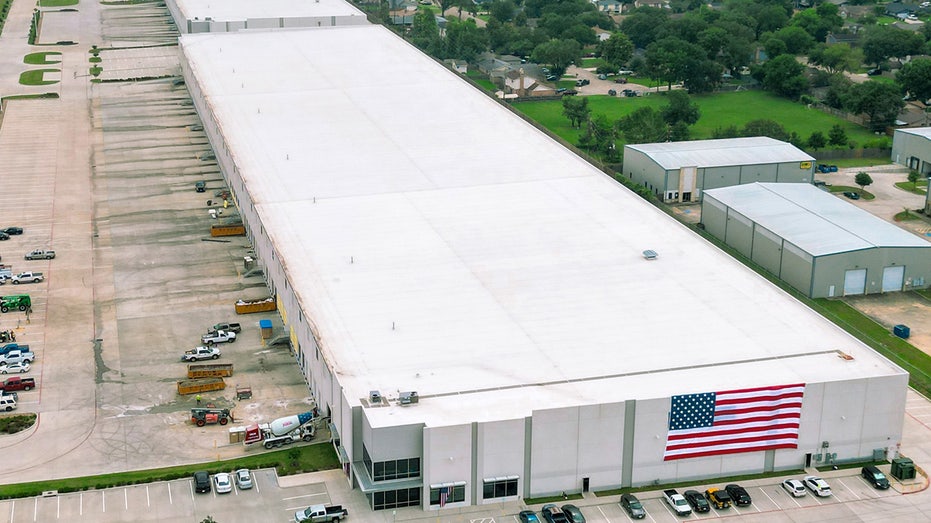
Apple's new manufacturing facility in Houston, Texas.

Apple’s new manufacturing facility in Houston, Texas. (Apple)

The expansion comes as technology companies increase domestic AI infrastructure capacity and reassess overseas supply chain exposure. Apple did not disclose financial details specific to the Houston project, but it previously pledged to invest $600 billion in the U.S. and says it has surpassed some related targets.

apple mac mini

Apple will begin producing Mac minis in Houston later this year for the first time. (Jakub Porzycki/NurPhoto via Getty Images)

As part of that broader effort, Apple said it has sourced more than 20 billion U.S.-made chips from 24 factories across 12 states, working with suppliers including TSMC, Broadcom and Texas Instruments. The company expects to purchase well over 100 million advanced chips from TSMC’s Arizona facility in 2026. It is also supporting semiconductor and materials investments in Texas, Arizona and Kentucky through partners such as Amkor, GlobalWafers and Corning.

Ticker Security Last Change Change % AAPL APPLE INC. 274.24 +2.10
+0.77%

Beyond Houston, Apple has expanded its Apple Manufacturing Academy in Detroit, which provides training in artificial intelligence, automation and smart manufacturing to small- and medium-sized U.S. businesses.

Customers wait outside Apple store in Los Angeles

Customers line up outside of Apple’s Grove store in Los Angeles. (Eric Thayer/Bloomberg via Getty Images)

The Houston expansion is expected to generate new high-tech manufacturing roles and create additional opportunities for suppliers in the region.

CLICK HERE TO GET FOX BUSINESS ON THE GO

While Apple did not detail potential pricing implications, the increased U.S.-based production of advanced chips and AI servers reflects the company’s growing reliance on domestic facilities to support its artificial intelligence and data center operations.


Free Training

Source link

Apple to move part of Mac Mini production to US with Houston expansion


Apple Inc. will move part of its Mac Mini production to the United States, with assembly set to begin later this year at a Foxconn facility in north Houston, according to a Wall Street Journal report.

Apple Inc. will move part of its Mac Mini production to the United States, with assembly set to begin later this year at a Foxconn facility in north Houston, according to a Wall Street Journal report.

Apple will move some
production of its Mac Mini desktop computer ​to the U.S. from
Asia, with a new manufacturing ‌effort set to begin later this
year at ​a Foxconn facility in north Houston, ⁠The Wall Street
Journal reported on Monday.

The plan marks the iPhone maker’s most recent U.S.
investment, following its commitment announced ‌last August to
invest $600 billion in the U.S. over the next four years.

In May, ‌U.S. President Donald Trump had threatened Apple
with ‌a ⁠25% tariff on products manufactured overseas, a ⁠sharp
reversal from earlier policy when his administration had
exempted smartphones, computers and other electronics from
rounds of tariffs on Chinese imports.

The ​production for Mac ‌Mini will continue in Asia, its chief
operating officer Sabih Khan told WSJ, adding that the facility
will meet local demand as the U.S. assembly ‌line ramps up.

It was not immediately clear ​whether Apple plans to
scale down production in its Asia facilities. Apple did not
immediately ⁠respond to a Reuters request for comment.

The company feels more confident projecting long-term demand
for the Mac ‌Mini, which is more popular than the Mac Pro, Khan
added.

It is also expanding the Houston facility to include a new
training center for advanced manufacturing, according to the
report.

Apple has a mixed track record when it comes to following
through on ‌investment promises.

In 2019, for instance, Cook toured a Texas ​factory
with Trump that was promoted as a new manufacturing site.
However, the facility had ⁠been producing Apple computers since
2013 and Apple has since ⁠moved that production to Thailand.

Apple continues to manufacture most of its products,
including iPhones ‌and iPads, in Asia, primarily in China,
although it has shifted some production to Vietnam, Thailand ​and
India in recent years.

Published on February 24, 2026

Free Training

Source link

Copper Mountain Technologies Advances Global Production Strategy with Expanded Manufacturing Operations in Cyprus


INDIANAPOLIS, Feb. 03, 2026 (GLOBE NEWSWIRE) — Copper Mountain Technologies (CMT) enters 2026 after a year of significant advances in manufacturing capability, security compliance, and product development. Throughout 2025, the company invested in strengthening its infrastructure and delivering VNA solutions to better support RF engineers and test and measurement professionals worldwide.

To support rising global demand, CMT expanded its production capabilities through strategic investment in operations and resources. In addition to its established manufacturing site in the United States, the company has extended its footprint in the European Union.

While the Cyprus office was originally established in 2022, this February, the company has moved into a new, larger manufacturing facility. The new facility brings design engineering, production, software development, and service under one roof — enhancing agility, scalability, customer support, reliable supply and faster delivery worldwide.

Together with US manufacturing operations, this European Union expansion strengthens CMT’s ability to meet increasing demand across Europe and the EMEA region.

About Copper Mountain Technologies

Copper Mountain Technologies develops innovative RF test and measurement solutions for engineers around the world. Headquartered in Indianapolis, Indiana (USA), CMT maintains manufacturing, R&D, applications engineering and service operations in both the United States and Paphos, Cyprus (EU), with additional regional offices in Singapore, London, and Miami. They offer a broad range of USB vector network analyzers, calibration kits, and accessories for 50 Ohm and 75 Ohm impedances to 330 GHz. Their VNAs use software for Windows® and Linux® operating systems on an external computer, PC, or tablet. Every CMT VNA includes robust application and automation support, backed by years of RF engineering expertise dedicated to customer success.

A photo accompanying this announcement is available at https://www.globenewswire.com/NewsRoom/AttachmentNg/ea94e617-829d-47a7-ab62-3a20b453193f

Primary Logo

Free Training

Source link

Hadrian Launches Additive Manufacturing Division to Expand U.S. Defense Production Capacity


New division brings production-ready additive manufacturing capacity online in 2026

TORRANCE, Calif., Jan. 22, 2026 /PRNewswire/ — Hadrian, the advanced manufacturing company building AI-powered factories for America, today announced the launch of Hadrian Additive. This dedicated division is designed to deliver scalable, production-ready additive manufacturing capacity for the U.S. Defense Industrial Base and allied partners.

The new division expands Hadrian’s Opus factory platform to include additive manufacturing systems built for qualification, repeatability, and sustained throughput—enabling defense programs to move from validated designs into reliable, at-scale production. Initial additive manufacturing capacity is expected to come online in 2026 as part of Hadrian’s expanding U.S. factory footprint.

Hadrian Additive integrates additive manufacturing directly into the company’s existing factory model, allowing additive production to support mission-critical systems within a single, end-to-end manufacturing environment.

“America’s defense industrial base needs additive manufacturing that works in real production, not just in prototypes,” said Chris Power, Founder and CEO of Hadrian. “We’re building this capacity the same way we build our factories—engineered for qualification, throughput, and speed—so critical programs can scale when it matters most.”

The division will be led by Matthew Parker, Vice President of Additive Manufacturing at Hadrian, and will focus on meeting the reliability, quality, and traceability requirements of defense and national security programs.

“Additive manufacturing only becomes strategic when it’s industrialized,” Parker said. “Hadrian Additive is designed as a production system from day one, integrated with our factory stack and capable of scaling as demand grows.”

The launch of Hadrian Additive builds on the company’s recent factory expansions and manufacturing initiatives, further strengthening domestic production capacity for priority defense programs.

About Hadrian
Hadrian is a next-generation manufacturing company transforming the U.S. industrial base by rapidly adding domestic manufacturing capacity through its highly automated factories. By integrating process engineering, artificial intelligence, machine learning, and robotics, Hadrian strengthens American manufacturing capabilities and enables U.S. workers to compete globally.

Hadrian’s mission is to enable space and defense manufacturers to produce domestically at scale, supporting production at every level, from individual components to full-scale programs. The company currently operates three advanced manufacturing facilities totaling approximately 600,000 square feet, including two sites in Torrance, California, and a newly launched facility in Arizona. Hadrian is actively developing additional production sites across the United States. More information at https://www.hadrian.co/.

About Matthew Parker
Matthew Parker is Vice President, Additive Manufacturing at Hadrian, where he leads the company’s Additive Manufacturing business unit and the buildout of a large-scale additive manufacturing capability supporting defense and aerospace customers. He is an engineering and operations leader in industrial AM, with a track record of standing up manufacturing capacity, industrializing processes, and transitioning additive programs into repeatable production.

Prior to joining Hadrian, Parker held senior leadership roles in additive manufacturing operations and engineering, leading cross-functional teams spanning production, engineering, quality, and customer delivery. A U.S. Army veteran, he brings a mission-first perspective and an emphasis on readiness—prioritizing speed, reliability, and disciplined execution—directly aligned with scaling additive manufacturing into dependable production capacity. His background includes large-format AM deployment, process qualification, industrialization, and partnership development across industry and standards organizations to advance material and process maturity for demanding applications.

Media contact: [email protected]

SOURCE Hadrian

Free Training

Source link

Tariff threats prompted pharma production boom last year: report


While the threat of U.S. import tariffs prompted a surge in drug production last year, that output is slated to slow across multiple geographies in 2026. And, even as the biopharma industry enters the new year with greater certainty around the U.S.’ trade policy, the risk of another “tariff flare-up” looms large.

That’s the macro situation according to financial services firm Atradius, which noted in a new industry trend report (PDF) that global pharmaceutical production leapt 9.1% in 2025, mainly on the back of “front-loading activity in anticipation of US tariffs.” 

In 2026, however, output growth is expected to slow to 1.6% as a move toward “retrenchment” results in a slowdown of production growth in the first half of the year, the report predicts.

Nevertheless, a rebound could be not too far behind, with Atradius reckoning that global drug production will eke out 3.7% growth in 2027. That general trend holds true when looking at Atradius’ predictions for the growth of pharmaceutical sales and investments around the world in 2027, too.

As for 2025, the financial services company logged 9.7% growth in global pharmaceutical sales and 5.2% growth in overall industry investment. Atradius expects momentum in those areas will slow to 1.6% and 2.7% in 2026, respectively. 

The Trump administration’s persistent threat of pharmaceutical import tariffs was the driving force behind last year’s manufacturing surge, the experts say.

Still, the overall impact of U.S. trade duties has been “limited,” according to Atradius, which pointed to the exemptions Big Pharma companies have won through White House drug pricing deals as well as country- and region-specific agreements capping U.S. import tariff rates. Furthermore, generic drugs have largely been excluded from President Donald Trump’s trade negotiations, sparing the medicines that make up the bulk of the American public’s prescriptions from supply and price disruptions.

The industry isn’t out of the woods yet, with the report cautioning that “the downside risk of another tariff flare-up remains.”

Earlier this week, following an intensification of Trump’s rhetoric around a potential U.S. acquisition of Greenland, concerns were raised that the threat of new 10% taxes on select European countries that showed military support for the autonomous Danish territory might scupper the U.S.-EU trade deal reached last summer. Under that accord, which still needs to be ratified by European lawmakers, most European exports, including pharmaceuticals, will have tariffs capped at 15%.

Trump ultimately backed down on the threat after reaching the “framework of a future deal” on his Greenland ambitions during the World Economic Forum in Davos, Switzerland, this week. Still, the uncertainty his comments cast on previously secured agreements lends credence to Atradius’ “tariff flare-up” warning.

Overall, Atradius suggested industrial policy will play an increasingly large role across the pharmaceutical industry in the coming years, buoyed by government efforts around the globe to reduce reliance on imports and incentivize strategic stockpiling and domestic manufacturing.

“Supply networks of pharmaceuticals and medical devices will become more fragmented due to geopolitical tensions,” the firm predicted.
 

Mapping 2025’s production output
 

In the U.S., pharmaceutical manufacturing output is expected to “decelerate” to 0.9% this year—a marked departure from the 5.2% increase charted in 2025, according to Atradius’ report. The outlook forecasts a 2.5% rebound in U.S. pharmaceutical output growth in 2027.

The report again pointed to industry-won tariff exemptions as a relief for drugmakers in the near term, while caveating that “uncertainty remains, as Washington has repeatedly announced its intention to target medicine imports.”

Aside from the most-favored-nation drug pricing deals that have won many large pharma companies exemptions from tariffs, efforts by the FDA to ease the build-out of new production facilities in the U.S. could also bolster the country’s pharmaceutical output, Atradius said.

At the same time, “high production costs could still make it more cost-effective for pharmaceuticals to be manufactured elsewhere,” the report reads.

Perhaps most striking in Atradius’ report was the 21.6% growth in pharmaceutical output that the U.K. and the EU charted in 2025, again attributed to “front-loading triggered by massive U.S. tariff threats.” In Ireland—a country with a wealth of large pharma manufacturing outposts—production output surged a whopping 41.3% in 2025, according to Atradius. The country is predicted to experience a sharp turn in the other direction this year, with Atradius forecasting a 6.4% output decline.

This year, the U.K. and the EU’s combined output is tipped to “contract temporarily” by 3.7%, by Atradius’ reckoning.

While the EU has presently secured a 15% tariff rate cap, the U.K. has dodged U.S. import duties altogether in part by agreeing to raise the net prices its National Health Service pays for innovative medicines by 25%.

While those agreements blunt the impact of tariffs in Europe, Atradius acknowledged that shifting manufacturing to the U.S.—a key part of Trump’s trade agenda—is both expensive and complex, posing challenges for smaller companies with fewer resources.

Unlike Europe and the U.S., China’s pharmaceutical output is expected to continue growing in 2026. Atradius estimates that the country’s drug production will increase 6.6% this year versus 3.6% growth in 2025. 

China’s exposure to U.S. tariffs is “limited,” and, while the country accounts for some 40% of the world’s active pharmaceutical ingredient output, those drug building blocks aren’t targeted by U.S. tariffs, Atradius noted. 

Free Training

Source link