
The Trump Administration Failed the U.S. Auto Industry, and the Canada-China Deal Proves It


On January 16, 2026, Canadian Prime Minister Mark Carney announced a landmark trade deal with China that will open its market to Chinese electric vehicles (EVs) in exchange for lower tariffs on Canadian-produced canola oil. It’s a major change that could lead to the Canadian market welcoming Chinese-made passenger vehicles at a significantly higher scale and throws into stark relief the consequences of the Trump administration’s reckless trade policy and its large-scale disinvestment in EVs.

The Trump administration’s wrecking-ball approach to traditional forms of international cooperation; its willingness to attack long-time partners and allies with ever more outrageous tariff threats; and its destruction of the U.S. EV supply chain has forced Canada to change its strategy for modernizing and growing its domestic auto industry. Canada has historically been the largest importer of U.S. passenger vehicles. Now, as a direct result of the Trump administration’s actions, Canada’s pivot toward Mexico, China, and elsewhere stands to further isolate the U.S. market as the rest of the world moves decidedly toward a cleaner future. Indeed, if U.S. automakers were already behind Chinese and other international EV producers in terms of technology, production, and price, then the Trump administration’s antics on the world stage will only widen the gap and jeopardize a lucrative export market, to the detriment of American workers and consumers alike.

Stay informed

on Energy and Environment

What’s in the deal?

Canada and China recently agreed to lower tariffs on Canadian canola oil—from 84 percent to approximately 15 percent by March 1, 2026—in exchange for Canada lowering the tariff rate on Chinese EVs from 100 percent to 6.1 percent on the first 49,000 vehicles, eventually growing to 70,000 over five years. Perhaps more importantly, China will invest in EV production capacity in Canada. While this is more of an understanding than an official agreement at this point, it may turn out to be the most significant component of the deal. Legacy North American automakers lag behind their Chinese counterparts in the maturity of their EV production processes. Landing direct investment in domestic production capacity will allow Canadian participants in the supply chain a significant opportunity to learn from Chinese EV and battery makers and produce affordable cars for Canadian citizens. The new Chinese electric vehicles, whether imported or produced in Canada, are likely to be less expensive than other vehicles produced in North America, which will force North American automakers to innovate and learn in order to remain competitive—preferably not to the detriment of autoworker jobs.

Which parts of the manufacturing process ultimately end up onshored in Canada will matter significantly. China has surged ahead of the rest of the world the further upstream one goes in the supply chain. Localizing battery active material production—cathodes and anodes—would bring more economic value and direct jobs than just final battery pack assembly.

It remains to be seen whether this deal will deliver positive benefits to Canada—although ensuring that any factory that supplies EVs either made in Canada or exported into Canada meets the highest standards for workers’ rights and sustainability would be a good start. But what is clear is that this deal would not have occurred without the Trump administration’s ongoing hostility toward EVs and the U.S.-Canada relationship more broadly.

Why make the deal?

The deal is, no doubt, a calculated risk by the Canadian government, based on two key factors. First, the Trump administration has undermined innovation in the domestic auto industry, gutting investments in EVs and causing domestic automakers to cancel billions of dollars of investment in advanced manufacturing. Second, it has deeply exacerbated trade and diplomatic tensions between Washington and Ottawa. As a result, Canada finds itself with a need to reduce its dependency on and integration with the United States to reclaim control over its economy and industrial future. It is a message that Mark Carney, Canada’s prime minister, delivered to his country via video message a few days after signing the agreement with China.

On the future of the auto sector in the United States, it is hard to question the Canadian government’s assessment. One of the first actions taken by the Trump administration, starting with a day-one executive order, was to launch an all-out attack on American EV manufacturing, directing the government to “eliminate the ‘electric vehicle (EV) mandate’,” despite no such mandate existing. Less than a month later, the administration unilaterally and unlawfully froze billions of dollars of funding for everything from EV charger installation to critical mineral processing for batteries, including funds for which the government had already signed contracts with American companies. Finally, in July, the president signed the One Big Beautiful Bill Act and delivered the coup de grâce for the future auto industry, repealing tax credits for EVs made in North America and hamstringing government support for American battery manufacturing. High-quality EVs have an average cost of $25,000 in China, but instead of helping American automakers offer a similarly affordable vehicle, the administration has held them back. NPR captured it succinctly in December:

California’s ability to require the sale of EVs: gone. Federal rules about emissions and fuel economy — being rewritten. Federal penalties for car companies that sell too many gas guzzlers: zeroed out. The $7,500 federal tax credit? Kaput.

These actions have already caused damage. Ford took a $19.5 billion write-down scaling back its plans for EV production, while GM took a $6 billion hit. As of the end of the third quarter of 2025, EV supply chain investment was down 30 percent from that point a year earlier. These cancellations won’t just hurt the United States and American workers but also Canada. The auto industry is not an American industry; it’s a North American industry, with the region that includes Michigan, Ohio, Indiana, and Ontario often referred to as the “Great Lakes supercluster.” As described in a recent report to Congress, “Across the region, hundreds of suppliers provide thousands of parts for vehicles, some of which cross the border seven or eight times as they are assembled into larger products.” The industry is deeply intertwined, so major changes in the United States will significantly affect both Canada and Mexico. Without a strong automotive industry—along with all the supplier industries that serve the auto industry—Canada’s industrial future would be far weaker and far less resilient to the vagaries of policy choices in the United States and elsewhere.

Without a strong automotive industry, Canada’s industrial future would be far weaker and far less resilient to the vagaries of policy choices in the United States and elsewhere.

Canada and the United States have had a remarkably close relationship, consistently sharing economic and foreign policy goals over generations. In 2023, more than $2.5 billion in goods and services crossed the U.S.-Canada border each day. In all likelihood, Ottawa would like to maintain this close relationship and economic integration as much as possible, but as Carney noted in his recent speech to the World Economic Forum in Davos, Switzerland, Canada must react to the world as it is—not the world it wishes existed. And the current world is defined by the brazen tariff threats and toxic nationalism of the Trump administration.

In just its first year in office, the Trump administration has ushered in a trade war unprecedented in its size and scale, imposing new tariffs on nearly every nation and on roughly half the goods entering the United States. In addition to tariffs, the Trump administration has done its best to antagonize Canada, from referring to Canada as the “51st state” and Prime Minister Carney as “Governor Carney” to reportedly meeting with Albertan separatists. As a result, Canada has come to view the United States not as a partner or ally but as a belligerent nation that no longer shares its interests and values—at least not as long as the Trump administration is in the White House.

What about U.S. manufacturing?

Allowing Chinese EVs into the Canadian market, albeit in limited numbers at first, will place massive pressure on American automakers to catch up technologically—which would be the best-case outcome. There are some positive signs that this is happening, such as GM’s investment in new battery technologies. However, if U.S. automakers choose instead to cede the market entirely, then that loss will be felt directly in the U.S. labor market. As the United States has deprioritized affordable EVs—and affordable vehicles in general—China has kept up its massive push to build and adopt EVs. More than half of new cars sold in China are now EVs, accounting for roughly 70 percent of global EV production. This global EV adoption is helping change the trajectory of global oil demand to peak in five years. And it’s not just China, with countries like India electrifying even faster.

There is no turning away from an electrified future for passenger vehicles unless the goal is to condemn people to a future of more expensive cars and fewer jobs.

This means that Canada is a canary in the coal mine for U.S. automakers. If they cannot build and sell EVs to compete with those manufactured by their competitors in a market physically next door—and one that was previously accustomed to buying U.S.-made vehicles—then there is little hope of them competing in a broader world that is rapidly electrifying. One in 4 vehicles sold in 2025 was electric; making a cost-competitive EV is not optional for automakers who want to retain significant market share. Should American automakers fail to do so, autoworkers and U.S. industry more broadly would likely be the first to suffer the consequences.

On the campaign trail, President Trump wildly claimed that “all the electric cars are going to be made in China.” This isn’t likely to become true with other parts of the world such as Europe shifting toward EV production, but what may be true is that significant numbers won’t be made in the United States, which will be a problem when the rest of the world ultimately decides EVs are the way to go. Investors want to invest in industries of the future, and workers need training in those industries now. But instead of recognizing this future—one that Canada clearly does—President Trump appears focused on keeping American auto manufacturing stuck in the past. If he is successful, those investors won’t invest in the U.S. auto industry, and there will be fewer workers in it as a result.

Conclusion

In only a year, the Trump administration’s reckless policies forced a dilemma upon Canada: Continue to be tied to a historic trading partner whose current leadership has decided to hold its own—and, by extension, Canada’s—industry back from producing innovative EVs, or make a deal with China, a competitor leading in the EV industry.

Canada has made a choice to welcome Chinese EVs today, and that should be a wake-up call: There is no turning away from an electrified future for passenger vehicles unless the goal is to condemn people to a future of more expensive cars and fewer jobs. The rest of the world is moving on to cheaper, cleaner vehicles. If the United States wants to produce the vehicles the world wants, as it should, then the country must return to investing in electric vehicle production and an associated supply chain. Nearly 1 million direct jobs are at stake. The Trump administration, and U.S. automakers, should stop seeing the world they wish to see and start seeing the world as it is. Otherwise, U.S. autoworkers and consumers are going to pay the price. A continuation of the Trump administration’s toxicity on the world stage and its backward auto and energy policy would only mean more deals like the one Canada and China agreed to a few weeks ago.

The authors would like to thank Kalina Gibson, Allison McManus, Steve Bonitatibus, and Mona Alsaidi for their feedback, guidance, and support on this column.

Free Training

Source link

Manufacturing Construction Spending Declines Under Trump


Spending to build, expand and rehabilitate manufacturing sites in the U.S. has declined since President Donald Trump took office, according to U.S. Census Bureau data. Yet, Trump has repeatedly boasted that “factory construction” is up 41%.

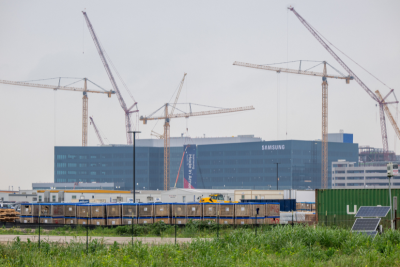
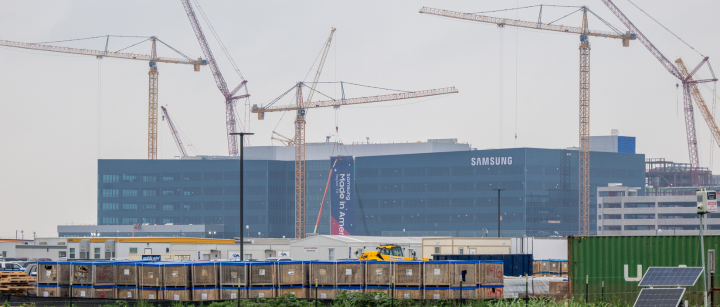
A general view of the Samsung Austin Semiconductor plant on April 16, 2024, in Taylor, Texas, which received CHIPS Act funds. Photo by Brandon Bell/Getty Images.
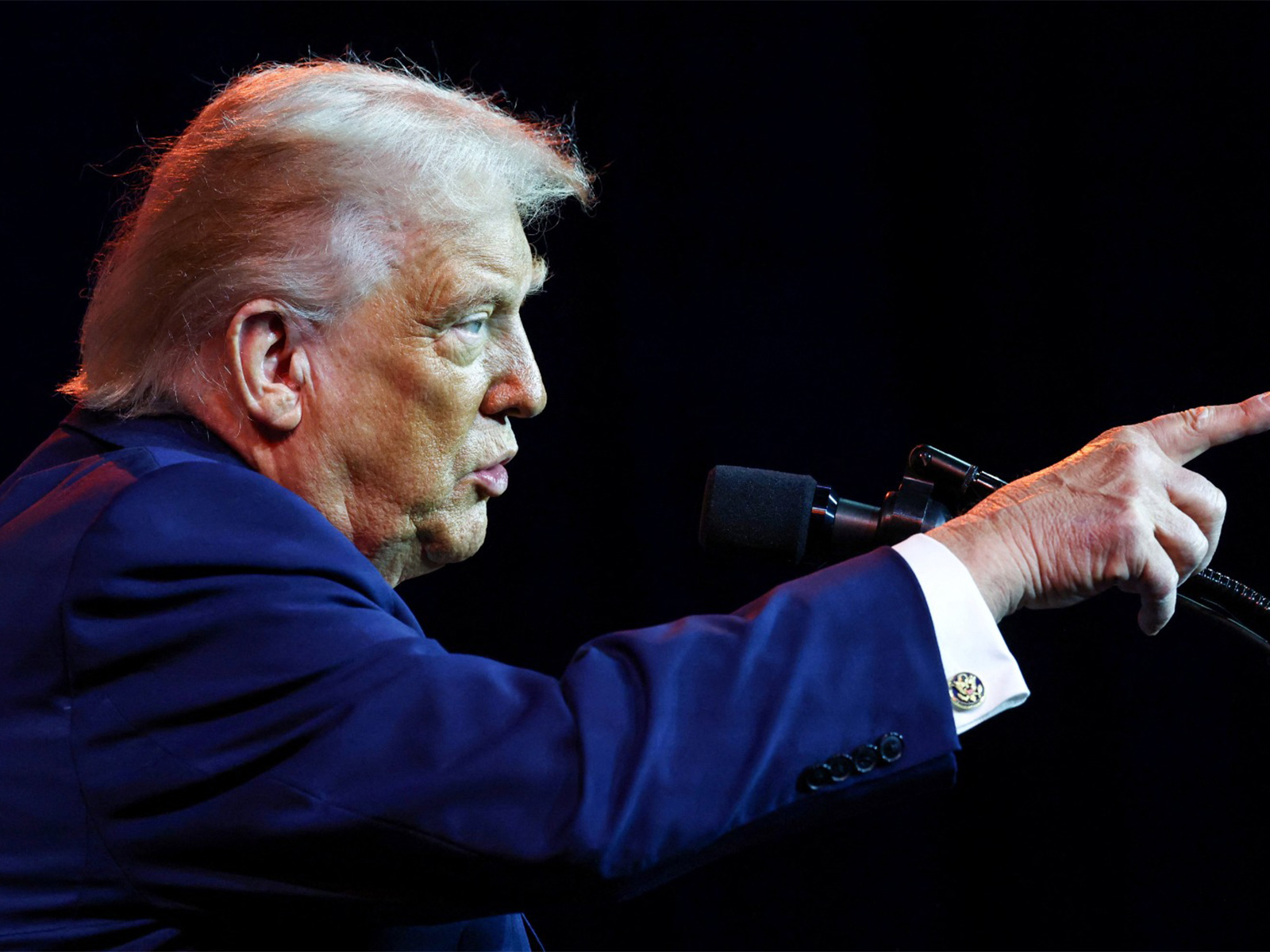
Trump cited the 41% statistic in a White House press conference on Jan. 20 – calling it a “record” increase and suggesting that other presidents cannot compare to this “record.” 

“Investment in American factories is up 41%. That’s a record. Nobody goes 41% up. You go 2% up, 1% up. You go down by 3%. If Kamala [Harris] got elected, the 41% up would be 41% down,” Trump said at the press conference, referring to the former vice president and Democratic presidential nominee who lost to Trump in the 2024 election.

A day later, in a Jan. 21 speech at the World Economic Forum Annual Meeting in Davos, Switzerland, Trump repeated the 41% figure. 

“Factory construction is up by 41%, and that number is really going to skyrocket right now, because that’s during a process that they’re putting in to get their approvals and we’ve given very, very quick, fast approvals,” Trump said. 

This claim is part of a theme the president has emphasized of a “manufacturing boom” or “booming” economy due to his trade policies.

At our request, the White House sent us a link to the Census Bureau’s manufacturing construction spending data via the Federal Reserve Bank of St. Louis’ online database known as FRED. We provide more about the White House response later, but let’s focus first on what the data show.

Under President Joe Biden — who served from Jan. 20, 2021, to Jan. 20, 2025 — there was a significant increase in manufacturing construction spending in all four years, according to the Census Bureau’s annual average estimates. After declining 6.9% in 2020 – the last year of Trump’s first term – manufacturing construction spending started to rise in 2021, the data show. 

(Technical note: The Census Bureau provides average quarterly and annual estimates and monthly reports for construction spending, including manufacturing construction spending, based on its monthly Value of Construction Put in Place survey. We use all three in this story.) 

Initially, the increases during the Biden years were in response to the COVID-19 pandemic, Anirban Basu, chief economist for the Associated Builders and Contractors, an industry trade association, told us in an email. 

“Supply chain disruptions at the start of the COVID-19 pandemic convinced many producers to reshore capacity, while a sudden and sharp increase in construction materials prices—which rose more than 40% during the early years of the pandemic—also boosted nominal construction spending,” Basu said. 

Manufacturing construction spending accelerated after Biden signed legislation in August 2022 designed to encourage private investment in U.S. manufacturing for semiconductors and clean energy. The bipartisan CHIPS Act, for example, included $39 billion to help fund semiconductor manufacturing facilities in the U.S., as explained in an April 2023 report by the Congressional Research Service.

During Biden’s four years, the annual average rate of manufacturing construction spending jumped more than 200%, from $75.5 billion to $235.6 billion, according to Census Bureau estimates. Spending surged 62% in a single year – 2023, a year after Biden signed the CHIPS Act. 

But manufacturing construction spending peaked in the third quarter of 2024 and has been trending down slightly ever since. Census Bureau quarterly data show that under Trump, measuring from the last quarter in 2024 through the third quarter in 2025, spending declined 6.7%. 

That decline is expected to continue in 2026 and 2027, according to the most recent survey of construction economists that is conducted twice a year by the American Institute of Architects.

“Manufacturing construction spending has seen phenomenal growth in recent years, increasing by over 50% in 2022, another 62% in 2023, and then another 16% in 2024,” the AIA consensus construction forecast published Jan. 15 said. “However, growth paused last year as spending in this category fell about 5% and is projected to decline another 4% this year and 1% in 2027.”

Despite the slight declines, the AIA construction forecast noted that the semiconductor fabrication plants continue to fuel manufacturing construction spending and will do so in the long term.

“The longer-term prospects look much more promising, as construction starts for manufacturing projects have shot up again,” the AIA forecast said. “Since many of these starts are for megaprojects, such as large semiconductor fabrication plants that entail a complex construction process, it may take a while before the activity shows up in the construction spending data.”

In January, Basu analyzed the Census Bureau’s most recent monthly report for nonresidential construction spending, which showed manufacturing construction spending as of October had declined for nine straight months

“With CHIPS Act-enabled megaprojects winding down and the stiff headwind of trade policy, manufacturing construction spending has fallen by nearly 10% over the past 12 months, accounting for more than the entire decline in private nonresidential spending,” Basu said in an ABC press release issued Jan. 21. (By “trade policy,” Basu is referring to the economic impact of Trump’s tariffs on construction materials.)

On a monthly basis, the Census Bureau shows a 7.3% decline in manufacturing construction spending last year under Trump from January through October, the most recent data available.

Beginning on Jan. 23, we asked the White House on multiple occasions to provide support for the 41% figure used in Trump’s Jan. 20 and 21 remarks. After not receiving a response, we sent another email on Feb. 2 after the president wrote an opinion piece for the Wall Street Journal on Jan. 30 that said, “Factory construction is up by 42% since 2022.” We asked how it arrived at a 42% increase “since 2022.” That evening, the White House sent us a link to the Census Bureau’s manufacturing construction spending data, saying it compared “averages of Jan – August 2025 vs 2021-2024 average.”

That’s true — as far as it goes. On an annualized basis, monthly manufacturing construction spending averaged $226.1 billion for January through August — which is 40% higher than the annual average of $161.1 billion in Biden’s four years. But Trump wrote that the 42% increase was “since 2022,” not 2021. (We’ve asked the White House for a clarification.)

More importantly, the White House methodology fails to take into account the 212% increase in factory construction spending over Biden’s four years, which peaked in 2024 at an annual average of $235.6 billion, and how the Biden-era CHIPS Act continues to fuel manufacturing construction spending.

As we noted earlier, Basu attributed the recent decline to Trump’s tariffs and the slowing — not the halting — of construction projects spurred by the CHIPS Act. Asked to elaborate on his analysis, Basu told us that the manufacturing construction spending in 2025 is “largely due” to the CHIPS Act.

“While spending in the segment remains elevated from 2022 levels, that’s partially due to a precipitous increase in materials prices that occurred in 2022 and 2023 — these data are in nominal terms — and largely due to the surge in megaproject activity induced by the CHIPS Act,” Basu said.

He added that Trump’s tariffs have helped drive up the costs of fabricated metal — which has increased manufacturing construction costs.

“[I]t should be noted that spending in the fabricated metal manufacturing subsegment is up 19% over the past year,” Basu said. “Some of the increase can be contributed to tariffs and the resulting increase in demand for domestic production.”

We should note that even with the recent surge in manufacturing construction spending, there has been a decline in the number of manufacturing jobs. As we reported last month, the economy lost 63,000 manufacturing jobs in Trump’s first 11 months. That followed a loss of 98,000 in the preceding 11 months, according to the Bureau of Labor Statistics.

Shortly before Biden left office, Manufacturing Today, a trade magazine, wrote in December 2024 that manufacturing jobs were slow to materialize despite Biden’s incentives to spur manufacturing construction. But the magazine predicted the jobs “will materialize in the future.”

“Unlike traditional industrial projects, today’s semiconductor and clean energy facilities require longer timelines,” the article said. “Factories of this scale can take two to three years to complete, with even longer delays for more complex facilities, such as semiconductor plants. This extended timeline means the full benefits will not be realized for several more years.”

Basu agreed that CHIPS-related spending will result in an overall increase in U.S. manufacturing jobs – but cautioned that the impact of Trump’s tariffs could offset those gains. 

“The massive facilities incentivized by the CHIPS Act will employ thousands of people,” Basu told us. “That said, all else is not equal, and recent trade policy and the effects on manufacturing input prices have put downward pressure on the industry’s employment.” (Input prices are costs of materials and other resources manufacturers need to produce goods, with some of those materials being imported.)

Others are bullish that Trump’s trade policies will encourage more manufacturers to expand in the U.S. 

In April, when Trump announced higher tariffs on nearly all foreign imports, Morgan Stanley analyst Chris Snyder called tariffs “a positive catalyst” for relocating manufacturing to the U.S. More recently, Snyder said in a podcast last month that the tariffs have changed the “supply chain cost calculation” and will result in new U.S. factories. 

“What we’re seeing is the cost of imports have gone higher with tariffs, and now it’s more economically advisable for these companies to make the product in the United States,” Snyder said. “And if that’s the case, that means that when they need a new factory, it’s going to come to the United States. They might not need a factory now, but when they do, the U.S. is at least incrementally better positioned to get that factory.”

In a January news article, the Wall Street Journal wrote that Trump’s tariffs “haven’t worked, so far.” The article said tariffs have increased manufacturers’ costs for foreign parts, adding that the “White House’s stop-and-start” tariff policy announcements have “also led to what many executives view as a lost year for investment.”

In a December interview with the Wall Street Journal, Trump cited — as he often does — the value of investments that he says his administration has secured to date. (As we’ve written, he has exaggerated pledges to invest made by various companies and countries that may or may not materialize, experts say.) But he couldn’t say if the investments would show results in time for the midterm elections, when the Republican Party is in jeopardy of losing its slim majority in the House. “I can’t tell you. I don’t know when all of this money is going to kick in,” the president told the Journal, adding that it may happen in the second quarter of this year.

What will happen in the coming months and years remains to be seen. But what we can say is that factory construction so far has declined under Trump and his claim that it has increased 41% depends on a spending surge that occurred under Biden. 

Editor’s note: FactCheck.org does not accept advertising. We rely on grants and individual donations from people like you. Please consider a donation. Credit card donations may be made through our “Donate” page. If you prefer to give by check, send to: FactCheck.org, Annenberg Public Policy Center, P.O. Box 58100, Philadelphia, PA 19102. 

Free Training

Source link

Trump said tariffs would bring factories ‘roaring back.’ So why are manufacturing jobs on the decline?


Just before President Trump announced his sweeping tariffs on “Liberation Day” last spring, the White House celebrated February’s gain of 10,000 manufacturing jobs, noting that more than 100,000 positions in the sector had been shed in the final year of the Biden administration.

“Manufacturing is Roaring Back,” the White House website declared.

But such gains were short-lived. Manufacturing jobs began to slide again in May and haven’t stopped declining. 72,000 manufacturing positions have been lost since April’s tariffs announcement, including 8,000 roles in December alone.

What gives?

“What we’re seeing is certainly a continuation of trends that began before the Trump administration,” Gordon Hanson, an economist and professor in urban policy at the Harvard Kennedy School, told Yahoo Finance. “But the tariffs haven’t helped.”

Indeed, millions of manufacturing jobs have disappeared from the US since 1979 amid a combination of “powerful” trends, Hanson said, including automation, “the continuing effects of the China trade, and the fact that the US has not done a lot of the things you need to do to restore manufacturing prowess.”

Tariffs are hardly the solution to those problems, Hanson said — though Trump insists otherwise. He vowed in April that jobs and factories would “come roaring back into our country” as levies on imports boosted locally produced goods.

While tariffs do reduce import competition, they can also increase the cost of key components for domestic manufacturers. Take US electric vehicle plants that rely on batteries made with rare earth elements imported from overseas, for instance. Some parts simply aren’t made in the United States.

Read more: What are rare earth minerals, and why are they important?

As for sectors that had already largely left the US, like apparel and textile manufacturing, “a lot of those industries are just substantially gone,” Hanson said, meaning there aren’t many existing factories where production could be ramped up and hires could be made.

Do you have a story about navigating the job market? Reach out to Emma Ockerman here.

Manufacturing is hardly the only industry to add few workers these days: Job growth remains paltry across the board, and what hiring does exist is largely being driven by the healthcare and social assistance sectors.

DEARBORN, MICHIGAN - JANUARY 13: U.S. President Donald Trump (2R) tours the assembly line at the Ford River Rouge Complex on January 13, 2026 in Dearborn, Michigan. Trump is visiting Michigan where he will participate in a tour of the Ford River Rouge complex and later give remarks to the Detroit Economic Club. (Photo by Anna Moneymaker/Getty Images) President Trump tours the assembly line at the Ford River Rouge Complex on Jan. 13 in Dearborn, Mich. (Photo by Anna Moneymaker/Getty Images) · Anna Moneymaker via Getty Images

Then there’s the uncertainty caused by the administration’s whipsawing tariff policies, which can lead employers to pull back on hiring as they await greater clarity.

“If Trump just picked a number — whatever it was, 10% or 15% to 20% — we might all say it’s bad, I’d say it’s bad, I think most economists would say it’s bad,” Dean Baker, senior economist at the Center for Economic and Policy Research, said. “But the worst thing is there’s no certainty about it.”

Story Continues

Trump’s tariff threats against several European nations as he sought control of Greenland, for example, appeared and abated within a matter of days, injecting some volatility into the stock market in the process.

Read more: How Trump’s tariffs affect your money

With rates “constantly changing, what becomes very difficult for businesses is to plan,” Baker added. “I think you’ve had a lot of businesses curtail investment plans because they just don’t know whether the plans will make sense.”

Manufacturing job losses could also be more severe than they appear in preliminary data. Fed Chair Jerome Powell said in December that federal statistics may have overstated job growth by “about 60,000” per month.

It’s “too early to say with any certainty” that these manufacturing jobs would be around if not for the tariffs, Baker noted, but there’s also “zero evidence” that they came charging back.

To be sure, the Biden administration also claimed a renaissance in manufacturing jobs, but that was after massive job destruction in 2020. Though employment in the sector eventually jumped above pre-pandemic levels, the growth was uneven regionally and lagged growth in other sectors, the Economic Innovation Group said in a 2024 analysis. Still, spending on manufacturing construction boomed following the 2021 bipartisan infrastructure bill, 2022 CHIPS Act, and 2022 inflation reduction bill.

That spending declined in 2025.

But, tariffs or no tariffs, a manufacturing employment boom would be difficult to construct.

As a country develops, manufacturing might first rise as a share of employment, but “in every single industrial economy” it declines steadily after a certain point, Robert Lawrence, senior fellow at the Peterson Institute for International Economics and professor of international trade and investment at the Harvard Kennedy School, said.

“It doesn’t matter if you have a trade deficit or a trade surplus,” Lawrence said.

Consumers use the money they save on cheaper goods and spend it on services, where there’s more employment growth. That’s what’s happened in the US, where payroll gains for 2025 were concentrated in services like healthcare, food services, and social assistance.

“I think this is deep,” Lawrence said. “We’ve tried industrial policy, we’ve tried trade protection — even before Trump’s initiatives and Liberation Day tariffs — and we haven’t seen much recovery at all. If anything, it continues to decline.”

Emma Ockerman is a reporter covering the economy and labor for Yahoo Finance. You can reach her at emma.ockerman@yahooinc.com.

Sign up for the Mind Your Money newsletter

Click here for the latest personal finance news to help you with investing, paying off debt, buying a home, retirement, and more

Read the latest financial and business news from Yahoo Finance

Free Training

Source link

Trump Administration Slaps 25% Tariffs on High-End NVIDIA and AMD AI Chips to Force US Manufacturing


In a move that marks the most aggressive shift in global technology trade policy in decades, President Trump signed a national security proclamation yesterday, January 14, 2026, imposing a 25% tariff on the world’s most advanced artificial intelligence semiconductors. The order specifically targets NVIDIA (NASDAQ: NVDA) and AMD (NASDAQ: AMD), hitting their flagship H200 and Instinct MI325X chips. This “Silicon Surcharge” is designed to act as a financial hammer, forcing these semiconductor giants to move their highly sensitive advanced packaging and fabrication processes from Taiwan to the United States.

The immediate significance of this order cannot be overstated. By targeting the H200 and MI325X—the literal engines of the generative AI revolution—the administration is signaling that “AI Sovereignty” now takes precedence over corporate margins. While the administration has framed the move as a necessary step to mitigate the national security risks of offshore fabrication, the tech industry is bracing for a massive recalibration of supply chains. Analysts suggest that the tariffs could add as much as $12,000 to the cost of a single high-end AI GPU, fundamentally altering the economics of data center builds and AI model training overnight.

The Technical Battleground: H200, MI325X, and the Packaging Bottleneck

The specific targeting of NVIDIA’s H200 and AMD’s MI325X is a calculated strike at the “gold standard” of AI hardware. The NVIDIA H200, built on the Hopper architecture, features 141GB of HBM3e memory and is the primary workhorse for large language model (LLM) inference. Its rival, the AMD Instinct MI325X, boasts an even larger 256GB of usable HBM3e memory, making it a critical asset for researchers handling massive datasets. Until now, both chips have relied almost exclusively on Taiwan Semiconductor Manufacturing Company (NYSE: TSM) for fabrication using 4nm and 5nm process nodes, and perhaps more importantly, for “CoWoS” (Chip-on-Wafer-on-Substrate) advanced packaging.

This order differs from previous trade restrictions by moving away from the “blanket bans” of the early 2020s toward a “revenue-capture” model. By allowing the sale of these chips but taxing them at 25%, the administration is effectively creating a state-sanctioned toll road for advanced silicon. Initial reactions from the AI research community have been a mixture of shock and pragmatism. While some researchers at labs like OpenAI and Anthropic worry about the rising cost of compute, others acknowledge that the policy provides a clearer, albeit more expensive, path to acquiring hardware that was previously caught in a web of export-control uncertainty.

Winners, Losers, and the “China Pivot”

The implications for industry titans are profound. NVIDIA (NASDAQ: NVDA) and AMD (NASDAQ: AMD) now face a complex choice: pass the 25% tariff costs onto customers or accelerate their multi-billion dollar transitions to domestic facilities. Intel (NASDAQ: INTC) stands to benefit significantly from this shift; as the primary domestic alternative with established fabrication and growing packaging capabilities in Ohio and Arizona, Intel may see a surge in interest for its Gaudi-line of accelerators if it can close the performance gap with NVIDIA.

For cloud giants like Amazon (NASDAQ: AMZN), Google (NASDAQ: GOOGL), and Microsoft (NASDAQ: MSFT), the tariffs represent a massive increase in capital expenditure for their international data centers. However, a crucial “Domestic Exemption” in the order ensures that chips imported specifically for use in U.S.-based data centers may be eligible for rebates, further incentivizing the concentration of AI power within American borders. Perhaps the most controversial aspect of the order is the “China Pivot”—a policy reversal that allows NVIDIA and AMD to sell H200-class chips to Chinese firms, provided the 25% tariff is paid directly to the U.S. Treasury and domestic U.S. demand is fully satisfied first.

A New Era of Geopolitical AI Fragmentation

This development fits into a broader trend of “technological decoupling” and the rise of a two-tier global AI market. By leveraging tariffs, the U.S. is effectively subsidizing its own domestic manufacturing through the fees collected from international sales. This marks a departure from the “CHIPS Act” era of direct subsidies, moving instead toward a more protectionist stance where access to the American AI ecosystem is the ultimate leverage. The 25% tariff essentially creates a “Trusted Tier” of hardware for the U.S. and its allies, and a “Taxed Tier” for the rest of the world.

Comparisons are already being drawn to the 1980s semiconductor wars with Japan, but the stakes today are vastly higher. Critics argue that these tariffs could slow the global pace of AI innovation by making the necessary hardware prohibitively expensive for startups in Europe and the Global South. Furthermore, there are concerns that this move could provoke retaliatory measures from China, such as restricting the export of rare earth elements or the HBM (High Bandwidth Memory) components produced by firms like SK Hynix that are essential for these very chips.

The Road to Reshoring: What Comes Next?

In the near term, the industry is looking toward the completion of advanced packaging facilities on U.S. soil. Amkor Technology (NASDAQ: AMKR) and TSMC (NYSE: TSM) are both racing to finish high-end packaging plants in Arizona by late 2026. Once these facilities are operational, NVIDIA and AMD will likely be able to bypass the 25% tariff by certifying their chips as “U.S. Manufactured,” a transition the administration hopes will create thousands of high-tech jobs and secure the AI supply chain against a potential conflict in the Taiwan Strait.

Experts predict that we will see a surge in “AI hardware arbitrage,” where secondary markets attempt to shuffle chips between jurisdictions to avoid the Silicon Surcharge. In response, the U.S. Department of Commerce is expected to roll out a “Silicon Passport” system—a blockchain-based tracking mechanism to ensure every H200 and MI325X chip can be traced from the fab to the server rack. The next six months will be a period of intense lobbying and strategic realignment as tech companies seek to define what exactly constitutes “U.S. Manufacturing” under the new rules.

Summary and Final Assessment

The Trump Administration’s 25% tariff on NVIDIA and AMD chips represents a watershed moment in the history of the digital age. By weaponizing the supply chain of the most advanced silicon on earth, the U.S. is attempting to forcefully repatriate an industry that has been offshore for decades. The key takeaways are clear: the cost of global AI compute is going up, the “China Ban” is being replaced by a “China Tax,” and the pressure on semiconductor companies to build domestic capacity has reached a fever pitch.

In the long term, this move may be remembered as the birth of true “Sovereign AI,” where a nation’s power is measured not just by its algorithms, but by the physical silicon it can forge within its own borders. Watch for the upcoming quarterly earnings calls from NVIDIA and AMD in the weeks ahead; their guidance on “tariff-adjusted pricing” will provide the first real data on how the market intends to absorb this seismic policy shift.

This content is intended for informational purposes only and represents analysis of current AI developments.

TokenRing AI delivers enterprise-grade solutions for multi-agent AI workflow orchestration, AI-powered development tools, and seamless remote collaboration platforms.
For more information, visit https://www.tokenring.ai/.


Free Training

Source link

Trump meets Intel CEO, hails US-Made Sub-2 Nanometer Chip, links manufacturing push to tariff policy


ANI |
Updated:
Jan 09, 2026 08:39 IST

Washington DC [US], January 9 (ANI): US President Donald Trump has hailed chipmaker Intel for launching an advanced semiconductor product manufactured entirely in the United States, calling it a major achievement for American industry and a validation of his administration’s aggressive trade and manufacturing policies.
In a social media post, President Trump said he had a “great meeting” with Intel CEO Lip-Bu Tan, praising the company’s technological progress and its commitment to domestic manufacturing.
Trump stated that Intel has launched the first sub-2 nanometer CPU processor that has been designed, built, and packaged in the USA.
“I just finished a great meeting with the very successful Intel CEO, Lip-Bu Tan. Intel just launched the first SUB 2 NANOMETER CPU PROCESSOR designed, built, and packaged right here in the U.S.A.,” Trump wrote in the post.
The US President also highlighted the financial gains made by the US government through its ownership position in Intel. According to Trump, the United States government is a shareholder in the company and has already earned tens of billions of dollars for the American people in just four months through this stake.
“The United States Government is proud to be a Shareholder of Intel, and has already made, through its U.S.A. ownership position, Tens of Billions of Dollars for the American People – IN JUST FOUR MONTHS. We made a GREAT Deal, and so did Intel,” Trump said.
Trump further asserted that his administration is determined to bring leading-edge chip manufacturing back to America, adding that the progress made by Intel demonstrates that this objective is being achieved.
“Our Country is determined to bring leading edge Chip Manufacturing back to America, and that is exactly what is happening!!!” the President added.
Echoing Trump‘s comments, Intel CEO Lip-Bu Tan also shared a social media post expressing appreciation for the support received from the US leadership.
“Honored and delighted to have the full support and encouragement of @POTUS @realDonaldTrump and @CommerceGovSecretary @howardlutnick as we bring leading edge chip manufacturing back to America,” Tan said in his post.

He added that Intel is now shipping its latest Core Ultra Series 3 CPU processors, which are designed, manufactured, and packaged in the USA using the most advanced semiconductor technology.
“@intel is now shipping the latest Core Ultra Series 3 CPU processors – designed, manufactured and packaged with the most advanced semiconductor technology, right here in the USA,” the Intel CEO stated.
President Trump has repeatedly linked such developments to his administration’s trade policies. Since beginning his second term as President, Trump has pursued aggressive trade measures, including the imposition of tariffs, with the stated objective of boosting domestic manufacturing in the United States.
Trump has imposed tariffs on countries that were major exporters to the US, including India and China.
On India, Trump has already imposed 50 per cent tariffs on goods entering the United States since August 2025.
In another social media post, Trump cited recent economic data to argue that tariffs have strengthened the US economy and improved national security.
He claimed that the United States has recorded its lowest trade deficit since 2009 and that the figure is continuing to decline.
“Numbers released today show that the United States of America has the lowest Trade Deficit since 2009, and going even lower,” Trump said.
He further stated that the nation’s gross domestic product is predicted to come in at over 5 per cent, even after what he described as a 1.5 per cent loss due to a Democrat “Shutdown.”
Trump attributed these outcomes directly to his tariff policies, saying they have “rescued” the US economy and national security. He also urged the Supreme Court to take note of what he described as historic achievements before issuing what he called its most important decision ever.
“These incredible numbers, and the unprecedented SUCCESS of our Country, are a direct result of TARIFFS, which have rescued our Economy and National Security. I hope the Supreme Court is aware of these Historic, Country saving achievements prior to the issuance of their most important (ever!) Decision. Thank you for your attention to this matter! PRESIDENT DONALD J. TRUMP.” (ANI)

Free Training

Source link