Did New U.S. Defense-Focused Manufacturing Partnerships Just Shift Amprius Technologies’ (AMPX) Investment Narrative?


  • Recently, Needham began covering Amprius Technologies, highlighting its silicon-anode battery technology and citing a US$35 million unmanned aerial systems order alongside contract manufacturing capacity of 1.8 GWh.
  • A separate agreement made Nanotech Energy Amprius’ first U.S.-based manufacturing partner, aligning its high-performance batteries with domestic sourcing rules for defense applications.
  • Next, we’ll examine how this new U.S. manufacturing partnership may influence Amprius’ investment narrative and future growth assumptions.

This technology could replace computers: discover 23 stocks that are working to make quantum computing a reality.

Amprius Technologies Investment Narrative Recap

To own Amprius, you need to believe its silicon-anode batteries can convert early traction in drones and defense into durable, profitable demand while it scales manufacturing. The Nanotech Energy partnership directly addresses one near term catalyst and risk at once: it could support US defense opportunities that require local supply, while beginning to reduce the company’s heavy reliance on overseas contract manufacturing and the related geopolitical and supply chain uncertainties.

Among the recent updates, the Nanotech Energy alliance stands out as most relevant. By adding Amprius’ first US-based manufacturing partner for its silicon-anode cells, the company is creating a domestic pathway that aligns with updated National Defense Authorization Act sourcing rules. For investors focused on catalysts, this matters because it directly intersects with Amprius’ concentration in aviation and drones and its goal of securing higher visibility, defense-linked production orders.

Yet behind the promise of US manufacturing, investors should also be aware of how concentrated defense and drone demand leaves Amprius exposed to shifts in procurement cycles and…

Read the full narrative on Amprius Technologies (it’s free!)

Amprius Technologies’ narrative projects $306.6 million revenue and $13.4 million earnings by 2028. This requires 89.8% yearly revenue growth and a $52.1 million earnings increase from $-38.7 million today.

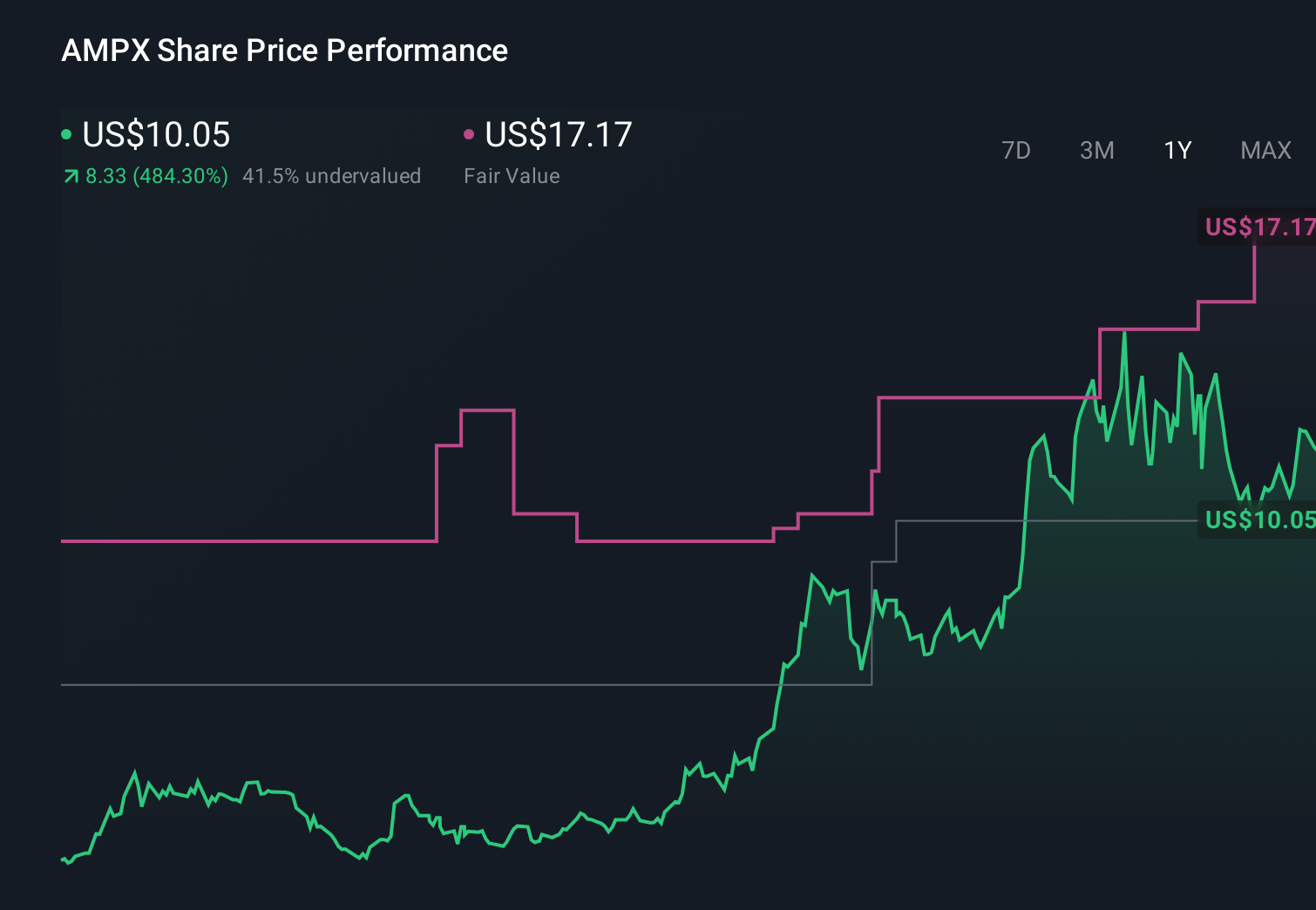
Uncover how Amprius Technologies’ forecasts yield a $17.57 fair value, a 85% upside to its current price.

Exploring Other Perspectives

AMPX 1-Year Stock Price ChartAMPX 1-Year Stock Price Chart

Some of the lowest ranked analysts took a far more cautious view, even while modeling roughly 77.6% annual revenue growth and a potential US$25.5 million profit by 2028, highlighting how sensitive those outcomes could be if drone demand weakens or external manufacturing partners run into trouble.

Explore 9 other fair value estimates on Amprius Technologies – why the stock might be worth less than half the current price!

Form Your Own Verdict

Don’t just follow the ticker – dig into the data and build a conviction that’s truly your own.

Interested In Other Possibilities?

These stocks are moving-our analysis flagged them today. Act fast before the price catches up:

This article by Simply Wall St is general in nature. We provide commentary based on historical data
and analyst forecasts only using an unbiased methodology and our articles are not intended to be financial advice.
It does not constitute a recommendation to buy or sell any stock, and does not take account of your objectives, or your
financial situation. We aim to bring you long-term focused analysis driven by fundamental data.
Note that our analysis may not factor in the latest price-sensitive company announcements or qualitative material.
Simply Wall St has no position in any stocks mentioned.

New: Manage All Your Stock Portfolios in One Place

We’ve created the ultimate portfolio companion for stock investors, and it’s free.

• Connect an unlimited number of Portfolios and see your total in one currency
• Be alerted to new Warning Signs or Risks via email or mobile
• Track the Fair Value of your stocks

Try a Demo Portfolio for Free

Have feedback on this article? Concerned about the content? Get in touch with us directly. Alternatively, email editorial-team@simplywallst.com

Free Training

Source link

One Big Beautiful Bill Act Drives U.S. Construction Boom and Manufacturing Growth


The One Big Beautiful Bill Act (BBBA) is reshaping the U.S. manufacturing and construction landscape by introducing significant tax incentives tied to capital investment, domestic production and research activity.

Courtesy: Photo by Scott Blake on Unsplash

Signed as part of President Donald Trump’s broader tax and spending agenda, the legislation is designed to stimulate U.S.-based manufacturing capacity and reduce reliance on overseas production.

BBBA Incentives Expected to Accelerate U.S. Factory Construction

One of the most impactful provisions is the Qualified Production Property Deduction. Under this measure, companies that build new manufacturing facilities — or significantly expand existing ones — can deduct 100% of eligible capital expenditures, provided construction begins between January 20, 2025 and December 31, 2028. Projects must be placed into service by January 1, 2031.

This accelerated deduction dramatically improves project economics. Instead of spreading depreciation over decades, companies can deduct the full investment upfront, strengthening short-term cash flow and improving internal rates of return.

For the construction sector, this creates a narrow but powerful investment window. Industry analysts expect a surge in factory groundbreakings over the next three years as companies race to qualify.

For composites manufacturers and suppliers, the ripple effects could be substantial. Increased factory construction means higher demand for advanced building materials such as fiber-reinforced polymer (FRP) rebar, composite panels, corrosion-resistant structures and lightweight structural components.

100% Bonus Depreciation Strengthens Capital Spending and R&D

In addition to the production property deduction, the BBBA reinstates 100% bonus depreciation for qualifying capital expenditures. Traditionally, capital investments are depreciated over multiple years according to IRS schedules. Under the updated framework, companies can deduct the entire cost of machinery, tooling, and production equipment in the year it is placed in service.

This provision improves liquidity and encourages businesses to modernize production lines, automate facilities and invest in advanced manufacturing technologies.

For the composites industry, this could accelerate:

  • Expansion of domestic composite fabrication plants
  • Investment in automated layup and molding systems
  • Increased capacity for thermoplastic and thermoset production
  • Growth in aerospace, automotive and infrastructure supply chains

Beyond construction, R&D-related incentives embedded in the broader tax package are expected to encourage innovation in advanced materials. Composites firms developing lightweight, high-strength and sustainable materials stand to benefit from a more favorable tax treatment of research expenditures.

Strategic Timing for Composites Manufacturers

The timing window built into the legislation is critical. With eligibility tied to construction start dates and service deadlines, companies must act quickly to secure benefits.

Domestic firms considering U.S. expansion now have a tax-advantaged environment to do so. Likewise, international composites manufacturers evaluating North American production footprints may view the current period as an optimal entry point.

The legislation effectively compresses investment decisions into a three- to four-year horizon. That urgency is likely to generate elevated activity across engineering, procurement and construction (EPC) markets.

For suppliers of composite materials used in industrial flooring, bridge decks, wastewater facilities, reinforcement systems and structural retrofits, the anticipated uptick in manufacturing plant construction could translate into steady order growth through the end of the decade.

Broader Economic Implications

Courtesy: Photo by Pixabay on Pexels

The BBBA’s construction and capital expenditure provisions are not isolated measures; they are part of a broader strategy to strengthen domestic industrial capacity.

If widely adopted, the incentives could:

  • Expand U.S. manufacturing output
  • Increase demand for skilled labor in construction and engineering
  • Shorten supply chains for advanced materials
  • Support long-term infrastructure modernization

For the composites industry, the law represents more than a short-term stimulus. It creates structural incentives for reshoring production and investing in advanced materials technologies — positioning the sector to play a central role in the next wave of U.S. industrial growth.

As companies evaluate investment pipelines for 2025–2029, the BBBA’s tax environment may prove decisive in determining where and when new manufacturing capacity is built.

Originally Reported by JEC Composites.

Free Training

Source link

Orion taps expanded U.S. manufacturing to produce stretch wrapper for the U.S. market


Orion Packaging Systems, a ProMach brand and a leading manufacturer of pallet stretch wrapping solutions, has announced the launch of the Orion Flex Legion semi-automatic stretch wrapper. This fully U.S.-designed and highly engineered machine expands Orion’s Flex line and reinforces the company’s commitment to domestic manufacturing, supply chain reliability, and long-term customer value, the company said.

The new Flex Legion system replaces Orion’s imported entry-level stretch wrapper, providing manufacturers with a 100-percent U.S.-built solution designed to deliver greater consistency in quality, more predictable lead times, and improved control over total cost of ownership. 

“Flex Legion reflects our focus on building equipment that customers can rely on – not just today, but over the long term,” said Pat Pownell, Director of Sales, at Orion. “Manufacturing this system in the United States enables us to respond faster to customer needs, ensure consistent build quality, and deliver an entry-level machine that performs at a level typically associated with more advanced systems.”

Orion Stretch Wrappers operates out of its Alexandria, Minnesota production facility, encompassing more than 250,000 square feet of dedicated production space between Brenton and Orion product lines. Within this facility, they leverage cross trained talent across the Brenton and Orion teams to support both production and aftermarket functions. They also have a dedicated Orion sales and engineering team focused exclusively on the Orion product line, enabling tight alignment between market demand, product development, and manufacturing execution. This structure has allowed Orion to internalize the full ownership of design, build quality and customer support.

“Bringing the Flex Legion’s design and production to our U.S. floor is about doing what’s right for the customer,” said Kelly Hawkinson, Director of Operations for Brenton and Orion, brands of ProMach. “It gives us greater control over quality, improves responsiveness, and shortens lead times. Just as importantly, it reduces exposure to tariff volatility and global supply chain disruption, allowing us to deliver greater cost predictability and long-term confidence in the total cost of ownership for our customers.”

While Flex Legion serves as Orion’s entry point into semi‑automatic automation, it is engineered with the same design philosophy and quality found across the Flex line. The Flex Legion comes with Allen-Bradley HMI operation that is paired with intuitive manual adjustment knobs for turntable speed, carriage travel, and film tension. Flex Legion is also equipped with a powered ‘InstaThread’ carriage capable of delivering uniform 200% film pre‑stretch, helping manufacturers achieve consistent load containment while reducing film consumption compared to friction‑based or core‑break systems commonly used in entry‑level applications.

The system’s semi‑automatic operation and intuitive controls make it well-suited for manufacturers transitioning from hand wrapping to automation. 

Subscribe today!

Free Training

Source link

U.S. Manufacturing Boost as Agencies Order 525 New Flyer Buses


New Flyer has received an order from NJ TRANSIT for 375 Xcelsior 40-foot, clean-diesel buses. This order is part of a larger, previously announced multi-phase fleet replacement program, with orders placed in the third and fourth quarters of 2025.

The original contract, awarded in the first quarter of 2024, included a base order of 550 Xcelsior 40-foot, buses to be delivered in three distinct lots, along with options for an additional 750 units. With this newly announced order, NJ TRANSIT has now completed the full base order of 550 buses, leaving all 750 option buses available for future procurement.

“The Xcelsior buses included in this contract deliver dependable, cost-effective performance while improving safety and accessibility for passengers,” said Chris Stoddart, president, North American Bus and Coach, NFI. “Built for durability and long service life, these new buses will help NJ TRANSIT continue providing the reliable, essential transportation services that keep communities and economies moving every day.”

With this additional portion of the contract, NJ TRANSIT can continue replacing aging buses without compromising service. Building and deploying these replacement vehicles strengthens domestic manufacturing, secures good local jobs, and ensures taxpayers get maximum utility from their investment in public transit.

“This additional order underscores NJ TRANSIT’s unwavering commitment to our customers and to delivering the safe, reliable service they depend on every day,” said NJ TRANSIT President & CEO Kris Kolluri. “Modernizing our bus fleet is a critical investment in our riders, our employees, and the communities we serve. These new buses move us closer to our goal of a fully modernized bus fleet by 2031—improving reliability, accessibility, and comfort while ensuring we can continue meeting the needs of hundreds of thousands of daily trips across New Jersey.”

New Flyer also announced that the Washington Metropolitan Area Transit Authority (WMATA / Metro) has exercised options for 75 Xcelsior hybrid-electric 40-foot buses and 25 Xcelsior CHARGE NG battery-electric forty-foot buses. The options are being exercised from New Flyer’s Q4 backlog.

The purchase will be supported by federal, state, and local funding as well as funds awarded through FTA’s Low- or No-Emission grant program. The new buses will replace end-of-life vehicles and provide Metro customers with a modernized, efficient passenger experience, while also delivering on the agency’s five-year Strategic Transformation Plan.

“New Flyer is committed to continuing our decades-long relationship with Metro, providing buses that deliver strong value, reliability, and performance,” said Chris Stoddart. “As Metro phases out aging buses, New Flyer’s Buy America-compliant, advanced hybrid and battery-electric vehicles will boost the efficiency, power, and overall service quality of its transit system while fueling good manufacturing jobs and economic opportunity across the United States.”

“These new hybrid and battery-electric buses allow us to replace aging vehicles, improve the customer experience, and continue modernizing our fleet while reducing emissions across the region,” said Randy Clarke, WMATA general manager and CEO. “Partnering with New Flyer helps ensure we’re delivering safe, dependable service and demonstrating good financial stewardship.”

In addition, New Flyer confirmed that the Regional Transportation Commission of Southern Nevada (RTC) is exercising options for 19 60-foot and 31 40-foot Xcelsior compressed natural gas (CNG) buses. This order was included in NFI’s fourth quarter 2025 firm backlog.

Valued at approximately $56 million, the options are part of two five-year contracts with RTC, supported by local and FTA funds, and meet Buy America requirements supporting manufacturing jobs in the U.S. The low-emission buses in this order will replace end-of-life vehicles, ensuring efficient, safe, clean, and sustainable transit for the region’s 64 million annual riders.

“For more than three decades, New Flyer and RTC have partnered to deliver efficient and reliable transportation options tailored to the community’s evolving needs, delivering over 900 buses to date, with more than 500 utilizing low-emission CNG propulsion,” said Stoddart.

Free Training

Source link

John Deere Expands Operations, Set to Strengthen U.S. Manufacturing


Deere & Company’s stocks have been trading up by 13.32 percent due to rising demand for precision agriculture technology.

  • North Carolina factory, costing $70M, will shift excavator production from Japan, boosting local employment by over 150 job opportunities.

  • The Indiana distribution center is poised to employ 150 workers, aligning with John Deere’s ongoing U.S. operational expansion.

  • Interim CFO, Ryan Campbell, reappointed, providing stability amid leadership changes as the company gears up for robust growth.

  • Industrial sector shows promise with upcoming earnings announcements where Deere aligns with strong S&P 500 performance.

Candlestick Chart

Live Update At 14:32:33 EST: On Thursday, February 19, 2026 Deere & Company stock [NYSE: DE] is trending up by 13.32%! Discover the key drivers behind this movement as well as our expert analysis in the detailed breakdown below.

Quick Financial Overview

In recent times, John Deere has made significant financial strides, reflecting in its robust earnings report. With the stock trading at around $672.69 recently, its financial health appears solid. A closer examination of their financial statements reveals an impressive EBIT margin of 81 and EBITDAMARGIN of 85.8, indicating strong operational efficiency. Importantly, revenue per share is maintaining a healthy level of $165.15346 with pragmatic cost-control measures.

The company’s leverage ratio of 4.1 suggests a prudent balance between debt and equity, ensuring financial agility. As John Deere ventures into this new chapter of expanding facilities, their strong profitability metrics, bolstered by a pretax profit margin of 17.7%, affirms investor confidence.

This expansion dovetailing with their impressive EBIT of $2.19 billion underlines a strategic push to enhance market position amid changing industrial landscapes. As industrial sectors lead in S&P 500’s earnings, Deere’s proactive manufacturing advancements typify a strategic alignment with these positive trends. This affirms investor sentiments, envisioning favorable price movement in the longer horizon.

Local Expansion Bolsters Investor Confidence

Amidst the backdrop of financial growth, John Deere’s strategic expansion into local territories stands as a stellar move. The Indiana distribution center and North Carolina factory are more than just bricks and mortar; they embody a vision to shift gears in localized manufacturing and distribution. With the North Carolina facility transferring production from overseas, it’s a tangible indicator of the firm commitment to boosting domestic capabilities.

But what does this mean for investors? Simply put, a focus on domestic manufacturing typically implies better control over supply chains, cost efficiencies, and possibly even faster time-to-market solutions. As John Deere’s facilities spring to life, investors are likely to read this as a signal of enhanced operational leverage and potential for upward ticks in share values.

More Breaking News

The Indiana plant creating 150 jobs is also more than an employment statistic; it’s a direct dividend of local economic growth fueled by corporate expansionism. For investors keen on socio-economic impacts, this paints John Deere as a brand deeply entrenched in national development narratives.

Market Reaction and Potential Impact

The buzz around these facility openings isn’t just a corporate feat but a market muscle movement too. How markets respond is a tale worth telling. Currently, Deere’s stock displays a promising uptick in trading sessions. This momentum dovetails with recent announcements of sector-wide industrial performance influencing S&P 500 most favorably.

Investors keenly note that John’s reliability in maintaining robust profit margins hints at potential stock price bolstering in the coming trading rounds. The timing of these facilities also aligns with anticipated earnings reports from several big-league entities, including Walmart and Wayfair. Such strategic alignment incites projections of Deere’s amplified market stability in an intensely competitive landscape.

As upcoming earnings are poised to reveal broader industrial sector performance, John Deere’s alignment with top performers likely reassures stakeholders of its competitiveness. With interim CFO Ryan Campbell steering the financial helm, continuity is assured amidst an ebb and flow of market tides.

Conclusion

Underlining the growth narrative, John Deere’s expanded U.S. footprint speaks volumes of both strategic vision and market confidence. As new facilities gear up for opening, they symbolize a commitment to innovation and operational excellence. The ripple effects are myriad: job creation meets market optimism, all echoing through the trading floors.

Within this intricate dance of expansion and market performance, John Deere weaves a tale of promise. Traders considering their stakes should perceptively note the forward-looking strategies unfolding in the heart of America’s industrial narrative. Embracing domestic operations heralds a nuanced understanding of positioning within both the U.S. economy and the global industrial framework.

As millionaire penny stock trader and teacher Tim Sykes, says, “Be patient, don’t force trades, and let the perfect setups come to you.” This advice is particularly relevant for those navigating the dynamic landscape of industrial growth. John Deere’s narrative aligns with the whispers of market winds, painted in shades of growth, opportunity, and strategic strength. The anticipation builds – would this dance of corporate prowess and market agility compose a symphony of increased shareholder value in times ahead? As the ticker symbols sway, so does the promise of a brighter market horizon.

This is stock news, not investment advice. Timothy Sykes News delivers real-time stock market news focused on key catalysts driving short-term price movements. Our content is tailored for active traders and investors seeking to capitalize on rapid price fluctuations, particularly in volatile sectors like penny stocks. Readers come to us for detailed coverage on earnings reports, mergers, FDA approvals, new contracts, and unusual trading volumes that can trigger significant short-term price action. Some users utilize our news to explain sudden stock movements, while others rely on it for diligent research into potential investment opportunities.

Dive deeper into the world of trading with Timothy Sykes, renowned for his expertise in penny stocks. Explore his top picks and discover the strategies that have propelled him to success with these articles:

Once you’ve got some stocks on watch, elevate your trading game with StocksToTrade the ultimate platform for traders. With specialized tools for swing and day trading, StocksToTrade will guide you through the market’s twists and turns.
Dig into StocksToTrade’s watchlists here:

Free Training

Source link

Japan’s $36 Billion U.S. Investments: A New Era in Energy and Manufacturing


In a major economic development, President Donald Trump’s administration has unveiled three significant projects totaling $36 billion, all financed by Japan. These ventures mark the first wave of investments under Japan’s $550 billion commitment to the United States as part of a trade agreement that reduced tariffs on Japanese imports to 15%.

Among the projects is a $2.1 billion deepwater crude oil export facility in Texas, expected to generate up to $30 billion annually in exports. An $800 million industrial diamonds plant is set for Georgia, aimed at meeting the entire U.S. demand for synthetic diamond grit used in advanced manufacturing. The centerpiece, however, is a $33 billion natural gas-fired power plant in Ohio, slated to become the world’s largest of its kind by capacity.

The announcement follows recent discussions between U.S. Secretary of Commerce Howard Lutnick and Japan’s economic minister, Ryosei Akazawa. While the projects promise significant benefits, key issues, including financial specifics and tariff implications, remain under negotiation as both nations navigate this landmark collaboration.

(With inputs from agencies.)

Free Training

Source link

SICCET USA Chooses Grove City for First U.S. Manufacturing Facility


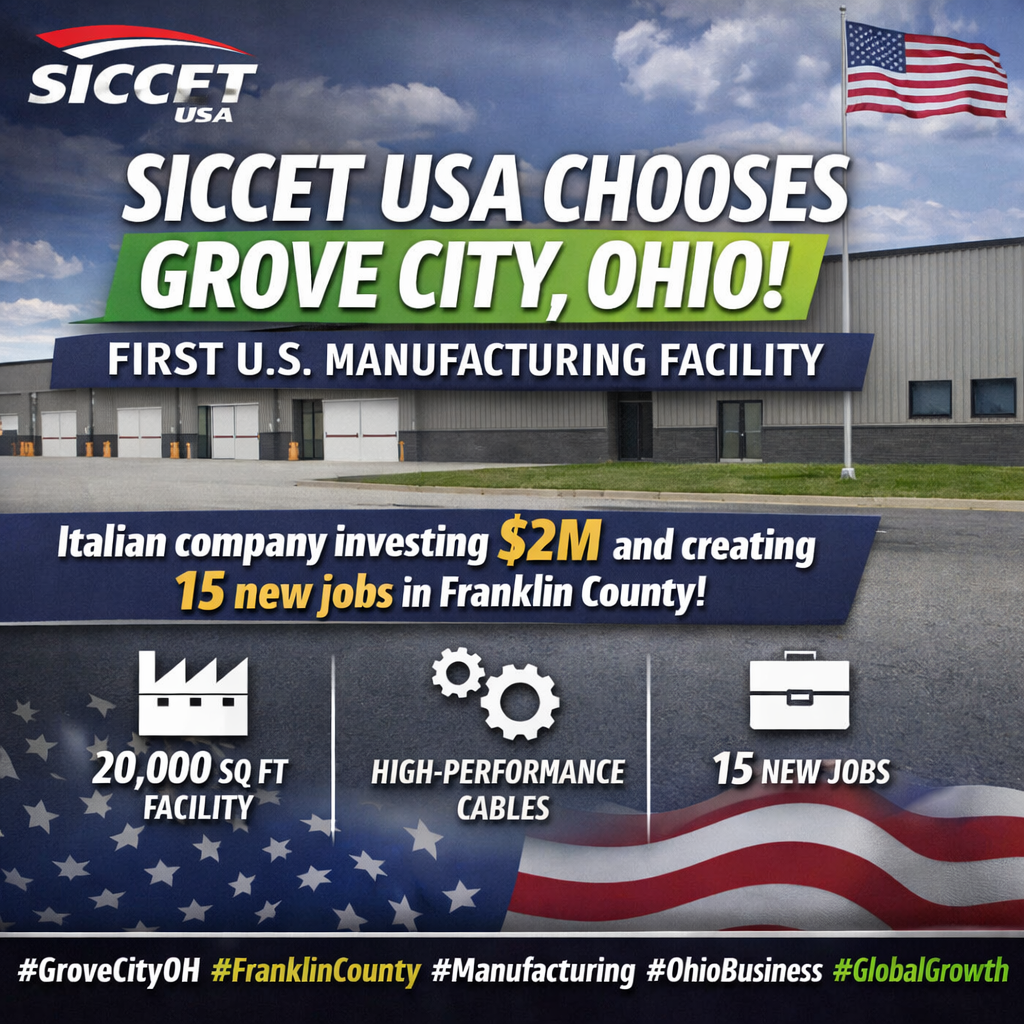
GROVE CITY, Ohio — SICCET USA has announced plans to open its first U.S. manufacturing facility in Grove City, marking a significant investment by the Italy-based company into the American market.

The new 20,000-square-foot operation represents a $2 million investment and is expected to create 15 new jobs in Franklin County. The facility will manufacture high-performance cables used to monitor and control temperature in demanding environments, including aircraft engines, power plants and industrial food equipment.

SICCET USA is the American subsidiary of SICCET SRL, a longtime European supplier of temperature sensor cable solutions. The company specializes in thermocouple and RTD cable manufacturing — critical components in ensuring performance, precision and safety in modern industrial systems.

Company leadership said the decision to locate in Grove City was driven by the Columbus Region’s central location, robust logistics network and access to a skilled workforce.

Quick Action by Circleville Firefighters Prevents House Fire from SpreadingTrendingQuick Action by Circleville Firefighters Prevents House Fire from Spreading

“SICCET USA is proud to begin our U.S. manufacturing journey in Grove City,” said Ivan Dall’Armellina, president of SICCET USA and co-owner of SICCET SRL. “This location offers strong infrastructure, a collaborative business environment and proximity to key markets that are vital for our long-term growth.”

Grove City Mayor Richard “Ike” Stage welcomed the announcement, noting that the community continues to attract advanced manufacturing firms seeking long-term growth opportunities.

Regional economic development leaders say the investment reflects a broader trend of international companies choosing central Ohio as a gateway into the North American market.

Deborah Scherer, senior vice president of global trade and investment at the Columbus Partnership, said SICCET’s move underscores growing global confidence in the region’s industrial base and logistics strengths.

JobsOhio President and CEO J.P. Nauseef added that Ohio’s workforce, infrastructure and global reach continue to attract world-class manufacturers looking to expand operations in the United States. JobsOhio partnered in supporting the project.

The Grove City facility positions SICCET to better serve its expanding North American customer base as demand grows for specialized, high-performance industrial components amid a resurgence in U.S. manufacturing.

Free Training

Source link

Ford (F) Explores U.S. Manufacturing Ties with Chinese Automaker


Key Takeaways:

  • Ford (F, Financial) is exploring strategic partnerships with Chinese automotive firms to enhance its market presence in the U.S.
  • Ford’s financial health shows mixed signals with strong revenue but challenges in profitability and debt management.
  • Valuation metrics suggest Ford is trading near historical highs, with a focus on improving operational efficiency.

Ford (F) is in discussions with senior U.S. government officials regarding a strategy for Chinese automotive companies to produce vehicles in the United States through partnerships with American firms. These conversations, involving CEO Jim Farley, propose a basic framework where Chinese manufacturers could engage in joint ventures with U.S. automotive companies, provided the American partner maintains majority control. This initiative aims to foster collaboration between Chinese and domestic automakers, enhancing their presence in the U.S. market.

Ford Motor Co. manufactures automobiles under its Ford and Lincoln brands. In March 2022, the company announced that it will run its combustion engine business, Ford Blue, and its BEV business, Ford Model e, as separate businesses but still all under Ford Motor. The company has nearly 13% market share in the United States, about 10% share in the UK, and under 2% share in China including unconsolidated affiliates. Sales in the US made up about 68% of 2024 total company revenue. Ford has about 171,000 employees, including about 56,500 UAW employees, and is based in Dearborn, Michigan.

With a market capitalization of $56.33 billion, Ford operates within the Consumer Cyclical sector, specifically in the Vehicles & Parts industry. The company’s strategic positioning is crucial as it navigates the competitive automotive landscape.

Financial Health Analysis

Ford’s financial performance presents a complex picture:

  • Revenue Growth: Ford reported a revenue growth of 10.8% over the past three years, indicating a positive trajectory in sales.
  • Profitability: The company faces challenges with a negative EPS of -2.07 and an operating margin of 1.91%, reflecting operational inefficiencies.
  • Balance Sheet Strength: Ford’s debt-to-equity ratio stands at 3.47, highlighting significant leverage, while the current ratio of 1.12 suggests adequate short-term liquidity.
  • Warning Signs: The Altman Z-Score of 1.05 places Ford in the distress zone, indicating potential financial instability.

Valuation & Market Sentiment

Ford’s valuation metrics provide insights into its market positioning:

  • Valuation Ratios: The P/B ratio of 1.19 and P/S ratio of 0.3 are near historical highs, suggesting the stock may be overvalued.
  • Analyst Targets: The target price is set at $13.73, with a moderate recommendation score of 3.
  • Technical Indicators: The RSI of 56.97 indicates a neutral market sentiment, while moving averages suggest a stable trading pattern.
  • Ownership: Institutional ownership is at 62.35%, reflecting strong interest from large investors.

Risk Assessment

Ford’s risk profile is shaped by several factors:

  • Financial Health Grades: The Beneish M-Score of -2.71 suggests Ford is unlikely to be a financial manipulator.
  • Sector-Specific Risks: As a cyclical company, Ford is exposed to economic fluctuations that can impact demand for vehicles.
  • Volatility and Beta: With a beta of 1.38, Ford’s stock is more volatile than the market, indicating higher risk.
  • Upcoming Catalysts: Strategic partnerships and potential joint ventures with Chinese firms could serve as significant growth drivers.

In conclusion, while Ford is actively pursuing strategic initiatives to enhance its market presence, the company’s financial health and valuation metrics suggest a cautious approach. Investors should consider the inherent risks and opportunities as Ford navigates the evolving automotive landscape.

This stock alert was generated using automated technology and GuruFocus financial data to provide readers with timely and accurate market reporting. This content was reviewed by GuruFocus editorial team prior to publication. Please send any questions or comments about this story to [email protected].

Free Training

Source link

The Trump Administration Failed the U.S. Auto Industry, and the Canada-China Deal Proves It


On January 16, 2026, Canadian Prime Minister Mark Carney announced a landmark trade deal with China that will open its market to Chinese electric vehicles (EVs) in exchange for lower tariffs on Canadian-produced canola oil. It’s a major change that could lead to the Canadian market welcoming Chinese-made passenger vehicles at a significantly higher scale and throws into stark relief the consequences of the Trump administration’s reckless trade policy and its large-scale disinvestment in EVs.

The Trump administration’s wrecking-ball approach to traditional forms of international cooperation; its willingness to attack long-time partners and allies with ever more outrageous tariff threats; and its destruction of the U.S. EV supply chain has forced Canada to change its strategy for modernizing and growing its domestic auto industry. Canada has historically been the largest importer of U.S. passenger vehicles. Now, as a direct result of the Trump administration’s actions, Canada’s pivot toward Mexico, China, and elsewhere stands to further isolate the U.S. market as the rest of the world moves decidedly toward a cleaner future. Indeed, if U.S. automakers were already behind Chinese and other international EV producers in terms of technology, production, and price, then the Trump administration’s antics on the world stage will only widen the gap and jeopardize a lucrative export market, to the detriment of American workers and consumers alike.

Stay informed

on Energy and Environment

What’s in the deal?

Canada and China recently agreed to lower tariffs on Canadian canola oil—from 84 percent to approximately 15 percent by March 1, 2026—in exchange for Canada lowering the tariff rate on Chinese EVs from 100 percent to 6.1 percent on the first 49,000 vehicles, eventually growing to 70,000 over five years. Perhaps more importantly, China will invest in EV production capacity in Canada. While this is more of an understanding than an official agreement at this point, it may turn out to be the most significant component of the deal. Legacy North American automakers lag behind their Chinese counterparts in the maturity of their EV production processes. Landing direct investment in domestic production capacity will allow Canadian participants in the supply chain a significant opportunity to learn from Chinese EV and battery makers and produce affordable cars for Canadian citizens. The new Chinese electric vehicles, whether imported or produced in Canada, are likely to be less expensive than other vehicles produced in North America, which will force North American automakers to innovate and learn in order to remain competitive—preferably not to the detriment of autoworker jobs.

Which parts of the manufacturing process ultimately end up onshored in Canada will matter significantly. China has surged ahead of the rest of the world the further upstream one goes in the supply chain. Localizing battery active material production—cathodes and anodes—would bring more economic value and direct jobs than just final battery pack assembly.

It remains to be seen whether this deal will deliver positive benefits to Canada—although ensuring that any factory that supplies EVs either made in Canada or exported into Canada meets the highest standards for workers’ rights and sustainability would be a good start. But what is clear is that this deal would not have occurred without the Trump administration’s ongoing hostility toward EVs and the U.S.-Canada relationship more broadly.

Why make the deal?

The deal is, no doubt, a calculated risk by the Canadian government, based on two key factors. First, the Trump administration has undermined innovation in the domestic auto industry, gutting investments in EVs and causing domestic automakers to cancel billions of dollars of investment in advanced manufacturing. Second, it has deeply exacerbated trade and diplomatic tensions between Washington and Ottawa. As a result, Canada finds itself with a need to reduce its dependency on and integration with the United States to reclaim control over its economy and industrial future. It is a message that Mark Carney, Canada’s prime minister, delivered to his country via video message a few days after signing the agreement with China.

On the future of the auto sector in the United States, it is hard to question the Canadian government’s assessment. One of the first actions taken by the Trump administration, starting with a day-one executive order, was to launch an all-out attack on American EV manufacturing, directing the government to “eliminate the ‘electric vehicle (EV) mandate’,” despite no such mandate existing. Less than a month later, the administration unilaterally and unlawfully froze billions of dollars of funding for everything from EV charger installation to critical mineral processing for batteries, including funds for which the government had already signed contracts with American companies. Finally, in July, the president signed the One Big Beautiful Bill Act and delivered the coup de grâce for the future auto industry, repealing tax credits for EVs made in North America and hamstringing government support for American battery manufacturing. High-quality EVs have an average cost of $25,000 in China, but instead of helping American automakers offer a similarly affordable vehicle, the administration has held them back. NPR captured it succinctly in December:

California’s ability to require the sale of EVs: gone. Federal rules about emissions and fuel economy — being rewritten. Federal penalties for car companies that sell too many gas guzzlers: zeroed out. The $7,500 federal tax credit? Kaput.

These actions have already caused damage. Ford took a $19.5 billion write-down scaling back its plans for EV production, while GM took a $6 billion hit. As of the end of the third quarter of 2025, EV supply chain investment was down 30 percent from that point a year earlier. These cancellations won’t just hurt the United States and American workers but also Canada. The auto industry is not an American industry; it’s a North American industry, with the region that includes Michigan, Ohio, Indiana, and Ontario often referred to as the “Great Lakes supercluster.” As described in a recent report to Congress, “Across the region, hundreds of suppliers provide thousands of parts for vehicles, some of which cross the border seven or eight times as they are assembled into larger products.” The industry is deeply intertwined, so major changes in the United States will significantly affect both Canada and Mexico. Without a strong automotive industry—along with all the supplier industries that serve the auto industry—Canada’s industrial future would be far weaker and far less resilient to the vagaries of policy choices in the United States and elsewhere.

Without a strong automotive industry, Canada’s industrial future would be far weaker and far less resilient to the vagaries of policy choices in the United States and elsewhere.

Canada and the United States have had a remarkably close relationship, consistently sharing economic and foreign policy goals over generations. In 2023, more than $2.5 billion in goods and services crossed the U.S.-Canada border each day. In all likelihood, Ottawa would like to maintain this close relationship and economic integration as much as possible, but as Carney noted in his recent speech to the World Economic Forum in Davos, Switzerland, Canada must react to the world as it is—not the world it wishes existed. And the current world is defined by the brazen tariff threats and toxic nationalism of the Trump administration.

In just its first year in office, the Trump administration has ushered in a trade war unprecedented in its size and scale, imposing new tariffs on nearly every nation and on roughly half the goods entering the United States. In addition to tariffs, the Trump administration has done its best to antagonize Canada, from referring to Canada as the “51st state” and Prime Minister Carney as “Governor Carney” to reportedly meeting with Albertan separatists. As a result, Canada has come to view the United States not as a partner or ally but as a belligerent nation that no longer shares its interests and values—at least not as long as the Trump administration is in the White House.

What about U.S. manufacturing?

Allowing Chinese EVs into the Canadian market, albeit in limited numbers at first, will place massive pressure on American automakers to catch up technologically—which would be the best-case outcome. There are some positive signs that this is happening, such as GM’s investment in new battery technologies. However, if U.S. automakers choose instead to cede the market entirely, then that loss will be felt directly in the U.S. labor market. As the United States has deprioritized affordable EVs—and affordable vehicles in general—China has kept up its massive push to build and adopt EVs. More than half of new cars sold in China are now EVs, accounting for roughly 70 percent of global EV production. This global EV adoption is helping change the trajectory of global oil demand to peak in five years. And it’s not just China, with countries like India electrifying even faster.

There is no turning away from an electrified future for passenger vehicles unless the goal is to condemn people to a future of more expensive cars and fewer jobs.

This means that Canada is a canary in the coal mine for U.S. automakers. If they cannot build and sell EVs to compete with those manufactured by their competitors in a market physically next door—and one that was previously accustomed to buying U.S.-made vehicles—then there is little hope of them competing in a broader world that is rapidly electrifying. One in 4 vehicles sold in 2025 was electric; making a cost-competitive EV is not optional for automakers who want to retain significant market share. Should American automakers fail to do so, autoworkers and U.S. industry more broadly would likely be the first to suffer the consequences.

On the campaign trail, President Trump wildly claimed that “all the electric cars are going to be made in China.” This isn’t likely to become true with other parts of the world such as Europe shifting toward EV production, but what may be true is that significant numbers won’t be made in the United States, which will be a problem when the rest of the world ultimately decides EVs are the way to go. Investors want to invest in industries of the future, and workers need training in those industries now. But instead of recognizing this future—one that Canada clearly does—President Trump appears focused on keeping American auto manufacturing stuck in the past. If he is successful, those investors won’t invest in the U.S. auto industry, and there will be fewer workers in it as a result.

Conclusion

In only a year, the Trump administration’s reckless policies forced a dilemma upon Canada: Continue to be tied to a historic trading partner whose current leadership has decided to hold its own—and, by extension, Canada’s—industry back from producing innovative EVs, or make a deal with China, a competitor leading in the EV industry.

Canada has made a choice to welcome Chinese EVs today, and that should be a wake-up call: There is no turning away from an electrified future for passenger vehicles unless the goal is to condemn people to a future of more expensive cars and fewer jobs. The rest of the world is moving on to cheaper, cleaner vehicles. If the United States wants to produce the vehicles the world wants, as it should, then the country must return to investing in electric vehicle production and an associated supply chain. Nearly 1 million direct jobs are at stake. The Trump administration, and U.S. automakers, should stop seeing the world they wish to see and start seeing the world as it is. Otherwise, U.S. autoworkers and consumers are going to pay the price. A continuation of the Trump administration’s toxicity on the world stage and its backward auto and energy policy would only mean more deals like the one Canada and China agreed to a few weeks ago.

The authors would like to thank Kalina Gibson, Allison McManus, Steve Bonitatibus, and Mona Alsaidi for their feedback, guidance, and support on this column.

Free Training

Source link

The U.S. needs leading-edge chips. Can Intel deliver? Will it even try?


Semiconductor manufacturers are spending tens of billions of dollars to build advanced factories in Arizona and Texas. They’re being cheered on by the federal government, which has chipped in billions of taxpayer dollars to ensure the U.S. doesn’t become completely reliant on technology from overseas.

But these new factories, which the industry calls foundries, rely entirely on manufacturing technology developed in Asia.

A geopolitical or natural disaster could leave those new factories stranded, with all that new American manufacturing muscle cut off from the brains in Asia that make them go. There would be no one in the U.S. to develop new manufacturing technologies.

“You’d be stuck in time,” according to veteran chip industry researcher Patrick Moorhead. Cut off from engineers in Taiwan, he said, “the foundry would not advance on anything.”

The U.S. has a solution. Maybe.

It’s Intel, which was the world’s largest and most advanced chipmaker until a series of factory and leadership missteps derailed its business a decade ago. Intel still has thousands of scientists working in its Hillsboro research factories, where the company develops the recipes to manufacture new generations of computer chips.

Those Oregon engineers have made great strides over the past five years in recovering what Intel lost in the 2010s. The company is the only one based in the U.S. doing this kind of leading-edge work and its brand-new technology, which it calls 18A, offers major advances in chip architecture, performance and efficiency.

Still, it may not be enough.

Taiwan Semiconductor Manufacturing Co. continues to lead the industry, making chips for Apple, Nvidia and many other huge technology companies. Intel has been working for five years to win a share of their business but has yet to announce any large customers for its factories. Intel even outsources some of its own leading-edge designs to rival TSMC.

Intel still makes most of its own chips. But the company has cut 6,000 Oregon jobs over the past two years, and many of its top researchers have left. Intel startled the tech industry last summer when it warned that it would abandon its next generation of production technology, called 14A, unless it wins some big outside customers.

That would leave the U.S. without any chipmaker developing advanced technology domestically. The nation’s defense and tech sectors would be reliant on innovations from overseas.

The stakes are just as high for Oregon. Intel is the state’s largest corporate employer and Oregon’s economy is hugely reliant on the billions the company spends building, equipping and maintaining leading-edge factories.

Intel CEO Lip-Bu Tan delivers a speech  in front of a backdrop that reads "Build the Best Products"Intel CEO Lip-Bu Tan says customers are telling him they’re pleased with Intel’s direction: “I’m hearing a clear, consistent message. They see the progress we are making. They want Intel at the table as they navigate their own transformations.”AP Photo/Chiang Ying-ying

Intel repeated its warnings about abandoning 14A in regulatory filings and conversations with analysts as recently as last month. But its executives insist that 14A, being developed by Oregon engineers, is on track and that Intel is charging ahead on future generations of technology that will put the company — and the country — back on the leading edge.

“There should be no ambiguity that we are all-in on 14A,” said Chris Auth, an Intel vice president in Hillsboro who leads manufacturing development. He said that’s the central mission of Intel’s operations in Oregon, and that focus and commitment haven’t changed.

“There’s thousands of people here,” Auth said, “and they are innovating and developing 14A and beyond, just like they were before.”

Historic cuts hit innovation, manufacturing

Intel’s technology may again be near the leading edge, but its business model is a dinosaur. The company is the last major player that both designs and manufactures its computer chips.

All the other big players have chosen to specialize in one or the other. Nvidia, for example, dominates the market for artificial intelligence by designing a class of chip called a GPU — a booming sector Intel missed out on. But Nvidia doesn’t make any of those GPUs itself. It sends its designs off to TSMC.

For decades, Intel maintained that integrating design and manufacturing gave it an advantage. It could work more quickly to adapt its factories for new designs, and vice versa, so advances in one part of its business benefitted the other. Intel made all its own chips and none for anyone else.

Integration is no longer an accelerant for Intel. It’s become an albatross.

A leading-edge factory costs $10 billion to build, plus several billion more every year just to keep up with advances in manufacturing technology. Intel says it can’t afford to keep spending that way if its only customer is Intel itself — especially because the market for its own chips, which primarily power personal computers and servers, is also in decline.

That presents a conundrum, for Intel and for the United States, because the country wants advanced manufacturing and domestic companies that can keep those factories on the leading edge.

“It’s very important for national security to have both,” Moorhead said.

Chris AuthIntel Vice President Chris Auth has worked at the chipmaker for nearly three decades. He leads manufacturing development and customer engineering at Intel’s factories in Hillsboro, and says the company’s commitment to Oregon is solid: “This is still the main R&D site for Intel and there’s no indication that that’s going to change in the future.”Sean Meagher/The Oregonian

For now, Intel is trying to hold on financially until it has proven itself technologically and won some outside customers who can help subsidize continued investment in its manufacturing process.

It’s a tough needle to thread. Desperate to save money, Intel has cut 30,000 jobs globally over the past 18 months. That included the 6,000 lost jobs in Oregon. While Washington County remains the company’s largest site anywhere, layoffs and buyouts have reduced its local workforce to its lowest point in 14 years.

CEO Lip-Bu Tan says the cuts reduced layers of bureaucracy that were impeding innovation. But buyouts, layoffs and retirements have cost Intel some of its best-known researchers. And a round of November layoffs eliminated 600 frontline factory technicians, engineers and scientists in Hillsboro.

Many more are leaving on their own. The company has cut stock benefits and sabbatical time and says nearly 8% of its employees quit last year. That’s the biggest voluntary exodus in nearly two decades — what Intel calls “undesired turnover” — and a steep increase from 2024.

After a surge in spending at the beginning of the decade, Intel slashed its research budget by 16% last year. That’s an enormous cut unmatched any time this century.

Intel has shelved plans for a fourth phase of its D1X research factory in Hillsboro, a multibillion-dollar project that would have provided a massive boost to the state’s economy and Intel’s innovation capacity. At one time, Intel had planned to start construction in 2025.

If those cuts diminished Intel technologically, its financial picture has improved — and only partly because it is spending less. The Trump administration negotiated an $8.9 billion investment in Intel last summer, followed by billions from Nvidia and the Japanese technology investment firm SoftBank.

That money is more than just a financial lifeline. The ties to the government and wealthy backers buy Intel clout in the industry and could open doors to potential customers.

And in the long run, Apple, Nvidia and other big tech companies don’t want to be wholly dependent on TSMC as their only source of leading-edge chips. They would presumably enjoy having Intel as a second option.

But since none of them have signed up to use Intel’s factories, they’re evidently not convinced that it can deliver. At least not yet.

‘They’re not even willing to catch up’

Neither is Christof Teuscher, an engineering professor at Portland State University. He’s spent nearly two decades teaching Ph.D. students who went on to careers at Intel. Now, he says, Intel isn’t hiring anyone and students don’t want to go.

“The excitement is not at Intel anymore,” Teuscher said. “It’s just not there.”

While the Trump administration has invested billions in Intel, and awarded billions to other chipmakers to build factories, Teuscher said the administration’s immigration policies are deterring promising students and researchers.

“That was almost entirely an international pipeline,” he said. “You can be sure they’re going to do their own stuff somewhere else, and not in the U.S.”

Among the students who are here, Teuscher said they are more interested in young Oregon chip companies like Ampere and AheadComputing or in Nvidia, which employs more than 300 at an engineering office in Washington County. He questions Intel’s commitment to its own future.

“Intel had the talent,” Teuscher said, “but they lost that game and it seems like they’re not even willing to catch up.”

Intel’s own messaging is confusing and contradictory on that point. Tan, the CEO, declared at the beginning of this year that “We are going big time into 14A,” the new manufacturing node due sometime in 2028.

But less than two weeks later, Chief Financial Officer David Zinsner reiterated that Intel will restrain research and manufacturing spending on the new technology “until we have customers secured.” The company said it expects potential clients will begin making decisions about using Intel’s 14A technology late this year or early in 2027.

“Once visibility improves there,” Zinsner said, “we’ll start to unlock the spend on 14A.”

Baking the cake

For now, Wall Street appears to be willing to give Intel time to make up its mind. The company’s share price has doubled in the last six months. There is a growing consensus among analysts that Intel is close to a deal to manufacture Apple’s chips for the iPad and some Mac computers.

Many, though, continue to doubt Intel’s technological prowess.

Bank of America’s Vivek Arya told clients last month that he believes that Intel’s brand-new generation of chips, the ones called 18A, are ramping up slowly because so many have defects that require the company to discard them. That’s typical with new generations of chip technology, but Arya said Intel is moving too slowly to improve yields, making its manufacturing process too expensive and unpredictable.

“We appreciate the scarcity value of leading-edge manufacturing,” he said. But if Intel cannot deliver high yields on its 18A technology, Arya said that’s an ill omen for the next generation of 14A chips. That leaves him skeptical Intel can thrive as a contract manufacturer — a market where Intel “has no scale or history of execution.”

It’s true that Intel has no track record as a contract manufacturer, but its history as an innovator stretches back generations. Moore’s Law, the industry maxim that the ability to miniaturize and pack denser circuitry on computer chips would produce exponential growth in computing power while simultaneously driving down the cost to manufacture them, was coined by and named for Intel’s co-founder.

Jamel Tayeb spent 25 years at Intel as an engineer and chip architect before retiring and becoming a professor in Portland State’s engineering department last fall. Intel is again listening to its technologists, Tayeb said, and that’s why he believes it can overcome its technological struggles.

“Do I believe that Intel can do it?” he asked. “I would say that yes, I really deeply feel that they can pull it off.”

To succeed as a leading-edge manufacturer, Intel must demonstrate that it is both capable of making advanced chips and committed to continue doing so.

Even Intel employees expressed confusion last summer when the company appeared to be hedging on its commitment to leading-edge manufacturing. But Auth, the manufacturing vice president in Hillsboro, insists the company never slowed the pace of research.

“The commitment to 14A is unwavering,” Auth said. “We have key milestones that Lip-Bu wants us to hit, and we’ve been hitting those milestones.”

He likens Intel scientists to bakers. The engineers, technicians and researchers working in cleanroom bunny suits are making cakes that need millions of ingredients and thousands of steps.

“Those are the type of things that we do to, at the end of the day, make the best cake we can,” he said, “which is what our customers see.”

Intel has addressed its technological struggles, according to Auth, by focusing on a single cake rather than dabbling in many different ideas. He said Intel has a hard-earned understanding of how to focus on a single concept — manufacturing chips that clients want — and he said the company is convinced it can deliver.

External customers care most of all that chip designs arrive on a predictable schedule, Auth said, and he said a commitment to meeting those expectations is fueling a technological renaissance inside Intel.

“It’s paramount,” Auth said. “And so that has been something that we’ve really embraced.”

Free Training

Source link