
NexWafe and Talon PV Announce a Strategic Partnership and Wafer Supply Agreement to Advance Next-Generation TOPCon Solar Manufacturing in the United States


FREIBURG, Germany and HOUSTON, Feb. 19, 2026 /PRNewswire/ — NexWafe GmbH (“NexWafe”), a German solar technology company pioneering a proprietary direct gas-to-wafer manufacturing method to produce high-efficiency, low-oxygen monocrystalline silicon wafers fully compatible with existing high-volume cell production lines, and Talon PV, a U.S.-based manufacturer of high-performance N-type solar cells, today announced the signing of a supply agreement establishing a strategic partnership for the supply of NexWafe’s EpiNex® silicon wafers to support Talon’s U.S. TOPCon solar cell manufacturing operations.


Talon PV CEO, Adam Tesanovich, and NexWafe VP Business Development USA, Jonathan Pickering, signing wafer supply agreementTalon PV CEO, Adam Tesanovich, and NexWafe VP Business Development USA, Jonathan Pickering, signing wafer supply agreement

Under the agreement, NexWafe and Talon anticipate wafer supply volumes initially through 2032, representing a cumulative total of approximately 7 gigawatts of advanced silicon wafers to support Talon’s planned U.S. cell production. The partnership is subject to the execution of definitive long-term supply documentation and the completion of customary technical qualification and investment conditions.

The partnership aligns Talon’s planned 4.8 GW TOPCon cell manufacturing facility in Baytown, Texas with NexWafe’s EpiNex® wafer platform, initially produced from NexWafe’s pilot-scale operations in Bitterfeld, Germany. Over time, the collaboration supports a pathway toward future multi-gigawatt manufacturing expansion in the United States through NexWafe-led partnerships with established industry players. Together, the companies aim to strengthen domestic content in solar products, reduce reliance on imported silicon-based components, and advance a resilient Western-aligned supply chain for next-generation photovoltaics.

“We are pleased to establish this partnership with NexWafe as we advance Talon’s U.S. manufacturing roadmap,” said Adam Tesanovich, CEO and Co-Founder of Talon PV. “NexWafe’s innovative EpiNex wafer technology offers an exciting opportunity to further enhance TOPCon performance while building a strong domestic and Western-aligned supply chain.”

Talon PV is establishing a TOPCon pilot line at Fraunhofer ISE, and the initial EpiNex wafer qualification work will be conducted at Fraunhofer ISE in Freiburg, Germany.

Beyond supply, NexWafe and Talon plan to collaborate closely on technical development and qualification efforts to further improve TOPCon cell performance using NexWafe’s EpiNex® substrates. The partnership will focus on advanced wafer material quality, ultra-low oxygen content, and next-generation junction engineering approaches to enable higher efficiency and long-term reliability in N-type solar cells.

“This agreement with Talon PV represents an important step toward building a next-generation wafer-to-cell ecosystem spanning Germany and the United States,” said Davor Sutija, PhD, CEO of NexWafe. “NexWafe is committed to enabling high-efficiency solar manufacturing through advanced substrates, and we look forward to working with Talon to qualify EpiNex wafers and further push the performance frontier for TOPCon solar cells.”

About NexWafe

NexWafe is a German deep-tech company developing advanced direct gas-to-wafer solar wafer manufacturing technology, with a strong focus on space applications alongside high-performance terrestrial use cases. Founded in 2015, NexWafe enables next-generation solar manufacturing with high material efficiency, low energy consumption, and performance characteristics suited for demanding environments.

About Talon PV

Founded in 2013, Talon PV is a U.S.-based high-tech manufacturer specializing in N-type photovoltaic (PV) cell production, dedicated to advancing high-efficiency cell technology. Talon places a strong emphasis on research and development, intellectual property innovation, and the deployment of state-of-the-art American and Western equipment to achieve industry-leading cell performance.


(PRNewsfoto/Talon PV)(PRNewsfoto/Talon PV)

CisionCision View original content to download multimedia:https://www.prnewswire.com/news-releases/nexwafe-and-talon-pv-announce-a-strategic-partnership-and-wafer-supply-agreement-to-advance-next-generation-topcon-solar-manufacturing-in-the-united-states-302692111.html

SOURCE Talon PV

Free Training

Source link

Manufacturing jobs in the United States declined in 2025


I would say the Trump tariffs are not helping. I mean, mostly because there’s no larger coherent plan attached to them. Like they’re very chaotic in terms of like what country faces what raid and maybe that changes and it differs across industry. And even the rationale, like sometimes the tariffs are invoked as we’re trying to bring back manufacturing jobs. Sometimes they’re somehow related to things like fentanyl, and what they’re doing in the meantime is they’re making imports or inputs into *** lot of manufacturing goods. And so when they get more expensive, all of *** sudden the output of manufacturing. Firms gets very expensive and not competitive in global markets and other countries retaliate and we’ve seen *** really big reduction in manufacturing exports as *** share of the total economy so I think all in all um there’s just no plan here and the tariffs have definitely done more damage than help.

Get the Facts: Are Trump’s tariffs bringing back manufacturing jobs? Here’s the data

KOCO logo

Updated: 4:40 PM CST Feb 11, 2026

Editorial Standards

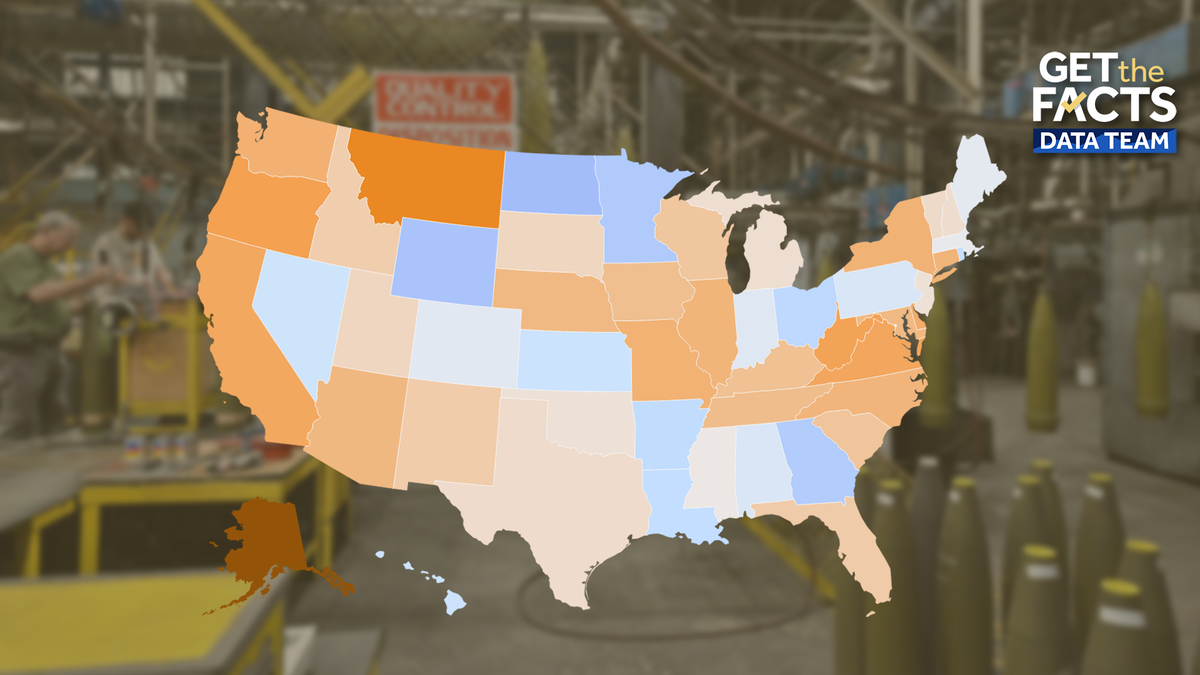
When President Donald Trump announced “reciprocal” tariffs last April, he promised it would help revitalize America’s manufacturing industry. Since that announcement, employment in the manufacturing industry has been in decline, according to an analysis by the Get the Facts Data Team using data from the Bureau of Labor Statistics.The loss of manufacturing jobs coincides with the softening in the labor market, said Josh Bivens, chief economist at the Economic Policy Institute, a Washington, D.C.-based nonpartisan think tank. There were about 12.2 million manufacturing employees in the sector when former President Joe Biden began his term. By the end of December 2024, near the end of his administration, the U.S. had about 12.7 million manufacturing employees.A year later, that number dropped by 108,000, according to the latest BLS jobs report. The industry has seen job losses each month since January 2025, but added 5,000 last month. Manufacturing is a major sector of the U.S. economy and supports other industries. But over the past 25 years, it’s been battered by globalization and policy mistakes that have put pressure on the industry, said Bivens. During the 2008 financial crisis, the manufacturing sector had steep job losses. Job growth began stabilizing in the late 2010s and held steady through the end of 2019 under President Trump’s first term. However, employment declined again following COVID-19. Since 2000, the sector has lost approximately five million jobs.Another challenge the industry is facing right now: Trump’s tariffs. According to Bivens, tariffs are currently doing more damage than helping the sector. Tariffs make imports expensive, which also makes manufacturing outputs expensive, making it harder for firms to compete in global markets. Countries can also retaliate and add their own tariffs on their goods.But Bivens points out tariffs can be beneficial in some cases; however, what he’s seeing from this administration doesn’t show evidence of a larger plan, and tariff decisions tend to be erratic. Some U.S. states, particularly in the Midwest, have a higher share of manufacturing jobs and rely on the sector. But more than half of U.S. states had a decline in manufacturing employment over the past year. Alaska had the steepest percentage drop at 6%, a loss of 800 employees. Montana and Oregon followed, with declines of roughly 5% and 3%.California, Texas and Ohio have the highest total number of manufacturing employees, but only Ohio reported job growth, gaining 8,500 employees over the year. California lost 32,600 employees, a 2.3% loss. “Manufacturing is still a place where you have a lot of workers without a college degree,” said Bivens. “When they lose a manufacturing job, they’re a little less likely to find a job with equivalent pay and equivalent benefits.” PHNjcmlwdCB0eXBlPSJ0ZXh0L2phdmFzY3JpcHQiPiFmdW5jdGlvbigpeyJ1c2Ugc3RyaWN0Ijt3aW5kb3cuYWRkRXZlbnRMaXN0ZW5lcigibWVzc2FnZSIsKGZ1bmN0aW9uKGUpe2lmKHZvaWQgMCE9PWUuZGF0YVsiZGF0YXdyYXBwZXItaGVpZ2h0Il0pe3ZhciB0PWRvY3VtZW50LnF1ZXJ5U2VsZWN0b3JBbGwoImlmcmFtZSIpO2Zvcih2YXIgYSBpbiBlLmRhdGFbImRhdGF3cmFwcGVyLWhlaWdodCJdKWZvcih2YXIgcj0wO3I8dC5sZW5ndGg7cisrKXtpZih0W3JdLmNvbnRlbnRXaW5kb3c9PT1lLnNvdXJjZSl0W3JdLnN0eWxlLmhlaWdodD1lLmRhdGFbImRhdGF3cmFwcGVyLWhlaWdodCJdW2FdKyJweCJ9fX0pKX0oKTs8L3NjcmlwdD4=

When President Donald Trump announced “reciprocal” tariffs last April, he promised it would help revitalize America’s manufacturing industry.

Since that announcement, employment in the manufacturing industry has been in decline, according to an analysis by the Get the Facts Data Team using data from the Bureau of Labor Statistics.

The loss of manufacturing jobs coincides with the softening in the labor market, said Josh Bivens, chief economist at the Economic Policy Institute, a Washington, D.C.-based nonpartisan think tank.

There were about 12.2 million manufacturing employees in the sector when former President Joe Biden began his term. By the end of December 2024, near the end of his administration, the U.S. had about 12.7 million manufacturing employees.

A year later, that number dropped by 108,000, according to the latest BLS jobs report. The industry has seen job losses each month since January 2025, but added 5,000 last month.

Manufacturing is a major sector of the U.S. economy and supports other industries. But over the past 25 years, it’s been battered by globalization and policy mistakes that have put pressure on the industry, said Bivens.

During the 2008 financial crisis, the manufacturing sector had steep job losses. Job growth began stabilizing in the late 2010s and held steady through the end of 2019 under President Trump’s first term. However, employment declined again following COVID-19. Since 2000, the sector has lost approximately five million jobs.

Another challenge the industry is facing right now: Trump’s tariffs. According to Bivens, tariffs are currently doing more damage than helping the sector. Tariffs make imports expensive, which also makes manufacturing outputs expensive, making it harder for firms to compete in global markets. Countries can also retaliate and add their own tariffs on their goods.

But Bivens points out tariffs can be beneficial in some cases; however, what he’s seeing from this administration doesn’t show evidence of a larger plan, and tariff decisions tend to be erratic.

Some U.S. states, particularly in the Midwest, have a higher share of manufacturing jobs and rely on the sector.

But more than half of U.S. states had a decline in manufacturing employment over the past year. Alaska had the steepest percentage drop at 6%, a loss of 800 employees. Montana and Oregon followed, with declines of roughly 5% and 3%.

California, Texas and Ohio have the highest total number of manufacturing employees, but only Ohio reported job growth, gaining 8,500 employees over the year. California lost 32,600 employees, a 2.3% loss.

“Manufacturing is still a place where you have a lot of workers without a college degree,” said Bivens. “When they lose a manufacturing job, they’re a little less likely to find a job with equivalent pay and equivalent benefits.”

Free Training

Source link

John Deere Announces Major Expansion With Two New United States Facilities : CEG


In keeping with its tradition of building America, John Deere announced plans to open two new U.S.-based facilities: a distribution center near Hebron, Ind., and an excavator factory in Kernersville, N.C., both set to open in the next year.

“Our investment in these new facilities underscores John Deere’s dedication to strengthening the backbone of American industry and supporting local economies,” said John May, chairman and chief executive officer of John Deere. “We believe in building America, and these projects represent our intent to continue driving innovation and job creation in the United States.”

New Distribution Center in Ind.

John Deere recently broke ground on a new distribution center near Hebron, Ind., located to enhance its supply chain capabilities nationwide, according to the company. This facility will be designed to streamline operations and ensure timely delivery of equipment and parts. The Indiana project is anticipated to generate employment opportunities with approximately 150 jobs, contributing to the state’s economic growth.

“This new facility is an investment in customer expectations around world class product support through parts availability for our US based ag, turf, construction, forestry, mining and turf customers,” said Denver Caldwell, vice president of aftermarket and customer support. “Indiana’s strong workforce and central location make it an ideal choice for expansion.”

John Deere will continue to maintain its primary North American parts distribution center in Milan, Ill., which has been in operation since 1973 and employs approximately 1,200 people.

Kernersville, N.C. Excavator Factory

The new $70 million factory in Kernersville, N.C., will bolster John Deere’s manufacturing capabilities, leveraging new technology to produce excavators for the construction market. The North Carolina factory will assume production of future generation excavators previously produced in Japan.

This facility will employ more than 150 people and will help meet equipment demand and strengthen the company’s commitment to manufacturing within the United States.

“We are excited to bring this new facility to our Kernersville campus and to be part of the region’s thriving manufacturing community,” said Ryan Campbell, president of worldwide construction, forestry and power systems. “Our focus will be on delivering excellence, creating jobs and advancing the legacy of John Deere in American manufacturing.”

Building America

With the opening of these two facilities, John Deere will create hundreds of new jobs in the United States, further supporting local communities and advancing our mission to build a stronger America.

“These investments further demonstrate our commitment to invest $20 billion in U.S. manufacturing over the next 10 years,” May said. “It is a testament to our confidence in the future of U.S. manufacturing and our unwavering commitment to innovation, quality and economic growth.”

For more information, visit deere.com/en/.

Free Training

Source link

Construction of a Hypersonic Weapons Manufacturing Facility Begins in the United States


Construction of a Hypersonic Weapons Manufacturing Facility Begins in the United States – Militarnyi

Приват: 5169 3351 0164 7408 PayPal – [email protected] Стати нашим патроном за лінком ⬇

modal-success lazyload

You are subscribed to our newsletter

Free Training

Source link

EOS invests $3m in United States manufacturing and logistics expansion


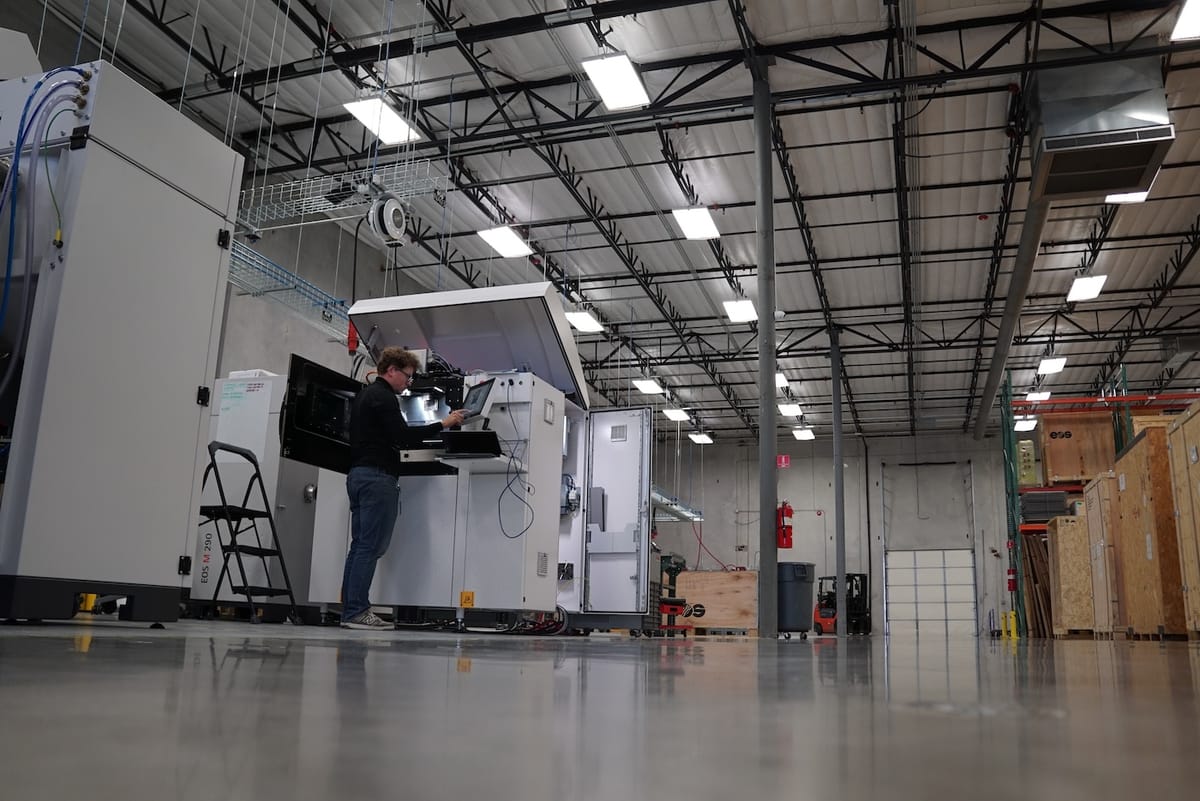
EOS has invested 3 million USD into the expansion of its US manufacturing and logistics capacity.

The company has consolidated its North American warehouse and logistics capability at its Pflugerville, Texas, campus into a new 40,000 square foot facility in Belton, Texas, which has enabled the manufacturing space in Pflugerville to be increased.

EOS says the reconfiguration of existing facilities and the opening of the new warehouse demonstrate its commitment to strengthening its U.S. manufacturing capacity. The assembly of its EOS M 290-1, EOS M 290-2, and EOS M 400-4 systems will receive a boost, while EOS has also created more space for a dedicated powder handling area and an in-house machine shop. It is expected that EOS will now be better equipped to meet increasing customer demand and reduce delivery times. The company has also created ten new jobs at the Pflugerville production site, including operations, quality assurance, engineering, and machine commissioning functions.

“Our Texas expansion enables us to scale North American metal AM assembly with both precision and consistency,” said Kent Firestone, SVP of Operations, EOS North America. “From optimising our production areas to onboarding new team members, every step has been carefully designed to accelerate turnaround times while maintaining the quality and reliability our customers expect from EOS.”   

“This expansion demonstrates our continued commitment to support the resurgence of American manufacturing,” added Glynn Fletcher, president of EOS North America. “This manufacturing facility is not just an investment in our own infrastructure; it is also about standing shoulder-to-shoulder with the U.S. manufacturing community to provide products and services for a superior customer experience. It demonstrates our dedication to the growing U.S. markets where our technology is in greatest demand. We fully understand the criticality that AM plays in the future of domestic manufacturing, and this expansion ensures EOS will continue to play a leading role for years to come.” 

Free Training

Source link

AbbVie to Acquire Arizona Manufacturing Facility, Further Strengthening Manufacturing Capabilities in the United States


  • Milestone marks progress against AbbVie‘s previously announced commitment to invest more than $10 billion of capital in the U.S. over the next decade to broadly support innovation and expand critical manufacturing capabilities and capacity
  • Supports production of AbbVie‘s current and next-generation immunology and neuroscience medicines
  • Transaction anticipated to close in mid-2026

AbbVie (NYSE: ABBV) and West Pharmaceutical Services (NYSE: WST) announced today a definitive agreement for AbbVie to acquire a device manufacturing facility in Tempe, Arizona and associated intellectual property from West. The acquisition of the manufacturing site will significantly expand AbbVie‘s drug delivery device manufacturing capabilities and capacity.

AbbVie plans to hire approximately 200 employees at the site and invest more than $175 million to acquire, as well as modernize and fully integrate it into its global manufacturing network. The combination of this acquisition and associated planned investments are part of AbbVie‘s commitment to expanding its pharmaceutical manufacturing in the United States (U.S.), supporting innovation and improving patient access and outcomes.

“Over the next decade, AbbVie is investing more than $10 billion in capital to broadly support innovation and expand our manufacturing capabilities and capacity in the U.S.,” said Robert A. Michael, chairman and chief executive officer, AbbVie. “With this investment, AbbVie is strengthening our manufacturing capabilities, ensuring we are well-positioned to develop and deliver next-generation medicines that make a remarkable impact on patients’ lives.”

The transaction includes the transfer of manufacturing facilities, including multiple production lines, and 3.5 mL on-body injector technology to support production of current and next-generation AbbVie immunology and neuroscience medicines.

With a presence in all 50 states and Puerto Rico, AbbVie employs approximately 29,000 people in the U.S., including more than 6,000 at its 11 U.S. manufacturing sites. When completed, this acquisition will significantly expand AbbVie‘s presence and economic impact in Arizona.

The transaction is anticipated to close in mid-2026, subject to closing conditions.

About AbbVie 

AbbVie‘s mission is to discover and deliver innovative medicines and solutions that solve serious health issues today and address the medical challenges of tomorrow. We strive to have a remarkable impact on people’s lives across several key therapeutic areas including immunology, oncology, neuroscience and eye care – and products and services in our Allergan Aesthetics portfolio. For more information about AbbVie, please visit us at www.abbvie.com. Follow @AbbVie on LinkedIn, FacebookInstagramX (formerly Twitter) and YouTube. 

Forward-Looking Statements  

Some statements in this news release are, or may be considered, forward-looking statements for purposes of the Private Securities Litigation Reform Act of 1995. The words “believe,” “expect,” “anticipate,” “project” and similar expressions and uses of future or conditional verbs, generally identify forward-looking statements. AbbVie cautions that these forward-looking statements are subject to risks and uncertainties that may cause actual results to differ materially from those expressed or implied in the forward-looking statements. Such risks and uncertainties include, but are not limited to, challenges to intellectual property, competition from other products, difficulties inherent in the research and development process, adverse litigation or government action, changes to laws and regulations applicable to our industry, the impact of global macroeconomic factors, such as economic downturns or uncertainty, international conflict, trade disputes and tariffs, and other uncertainties and risks associated with global business operations. Additional information about the economic, competitive, governmental, technological and other factors that may affect AbbVie‘s operations is set forth in Item 1A, “Risk Factors,” of AbbVie‘s 2024 Annual Report on Form 10-K, which has been filed with the Securities and Exchange Commission, as updated by its Quarterly Reports on Form 10-Q and in other documents that AbbVie subsequently files with the Securities and Exchange Commission that update, supplement or supersede such information. AbbVie undertakes no obligation, and specifically declines, to release publicly any revisions to forward-looking statements as a result of subsequent events or developments, except as required by law. 


Cision View original content:https://www.prnewswire.com/news-releases/abbvie-to-acquire-arizona-manufacturing-facility-further-strengthening-manufacturing-capabilities-in-the-united-states-302658118.html

SOURCE AbbVie


Free Training

Source link