


Manufacturing plant headed to Upper Macungie – Lehigh Valley Press


Eli Lilly and Company and the Lehigh Valley are joining together to build a new state-of-the-art manufacturing facility that will be designed for the research and production of injectable weight loss medications.

On Jan. 30 at Curiosity Hall in the Da Vinci Science Center, Allentown, an assortment of community members, business and political stakeholders joined Eli Lilly and Company Chair and Chief Executive Officer Dave Ricks and Pennsylvania Gov. Josh Shapiro to announce a major collaboration.

Ricks said it is expanding manufacturing sites in the United States and considered 800 applicants for this project before choosing the Lehigh Valley. He credits the tenacity of Shapiro as this project will come to fruition at a site in Upper Macungie.

“Our mission starts with patients and delivering the medicines they need. To meet increasing demand, we’re expanding our U.S. manufacturing network, with Lehigh Valley adding capacity for next‑generation weight-loss medicines. We’re creating high‑quality jobs and collaborating across the region – with suppliers, educators and workforce development partners – to make critical medicines in the U.S.,” Ricks said. “That’s our commitment – to patients, to our new Pennsylvania home and to our country.”

The property in Upper Macungie Township, owned by the Jaindl Corporation (under contract to buy), will be the “single largest investment in economic development since the days of Bethlehem Steel,” said Lehigh Valley Economic Development Corporation president and CEO Don Cunningham. Manufacturing in Pennsylvania is 4 percent higher than the national average and is the largest industry within the state. Lilly proposes to invest $3.5 billion in this specific project. This will boost the Lehigh Valley economy on many levels.

For every dollar Lilly invests, it estimates up to $4 in additional local economic activity.

Ricks said Lilly is committed to the community and an interactive workforce development by including existing businesses and educational opportunities in its program. Lilly will connect with local nonprofits and encourage volunteerism.

Lehigh County Executive Josh Siegel pointed out, “Things are still made in the valley and we should be proud of that. This is more than creating jobs and buildings; it is creating futures and careers for our residents and their families.”

This project will employ 850 engineers, scientists, operations personnel and lab technicians.

Lehigh Valley Building and Construction Trades Council President Paul Anthony pointed out the many benefits of the shared commitment to building a safe, quality facility by skilled union tradesmen. “Government, businesses and labor, working together has made this project happen,” Anthony said.

This project will offer employment in the building trades, as well as apprenticeships leading to skilled union jobs. Construction is expected to begin this year and expects to create 2,000 construction jobs. The site will be operational in 2031.

Shapiro also pointed out the permitting reforms, the Pennsylvania Economic Development for a Growing Economy (PA EDGE), a collection of tax credit programs designed to attract new investments from businesses in critical manufacturing sectors, as well as The Pennsylvania Strategic Investments to Enhance Sites Program (PA SITES), established to provide grant and loan funding to eligible applicants, helped this project.

PA SITES invested an initial $500,000.

The PA SITES program encourages businesses to build or relocate within Pennsylvania. The funding for the program includes two components that support the development of competitive sites within the commonwealth, and expansion of existing sites. Funding is made available through planning grants, construction grants and loans

Ricks said this project is where “Curiosity meets Capability.” He reminded the audience of Lilly’s long history with pharmaceuticals starting post-Civil war. The emphasis was on defining ingredients and making safe, quality, accessible and affordable drugs for all Americans.”

The Lilly name will be seen throughout the valley.

“If it bares the red Lilly, you know it’s right,” Ricks said.

Gov. Josh Shapiro and Eli Lilly and Company CEO Dave Ricks place the Lilly pin/marker on the map of the Lehigh Valley, denoting where Lilly will make their mark.

PRESS PHOTOS BY JENN RAGOEli Lilly and Company and the Lehigh Valley are joining together to build a new state-of-the-art manufacturing facility where 850 new pharmaceutical jobs and 2,000 union construction jobs will be available in the Lehigh Valley with the proposed manufacturing plant in Upper Macungie Township.

Lehigh Valley Economic Development Corporation President and CEO Don Cunningham points out this was a bipartisan effort. Cunningham was instrumental in unifying all parties involved in this project.

“We still make things happen here [in the valley. This project shows government delivering,” Lehigh County Executive Josh Siegel tells the crowd.

Eli Lilly and Company Chair and Chief Executive Officer Dave Ricks tells the audience “800 municipalities and sites were considered for this project.” Upper Macungie Township was chosen for Lilly’s injectable manufacturing plant.

Free Training

Source link

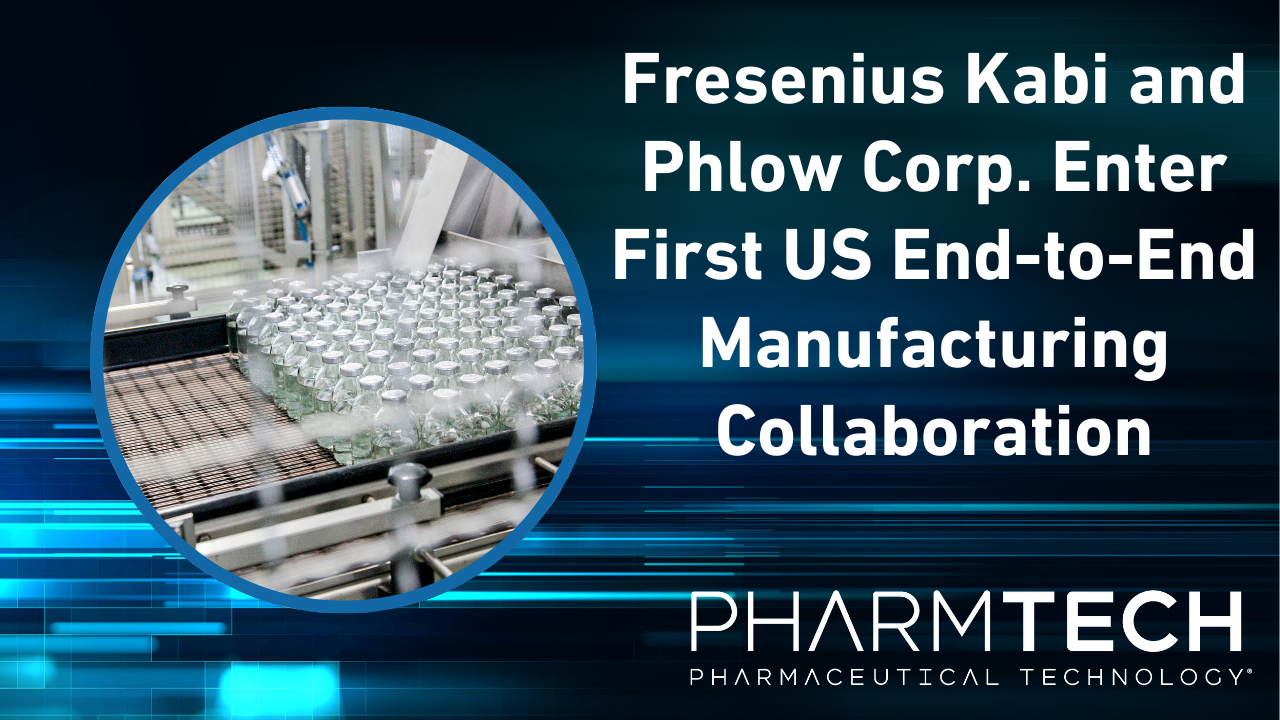
Fresenius Kabi and Phlow Corp. Enter First US End-to-End Manufacturing Collaboration


Fresenius Kabi and Phlow Corp. have announced a collaboration to onshore the manufacture of epinephrine injection, USP, including the production of APIs and finished doses.¹ This first-of-its-kind initiative represents a strategic response to the chronic shortages that have long impacted the availability of this essential medicine in the US. The arrangement utilizes a divided production model where Phlow Corp. produces the APIs at its advanced manufacturing campus in Virginia, while Fresenius Kabi manages the formulation and production of finished doses at its existing US facilities.

How Does This End-To-End Model Address Domestic Supply Chain Vulnerabilities?

The integration of API and finished dose manufacturing is a significant development because, while domestic production of the finished injection has existed, there has been no US-based source for the epinephrine API. To address this gap, a successful US-based validation campaign for the API was recently completed, and a Drug Master File has been filed with FDA.¹ This move aligns with a broader local-for-local strategy supported by over $1 billion in investments to modernize domestic manufacturing and logistics centers. Joel Rosenstack, president, US pharmaceuticals at Fresenius Kabi, stated in a press release,¹ “Fresenius is a committed partner in advancing America’s vision of a fully domestic, end-to-end, supply chain for essential medicines, closing a vital gap in national security.” By establishing a domestic source for both components, the collaboration aims to secure the supply of a drug indicated for critical applications, including the treatment of anaphylaxis and increasing mean arterial blood pressure during septic shock.

Why Is a Scalable Manufacturing Framework Vital for Future Pharmaceutical Security?

This collaboration is designed to be a scalable model that can be applied to other essential medicines identified by FDA and the WHO. The focus is on creating resilient supply assurance through tech-enabled processes and advanced development techniques. Eric Edwards, MD, PhD, CEO of Phlow, noted in a press release that, “Phlow is pioneering bold solutions to restore pharmaceutical sovereignty and strengthen America’s national health security”. He further commented, “For several years, we have worked alongside Fresenius Kabi to build resilient, end-to-end supply assurance for essential medicines. This expanded collaboration is focused on securing a reliable domestic supply of epinephrine, one of the most critical, life-saving drugs used across emergency and acute care settings in the United States.”¹ Pending necessary regulatory approvals, the product resulting from this domestic pipeline is expected to be available to US hospitals in 2027, potentially setting a new standard for how critical care medicines are developed and manufactured domestically.

How Else Is Fresenius Kabi Utilizing Collaborations?

Beyond the onshoring of traditional injectables, the drive for manufacturing innovation extends into the emerging field of cell and gene therapy. A strategic development agreement between Fresenius Kabi and TQ Therapeutics aims to enhance accessibility by enabling scalable and efficient manufacturing through integrated cell selection technology. Under this agreement Fresenius Kabi has the ability to develop, produce, and distribute products that are created with TQ Therapeutics’ proprietary cell selection technology.²

How Is Automated Cell Selection Streamlining Complex Manufacturing Workflows?

The integration of affinity and column-based isolation technology into automated processing systems is designed to produce high-purity cells quickly and consistently. This addresses the significant manufacturing challenges associated with process development and full commercialization. Saurabh Bhasin, head of Portfolio, Cell Therapies & contract manufacturing operations at Fresenius Kabi, noted in a press release,² “By integrating TQ Therapeutics’ novel selection technology into our Cue system, our aim is to improve manufacturing success and scalability—key steps toward supporting the advancement of cell and gene therapies.”

What Role Does Point-of-Care Processing Play in the Future of Individualized Medicine?

Advancing these technologies allows for ultra-short processes that can be performed closer to the point of care, simplifying treatment workflows. This modular approach supports the development of next-generation therapies delivered directly to the patient. “With Fresenius Kabi’s expertise in cell and gene therapy device technologies development and commercialization, and TQ Therapeutics’ focus on developing ultra-short processes for clinical cell therapies from manufacturing to in vivo applications, we are creating a novel value proposition for scaling and enabling the supply of cell therapies for broader patient populations,” stated Christian Eckert, CEO of TQ Therapeutics, in a press release. Such advancements reflect a broader commitment to utilizing technological knowledge to ensure access to world-class therapies through improved clinical practice and industrial production.

References

  1. Fresenius Kabi. Fresenius Kabi and Phlow Corp. Announce First-Ever, End-to-End, U.S. Manufacturing Collaboration for Epinephrine Injection, USP. Press Release. Feb 9, 2026.
  2. Fresenius Kabi. Fresenius Kabi, TQ Therapeutics Announce Cell Therapy Technology Agreement. Press Release. Feb 9, 2026.

Free Training

Source link